
AP Exam Planner Command Center (2026–2027)
Target Grades
Grades 9 to 12
Structured grade-by-grade progression from foundation habits to high-stakes quantitative STEM/econ depth.
View 4-Year Plan1-on-1 AP Coaching
Bluebook & Theory
Personalized coaching across 28+ AP subjects, diagnostic calibration, and past free-response rubric drills.
Explore AP CoachingFree Download
2027 Roadmap PDF
Download the complete grade-wise AP exam planner, career pathways table, and College Board calendar checklist.
An **AP exam planner** is a year-by-year map that tells a student which Advanced Placement (AP) subjects to take in Grade 9, 10, 11 and 12, and when to sit each exam. For Indian students aiming at universities in the US, Canada, the UK, Singapore or Europe, that map matters more than most families realise. AP subjects chosen at random create a heavy, unfocused transcript. AP subjects chosen with a plan build a clear academic story that admissions officers can read in seconds.
At EduQuest, we meet this problem every year. A Grade 9 student takes five APs because a friend did. Another waits until Grade 11 and then has two years of content to cover in one. Both situations are avoidable. This guide gives you a simple, grade-wise AP exam planner for students who are entering or currently in Grade 9–10, with sample pathways for medicine, economics, computer science and finance.
Download the Complete Grade 9–12 AP Exam Planner & 4-Year Pathway Guide (PDF)
Get the printable master planner with grade-by-grade timelines, syllabus overlap maps for CBSE/ISC/IB, and the official 2026–2027 College Board testing calendar.
AP basics every Indian family should know
Before you plan, these facts keep expectations realistic:
Fast-Track Your College & Career Strategy
Get immediate, personalized AI insights tailored to your grade, strengths, and dream universities — 100% free with instant reports.
Know Your Personality Type for Free
Take our 18-question AI psychometric test to uncover your cognitive archetype, hidden learning superpowers, and ideal university courses.
Personalized Career & University EduPath
Build a step-by-step Grade 8–12 admissions blueprint with AI-matched target universities, exam schedules, and extracurricular profiles.
- **What AP is:** AP is a College Board programme of college-level courses and exams. Exams are scored from 1 to 5, and a 3 or above is generally treated as a passing score (with 4 and 5 required for selective credit and admissions).
- **When the exams happen:** The 2027 AP exams run from **3 to 14 May 2027**, over two weeks. Late-testing slots run from **17 to 21 May 2027**. Scores are released in July.
- **Ordering deadline:** For 2027 exams, the final standard ordering deadline for full-year courses was **13 November 2026**. Orders after that carry a late fee of 40 US dollars per exam, so students who have not registered should speak to their school AP coordinator or an authorised test centre immediately.
- **Where AP counts most:** US and Canadian universities use AP for credit, placement and as proof of rigour. Universities in the UK, Singapore and Europe usually give more weight to board results, but strong AP scores still support a subject-specific application. Always check each university's own policy.
- **AP Seminar and AP Research:** These two courses form the AP Capstone programme. Independent self-study is not permitted for either, and AP Research requires AP Seminar first. A student can take them only through a school that offers AP Capstone.
These rules shape the plan below. For example, if your school does not offer AP Capstone, the Grade 10 Seminar and Grade 11 Research steps need an approved alternative, such as a research project, a science fair or a published paper through EduQuest's mentorship.
The core AP exam planner for Grades 9 to 12
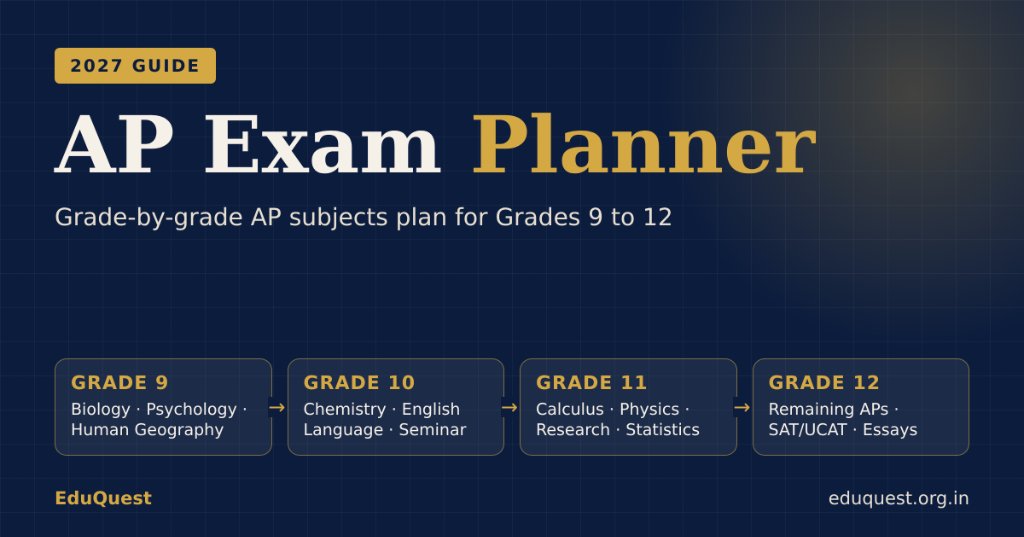
The plan below assumes the student is entering or already in Grade 9 or 10 now. It adds one or two meaningful APs each year, saves the heaviest quantitative subjects for Grade 11, and keeps Grade 12 for gaps, test prep and applications.
| Grade | AP subjects to plan | What the year is for |
|---|---|---|
| Grade 9 | AP Biology, AP Psychology or AP Human Geography | Learn the AP style of reading, writing and exam timing with subjects that match a first-year load |
| Grade 10 | AP Chemistry, AP English Language & Composition, AP Seminar | Build lab science, argument writing and the research habit |
| Grade 11 | AP Calculus AB/BC, AP Physics 1/2, AP Research (if Seminar was taken), AP Statistics (optional) | Add quantitative depth and an independent research project |
| Grade 12 | Any remaining APs, plus UCAT/SAT prep and application essays | Close gaps, lift scores and finish applications |
The logic is simple. **Grade 9 builds the habit.** Grade 10 builds range, by pairing a science with a writing course. **Grade 11 builds depth**, because Calculus, Physics and Research are the courses admissions readers look at first for STEM and medicine applicants. **Grade 12 is the finishing year:** only a few new APs, but a lot of test and essay work.
Grade 9: start with one or two AP subjects
Grade 9 is a testing ground. The goal is not a long AP list. The goal is to learn how an AP course works: heavy reading, short written answers, data and graph questions, and a May exam that covers a full year. Choose one subject, or two if the student is comfortable.
- **AP Biology:** This is the best fit for students aiming at medicine, biotechnology or life sciences. It covers evolution, cell structure and energy, genetics, and how organisms interact. It is a demanding first AP, because it mixes memory with data analysis and lab reasoning, so it suits students who are already strong in science.
- **AP Psychology:** This is one of the most accessible APs. It covers how people think, learn, remember and behave. It is useful for medicine and neuroscience profiles, and for economics students interested in behavioural economics. The workload is mostly reading and vocabulary, so it is a safe first AP.
- **AP Human Geography:** This subject looks at population, culture, cities, migration and economic patterns. It is a gentle introduction to AP-style analysis, and it connects well to economics, public policy and international relations.
**How to choose:** A future doctor should lean towards AP Biology or AP Psychology. A future economist or policy student should consider AP Human Geography or AP Psychology. A student who is unsure should start with AP Psychology or AP Human Geography, then add AP Biology in Grade 10 if the first year goes well.
**What else Grade 9 needs:** At EduQuest, Grade 9 also carries [SAT and PSAT preparation](/sat/) over roughly six to seven months, and the first layer of profile building: a club, a reading habit, a small project. AP is one part of that, not the whole.
Grade 10: add a lab science, a writing course and research
Grade 10 is where the planner starts to show a direction. The suggested list is AP Chemistry, AP English Language & Composition and AP Seminar. A student does not need to take all three. Two well-prepared exams are better than three rushed ones.
- **AP Chemistry:** This is a college-level general chemistry course. It covers atomic structure, bonding, reactions, equilibrium, thermodynamics and kinetics. It needs strong algebra and steady practice with problems, and it is a core subject for medicine, pharmacy and chemical engineering profiles.
- **AP English Language and Composition:** This course trains students to analyse rhetoric, build arguments and synthesise sources. It helps every other subject, and it directly improves the essays that students write for university applications. Indian students who are strong in science but cautious with writing often gain the most from it.
- **AP Seminar:** This is the first half of the AP Capstone programme. Students work in teams and alone, read research articles, write evidence-based arguments and present them. It cannot be self-studied. If the school offers AP Capstone, Grade 10 is the ideal year to start, because AP Research follows in Grade 11. If the school does not offer it, plan a research project or a mentored paper instead.
**SAT timing:** In Grade 10 the focus shifts from the PSAT to [SAT and PSAT preparation](/sat/), again over about six to seven months. Keep the AP load and the SAT load realistic together.
Grade 11: the heaviest and most important year
Grade 11 carries the subjects that universities weigh most. It is also the year when board exams, SAT sittings and AP courses all compete for the same hours. Plan it first, and plan it honestly.
- **AP Calculus AB or BC:** AB covers limits, derivatives and integrals, roughly a first college calculus course. BC covers all of AB and adds series, parametric and polar functions, so it suits students aiming at engineering, computer science, physics or quantitative finance. Students heading to medicine or economics can usually choose AB without losing anything.
- **AP Physics 1 or 2:** Both are algebra-based. Physics 1 covers mechanics, waves and basic circuits. Physics 2 covers fluids, thermodynamics, electricity, optics and modern physics. Many students take Physics 1 first and Physics 2 later. A student who will study physical sciences or engineering should also look at AP Physics C in Grade 12, which needs calculus.
- **AP Research:** This follows AP Seminar and is the second half of AP Capstone. The student chooses a topic, runs an independent investigation, writes an academic paper of about 4,000 to 5,000 words and defends it in a presentation. It is one of the few AP courses that produces something a student can discuss in an interview and in application essays.
- **AP Statistics (optional):** This course teaches data collection, probability and inference. It is useful for medicine, economics, psychology and data science, and it is among the more manageable AP courses next to Calculus.
**Alongside AP:** advanced SAT preparation, over about six to seven months, plus [profile building for medicine / economics](/eduquest-guide/). In practice this means choosing a few activities that match the intended course and going deeper, instead of collecting many small certificates.
Grade 12: finish strong, do not start new mountains
Grade 12 should have a lighter AP load. Add only the remaining subjects that fit the intended course, such as AP Microeconomics, AP Macroeconomics, AP Physics C or AP Calculus BC, and use the rest of the year for what decides admissions.
- **UCAT or SAT preparation:** UK medicine and dentistry applicants sit the [UCAT](/ucat/), normally in the summer before applying. US-bound students finalise their SAT scores. Check each test's current dates and registration windows.
- **Application essays and statements:** These take longer than most students expect. At EduQuest, Grade 12 is a six-month, ongoing phase covering [study abroad guidance](/overseas-education-consultant-studyabroad-consultant/), statements of purpose, letters of recommendation, college selection and scholarship applications.
- **Deadlines:** UCAS applications for medicine, dentistry and Oxbridge close in mid-October. US early rounds usually close around 1 November, and regular rounds close in early January.
EduQuest AP Mocks & Bluebook Simulation Lab
Diagnostic Mocks
Free Baseline Test
Evaluate your foundation in AP Calculus, Physics, Chemistry, or Biology before locking in your grade-wise registration.
Start Diagnostic MockBluebook Simulators
28 Digital Exams
Full-length timed computer-based mock exams matching the official College Board Bluebook interface, embedded Desmos calculators, and FRQ timers.
Access AP MocksClassroom & Online
Gurgaon & Global
Small-batch AP coaching led by master tutors with 10+ years of College Board curriculum experience. 94% students score 4 or 5.
Book AP Free TrialAP subject pathways by career goal
The core plan is a base. The right AP subjects change with the degree the student wants. This table shows four sample pathways. Use it as a starting point, then adjust it to the school's offerings and the student's strengths:
| Goal | Grade 9 | Grade 10 | Grade 11 | Grade 12 |
|---|---|---|---|---|
| Medicine and life sciences | AP Biology or AP Psychology | AP Chemistry, AP English Language, AP Seminar | AP Calculus AB, AP Physics 1/2, AP Research, AP Statistics (optional) | Remaining APs, UCAT/SAT, essays |
| Economics | AP Human Geography or AP Microeconomics (intro) | AP Macroeconomics, AP Statistics | AP Calculus AB, AP Microeconomics (if not taken), AP Psychology (optional) | AP Calculus BC (if math-focused), AP Government (optional), AP Research |
| Computer science and AI | AP U.S. History (optional) | AP Computer Science Principles, AP Statistics (optional) | AP Computer Science A, AP Calculus AB or BC | AP Physics C: Mechanics, AP Calculus BC, AP Research (optional) |
| Finance | AP U.S. History (optional) | AP Statistics | AP Microeconomics, AP Calculus AB or BC | AP Macroeconomics, AP Government (optional), AP Research |
**Medicine:** Biology and Chemistry carry the profile. Calculus and Physics show that the student can handle quantitative science. Seminar and Research add the research story that medical programmes like.
**Economics:** Microeconomics and Macroeconomics build the subject base, while Statistics and Calculus supply the maths that economics degrees expect. Psychology adds a useful view into behavioural economics.
**Computer science and AI:** AP Computer Science Principles introduces the ideas, and AP Computer Science A teaches Java and data structures. Calculus and Statistics support machine learning later, and Physics C helps students who lean towards hardware or robotics.
**Finance:** Statistics, Microeconomics and Calculus build the quantitative base. Macroeconomics and Government help the student understand the policy side of markets.
One rule for all pathways: each AP should answer the question, 'Why does this subject belong in this student's story?'. If the answer is only 'everyone takes it', leave it out.
— EduQuest Global Admissions Strategy Council
Student stories: four AP calendars EduQuest students followed
Pathways on paper are useful, but it helps to see how a real plan was built. Below are four AP calendars from EduQuest students who started planning early, from Grade 8. Each story shows what the student took, why the plan was built that way, and where the result goes. Student names stay private, so each story is labelled by goal.
Student story 1: The economics student who built maths first
**Goal:** Economics at a global university. **Starting point:** planning began in Grade 8.
| Grade | AP subjects | Why it was planned this way |
|---|---|---|
| Grade 8 | AP Human Geography (optional) | Builds a base in global economic systems, geography and demographics |
| Grade 9 | AP Microeconomics (introductory, if comfortable), AP Statistics (optional) | Introduces economic principles and basic statistics for reading data |
| Grade 10 | AP Macroeconomics, AP Statistics (if not taken in Grade 9) | Covers national and global economic policy and deeper statistical methods |
| Grade 11 | AP Calculus AB, AP Microeconomics (if not taken earlier), AP Psychology (optional) | Adds the quantitative skills economics needs and a view into consumer decisions |
| Grade 12 | AP Calculus BC (if math-focused), AP Government and Politics (optional), AP Research | Builds applied economics, policy understanding and independent research skills |
**How it was planned:** Economics and statistics came early, so Calculus in Grade 11 sat on top of data skills the student already had. AP Psychology added the behavioural side, and AP Research in Grade 12 gave the student an independent economics project to talk about in applications.
Student story 2: The economics student who started from history and policy
**Goal:** Economics, with an interest in policy. **Starting point:** planning began in Grade 8.
| Grade | AP subjects | Why it was planned this way |
|---|---|---|
| Grade 8 | AP Human Geography (optional) | Introduces global economies and population patterns |
| Grade 9 | AP U.S. History | Gives the historical context behind economic policy and regulation |
| Grade 10 | AP Statistics | Builds the quantitative skill for economic modelling and decisions |
| Grade 11 | AP Microeconomics | Introduces market structures, supply and demand, and quantitative analysis |
| Grade 12 | AP Calculus AB (or BC if strong in maths), AP Macroeconomics, AP Government and Politics (optional), AP Research | Covers national and global policy, regulation and advanced research methods |
**How it was planned:** This path moves from history to statistics to core economics, with Calculus only in Grade 12, so the maths load builds step by step. Government and Politics tied the story to policy.
Student story 3: The computer science student who built code, then maths
**Goal:** Computer science, AI and machine learning. **Starting point:** planning began in Grade 8.
| Grade | AP subjects | Why it was planned this way |
|---|---|---|
| Grade 8 | AP Human Geography (optional) | Builds analytical and problem-solving skills through spatial analysis |
| Grade 9 | AP U.S. History (optional) | Develops critical thinking and research skills, for a well-rounded record |
| Grade 10 | AP Computer Science Principles, AP Statistics (optional) | Introduces programming ideas, algorithms and statistics useful for data science |
| Grade 11 | AP Computer Science A, AP Calculus AB (or BC if strong in maths) | Builds Java, data structures and the maths behind AI |
| Grade 12 | AP Physics C: Mechanics, AP Calculus BC (if not taken earlier), AP Research (optional) | Adds advanced problem-solving, physics for robotics and AI, and an independent CS project |
**How it was planned:** Programming came in two clear steps: AP CSP in Grade 10, then AP CSA in Grade 11. Calculus and Statistics followed for machine learning, and Physics C is recommended for students who lean towards hardware, robotics or AI.
Student story 4: The finance student who put numbers first
**Goal:** Finance and financial analysis. **Starting point:** planning began in Grade 8.
| Grade | AP subjects | Why it was planned this way |
|---|---|---|
| Grade 8 | AP Human Geography (optional) | Builds an understanding of global economies and demographic trends |
| Grade 9 | AP U.S. History (optional) | Gives the historical context for financial regulation |
| Grade 10 | AP Statistics | Essential for data analysis and financial modelling |
| Grade 11 | AP Microeconomics, AP Calculus AB (or BC if strong in maths) | Covers market structures, demand and supply, and quantitative finance concepts |
| Grade 12 | AP Macroeconomics, AP Government and Politics (optional), AP Research | Covers national and global systems, policy impact and an independent finance project |
**How it was planned:** Statistics came first because it is the base of financial modelling. Micro and Macro then gave the market view, and AP Research let the student explore a finance question in depth.
What these four stories have in common
- **Flexibility:** Each plan was adjusted to the student's strengths, interests and school offerings.
- **Maths with purpose:** Calculus and Statistics appear in all four, because economics, finance and computer science all rest on them.
- **Research at the end:** AP Research appears in all four plans (optional in the computer science plan) and gives an independent project to discuss in applications. It needs a school that offers AP Capstone.
- **A steady build:** Every plan moves from broad context, to core subjects, to depth, with the heaviest subjects after the student has the base.
How many AP courses should you take, and how do they fit with boards?
There is no magic number. Selective universities look for a challenging course load that the student handled well, not for the longest AP list. As a rough guide, many strong applicants take around **four to eight AP exams across Grades 9 to 12**, with the best scores in subjects linked to their intended degree. One 5 in a relevant subject is worth more than three 3s in unrelated ones.
- **CBSE and ICSE students:** AP adds visible rigour on top of the board syllabus, and several AP subjects overlap with Class 11 and 12 content, such as Biology, Chemistry, Physics and Calculus. Study the overlap and save time, but remember that AP exams test application and data skills more than recall.
- **IB students:** The IB Diploma already shows rigour, so most IB students do not need many APs. A small number of APs in subjects the IB school does not cover can still help. If you are comparing the two routes, see our [IB coaching](/ib-international-baccalaureate/) page.
- **Workload:** As a rough estimate, plan three to five hours a week for each AP subject in the school year, and more in the last six weeks before the exam. Two APs plus board work plus SAT preparation is a full schedule for most students.
The AP calendar for the 2027 exam cycle
Use this calendar to plan the year. The exam dates and deadlines below are from the College Board's 2026–27 schedule. Because deadlines are tight, confirm the current dates with your school coordinator or authorised test centre:
| When | What to do |
|---|---|
| June to August | Choose subjects, confirm that the school or a test centre will register you, and start light summer preparation |
| By 2 October 2026 | Preferred deadline for exam orders and student enrolment |
| By 13 November 2026 | Final standard ordering deadline for full-year courses. Later orders carry a late fee of 40 US dollars per exam |
| December to February | Finish most units and take the first full-length practice test |
| By 12 March 2027 | Deadline for spring course orders and fall order changes |
| March to April | Take timed full-length mock exams and practise free-response questions |
| 3 to 14 May 2027 | AP exams, over two weeks |
| 17 to 21 May 2027 | Late-testing window |
| By 20 June 2027 | Last date to choose or change the free score-send recipient |
| July 2027 | Scores are released |
For the next cycle, the same pattern repeats a year later: register in the fall, study through the school year, sit the exams in May, and receive scores in July.
Connecting the AP plan with PSAT, SAT and profile building
AP subjects do not work alone. At EduQuest, the AP plan runs beside the test and profile plan for every grade, usually in blocks of six to seven months.
| Grade | Test and profile focus |
|---|---|
| Grade 9 | PSAT preparation and profile building |
| Grade 10 | SAT preparation and profile enhancement |
| Grade 11 | Advanced SAT preparation and profile alignment |
| Grade 12 | Admission guidance, statements of purpose, letters of recommendation, college selection and scholarship applications |
Students who start earlier, from Grade 7 or 8, can use the extra time for foundation skills, critical thinking, Olympiads and early profile development. That makes the Grade 9 start of PSAT and AP work much smoother.
Common AP planning mistakes to avoid
- Taking too many APs too early Three APs in Grade 9 usually means weak scores and a tired student. Start with one or two well-targeted foundational subjects.
- Choosing subjects because friends chose them Every AP should support your intended degree or demonstrate genuine intellectual curiosity, not follow peer trends.
- Ignoring the registration deadline Orders for the 2027 exams closed on 13 November 2026 at the standard fee. Missing the date costs money and sometimes an entire testing year.
- Planning AP Seminar or AP Research without checking the school Both require an authorized AP Capstone school. Independent self-study is strictly disallowed by the College Board.
- Stacking Calculus, Physics and Chemistry in the same year without a plan Spreading heavy quantitative STEM subjects across Grades 10, 11 and 12 prevents academic burnout and GPA drops.
- Forgetting that SAT, UCAT and board exams share the same hours A good AP plan maps out the full academic year, keeping test dates, school internals, and application essay windows synchronized.
- Treating AP as a checkbox Admissions readers want to see depth, such as a research paper, a project or a competition linked to the subjects, not just a score report.
EduQuest AI Diagnostics & Academic Roadmap Tools
Harness AI-driven psychometrics, timeline forecasters, and career cluster alignment tools alongside your AP subject plan.
AI Study Planner
Generate an adaptive, day-by-day study roadmap synchronizing AP exam prep, school boards, and SAT testing dates.
Launch AI Study Planner→Career Cluster Matcher
Identify whether your natural aptitudes point toward Medicine, STEM, Economics, or Global Policy before finalizing AP subjects.
Take Assessment→Personality & Narrative Test
Analyze 16 student cognitive archetypes to craft cohesive personal statement narratives linked to your AP courses.
Explore Personality Test→How EduQuest helps you plan AP subjects
EduQuest is an education consultancy that supports students from early school years to university applications. Our counsellors build an AP exam planner for each student, based on the intended course, the school curriculum (CBSE, ICSE, IB or others), current grades and the target countries.
Here is what that includes:
- A grade-wise AP plan matched to the student's intended degree and workload.
- PSAT and SAT preparation for Grades 9 to 11, aligned with the AP calendar. See our [SAT and PSAT preparation](/sat/) programme.
- Profile building with research, competitions and activities that connect to the chosen APs.
- [Study abroad guidance](/overseas-education-consultant-studyabroad-consultant/) for the US, UK, Canada, Singapore and Europe, including essays, statements of purpose, recommendation letters and scholarships.
- Online home tuition and [IB coaching](/ib-international-baccalaureate/) for students who need subject support alongside the plan.
If you would like a personalised AP plan for your child, speak to an EduQuest counsellor through eduquest.org.in. We will review the current grade, the school's AP offerings and the target universities, and build a plan that fits.
Download the 4-Year AP Master Roadmap (PDF)
Complete subject checklist, diagnostic timeline, and College Board 2027 testing dates for Indian students.
Which AP subjects should I take in 9th grade?
Take one or two. AP Biology, AP Psychology and AP Human Geography are the usual starting points. Choose based on the intended degree: Biology or Psychology for medicine, Human Geography or Psychology for economics and policy.
How many AP courses should an Indian student take?
There is no fixed number. Many successful applicants take about four to eight AP exams across Grades 9 to 12. Scores (aiming for 4s and 5s) and relevance to your target degree matter far more than the total count.
Can I take AP exams in India if my school does not offer AP?
Often yes, for most subjects. Students can usually register as exam-only candidates through an authorised school or test centre and study independently or with a tutor. Check availability early. AP Seminar and AP Research are the exceptions, because they must be taken through a school that offers AP Capstone.
When should I register for AP exams?
Schools place orders in the fall. For the 2027 exams, the preferred deadline was 2 October 2026 and the final standard deadline was 13 November 2026. Later orders carry a late fee per exam.
What is a good AP score?
Scores run from 1 to 5. A 3 is generally passing. For selective universities, aim for 4 or 5 in subjects related to the intended degree.
Should I choose AP Calculus AB or BC?
AB suits medicine, economics and business. BC suits engineering, computer science, physics and quantitative finance, because it covers more topics, including series and polar coordinates.
Is AP better than IB?
Neither is better in general. IB is a full diploma programme, while AP is a set of individual college-level subjects. The right choice depends on the school, the student's strengths and the target countries.
Do AP scores matter for UK universities?
UK universities usually give the most weight to board results and admission tests such as the UCAT for medicine. AP can support a subject-specific application, but always check each university's policy.
When do AP scores come out?
Scores are released online in July following the May exams.
Conclusion
A good AP exam planner does three things: it matches subjects to the student's goal, spreads the workload across four years, and keeps test preparation and applications in view. For a student entering Grade 9 or 10 now, the path is clear. Start with AP Biology, Psychology or Human Geography. Add AP Chemistry, English Language and Seminar in Grade 10. Build depth with Calculus, Physics and Research in Grade 11. Use Grade 12 for remaining APs, UCAT or SAT preparation and application essays.
Start early, choose with purpose, and review the plan every year. If you want help building it, EduQuest's counsellors can do it with you.
**Sources:** * [College Board: AP exam dates and fees](https://apcentral.collegeboard.org/courses/exam-dates-and-fees) * [College Board: AP 2026–27 key dates and deadlines](https://apcentral.collegeboard.org/about-ap/ap-coordinators/calendar-deadlines) * [College Board: AP Capstone policies](https://apcentral.collegeboard.org/courses/resources/ap-capstone-policies) *Dates and deadlines were verified on 21 November 2026. Confirm them with the College Board before publishing.*
How EduQuest Helps You in AP Exam Planner: Grade-by-Grade AP Subjects Plan for Grades 9 to 12 at Our Gurugram Centre (F-45, South City II)
Mastering AP and securing competitive global university admissions demands structured instruction, diagnostic error post-mortems, and proven testing frameworks. At EduQuest Gurugram, we deliver bespoke test preparation and holistic admissions consulting designed specifically for Indian and NRI high school students.
🏫 Offline Classroom Coaching
Study at our premier learning centre: F-45, First Floor, South City II, Sector 50, Gurugram, Haryana 122018. Small cohorts (8–10 students) ensure interactive whiteboard problem breakdowns, physical testing terminals, and immediate face-to-face mentor doubt resolution.
💻 Live Online Interactive Classes
Join high-definition two-way interactive classes via EduQuest LMS with live digital whiteboards, screen-shares, session video recordings for revision, and 1-on-1 virtual office hours for students across India, Dubai, Singapore, and the US.
🔄 Seamless Flexible Hybrid Mode
Transition effortlessly between classroom sessions at our Gurugram F-45 centre and live virtual classes whenever school exams, projects, or travel require flexibility, ensuring zero interruption to your preparation.
Batch timings are scheduled collaboratively around high school hours (CBSE, ICSE, IB, and Cambridge), featuring personalized 1-on-1 mentorship and small batches (8–10 students). A free diagnostic demo class is scheduled prior to enrollment. Weekday batches run in the afternoon and evening after school hours (Mon–Thu), alongside weekend intensive drill bootcamps (Sat–Sun). We invite parents and students for a complimentary 1-on-1 diagnostic evaluation before enrollment.
F-45, First Floor, South City II, Sector 50, Gurugram, Haryana 122018