

1. Australian & New Zealand Medical Admissions: Undergraduate vs Graduate Circuits
Medical education in Australia and New Zealand features two distinct pathways: direct-entry undergraduate programs (such as Monash University, the University of Adelaide, UNSW, Western Sydney, and Curtin University) utilizing UCAT ANZ scores, and graduate-entry Doctor of Medicine (MD) degrees (such as the University of Melbourne, the University of Sydney, the University of Queensland, UWA, ANU, and Otago) evaluated via GAMSAT. Both pathways culminate in the Multiple Mini Interview as the ultimate admissions gatekeeper.
Australian MMI circuits are renowned for testing real-world interpersonal competence, teamwork dynamics, and cultural safety. Unlike traditional interviews where rehearsed speeches dominate, Australian panels deliberately place you in unscripted clinical scenarios where your ability to listen and adapt is under the microscope.
| Australian University | Program Type | Station Count | Station Length | Distinctive Assessment Features |
|---|---|---|---|---|
| Monash University | Undergraduate Direct-Entry | 6 Stations | 8 Minutes | Situational Judgement, Empathy, Rural Healthcare |
| University of Melbourne | Graduate MD | 8 Stations | 5–6 Minutes | Cultural Competence, Interprofessional Conflict |
| University of Queensland | Provisional / Graduate MD | 6–8 Stations | 7 Minutes | Ethical Reasoning, Community Service Motivation |
| University of Sydney | Graduate MD | Multiple Mini Stations | 6 Minutes | Problem-Solving, Communication, Professionalism |
| University of Western Australia | Direct / Graduate MD | 8 Stations | 7 Minutes | Critical Analysis, Resilience, Indigenous Health |
| University of Auckland | MBChB (Year 1 Entry) | 8 Stations | 8 Minutes | Hauora Māori Principles, Public Health Equity |
2. Indigenous Health Disparities & Cultural Safety in Australian Medicine
One of the most defining characteristics of Australian medical school interviews is the mandatory inclusion of Indigenous health stations. Admissions panels expect candidates to understand the profound health gap between Aboriginal and Torres Strait Islander peoples and non-Indigenous Australians, underpinned by the national "Close the Gap" initiative.
Fast-Track Your College & Career Strategy
Get immediate, personalized AI insights tailored to your grade, strengths, and dream universities — 100% free with instant reports.
Know Your Personality Type for Free
Take our 18-question AI psychometric test to uncover your cognitive archetype, hidden learning superpowers, and ideal university courses.
Personalized Career & University EduPath
Build a step-by-step Grade 8–12 admissions blueprint with AI-matched target universities, exam schedules, and extracurricular profiles.
Understanding Social Determinants & Historical Context
Life expectancy for Indigenous Australians is approximately 8–9 years shorter than for non-Indigenous peers, with higher burdens of chronic cardiovascular disease, diabetes, and rheumatic heart disease. Candidates must articulate how historical dispossession, transgenerational trauma, and systemic barriers contribute to current health disparities.
Moving Beyond Cultural Awareness to "Cultural Safety"
Cultural safety means reflecting on your own cultural background, power imbalances in healthcare, and ensuring the clinical environment feels respectful, empowering, and free from discrimination. In role-plays, demonstrate humility, avoid paternalistic language, and emphasize community-controlled health organizations (e.g., ACCHOs).
Collaborative Care & Community Engagement
Healthcare solutions must be driven by community leadership rather than top-down directives. Highlight the vital role of Aboriginal Health Workers (AHWs) as cultural liaisons and clinical advocates.
3. Rural Healthcare Shortages & Doctor Distribution Dilemmas
Australia faces severe medical maldistribution: an overconcentration of specialist clinicians in major metropolitan capitals (Sydney, Melbourne, Brisbane) contrasted with critical shortages of general practitioners and emergency clinicians across rural and remote regions (Modified Monash Model categories MM3–MM7).
- Bonded Medical Places (BMP) Scheme: Understanding the commitments medical graduates make to complete a return of service in eligible regional, rural, and remote areas.
- Fly-In Fly-Out (FIFO) Healthcare Models: Analyzing the advantages and limitations of transient specialist visits versus establishing sustained, long-term primary care clinics.
- Resource Allocation in Remote Hospitals: Ethical dilemmas when an emergency patient requires urgent retrieval by the Royal Flying Doctor Service (RFDS) amidst adverse weather or limited aircraft capacity.
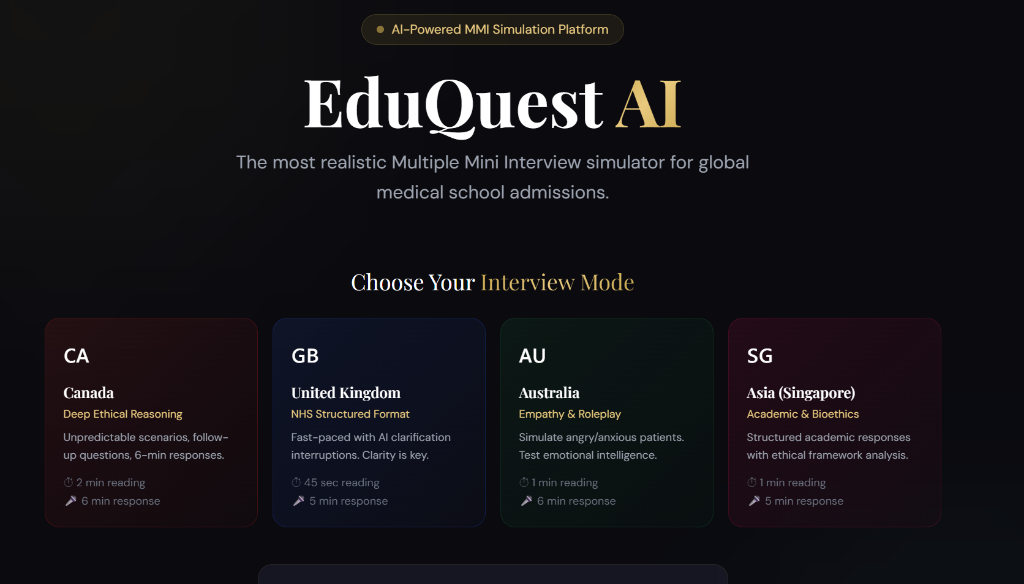
Practice Australian MMI Stations on EduQuest AI
Train on country-specific Australian MMI prompts tailored to Monash, Melbourne, and Sydney medical admissions standards.
Australia (AU) MMI Mode
Simulate realistic 6-to-8 minute stations focused on Australian clinical scenarios, AHPRA guidelines, and cultural safety.
- ✓ 150+ Australia & NZ station prompts
- ✓ Timed dynamic AI interlocutor
- ✓ Instant verbal feedback & scoring
- ✓ AHPRA professional criteria review
MMI Diagnostic Performance Suite
Track your pacing, empathy indicators, and ethical reasoning across multiple simulated Australian stations.
- ✓ Station-by-station score history
- ✓ Communication clarity analysis
- ✓ Strengths & improvement roadmap
“Select Australia (AU) Mode on our AI simulator to practice stations calibrated to AHPRA standards, rural healthcare ethics, and multidisciplinary teamwork.”
4. Interprofessional Teamwork & AHPRA Standards
Australian medical panels place heavy weighting on your ability to work collaboratively within a multidisciplinary healthcare team (doctors, nurse practitioners, physiotherapists, social workers, and clinical pharmacists). Candidates must demonstrate the standards defined by the Australian Health Practitioner Regulation Agency (AHPRA) and the Medical Board of Australia.
| Scenario Type | Underlying Assessment Goal | Strategic Response Structure |
|---|---|---|
| Colleague Conflict | Managing disagreements professionally | Acknowledge colleague's perspective privately, focus on patient safety, avoid public confrontation |
| Impaired Practitioner | Whistleblowing vs colleague welfare | Express compassionate concern, verify facts objectively, escalate through clinical governance |
| Medical Error Disclosure | Open disclosure standards under AHPRA | Apologize sincerely, explain corrective steps, report on incident management system |
| Rural Resource Triage | Ethical equity under clinical constraints | Prioritize based on objective medical urgency, coordinate with regional referral centers |

Targeting Monash, Melbourne, or Sydney Medicine?
Boost your MMI score with EduQuest's Australia-specific AI simulation drills and personalized mentor guidance.
Download the Australia & NZ Medical School MMI Guide (2026–2027)
Get instant access to our comprehensive Australian MMI candidate dossier featuring 10 model station answers, AHPRA ethical rubrics, and Indigenous health frameworks.
How much weight do Australian medical schools give to the MMI?
Most Australian medical schools (e.g., Monash, Melbourne, Sydney) weight the MMI between 33% and 50% of the final admission decision, with the remaining weight split between academic GPA / ATAR and UCAT ANZ / GAMSAT scores.
Are Australian MMI interviews conducted online or in person?
Many top universities (including Monash and Melbourne) now conduct virtual MMIs via online portals for interstate and international applicants, while domestic applicants may be offered in-person circuits depending on university policy.
Do international applicants face the same MMI stations as domestic students?
Yes, the station prompts, scoring criteria, and assessor rubrics are identical. International students are strongly advised to familiarize themselves with Australian healthcare terminology, Medicare basics, and cultural safety principles.
How do I practice for the Australian MMI alone?
You can practice on EduQuest's AI MMI Interview Agent by choosing Australia (AU) Mode at https://mmi-interview.eduquest.org.in/home, which gives you timed station prompts with instant AI voice and ethical feedback.