

Every year, thousands of ambitious high school students complete the College Board’s official Bluebook practice tests, achieve scores of 1450 or 1500, and arrive on official test day expecting a smooth exam. Yet, when they walk out of the testing room, many are left in shock: the Math questions felt significantly harder, the reading passages required faster skimming, and the countdown clock seemed to move at double speed. This leaves test-takers asking: is Bluebook practice test vs real SAT truly identical, or are there hidden differences that distort score expectations?
While the Bluebook application is the official platform created by College Board, treating official practice tests as an exact replica of test-day conditions without understanding their limitations is a dangerous mistake. Powered by the EduQuest SAT Prep Suite and EduPath, this comprehensive guide explores the core similarities, the 7 critical differences you must prepare for, timing realities, and how real students bridge the gap to achieve authentic 1500+ scores.
Test Your Digital SAT Readiness with EduQuest AI
EduQuest Adaptive SAT Mock
Hard Module 2 Stress Test
Simulate the exact Bluebook interface with updated 2026 difficulty curves and deep AI mistake diagnostics.
Take Additional Adaptive MockFree Mock Test Hub
Comprehensive Test Bank
Access full-length, timed Digital SAT simulations with instant sub-topic heat maps and video explanations.
Explore Mock HubPersonalized SAT Roadmap
EduQuest EduPath Platform
Map your study calendar balancing Bluebook milestone benchmarks with weekly adaptive practice drills.
Launch EduPath RoadmapSimilarities Between Bluebook and the Real SAT
First, let us acknowledge the areas where Bluebook matches the real SAT perfectly. You can rely on Bluebook 100% for the following operational aspects:
Fast-Track Your College & Career Strategy
Get immediate, personalized AI insights tailored to your grade, strengths, and dream universities — 100% free with instant reports.
Know Your Personality Type for Free
Take our 18-question AI psychometric test to uncover your cognitive archetype, hidden learning superpowers, and ideal university courses.
Personalized Career & University EduPath
Build a step-by-step Grade 8–12 admissions blueprint with AI-matched target universities, exam schedules, and extracurricular profiles.
Pixel-Perfect User Interface (UI)
The button placements, question navigation grid, text highlighting tools, answer eliminator (strikethrough), and flag-for-review tools in Bluebook are 100% identical to the official exam.
Embedded Desmos Graphing Calculator
The exact built-in version of Desmos available on the real exam is present in Bluebook, allowing you to master table regressions, sliders, and coordinate geometry.
Section Structure & Official Timers
Both exams feature 2 Reading & Writing modules (27 questions / 32 minutes each) and 2 Math modules (22 questions / 35 minutes each) separated by an official 10-minute break.
7 Differences Students Must Know
Despite the visual similarities, seven critical technical, psychological, and psychometric differences separate Bluebook practice tests from the real exam:
| Comparison Dimension | Official Bluebook Practice Tests | Real Digital SAT Exam Day | Practical Impact on Students |
|---|---|---|---|
| 1. Question Novelty | Questions are widely discussed online; many students encounter familiar patterns | 100% unseen, newly developed questions requiring fresh analytical synthesis | Practice tests feel easier due to subconscious familiarity |
| 2. Hard Module 2 Difficulty | Moderate in Tests 1–3; Realistic in Tests 4–6 | Noticeably harder in Math with high-density multi-step geometry and nonlinear algebra | Score drops of 40–80 points if unprepared for Module 2 spikes |
| 3. Experimental Pretest Items | Contains 2 un-scored pretest questions per module that are often simpler | Pretest items on the real SAT are often exceptionally difficult and drain mental energy | Students waste 3+ minutes on questions that do not even count |
| 4. Exam Environment Pressure | Taken in the comfort of home, coffee on desk, familiar temperature and chair | Strict proctor, check-in metal detectors, unfamiliar desks, room noises, mask rules | Adrenaline spikes reduce reading comprehension speed by 15% |
| 5. Time Flexibility Temptation | Students subconsciously pause timers, check notifications, or stretch casually | Absolute zero-tolerance countdown clock with automatic lockdown | Severe time crunches on the final 5 questions of each module |
| 6. Diagnostic Depth | Basic total score + simple right/wrong list with zero time tracking | Final score report gives broad percentiles but no per-question solution breakdown | Bluebook does not teach you why you made time-based careless errors |
| 7. Available Test Volume | Only 6 official adaptive tests in total | Endless combinations of secure test forms across global administrations | Students run out of official tests early and plateau without fresh material |
Timing: The "Panic Clock Effect"
On paper, the time allocation looks straightforward: **~71 seconds per Reading & Writing question** and **~95 seconds per Math question**. However, in practice, timing is where the real SAT creates its highest casualty rates:
The Visual Clock Anxiety Trap
On the real exam, watching the onscreen countdown timer tick down triggers adrenaline surges. Students who did not practice hiding the clock ("Hide Timer" button) frequently experience tunnel vision.
The Non-Linear Time Requirement in Module 2
In the Hard Math Module 2, questions 1 through 14 take about 50 seconds each, but questions 18 through 22 often require 150+ seconds of multi-step manipulation. Students who do not bank time early run out of time on the final grid-ins.
Difficulty: The 2024–2026 Difficulty Escalation
Is the real SAT harder than Bluebook? The consensus from 99th percentile scorers and psychometricians is nuanced:
This difficulty escalation means that if you score 1450 on Bluebook Test 1, your true baseline on a live exam may be closer to 1380 unless you have practiced with updated, high-difficulty adaptive challenge sets.
Adaptiveness: Understanding the Routing Algorithm
The multi-stage routing engine operates identically in theory, but on the real exam, the boundary between the Easy and Hard Module 2 is razor-thin:
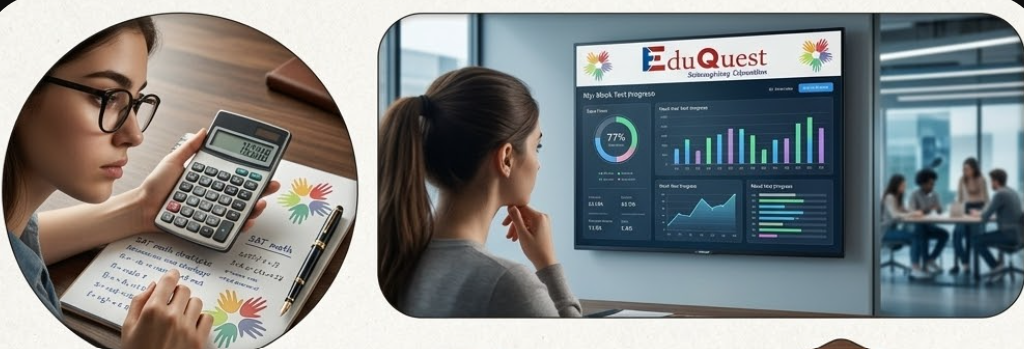
- The Routing Threshold: Missing more than 7–8 questions in Reading & Writing Module 1 or more than 6–7 questions in Math Module 1 will drop you into the Easy Module 2.
- The Harsh Penalty: Once in the Easy Module 2, your section score is capped (usually at 590–620 points), making an overall score of 1400+ mathematically impossible regardless of how well you perform.
- Pretest Question Confusion: Because 2 questions per module are un-scored pretest items, you might miss a pretest question and mistakenly believe it hurt your routing, or get a pretest question right that did not help you.
Student Experiences: Real Case Studies
Here are two real-world case studies from EduQuest students illustrating the difference between Bluebook-only prep and hybrid adaptive prep:
Student A (Bluebook-Only Prep): The False Confidence Trap
Averaged 1480 across Bluebook Tests 1–3 at home with snacks and casual pauses. On official test day, experienced shock at Math Module 2 difficulty and panicked when the clock ran low. Official Result: 1390 (-90 points from practice).
Student B (EduQuest Hybrid Prep): Calibrated Stress Testing
Used Bluebook Test 1 as baseline, completed 8 EduQuest Adaptive Mocks with updated 2026 Hard Module 2 curves under strict Saturday 8:00 AM lockdown, and finished with Bluebook Test 6. Official Result: 1530 (+30 points from practice average).
How EduQuest Powers Your Digital SAT Mastery
At EduQuest, our test preparation coaching ecosystem provides everything ambitious students need to achieve a top percentile:
- 1. 15+ Calibrated Adaptive Mock Tests: Simulates the exact Bluebook interface with updated 2026 difficulty curves for Hard Module 2.
- 2. Instant AI Heat Maps & Chronometer Analytics: Track exact seconds spent per question and eliminate pacing bottlenecks.
- 3. 1-on-1 Mentorship with 1550+ Top Scorers: Personalized strategy sessions to dissect error logs and master high-speed shortcuts.
Frequently Asked Questions (FAQ)
Is Bluebook harder or easier than the real Digital SAT?
Bluebook Tests 1, 2, and 3 are generally considered easier than recent official exams. Bluebook Tests 4, 5, and 6 are closely aligned with real exam difficulty, though the real exam’s Math Module 2 frequently features harder multi-step problems.
Which Bluebook practice test is the most accurate?
Bluebook Practice Tests 4, 5, and 6 are the most accurate and best reflect the current difficulty and scoring curves of official administrations.
Should I save Bluebook tests for the end of my preparation?
Take Bluebook Test 1 as an early diagnostic baseline, use third-party adaptive mocks (like EduQuest) for weekly practice during weeks 2–6, and take Bluebook Tests 4, 5, and 6 in the final 2–3 weeks before your exam.
Are EduQuest Adaptive SAT Mocks free?
Yes! EduQuest offers free full-length adaptive Digital SAT mock tests with instant AI diagnostic heat maps and score breakdowns.
Download the Official Bluebook Review Checklist & Gap Analysis Matrix
Get instant access to EduQuest’s 18-page PDF checklist covering how to review your Bluebook results, identify inflated scores, and patch topic leakages before test day.
Take Additional Adaptive SAT Mocks on EduQuest AI Today
Join thousands of ambitious students who bridged the Bluebook gap and achieved 1500+ on the Digital SAT with EduQuest AI. Take your free adaptive mock exam now.