

1. The McMaster University Origins: The World's Toughest MMI Circuit
The Multiple Mini Interview was originally conceptualized and pioneered in 2001 at the Michael G. DeGroote School of Medicine at McMaster University in Ontario, Canada. Frustrated by the poor predictive validity of traditional 45-minute panel interviews, McMaster researchers developed a multi-station format that objectively evaluated non-cognitive competencies such as collaboration, problem-solving, and communication.
Today, Canadian medical schools (including McMaster, the University of British Columbia (UBC), the University of Toronto, McGill University, the University of Calgary, Queen's University, and the University of Alberta) operate the most demanding MMI circuits in the world: typically 10 to 12 stations, lasting 8 minutes each with a 2-minute reading window. Managing cognitive stamina across a grueling 100-minute interview is essential.
| Canadian Medical School | Number of Stations | Circuit Duration | Reading Window | Key University Nuance |
|---|---|---|---|---|
| McMaster University | 10–12 Stations | 80–100 Minutes | 2 Minutes | Original MMI model; heavy focus on ethical reasoning |
| University of British Columbia (UBC) | 10–11 Stations | 80–90 Minutes | 2 Minutes | Rural & Indigenous health, teamwork stations |
| University of Toronto | MPI (Modified Personal Interview) | 4 Stations x 12 min | Embedded | Semi-structured hybrid behavioral stations |
| McGill University | 10 Stations | 80 Minutes | 2 Minutes | Bilingual French/English nuance, healthcare equity |
| University of Calgary | 8–10 Stations | 70–80 Minutes | 2 Minutes | Three-year accelerated MD, leadership scenarios |
| Queen's University | MMI + Panel Format | 6–8 MMI Stations | 2 Minutes | CanMEDS alignment, collaborative problem solving |
2. The CanMEDS Framework: The Core Compass of Canadian Medical Admissions
In Canada, medical schools evaluate applicants against the Royal College of Physicians and Surgeons of Canada's CanMEDS Physician Competency Framework. High-scoring candidates intentionally weave these seven competencies into their station responses:
Fast-Track Your College & Career Strategy
Get immediate, personalized AI insights tailored to your grade, strengths, and dream universities — 100% free with instant reports.
Know Your Personality Type for Free
Take our 18-question AI psychometric test to uncover your cognitive archetype, hidden learning superpowers, and ideal university courses.
Personalized Career & University EduPath
Build a step-by-step Grade 8–12 admissions blueprint with AI-matched target universities, exam schedules, and extracurricular profiles.
Medical Expert
Demonstrating sound clinical reasoning, structured problem solving, and evidence-based analytical judgment when evaluating medical scenarios.
Communicator
Facilitating active listening, establishing rapport with patients and families, using compassionate non-verbal communication, and avoiding medical jargon.
Collaborator
Working effectively in interprofessional healthcare teams to optimize patient-centered care and resolve professional disagreements respectfully.
Leader
Making difficult decisions under resource constraints, prioritizing clinical safety, and participating in healthcare system stewardship.
Health Advocate
Advocating for marginalized patient populations, addressing systemic social determinants of health, and addressing health inequities.
Scholar
Reflecting on personal learning gaps, accepting critical feedback gracefully, and demonstrating a lifelong commitment to scientific inquiry.
Professional
Upholding strict confidentiality, maintaining ethical boundaries, modeling personal integrity, and prioritizing patient welfare above all.
3. Canadian Bioethics & Healthcare Public Policy Dilemmas
Canadian MMI prompts frequently examine candidates on hot-button public policy and bioethical questions anchored in the Canada Health Act’s five foundational principles: Public Administration, Comprehensiveness, Universality, Portability, and Accessibility.
- Medical Assistance in Dying (MAID): Understanding federal legislative criteria, balancing patient suffering against vulnerability safeguards, and recognizing a physician's right to conscientious objection with mandatory effective referral.
- Two-Tier Healthcare Debates: Evaluating private clinics offering paid MRI scans or expedited orthopedic surgery versus the fundamental principle of single-payer equity.
- Truth and Reconciliation Commission (TRC) Calls to Action: Deconstructing Calls to Action 18–24 regarding Indigenous health rights, cultural safety training for clinicians, and anti-racism in Canadian emergency departments.
- Organ Allocation & Ventilator Triage: Ethical distribution of scarce intensive care beds during pandemics or organ donor shortages without socioeconomic bias.
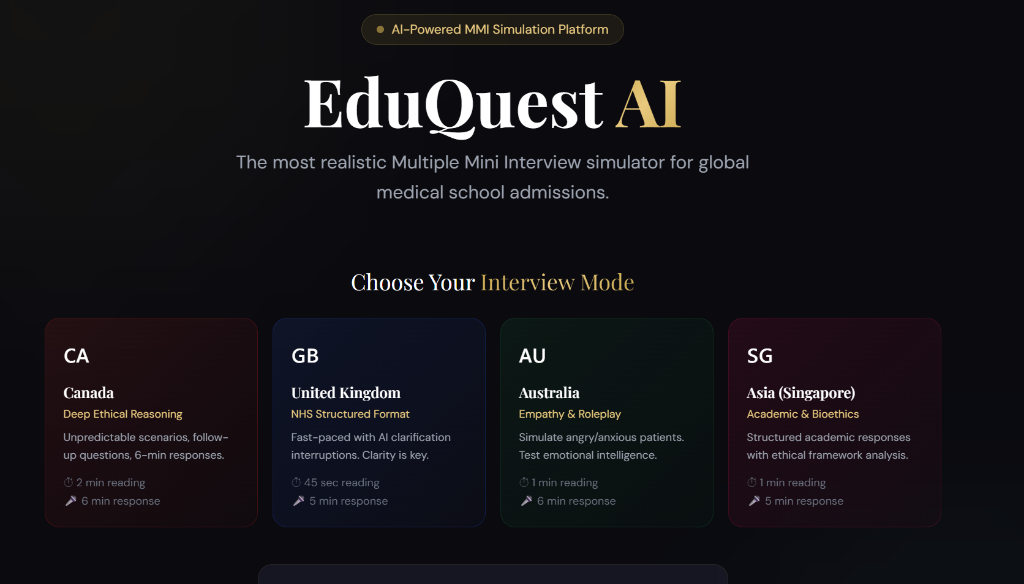
Practice Canadian MMI Stations on EduQuest AI
Train on authentic McMaster and UBC MMI stations with our dedicated Canada (CA) mode on EduQuest AI Interview Agent.
Canada (CA) MMI Mode
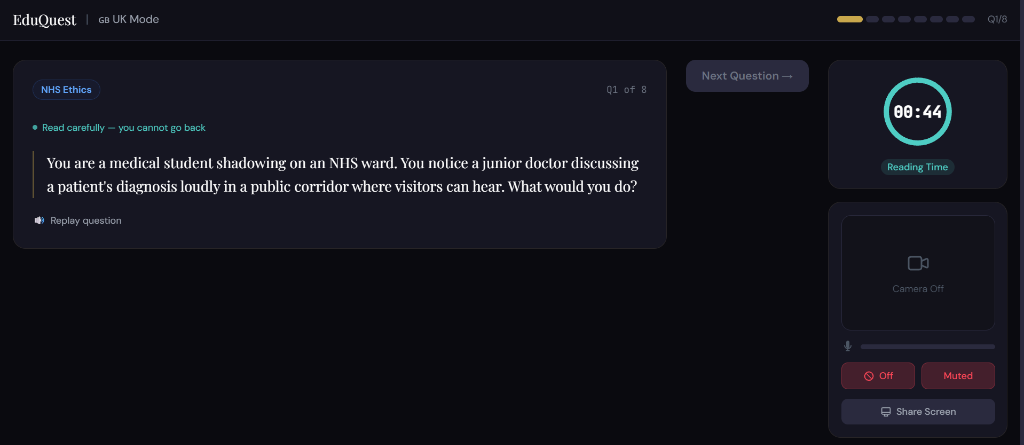
Simulate realistic 8-minute Canadian stations with dynamic AI prompts testing health advocacy, collaboration, and ethical decision-making.
- ✓ 150+ Canadian medical school prompts
- ✓ CanMEDS competency scoring rubric
- ✓ Voice & typed response analysis
- ✓ 2-minute prompt reading timer
CanMEDS Diagnostic Suite
Receive detailed scoring breakdowns across Communicator, Health Advocate, Collaborator, and Professional roles.
- ✓ Instant verbal pacing assessment
- ✓ Model answer comparisons
- ✓ Ethical argument validation
“Select Canada (CA) Mode to face 10-station circuits with instant scoring calibrated to CanMEDS physician competencies and Canadian bioethics.”
4. Creative & Non-Traditional Collaboration Stations
Canadian MMI panels are famous for unconventional, non-medical stations designed to assess creative problem solving under pressure. Examples include:
| Station Type | Prompt Example | Evaluation Benchmark |
|---|---|---|
| Blindfolded Instruction | Guide an actor through building a Lego structure using verbal instructions only | Clarity of language, spatial awareness, patience when errors occur |
| Peer Misconduct | You discover your study partner downloaded stolen exam questions from a shared drive | Balancing personal loyalty against academic integrity; private intervention first |
| Cultural Misunderstanding | A patient refuses life-saving surgery due to cultural beliefs of their extended family | Respectful exploration of beliefs without coercion; seeking hospital cultural liaison |
| Debating Non-Medical Policy | Should bicycle helmets be legally mandated for adults across all Canadian provinces? | Structuring arguments around personal liberty vs public healthcare cost burdens |
Aiming for McMaster, UBC, or Toronto Medicine?
Master the 10-station Canadian circuit with EduQuest's specialized AI simulator and admissions mentors.
Download the Canada Medical School MMI Guide (2026–2027)
Get instant access to our comprehensive Canadian MMI dossier featuring 10 model station answers, CanMEDS evaluation rubrics, and healthcare policy blueprints.
Why are Canadian MMI interviews considered more competitive?
Canadian medical schools have exceptionally low acceptance rates (typically 5%–10% for domestic applicants, and even lower for out-of-province candidates). With near-perfect GPA and MCAT scores being common, the MMI carries decisive weight in determining final admissions.
How does McMaster evaluate communication in MMI stations?
McMaster assessors grade on listening skills, non-verbal posture, empathetic tone, and the logical organization of your thoughts. Memorized scripts receive poor scores because examiners deliberately introduce interruptions to test authentic reaction.
Can international students apply to Canadian medical schools?
A limited number of Canadian medical schools (such as McGill, University of Toronto, and McMaster) accept applications from international candidates, but competition is fierce. Preparation on EduQuest AI ensures your communication aligns with Canadian expectations.
How do I maintain energy across 10 to 12 stations?
Treat each station as an independent race. Use the 2-minute reading window between stations to take deep breaths, physically shake off tension from the previous room, and mentally reset.