Har saal thousands of ambitious students Grade 8 aur Grade 9 se hi random activities join karte hain — coding bootcamps, Model UN (MUN), science Olympiads, robotic clubs, NGO fundraisers, and endless debate societies — sirf isliye kyunki "yeh college application resume mein achha lagega."
Lekin jab Grade 12 mein Common App, UC Application, ya UCAS personal statement likhne ka time aata hai, tab 90% students realize karte hain ki unke paas 15 disconnected certificates to hain, lekin ek coherent, compelling story nahi hai. Unka profile ek passionate scholar ka nahi, balki ek exhausted "activity collector" ka lagta hai.
Is definitive guide mein, hum EduQuest ke battle-tested 5-Year College Prep Roadmap ko detail mein break down karenge. Hum dekhenge ki Grade 8 se lekar Grade 12 tak har phase mein student mindset ka kya challenge hota hai, unhe actually kya deliverables deliver karni chahiye, aur kaise aap apne child ko ek typical resume builder se ek standout applicant bana sakte hain.
Download the Free 5-Year College Prep Checklist
Get the complete printable PDF guide containing all grade-by-grade milestones, deliverable checklists, competition deadlines, and strategy blueprints.
Fast-Track Your College & Career Strategy
Get immediate, personalized AI insights tailored to your grade, strengths, and dream universities — 100% free with instant reports.
Know Your Personality Type for Free
Take our 18-question AI psychometric test to uncover your cognitive archetype, hidden learning superpowers, and ideal university courses.
Personalized Career & University EduPath
Build a step-by-step Grade 8–12 admissions blueprint with AI-matched target universities, exam schedules, and extracurricular profiles.
Why Most Students Build a Resume, Not a Story
Admissions officers at world-class universities read between 40 to 60 applications every single day during peak review seasons. They spend an average of 8 to 10 minutes reviewing an entire file. In those brief minutes, they are not counting how many clubs you joined; they are looking for an intellectual narrative and a distinctive spike.
We are not looking for well-rounded students. We are looking for a well-rounded class composed of deeply angular, authentically passionate individuals who have pushed their interests to meaningful boundaries.
— Former Ivy League Senior Dean of Admissions
The fundamental trap is the "Resume Mentality" versus the "Story Architecture":
- The Resume Mindset: Focuses on breadth over depth. The student asks, "What else can I add to my CV?" They collect 10+ unrelated certificates, join 5 clubs with zero leadership, and do a 3-day superficial internship arranged by relatives.
- The Strategic Story Mindset: Focuses on depth, agency, and authentic curiosity. The student asks, "What specific problem in the world fascinates me, and how can I create tangible evidence of my engagement with it?" Every activity naturally connects to their central intellectual theme.
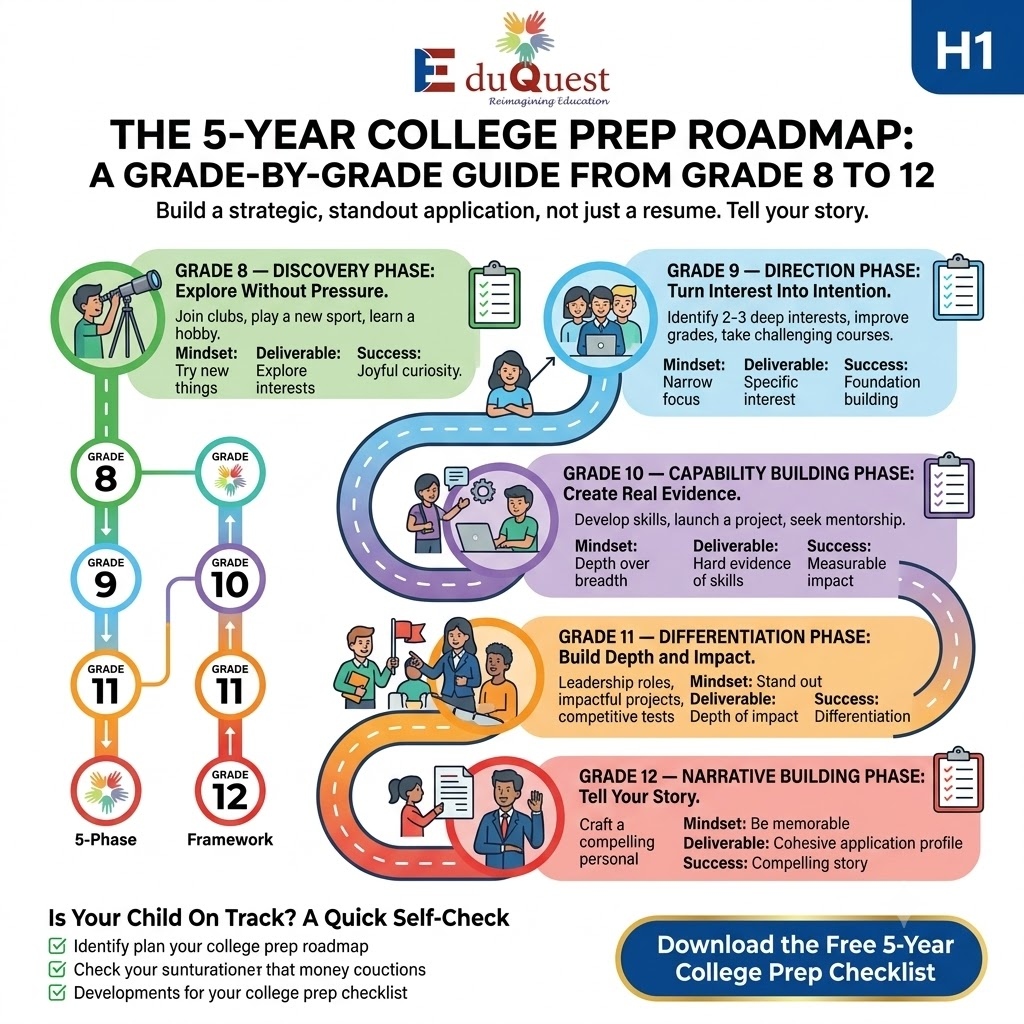
The 5-Phase College Prep Framework at a Glance
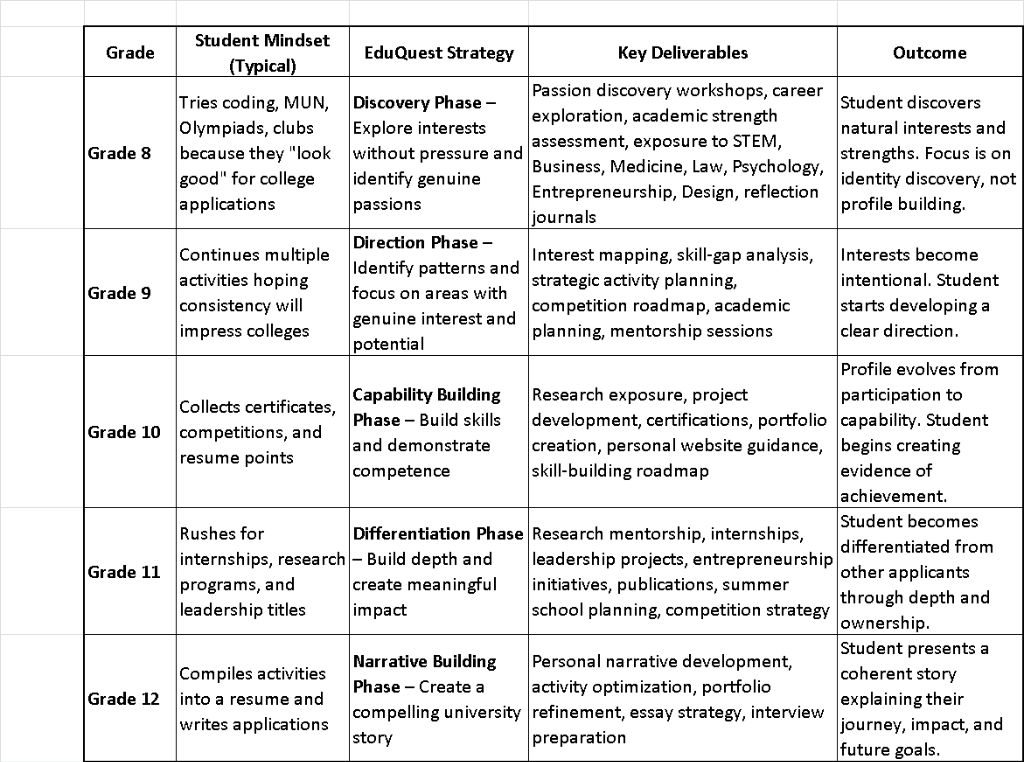
Yeh table summarize karti hai ki typical student mindset aur EduQuest ke strategic approach mein kya farak hota hai, aur har grade ke end mein kya concrete outcome achieve hona chahiye:
| Grade | Student Mindset (Typical) | EduQuest Strategy Phase | Key Deliverables | Outcome |
|---|---|---|---|---|
| Grade 8 | Tries coding, MUN, Olympiads, clubs because they "look good" for college applications. | Discovery Phase — Explore interests without pressure and identify genuine passions. | Passion discovery workshops, career exploration, academic strength assessment, exposure to STEM, Business, Medicine, Law, Psychology, Entrepreneurship, Design, reflection journals. | Student discovers natural interests and strengths. Focus is on identity discovery, not profile building. |
| Grade 9 | Continues multiple activities hoping consistency will impress colleges. | Direction Phase — Identify patterns and focus on areas with genuine interest and potential. | Interest mapping, skill-gap analysis, strategic activity planning, competition roadmap, academic planning, mentorship sessions. | Interests become intentional. Student starts developing a clear direction. |
| Grade 10 | Collects certificates, competitions, and resume points. | Capability Building Phase — Build skills and demonstrate competence. | Research exposure, project development, certifications, portfolio creation, personal website guidance, skill-building roadmap. | Profile evolves from participation to capability. Student begins creating evidence of achievement. |
| Grade 11 | Rushes for internships, research programs, and leadership titles. | Differentiation Phase — Build depth and create meaningful impact. | Research mentorship, internships, leadership projects, entrepreneurship initiatives, publications, summer school planning, competition strategy. | Student becomes differentiated from other applicants through depth and ownership. |
| Grade 12 | Compiles activities into a resume and writes applications. | Narrative Building Phase — Create a compelling university story. | Personal narrative development, activity optimization, portfolio refinement, essay strategy, interview preparation. | Student presents a coherent story explaining their journey, impact, and future goals. |
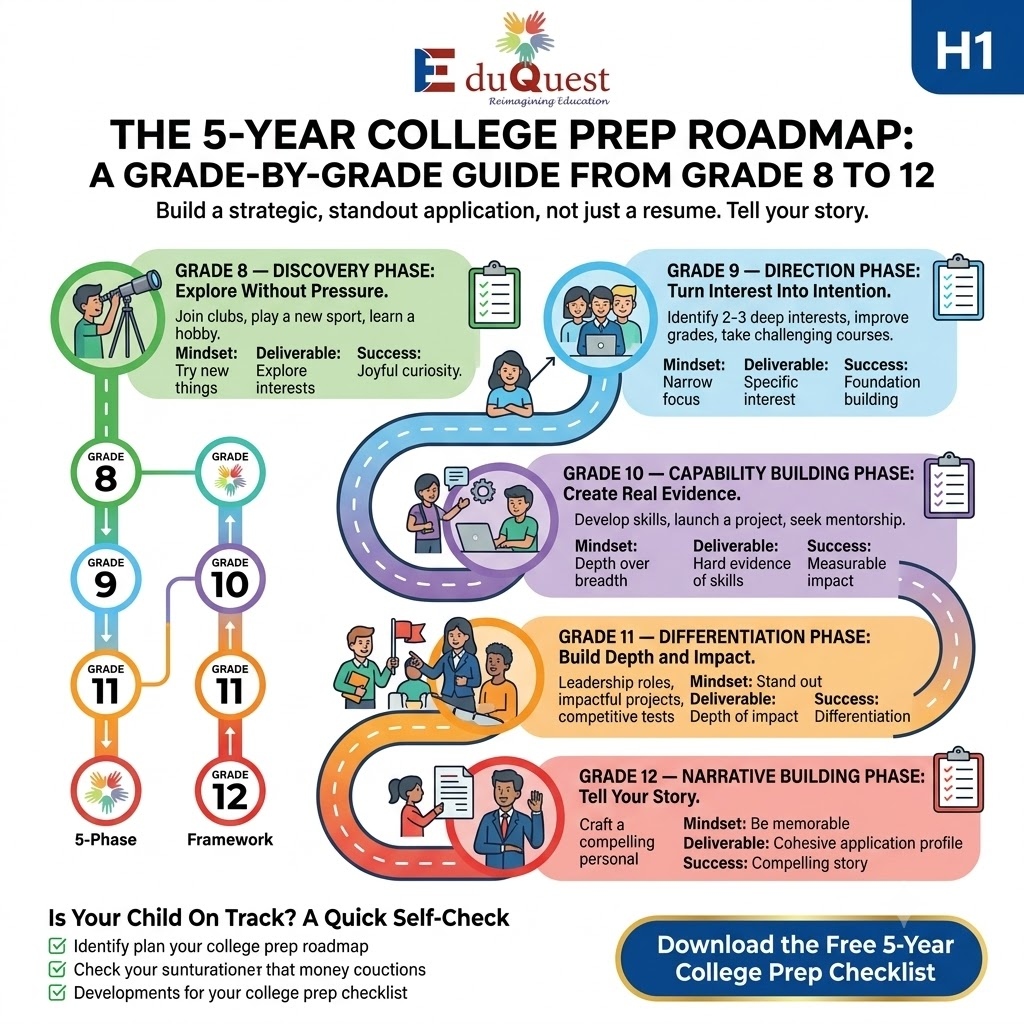
Grade 8 — Discovery Phase: Explore Without Pressure
Grade 8 mein zyada students coding, MUN aur Olympiads is liye join karte hain kyunki unhe lagta hai ki "resume ke liye abhi se points jama karne honge." Lekin is stage ka asli goal profile-building nahi, balki Identity Discovery hai.
Typical Mindset vs. Strategic Approach in Grade 8
- ❌ The Trap: Forcing an 8th grader to commit to a single career track (e.g. "You must become a computer engineer") or overburdening them with high-stakes coaching.
- ✅ The Strategy: Low-stakes, broad exploration across multiple disciplines — STEM, Business, Law, Medicine, Psychology, Robotics, Creative Writing, Design, and Social Impact.
Key Deliverables for Grade 8
- Passion Discovery Workshops: Structured interactive sessions to experience real-world applications of diverse fields.
- Academic Strength & Learning Style Assessment: Pinpointing natural cognitive strengths, analytical abilities, and verbal skills using scientific diagnostic tools like the EduQuest AI Personality Assessment.
- Broad Exposure Sprints: Mini-projects spanning 2–3 weeks in contrasting domains (e.g., building a simple webpage, reading behavioral economics case studies, debating ethics).
- Reflection Journaling: Encouraging the student to document what energized them versus what drained their enthusiasm.
What Success Looks Like in Grade 8
Grade 9 — Direction Phase: Turn Interest Into Intention
Grade 9 enters the official high school transcript for international universities (US universities review Grades 9 through 12). While students often continue 8–10 scattered activities hoping consistency alone will impress admissions officers, this phase requires filtering and strategic alignment.
Typical Mindset vs. Strategic Approach in Grade 9
- ❌ The Trap: Staying enrolled in 6 different school clubs without active engagement or purpose, simply to check boxes.
- ✅ The Strategy: Synthesizing Grade 8 insights to narrow down focus to 2–3 core theme areas where the student shows genuine aptitude and passion.
Key Deliverables for Grade 9
- Interest Mapping Matrix: Identifying common intersections (e.g., Computer Science + Environmental Science, or Psychology + Behavioral Economics).
- Skill-Gap Analysis: Evaluating the technical, writing, and mathematical skills required for advanced competitions and projects.
- 4-Year Academic Curriculum Map: Selecting rigorous coursework (IGCSE/IB MYP/CBSE/ICSE subjects, Pre-AP fundamentals) that aligns with future major goals.
- Competition Roadmap: Identifying beginner-to-intermediate national competitions (Olympiads, essay contests, hackathons, debate leagues) to target over the next 18 months.
- Quarterly Mentorship Touchpoints: Structured reviews to keep activities focused on quality rather than sheer quantity.
What Success Looks Like in Grade 9
Grade 10 — Capability Building Phase: Create Real Evidence
Grade 10 is the year where interest must convert into demonstrated competence. Rather than collecting attendance certificates from webinars or one-day seminars, students must build tangible artifacts that showcase skill mastery.
Typical Mindset vs. Strategic Approach in Grade 10
- ❌ The Trap: Prioritizing participation certificates and generic competitions that have zero barrier to entry.
- ✅ The Strategy: Building standalone projects, executing independent research foundations, and creating public proof of capability.
Key Deliverables for Grade 10
- First Independent Passion Project: Developing an app, launching a community initiative, curating an academic blog/newsletter, or designing a hardware prototype.
- Foundational Research Exposure: Learning academic methodology, literature review formatting, and citation standards.
- Advanced Certifications & Pre-College Coursework: Completing accredited university-level courses (Coursera/edX verified tracks, Advanced Placement (AP) exams).
- Digital Portfolio / Personal Website: Showcasing projects, essays, code repositories, art portfolios, or data models.
- Standardized Test Baseline: Taking a diagnostic PSAT / Digital SAT or ACT mock test to establish testing timelines.
What Success Looks Like in Grade 10
Grade 11 — Differentiation Phase: Build Depth and Impact
Grade 11 is the most academically rigorous and strategically critical year of high school. In this phase, the applicant must establish their "Spike" (Angular Profile) — achieving depth and measurable real-world impact that sets them apart from the top 1% applicant pool.
Typical Mindset vs. Strategic Approach in Grade 11
- ❌ The Trap: Frantically applying to 20 random summer programs and begging for arbitrary leadership titles in school clubs.
- ✅ The Strategy: Deep, selective execution in 1–2 flagship initiatives with high ownership, external validation, and mentorship from professors or industry leaders.
Key Deliverables for Grade 11
- Mentored Research Paper & Publication: Conducting original research under faculty mentorship and submitting to peer-reviewed student journals or IEEE/academic conferences.
- Impactful Leadership & Social Entrepreneurship: Scaling a community initiative to touch hundreds/thousands of beneficiaries or securing grant funding.
- Competitive Summer Programs & Selective Internships: Gaining entry into merit-based summer schools (RSI, PROMYS, TASP, Stanford SIMR, Wharton LBW) or substantive lab/corporate internships.
- Standardized Test Score Locking: Completing the Digital SAT (Target 1520+) or ACT (Target 34+), alongside UK pre-interview exams (TMUA, UCAT, ESAT, LNAT).
- Strategic University Shortlist: Building an initial list of Reach, Target, and Safety universities across the US, UK, Canada, Europe, and Asia.
What Success Looks Like in Grade 11
Grade 12 — Narrative Building Phase: Tell Your Story
Having built strong foundations over Grades 8 to 11, Grade 12 is about packaging and storytelling. Admissions committees don’t just evaluate what you did; they evaluate why you did it, what you learned, and who you will become on their campus.
Typical Mindset vs. Strategic Approach in Grade 12
- ❌ The Trap: Treating essays as a chronological summary of the CV, using clichés, and writing applications in isolation during November deadlines.
- ✅ The Strategy: Crafting a cohesive personal narrative that weaves together personal background, intellectual curiosity, ethical dilemmas, and future vision into unforgettable essays.
Key Deliverables for Grade 12
- Common App Main Essay & UCAS Personal Statement: Multiple iterative drafts focusing on authenticity, vulnerability, and intellectual insight.
- Supplemental Essay Matrix: Writing targeted, well-researched "Why College" and community essays for 15+ universities.
- Activity List Optimization: Writing high-impact, quantified 150-character descriptions for Common App with action verbs and quantifiable metrics.
- Letters of Recommendation (LOR) Strategy: Guiding teachers and counselors with detailed "brag sheets" and context anecdotes.
- Alumni & Admissions Interview Preparation: Mastering the art of authentic dialogue, answering behavioral questions, and discussing academic research under pressure.
What Success Looks Like in Grade 12
Phase 1: Discovery Phase
Explore Without Pressure
- Try new hobbies, coding, debating, and creative arts
- Identify academic strengths via AI diagnostic assessments
- Build foundational reading and analytical habits
Phase 2: Direction Phase
Turn Interest Into Intention
- Narrow down focus from 10 activities to 2–3 core theme areas
- Map out a 4-year curriculum with advanced courses
- Start national competition roadmaps and skill acquisition
Phase 3: Capability Building Phase
Create Real Evidence
- Launch an independent project or public-facing initiative
- Learn research methodology and write foundational papers
- Take baseline SAT/ACT mocks and earn specialized certifications
Phase 4: Differentiation Phase
Build Depth and Impact
- Publish mentored research in peer-reviewed journals
- Demonstrate measurable leadership and social impact
- Lock in target standardized test scores and build university list
Phase 5: Narrative Building Phase
Tell Your Compelling Story
- Craft authentic, reflective personal statements and supplementals
- Quantify and optimize the 10-activity Common App list
- Master admissions interviews and finalize early/regular submissions
Why This Matters: The Admissions Reality & Data
Why is starting early with a strategic framework so critical? Analysis of global admissions data across thousands of international applicants reveals several glaring patterns:
- 78% of students who start profile planning in Grade 11 or 12 end up choosing majors based on last-minute panic rather than genuine alignment, leading to disconnected personal statements.
- Admissions Yield on "Angular Profiles": Applicants with a clear intellectual "spike" (e.g. Published Computational Biology Research + Healthcare Policy Advocacy) have a 3.8x higher acceptance rate at top 20 global universities compared to "well-rounded" applicants with identical test scores.
- Stress Reduction: Spreading the milestones across 5 years prevents the extreme burnout and mental exhaustion that occurs when students try to juggle board exams, SAT prep, research, and 20 college essays in Grade 12.
Case Study: From Confused Middle-Schooler to Top University Admit
When Aarav came to us in Grade 8, he was doing robotics, playing tennis, preparing for math Olympiads, and writing poetry — completely exhausted and confused about his direction. By following the 5-Year Framework, we channeled his diverse interests into a groundbreaking Computational Linguistics research spike.
— EduQuest Admissions Strategy Case File #EQ-2026-US
Here is how Aarav’s journey unfolded across the 5 phases:
Grade 8 (Discovery)
Aarav explored literature and basic Python coding through structured workshops. His reflection journals revealed a fascination with how machines interpret human idioms and cultural nuance.
Grade 9 (Direction)
He dropped generic robotics and focused on NLP (Natural Language Processing). He began reading academic papers in linguistics and took an advanced university course in data structures.
Grade 10 (Capability)
He built an open-source NLP tool that translated regional Indian dialects into educational scripts, publishing the codebase on GitHub and gaining 500+ student users.
Grade 11 (Differentiation)
Under the mentorship of a university professor, Aarav published a research paper in a peer-reviewed computational linguistics journal. He also scored 1550 on his Digital SAT.
Grade 12 (Narrative)
His Common App essay brought together his love for ancient Sanskrit poetry and modern transformer neural networks. He secured admission to UC Berkeley and Carnegie Mellon University with scholarship.
Is Your Child On Track? A Quick Self-Check
Take 2 minutes to evaluate where your child stands right now on the high school prep spectrum:
- ☑️ Clear Direction: Can your child articulate their top 2 academic passions in 30 seconds without saying "it looks good for college"?
- ☑️ Tangible Artifacts: Does your child have independent projects, essays, or code that exists outside school homework?
- ☑️ Curriculum Alignment: Are their current high school subject selections calibrated to meet prerequisite criteria for their target degree?
- ☑️ Leadership with Ownership: Are they leading initiatives they founded or shaped, rather than holding nominal titles in school clubs?
- ☑️ Standardized Test Roadmap: Do they have a concrete timeline for SAT/ACT/AP diagnostic mocks and test dates?
Download the Free 5-Year College Prep Checklist & Roadmap
Download our full, high-resolution 5-Year College Prep Roadmap Checklist PDF containing actionable deliverable checklists, mindset shifts, and competition timelines for Grades 8, 9, 10, 11, and 12.
5-Year College Prep Roadmap: Official Guide Book
Complete printable checklist with step-by-step deliverable templates, spike frameworks, and international admissions milestones.
Frequently Asked Questions (FAQ)
Is Grade 8 too early to start college prep planning?
Grade 8 is too early for intense profile building or test prep pressure, but it is the ideal time for Identity Discovery and curiosity-driven exploration. Starting early without stress allows students to naturally discover their strengths so they make informed subject choices in Grade 9.
What if my child changes their mind about their interests in Grade 10 or 11?
Changing interests is completely natural and healthy! The 5-Year framework builds transferable meta-skills — analytical research, public communication, project execution, and problem solving. When a student pivots, these foundational skills ensure they can quickly build depth in their new area.
How do we balance school board exams (CBSE/ICSE/IB) with profile building?
Quality always triumphs over quantity. Rather than spending 15 hours a week across 6 random clubs, the strategic approach allocates 2–3 focused hours per week to 1 flagship passion project, ensuring school grades and board exam prep remain uncompromised.
Do top universities prefer IB, Cambridge A-Levels, CBSE, or AP courses?
Admissions committees evaluate students within the context of their school curriculum. They want to see that you took the most rigorous academic courses available to you and excelled in them. Supplementing CBSE/ICSE curricula with 3–4 relevant AP exams demonstrates university-level readiness.
How can EduQuest help my child build a personalized 5-year roadmap?
EduQuest pairs students with experienced global admissions strategists and academic mentors. Through diagnostic AI personality assessments, 1-on-1 strategy sessions, research mentorship, and bespoke profile roadmaps, we guide students from Grade 8 to Grade 12 admissions success.
Ready to Build Your Child’s Personalized University Roadmap?
Schedule a 1-on-1 strategy session with EduQuest’s senior admissions faculty to map out your child’s 5-year profile building journey.