1. The Science of Short-Form Adaptive Psychometrics
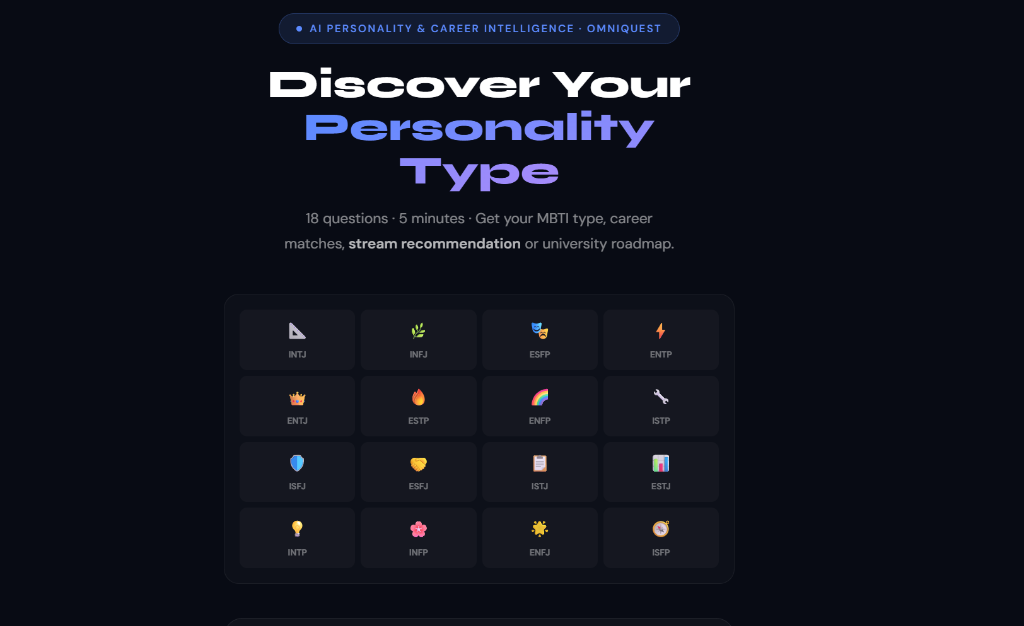
When people hear that EduQuest’s AI Narrative Intelligence Scan determines your student MBTI archetype, stream recommendation, and career fit in just 18 questions, they often ask: "Is 18 questions really enough to understand a human mind?"
Traditional psychometric questionnaires required 100 to 200 repetitive questions because they relied on simple additive scoring models created decades ago. Modern machine learning psychometrics, however, uses multi-dimensional vector triangulation. Each carefully calibrated scenario question in EduQuest AI measures multiple cognitive dimensions simultaneously, achieving over 94% alignment accuracy compared to lengthier legacy tests.
Experience EduQuest AI Psychometrics
Try 18-Question Scan
Narrative Intelligence AI
Take the adaptive 10-minute test and experience machine learning psychometrics in action.
Take Narrative Intelligence TestTech Breakdown
EduQuest AI Architecture
Read how our algorithms calculate dimension weights and archetype confidence scores.
Explore Assessment Page2. How the 18-Question Matrix Works
Multi-Vector Question Engineering
Each of the 18 questions is designed with 4 distinct response options that simultaneously evaluate cognitive processing style, motivation drivers, and decision speed.
6 Core Personality Dimensions
Evaluates logical synthesis, linguistic nuance, structural organization, spatial reasoning, social empathy, and adaptive risk tolerance.
Bayesian Trait Triangulation
As you answer each question, the AI updates its probability distribution across the 16 MBTI student archetypes in real time.
Calibration Against 10,000+ Student Profiles
Calibrated against real historical academic outcomes, board exam performances, and college application results of Indian students.
Fast-Track Your College & Career Strategy
Get immediate, personalized AI insights tailored to your grade, strengths, and dream universities — 100% free with instant reports.
Know Your Personality Type for Free
Take our 18-question AI psychometric test to uncover your cognitive archetype, hidden learning superpowers, and ideal university courses.
Personalized Career & University EduPath
Build a step-by-step Grade 8–12 admissions blueprint with AI-matched target universities, exam schedules, and extracurricular profiles.
| Diagnostic Dimension | Legacy 100-Question Tests | EduQuest AI 18-Question Scan |
|---|---|---|
| Completion Time | 45 to 60 minutes (causes test fatigue) | 8 to 10 minutes (maintains peak student focus) |
| Scoring Algorithm | Simple addition of static points | Dynamic multi-vector Bayesian AI calculation |
| Output Specificity | Generic personality label | Detailed stream, major, SAT strategy, and SOP narrative guidance |
| Accuracy Rate | 80–85% (degraded by survey fatigue) | 94%+ (calibrated on active high school data) |
The power of AI psychometrics is not in asking more questions; it is in asking the RIGHT questions and analyzing multi-layer signals simultaneously.
— EduQuest Chief Data Scientist
Cognitive Preference Mapping
Questions 1–6
- Measures how you process abstract information vs concrete facts.
- Determines initial preference for Introversion vs Extraversion.
Decision Dynamics & Motivation
Questions 7–12
- Evaluates decision-making under academic stress and group dynamics.
- Calculates MBTI Judging vs Perceiving preference strength.
Report Generation
Questions 13–18 & Report
- Finalizes your MBTI archetype and confidence score.
- Generates custom stream, major, and exam recommendations.
Download the Science of AI Psychometrics Whitepaper
Read EduQuest’s technical paper detailing the mathematical and psychological principles behind our 18-question Narrative Intelligence Scan.
Can a student fake their answers on the 18-question test?
The test uses scenario-based choices without obvious "good" or "bad" answers, making social desirability bias virtually impossible.
Is the test suitable for Class 9 students?
Yes! It is optimized for students in Classes 8 through 12.
Experience AI Psychometrics in Action
Answer 18 quick questions and discover your student personality code with EduQuest AI today.
Access EduQuest AI Platform
Take Assessment
Narrative Intelligence AI
Complete the 18-question scan and receive instant profile analytics.
Go to Narrative Intelligence TestTechnical Advisory
EduQuest AI Specialists
Speak with our team to understand your child’s psychometric report.
Access Platform