

Receiving an interview invitation from a prestigious medical or dental school in the UK, Australia, Canada, or the US is a massive achievement. However, for most applicants, this triumph is immediately followed by a wave of anxiety: **how to prepare for an MMI interview**? With over 85% of top medical institutions utilizing the Multiple Mini Interview format, traditional preparation—such as passively reading medical textbooks or writing out robotic monologues—inevitably leads to failure.
MMI circuits are designed specifically to test your real-time adaptability, clinical empathy, ethical integrity, and poise under high cognitive load. Learning **how to prepare for an MMI interview** requires a structured, multi-dimensional training system: mastering universal response frameworks (like the 4 Pillars of Medical Ethics, the SPIKES protocol, and the STARR model), optimizing your 1-minute reading strategy, and executing timed simulations with expert feedback. Powered by the EduQuest AI MMI Simulator and EduPath, this comprehensive guide provides the definitive step-by-step roadmap to transform your preparation and secure your medical school offer.

Accelerate Your MMI Preparation with EduQuest AI
AI MMI Station Simulator
Interactive Practice Circuits
Practice 150+ validated ethical scenarios, actor role-plays, and calculation stations with instant scoring and qualitative feedback.
Launch MMI SimulatorElite UCAT Coaching
Score 3000+ & Band 1 SJT
Master cognitive subtests and Situational Judgement with former top 1% scorers and medical school admissions readers.
Explore UCAT CoachingPersonalized Medical Roadmap
EduQuest EduPath Platform
Map your medical school timeline connecting GCSE/Class 10 subjects, clinical shadow hours, UCAT dates, and MMI circuits.
Launch EduPath Roadmap1. The 5-Step MMI Preparation System: From Blank Page to Interview Ready
To build genuine confidence and reflex-level fluency, structure your preparation around these five core pillars:
Fast-Track Your College & Career Strategy
Get immediate, personalized AI insights tailored to your grade, strengths, and dream universities — 100% free with instant reports.
Know Your Personality Type for Free
Take our 18-question AI psychometric test to uncover your cognitive archetype, hidden learning superpowers, and ideal university courses.
Personalized Career & University EduPath
Build a step-by-step Grade 8–12 admissions blueprint with AI-matched target universities, exam schedules, and extracurricular profiles.
- 1. Ethical & Regulatory Foundations: Master the 4 Pillars of Medical Ethics (Autonomy, Beneficence, Non-Maleficence, Justice), GMC Good Medical Practice guidance, consent laws, and Fraser guidelines.
- 2. Universal Response Frameworks: Learn structured blueprints—SPIKES for breaking difficult news, CAMP for personal insight, and STARR for teamwork and past experiences.
- 3. High-Frequency Station Drills: Practice categorized station sets (Ethical Scenarios, Actor Role-Plays, Prioritization/Triage, Data Interpretation, and Healthcare Policy).
- 4. 1-Minute Reading Strategy: Train yourself to deconstruct prompts in under 45 seconds, identify the core dilemma, and outline three structured arguments before entering.
- 5. Full Timed Circuit Simulations: Execute full 8-station mock circuits under timed conditions with former medical school interviewers to eliminate filler words and calibrate body language.
2. Master the Timing Strategy: How to Structure an 8-Minute MMI Station
Timing errors—either running out of things to say in 2 minutes or getting cut off mid-argument—are among the most common reasons candidates lose points. Use this optimal timing breakdown:

| Station Phase | Time Allocation | Candidate Action | Examiner Assessment Focus | Common Pitfall to Avoid |
|---|---|---|---|---|
| Reading Time | 1 to 2 Minutes | Read prompt, identify central ethical tension, bullet 3 core points | Mental readiness & composure | Over-reading prompt without planning structure |
| Opening Statement | Minute 1 (60–90 sec) | State core dilemma, define key ethical conflict, outline approach | Clarity, conciseness, communication | Rambling or summarizing prompt for 2 minutes |
| Perspective Analysis | Minute 2 to 5 (3 min) | Analyze Stakeholder A, Stakeholder B, legal/clinical constraints | Ethical balance, nuance, medical ethics | Taking a rigid, one-sided moralistic stance |
| Action Plan & Conclusion | Minute 5 to 6 (60 sec) | Propose decisive, safe, patient-centered clinical action plan | Clinical safety, empathy, leadership | Ending weakly with "So yeah, it depends" |
| Examiner Follow-Ups | Minute 6 to 8 (2 min) | Answer probing questions calmly, adapt to unexpected scenario twists | Composure, intellectual flexibility | Becoming defensive or arguing with the examiner |
3. The 6-Week High-Yield MMI Preparation Roadmap
Follow this sequential 6-week study schedule designed by EduQuest’s medical admissions panel:

Medical Ethics & Healthcare Governance
Master the 4 Pillars & GMC Good Medical Practice
- Deep-dive into the 4 Pillars of Medical Ethics, Gillick competence, Fraser guidelines, and consent laws.
- Study the 6 NHS Constitutional Values and current UK/global healthcare debates.
Personal Insight & Motivation Mastery
Apply the CAMP Model to Medical Work Experience
- Structure your motivations for medicine using the CAMP framework (Clinical, Academic, Management, Personal).
- Extract profound clinical reflections from your shadow hours, volunteering, and care home experience.
Role-Play Dynamics & De-Escalation Protocol
Master the SPIKES Framework & Active Listening
- Practice delivering difficult news and handling angry or distressed patients using the SPIKES framework.
- Focus on validating emotional distress before jumping into administrative or policy explanations.
Calculations, Prioritization & Triage Drills
Drug Dosage Math & Graph Interpretation Under Pressure
- Master rapid drug dosage conversions (mg to mcg, ml/hr flow rates) with zero calculator reliance.
- Practice resource allocation and ICU triage scenarios using clinical utility and ethical transparency.
Timed AI Station Circuits
Execute Rapid-Fire 7-Minute Stations
- Complete 15+ full practice stations using the [EduQuest AI MMI Simulator](/mmi-interview).
- Train strictly with 1-minute reading timers to eliminate hesitation.
Full 8-Station Mock Interviews & Clean-Slate Polish
Simulations with Clinical Doctors and Former Admissions Readers
- Complete a full 8-station live mock MMI circuit with qualitative video debriefs.
- Master the "clean slate" mental reset between consecutive stations.
4. 5 Golden Rules for High-Scoring MMI Preparation
Practice Out Loud, Never in Your Head
Thinking through an answer feels easy; articulating it smoothly while standing, maintaining eye contact, and managing time requires intense verbal practice.
Record and Audit Your Non-Verbal Communication
Film your mock practice on your phone. Audit your posture, eye contact, hand gestures, and eliminate filler words ("um", "like", "you know").
Build a Current Healthcare Affairs Dossier
Maintain a 2-page bulleted summary of recent NHS hot topics (e.g., waiting list backlogs, junior doctor pay disputes, AI diagnostic integration, healthcare funding).
Master the "Reset Button" Between Stations
If a station goes poorly, leave it completely behind the moment you exit the room. Each station is graded by an independent examiner with no memory of prior scores.
Simulate Under Realistic Physical Constraints
Wear your formal interview attire during practice, stand if required, and use strict stopwatches to replicate genuine adrenaline conditions.

5. Common MMI Preparation Mistakes That Cause Candidates to Fail
- Passive Reading Without Verbal Rehearsal: Reading model answer books without speaking aloud creates an illusion of competence that evaporates in the timed interview room.
- Preparing in Isolation Without External Feedback: Practicing only with yourself blinds you to repetitive mannerisms, weak vocal projection, or aggressive tone during role-plays.
- Neglecting NHS Healthcare Policy and Current Debates: Assuming you only need ethics and role-plays leaves you vulnerable when an examiner asks about healthcare funding or AI ethics.
- Panicking When Challenged by Examiners: When examiners push back on your arguments, they are testing your composure. Defending your stance rigidly instead of acknowledging valid points lowers your score.
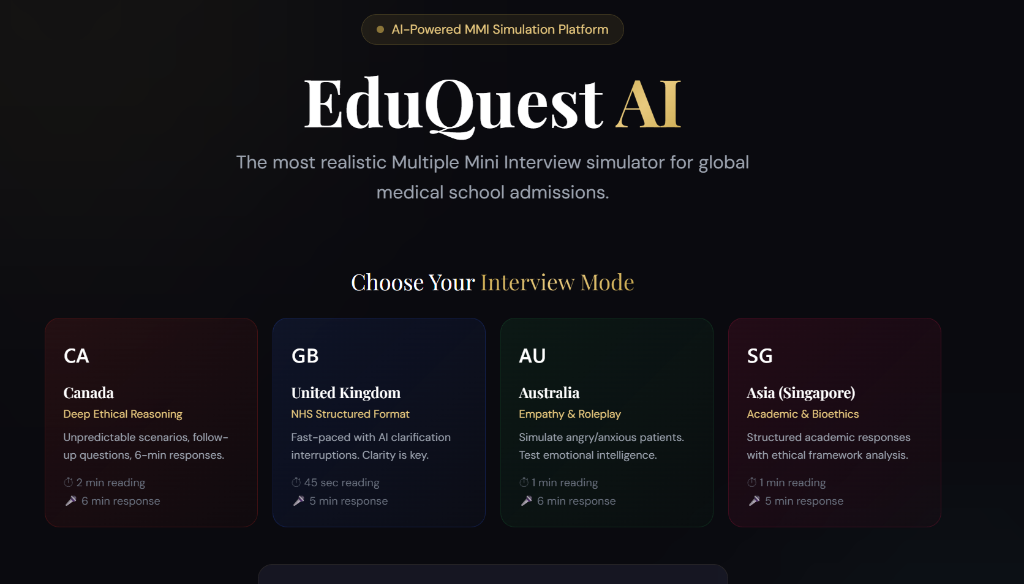
6. How EduQuest Empowers Your MMI Preparation Journey
At EduQuest, discovering **how to prepare for an MMI interview** is backed by our full global medical admissions ecosystem:
- 1. 150+ Interactive AI MMI Stations: Practice realistic ethical scenarios, calculations, and actor role-plays with instant domain scoring.
- 2. 1-on-1 Mock Panels with NHS Doctors: Receive individualized feedback from former medical school interviewers and admissions readers.
- 3. End-to-End Medical Strategy: Integrated support covering UCAT Preparation, super-curricular research papers, and Global Study Abroad Placement.
7. Frequently Asked Questions (FAQ) About MMI Interview Preparation
How many weeks should I spend preparing for an MMI interview?
Most successful candidates spend 4 to 6 weeks preparing. This allows sufficient time to master ethical frameworks, build communication fluency, and complete multiple timed mock circuits.
Can I prepare for an MMI interview alone?
While you can study ethics and NHS values independently, role-play practice and communication timing require external feedback from mentors, peers, or the EduQuest AI MMI Simulator.
How do I handle an MMI station prompt I know nothing about?
Do not panic. MMIs test structured reasoning and ethics rather than niche medical trivia. State what you know, acknowledge missing information, and apply the 4 Pillars of Medical Ethics logically.
Is virtual MMI preparation different from in-person preparation?
For virtual MMIs, focus on camera eye contact, clear microphone audio, professional lighting, and minimizing screen distractions, alongside standard ethical frameworks.
Is the EduQuest AI MMI Simulator free for students?
Yes! EduQuest offers free access to our AI MMI Simulator with high-yield ethical scenarios and interactive scoring.
Download the 2026 MMI Preparation Master Blueprint
Get instant access to EduQuest’s 32-page whitepaper featuring 50 high-yield ethical scenarios, model role-play transcripts, SPIKES frameworks, and scoring rubrics.
Prepare with Former Medical Admissions Interviewers Today
Join hundreds of successful medical students who secured offers at Oxford, Cambridge, Imperial, Monash, and KCL with EduQuest AI. Book your mock circuit now.