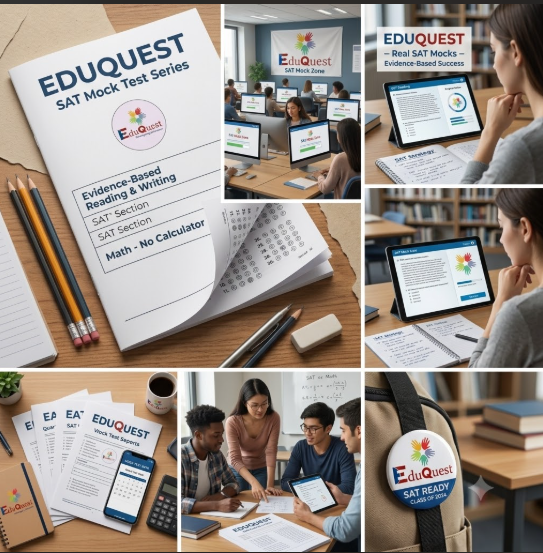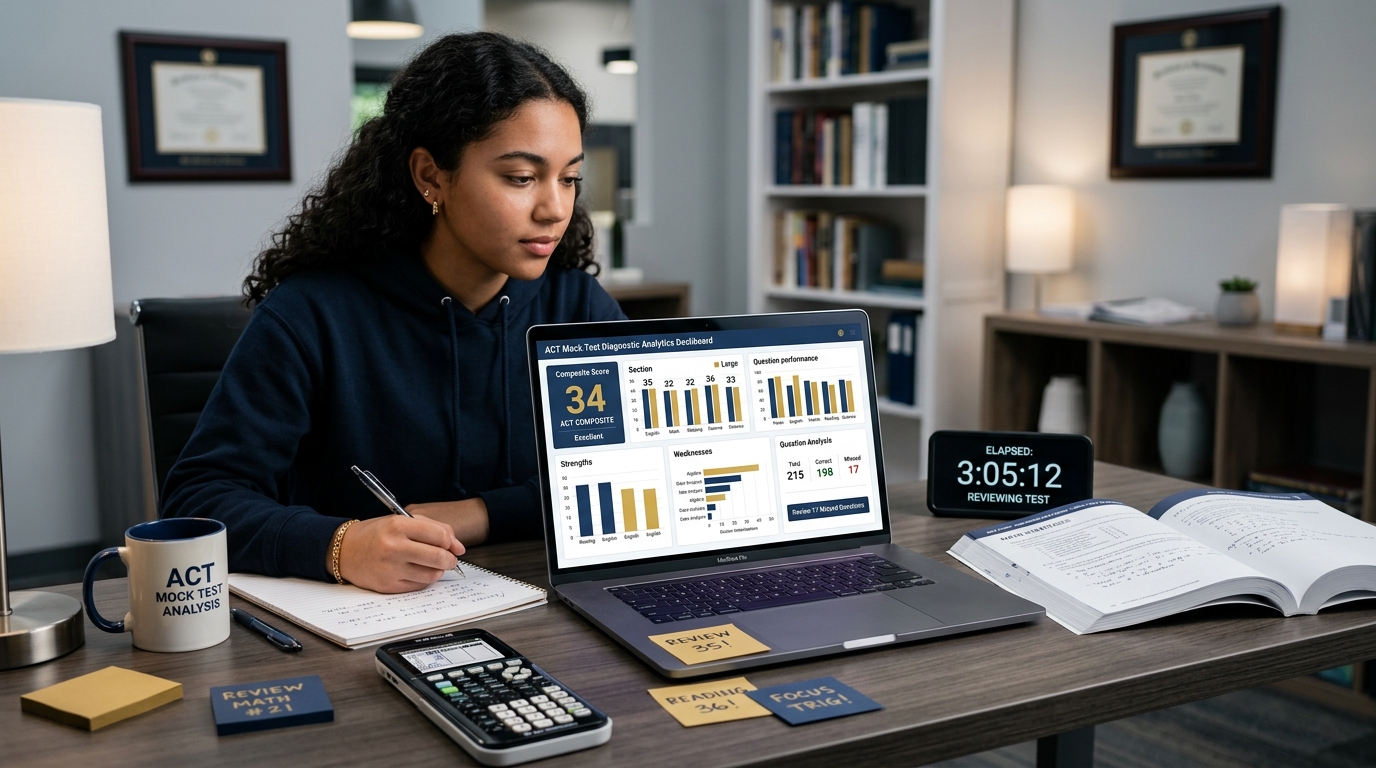

Every standardized test prep season, thousands of ambitious students fall into the "Mock Test Trap." They sit for full-length examinations every weekend, watch their scores fluctuate by ±20 points without meaningful progress, and wonder why 100 hours of testing haven’t propelled them into the 99th percentile. The reality of high-stakes testing—whether for the Digital SAT, ACT, UCAT, TMUA, or ESAT—is that taking mock tests is only 30% of the equation. The remaining 70% of score gains comes from how you extract diagnostic intelligence from those tests.
Mastering mock test preparation is about transforming raw test data into targeted, actionable score improvements. By implementing systematic error categorization, maintaining a dynamic mistake log, mastering the two-pass pacing strategy, and simulating authentic test-center conditions, you can turn every mock test into a 30-to-50 point score boost. Powered by EduQuest Mock Hub and EduPath, this comprehensive guide delivers the definitive step-by-step masterclass on how to use mock tests to achieve your target dream score.

Accelerate Your Test Scores with EduQuest AI
EduQuest Adaptive Mock Hub
Official Exam Simulations
Simulate full-length Digital SAT, UCAT, and ACT exams with official adaptive interfaces, strict timers, and diagnostic scoring.
Launch Free Mock ExamTargeted Skill Remediation
Sub-Topic Question Banks
Master weak concepts with thousands of categorized practice questions with instant step-by-step video solutions.
Explore Practice DrillsPersonalized Test Roadmap
EduQuest EduPath Platform
Create an integrated study calendar balancing weekly practice drills with scheduled milestone mock tests.
Launch EduPath Roadmap1. The 5-Step System to Maximize Every Mock Test
Top 1% test-takers follow a disciplined 5-step operational protocol for every single mock examination:
Fast-Track Your College & Career Strategy
Get immediate, personalized AI insights tailored to your grade, strengths, and dream universities — 100% free with instant reports.
Know Your Personality Type for Free
Take our 18-question AI psychometric test to uncover your cognitive archetype, hidden learning superpowers, and ideal university courses.
Personalized Career & University EduPath
Build a step-by-step Grade 8–12 admissions blueprint with AI-matched target universities, exam schedules, and extracurricular profiles.

Pre-Test Environmental Calibration
Take your mock test at a clean desk at the exact start time of your official exam (e.g., Saturday at 8:00 AM). Turn off your phone, close unrelated browser tabs, and ensure your laptop charger is plugged in.
Strict Real-Time Exam Execution
Never pause the timer, consult notes, or take unallocated breaks. Treat every mock as if it were the official test day to build authentic psychological endurance.
Sensory Decompression Buffer (1 Hour)
After finishing a 2-to-3 hour exam, do not immediately jump into error analysis. Take a 1-hour physical break to clear cognitive fatigue before reviewing your mistakes.
4-Tier Forensic Error Categorization
Categorize every incorrect or guessed question into one of four root causes: (A) Conceptual Gap, (B) Timing Rush, (C) Misread Question Stem, or (D) Careless Calculation Slip.
Surgical Remediation & The 5-Variation Rule
For every concept missed, immediately solve 5 similar practice problems to cement the correct methodology into your long-term memory.
2. The Art of the Dynamic Mistake Log (Error Log Masterclass)
A spreadsheet or notebook Mistake Log is the single most valuable asset in your standardized test preparation. For every question you get wrong or flag during a mock test, record the following seven data points:
| Mistake Log Column | What to Record | Example Entry (Digital SAT Math) | Why It Matters |
|---|---|---|---|
| 1. Test & Section | Mock test number and exact section | Mock Test #3, Math Module 2 | Tracks improvement across specific modules |
| 2. Question # & Topic | Number and sub-topic tested | Q18: System of Linear Equations with Infinitely Many Solutions | Identifies recurring thematic blind spots |
| 3. Error Tier | Root cause classification | Tier A: Conceptual Gap (did not know condition for infinite solutions) | Distinguishes knowledge gaps from pacing slips |
| 4. What I Did (Flawed Logic) | Your incorrect thought process | Tried to substitute random coordinates instead of matching coefficients | Exposes flawed subconscious heuristics |
| 5. What I Should Have Done | The 30-second optimal solution | Set a1/a2 = b1/b2 = c1/c2 and solve for the constant k immediately | Embeds the fastest shortcut into memory |
| 6. Key Rule / Takeaway | 1-sentence golden rule | For infinite solutions, both equations must be identical scalar multiples | Creates high-yield quick-revision flashcards |
| 7. Follow-Up Drill Date | Scheduled re-testing date | Re-test on Tuesday with 5 similar College Board question bank items | Guarantees concept retention through spaced repetition |
3. Time Management: Mastering the "Two-Pass Strategy"
Pacing anxiety is the #1 reason capable students lose 50–100 points on standardized tests. Top scorers use the **Two-Pass Pacing Strategy** during mock tests to guarantee they never leave easy points on the table:

Pass 1 (0–70% of Section Time): The Green Light Sprint
Answer all easy and medium questions immediately. If a question feels confusing after 20 seconds, flag it, pick an educated placeholder guess, and move on instantly.
Pass 2 (70–95% of Section Time): The Flagged Attack
Return to flagged questions with the confidence of knowing you have already secured all easy points. Apply process of elimination and alternative shortcuts (like Desmos graphing).
Final Buffer (95–100% of Section Time): Quality Assurance
Use the final 2–3 minutes to ensure no questions are left blank (since most standardized tests have zero negative marking) and verify student-produced response grid-ins.
4. The 6-Week Mock Test Score Acceleration Roadmap
Follow this 6-week progression timeline to transform your baseline score into a 99th percentile result:

Diagnostic Baseline & Mistake Log Setup
Identify Knowledge Gaps & Baseline Benchmark
- Take a full-length, untimed diagnostic mock test to map core weaknesses.
- Set up your dynamic Mistake Log spreadsheet and record every error.
Targeted Remediation & Modular Sprints
Eliminate Tier A Conceptual Gaps
- Focus 80% of study time on learning foundational rules and formulas.
- Complete 25-minute timed modular drills on identified weak topics.
Adaptive Full-Length Mock & Pacing Calibration
Master the Two-Pass Strategy Under Real Timers
- Take 1 full-length adaptive mock test under strict exam conditions.
- Spend 4 hours conducting 4-tier error analysis and updating your Mistake Log.
Double Mock Weekend (Stamina Simulation)
Simulate Consecutive Exam Days
- Take 2 full-length proctored mocks over the weekend at official exam start times.
- Review cumulative Mistake Log to identify stubborn recurring errors.
Taper Phase & Final Confidence Calibration
Lock In Timing Rhythms & Optimize Sleep
- Take one final confidence-boosting mock test 5 days before test day.
- Spend the final 48 hours reviewing your Mistake Log, resting, and hydrating.
5. 5 Golden Rules for High-Impact Mock Test Preparation
Schedule Mock Tests to Mirror Your Real Exam Clock
If your official exam starts at 8:00 AM on Saturday, schedule your weekly mocks at 8:00 AM on Saturdays to sync your circadian cognitive peaks.
Spend Twice as Long Reviewing as Testing (The 1:2 Rule)
A 2-hour mock test requires at least 4 hours of deep, forensic error analysis to extract maximum learning value.
Never Look at Explanations Before Retrying the Problem Blind
When reviewing mistakes, try solving the question again untimed. Reading an answer explanation gives the false illusion of mastery.
Master Official Digital Software Tools
Familiarize yourself with built-in digital calculators (like Desmos), highlighting tools, answer eliminators, and mark-for-review features.
Rehearse a Fixed Pre-Exam Morning Routine
Wake up at the same hour, eat the exact breakfast, and do the same 10-minute light warm-up problem set before every mock to build habitual confidence.

6. Common Mistakes That Sabotage Mock Test Score Gains
- Taking Mocks in Split Fragments or with Multitasking: Splitting a 3-hour exam across three separate days builds zero mental stamina and produces artificially inflated scores.
- Obsessing Over the Numerical Score Instead of Error Trends: A temporary score drop due to harder test scaling is normal; focus on whether your conceptual mistake rate is steadily dropping.
- Neglecting Nutrition, Sleep, and Physical State: Taking a mock test on 4 hours of sleep or an empty stomach tests your fatigue, not your academic competence.
- Taking Daily Mocks in the Final 7 Days (Burnout): Taking back-to-back mocks in the final week exhausts your brain, guaranteeing cognitive sluggishness on test day.
7. How EduQuest Powers Your Mock Test Performance
At EduQuest, our test prep coaching ecosystem provides an end-to-end framework to maximize your standardized testing scores:
- 1. Full-Scale Adaptive Mock Testing Hub: Access realistic full-length simulations for Digital SAT, ACT, UCAT, TMUA, and ESAT.
- 2. AI-Powered Heat-Map Diagnostics: Receive instant reports breaking down accuracy by sub-topic, question difficulty, and time spent per problem.
- 3. 1-on-1 Strategy Sessions with 99th Percentile Mentors: Work directly with expert coaches to dissect error logs and master high-speed testing shortcuts.
8. Frequently Asked Questions (FAQ) About Mock Test Preparation
How many mock tests should I take to see real score improvement?
Most successful students take between 8 and 12 full-length mock tests over a 2-to-3 month period, with rigorous 4-step error analysis after every single exam.
How can I increase my test score by 100 to 200 points?
Maintain a meticulous Mistake Log, eliminate recurring conceptual gaps through targeted drills, master the two-pass pacing strategy, and learn digital shortcuts like Desmos graphing.
Why does my score plateau despite taking multiple mock tests?
A score plateau occurs when you take tests without fixing root-cause weaknesses. If you repeat the same conceptual or pacing mistakes on every test, your score cannot improve until you pause and remediate those specific sub-topics.
Should I take a mock test the day before the real exam?
No! Never take a full-length mock test within 48 hours of your official exam. Use the final two days for light mistake log review, mental relaxation, and sleep optimization.
Are EduQuest full-length mock tests free for students?
Yes! EduQuest offers free full-length diagnostic mock tests with comprehensive score reports across the Digital SAT, UCAT, TMUA, and ACT.
Download the 2026 Ultimate Mock Test Score Acceleration Playbook
Get instant access to EduQuest’s 32-page whitepaper featuring dynamic Mistake Log templates, two-pass pacing blueprints, 6-week study schedules, and top 1% score-building strategies.
Unlock Your 99th Percentile Test Score Today
Join 10,000+ ambitious students who have achieved top scores on the SAT, UCAT, TMUA, and ACT with EduQuest AI. Take your free full-length mock exam now.