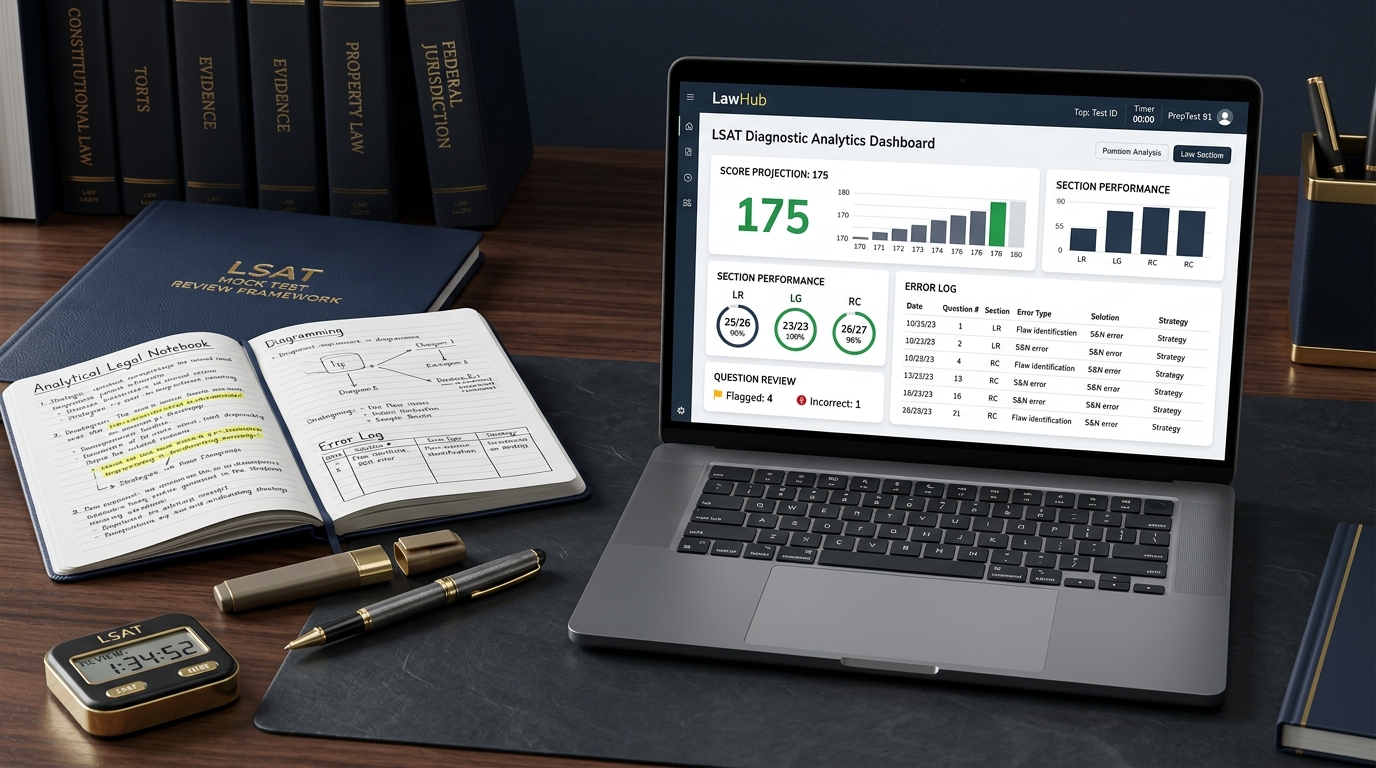


LSAT Self-Study Command Center
Self-Study Feasibility
65%+ of 170+ Scorers
Independent surveys of matriculating students at top 14 law schools reveal that over 65% achieved their peak score via structured self-study.
Explore Self-Study DataResource Budget
Under $350 Total
All you need: official LSAC LawHub Advantage ($115/yr), 2 foundational prep books ($80), and structured digital analytics ($150).
View Curated ToolkitFree Download
Study Plan PDF
Download the complete printable 12-week and 24-week study syllabi, PrepTest rotation tracker, and Blind Review log sheet.
Every year, thousands of prospective law school applicants spend $1,500 to $2,500 on generic commercial test-prep courses, only to find their score stuck in the mid-150s. They attend crowded Zoom lectures where an instructor walks through basic question types at the pace of the slowest student in the room, complete mandatory homework assignments that prioritize busywork over diagnostic precision, and finish the course wondering why their timed practice tests refuse to budge. Meanwhile, every cycle, an elite cohort of applicants prepares from their own desk with a curated stack of books, official LSAC practice tests, an Excel error log, and a relentless commitment to analytical review—and walks away with a 170, 173, or 176.
Here is the open secret of legal education: **the LSAT is fundamentally designed to reward self-directed intellectual discipline**. The skills tested on the LSAT—rigorous critical reading, precise logical deduction, independent error diagnosis, and sustained mental stamina under pressure—are the exact same skills required to survive 1L year at Harvard, Stanford, or Chicago. You cannot outsource critical thinking to a live lecture. You build it through solitary, deliberate, cognitive repetition. This comprehensive master guide gives you the exact blueprint to self-study for the modern Digital LSAT from scratch and break into the 98th percentile without spending thousands on commercial coaching.
Download the Complete LSAT Self-Study Curriculum & Weekly Schedule Handbook (PDF)
Get the printable master handbook: complete week-by-week syllabi for 3-Month, 6-Month, and 1-Year timelines, the official LawHub PrepTest rotation schedule, and the complete 4-step Blind Review error journal template.
1. The Essential Self-Study Toolkit: Books & Software
Do not buy 15 different LSAT prep books. Information overload and conflicting nomenclature across different prep companies will paralyze your progress. You only need a lean, high-octane toolkit of verified, gold-standard resources.
Fast-Track Your College & Career Strategy
Get immediate, personalized AI insights tailored to your grade, strengths, and dream universities — 100% free with instant reports.
Know Your Personality Type for Free
Take our 18-question AI psychometric test to uncover your cognitive archetype, hidden learning superpowers, and ideal university courses.
Personalized Career & University EduPath
Build a step-by-step Grade 8–12 admissions blueprint with AI-matched target universities, exam schedules, and extracurricular profiles.
| Resource Name | Provider / Author | Cost (Approx.) | Strategic Role in Your Prep | Verdict & Recommendation |
|---|---|---|---|---|
| 1. LSAC LawHub Advantage | Law School Admission Council (LSAC) | $115 / year | MANDATORY. Contains 58+ full, authentic, previously administered official LSAT PrepTests in the exact digital interface you will use on test day. | Essential. Do not study for the LSAT without it. Every mock test must be taken on LawHub to build authentic digital interface familiarity. |
| 2. The Loophole in LSAT Logical Reasoning | Ellen Cassidy | $38 (Paperback) | The single best book for Logical Reasoning fundamentals. Teaches the Translation Drill, Basic-C-L-I-R method, and how to spot argument flaws intuitively. | Highest Recommendation. Read this cover-to-cover in Month 1 before touching full timed practice sections. |
| 3. The PowerScore LSAT Bibles (LR & RC) | David M. Killoran | ~$70 total | Comprehensive, encyclopedic textbooks covering formal conditional logic, question-type classifications, and structural passage diagrams. | Excellent reference manual. Particularly invaluable for formal logic diagramming and Must Be True question mastery. |
| 4. The LSAT Trainer | Mike Kim | $42 (Paperback) | Superb macro-level curriculum. Excellent for developing active reading habits, structural mindset, and study planning. | Great foundational text for beginners building a high-level cognitive framework. |
| 5. 7Sage LSAT Core Subscription | 7Sage (JY Ping) | $69 / month | Digital video explanations for every single official LSAC question, advanced analytics, and automatic Blind Review tracking. | Optional but highly recommended for visual learners. Their question analytics pinpoint your exact blind spots by question type and difficulty level. |
2. The 3 Master Study Schedules: 3-Month, 6-Month & 1-Year
Your study timeline depends strictly on two variables: your **diagnostic baseline score** and your **available weekly study hours**. Attempting a 3-month intensive schedule while working 60 hours a week in investment banking or consulting will lead to severe cognitive burnout and score regression. Match your timeline to your reality.
| Schedule Type | Total Duration | Weekly Commitment | Ideal Student Profile | Expected Score Improvement |
|---|---|---|---|---|
| The 3-Month Intensive | 12 Weeks (300 hours total) | 25–30 hours/week (4–5 hours/day, 6 days/week) | Full-time students on summer break, graduates taking a dedicated study sabbatical, or LSAT retakers seeking a final 4-to-6 point boost. | +10 to +16 Points from cold diagnostic. |
| The 6-Month Balanced (GOLD STANDARD) | 24 Weeks (360–400 hours total) | 15–18 hours/week (2 hours on weekdays + 4 hours on Saturday/Sunday) | College seniors, working professionals with standard 40-hour workweeks, and students aiming for a 170+ score from a 150 baseline. | +15 to +24 Points from cold diagnostic. |
| The 1-Year Working Professional | 48 Weeks (450 hours total) | 8–10 hours/week (1 hour every morning + 3 hours on weekend) | Professionals with demanding careers, parents, non-native English speakers building verbal fluency, and college sophomores/juniors. | +18 to +28 Points from cold diagnostic. |
3. The 6-Month Master Curriculum: Week-by-Week Syllabus
Because the 6-month timeline represents the optimal balance between theoretical mastery, untimed drilling, and full-length timed endurance, here is the complete week-by-week curriculum:
Phase 1: Cold Diagnostic & Mental Model (Weeks 1–4)
Week 1: Take an official cold diagnostic test under strict timing (use LawHub PrepTest 140). Do not study beforehand; you must know your natural baseline. Weeks 2–4: Read 'The Loophole in LSAT LR' chapters 1–7. Master the Basic Translation Drill: read an argument, cover it up, and translate it into plain conversational English from memory. Practice bracket-mapping conclusions, premises, and intermediate conclusions. Zero timed practice tests during Phase 1.
Phase 2: Question Type Mastery & Untimed Drilling (Weeks 5–10)
Dedicate each week to specific question families: Week 5 = Flaw in the Reasoning (all 12 fallacies). Week 6 = Weaken & Strengthen. Week 7 = Necessary Assumption & The Negation Test. Week 8 = Sufficient Assumption & Formal Conditional Logic. Weeks 9–10 = Reading Comprehension structural mapping and comparative dual passages. DRILL UNTIMED. Your goal during this phase is 90%+ raw accuracy without a stopwatch. If you cannot get questions right untimed, timing will only solidify your mistakes.
Phase 3: The Introduction of the Timer & Section Sprints (Weeks 11–16)
Transition from untimed drilling to single timed 35-minute sections. Implement strict pacing discipline: Questions 1–10 in 10 minutes, Questions 11–18 in 12 minutes, and Questions 19–25 in 13 minutes. Take one full 4-section practice test every other weekend (PrepTests 141–146). Execute full Blind Review on every test. Target milestone: consistently scoring 162–165 on timed sections.
Phase 4: Full-Length Exam Endurance & Experimental Simulation (Weeks 17–21)
Take one full 4-section timed test every single Saturday morning at 9:00 AM sharp, replicating official test-day conditions. Include an un-scored 4th section to build mental endurance against cognitive fatigue. Spend Sunday (3–4 hours) executing exhaustive Blind Review. Drill your weakest question types on Tuesday and Thursday evenings using LawHub PrepTests 147–154. Target milestone: scoring 168–172 on three consecutive tests.
Phase 5: Peak Taper, Error Journal Review & Test Day Protocol (Weeks 22–24)
Weeks 22–23: Take your final two practice tests (PrepTests 156 and 157). Review your Error Log daily. Stop learning new theories; focus entirely on execution consistency and emotional equanimity. Week 24 (Test Week): Take zero full tests. Complete 10 light warm-up LR questions on Monday and Wednesday. Thursday: Review your high-level strategy checklist. Friday: Rest completely. Saturday: Test day peak performance.
4. The Blind Review Method: The #1 Score Multiplier
If you take practice tests without Blind Review, you are not studying—you are merely measuring your current score. **Blind Review (BR)** is the pedagogical engine that transforms an average 155 scorer into a 172 elite performer. Developed by 7Sage and adopted by every top tutor, Blind Review forces you to differentiate between **timing issues** and **conceptual gaps**.
| Step Number | Phase Name | How to Execute Step | What This Step Accomplishes |
|---|---|---|---|
| Step 1 | Timed Execution | Take a 35-minute section under strict time limits. Flag every single question where you are less than 100% confident in your choice. When the timer sounds, STOP immediately. Do NOT look at the answer key! | Produces your 'Timed Score', which reflects your current operational level under adrenaline and time pressure. |
| Step 2 | Untimed Blind Review | Open a fresh, blank copy of the section (or enter Blind Review mode on your software). Work through every flagged question with ZERO time limits. Spend 10 minutes on a single question if necessary. Prove to yourself mathematically why four choices are 100% wrong and one choice is 100% right. | Identifies your 'Untimed Potential Score'. If your Untimed Score is 172 but your Timed Score is 161, your issue is pure pacing and confidence, not reasoning ability. |
| Step 3 | The Reconciliation | Now check the official answer key. Grade both versions. Record: Did you get it right timed but wrong untimed? Did you get it wrong timed but right untimed? Did you get it wrong both times? | Isolates your cognitive vulnerabilities. Questions missed in both timed and untimed review represent profound conceptual misunderstandings that require immediate textbook review. |
| Step 4 | The Error Log Entry | For every question missed in either round, write a 3-part entry in your Error Log: (1) What was the argument's core assumption/flaw?, (2) Why was the wrong choice appealing?, (3) What exact word in the credited choice proves it correct? | Builds pattern recognition. When you review your error log weekly, you will notice you consistently fall for the exact same trap phrasing across dozens of tests. |
5. Official LawHub PrepTest Allocation Matrix
LSAC offers over 58 official practice tests in LawHub (renumbered as PrepTests 101 through 158 following the removal of Logic Games). Burning through the most recent tests early in your prep is a catastrophic strategic blunder. You must tier your tests based on purpose.
| Tier / PrepTest Range | Recommended Use in Prep | Format & Realism Notes | Strategic Allocation Guideline |
|---|---|---|---|
| Tier 1: PrepTests 101 to 125 | Untimed Drill Sets & Foundational Practice | Administered in the 1990s and early 2000s. Arguments are slightly shorter and more formal; reading comprehension passages are less comparative. | Use strictly for untimed topical drills in Month 1 and Month 2. Tear these tests apart for individual question-type practice. |
| Tier 2: PrepTests 126 to 140 | Timed Section Practice & Mid-Prep Mocks | Administered between 2005 and 2017. Modern phrasing begins; subtle trap answers emerge in Logical Reasoning. | Use for timed individual section sprints (Weeks 11–16). Use PT 140 as your official mid-point diagnostic benchmark. |
| Tier 3: PrepTests 141 to 154 | Full-Length Weekly Simulation Mocks | Administered between 2018 and 2022. Feature the modern Digital LSAT interface, dense Reading Comprehension, and sophisticated flaw patterns. | Save exclusively for full 4-section practice tests in Weeks 17–22. Never take these tests untimed or piecemeal. |
| Tier 4: PrepTests 155 to 158 | Final Dress Rehearsal Benchmarks | The most recently released modern tests. 100% reflective of the exact difficulty, cognitive tone, and curve of test day. | Administer during your final 3 weeks of prep as your ultimate predictive benchmarks. Protect these tests like gold. |
6. Score Plateau Breakthrough Protocols: Breaking 155, 162 & 168
Virtually every LSAT student encounters a score plateau where their score remains stubbornly flat for 3 to 5 consecutive practice tests. Here is how to diagnose and demolish each specific plateau:
Stuck at 150–155: The Structural Literacy Barrier
Diagnosis: You are still reading arguments as general English prose rather than formal structural logic. You are missing easy conclusion-identification questions and confusing premises with background context. Fix: Stop taking full timed tests immediately. Spend 10 consecutive days doing Basic Translation Drills and bracket-mapping conclusions on 100 consecutive questions. Master the 12 Classic Flaws until you can name the flaw before looking at the choices.
Stuck at 160–162: The Necessary Assumption & Pacing Barrier
Diagnosis: You understand the arguments, but you fall for Level 4 trap answers on Questions 16–22, and you run out of time on Passage 4 in Reading Comprehension. Fix: (1) Drill Necessary Assumptions using the Negation Test until your accuracy reaches 90%+, (2) Implement question triage—skipping complex Parallel Reasoning questions and banking time, and (3) Use Passage Mapping in RC to cap your initial reading at 3.5 minutes.
Stuck at 167–169: The Level 5 Trap & Fatigue Barrier
Diagnosis: You have mastered the theory. You miss only 1 to 2 questions per section, but careless errors on Section 3 or Section 4 cost you a 173+. Fix: (1) Simulate an un-scored 4th section on every single practice test to bulletproof mental stamina, (2) Keep a 'Nuance Journal' recording the single word in credited answers that made them objectively correct, and (3) Focus on test-day mental composure, sleep hygiene, and stress regulation.
7. Test Week Protocol & Official Test-Day Execution
You can prepare flawlessly for six months and lose 4 points on test day due to poor logistics, proctoring friction, or adrenaline mismanagement. The Digital LSAT is administered either remotely via Prometric proctoring or at an in-person Prometric testing center. Executing this step-by-step test week protocol guarantees peak performance:
| Test Week Timeline | Critical Action Required | Physical & Mental Protocol | Pitfall to Avoid |
|---|---|---|---|
| Monday to Wednesday (T-5 to T-3 Days) | Complete one 20-question mixed warm-up set daily. Review your Error Log for 30 minutes. Verify your testing environment (clear desk, external webcam, quiet room). | Lock in your sleep cycle: go to bed at 10:00 PM and wake up at 6:30 AM to match your scheduled exam check-in time. | Do NOT take full-length practice tests during test week. Taking a test 3 days before the exam only produces mental fatigue without adding new knowledge. |
| Thursday (T-2 Days) | Final system check on Prometric software. Test your microphone, webcam, and internet bandwidth (ensure 20+ Mbps wired connection if testing remotely). | Assemble your official test-day materials: government-issued photo ID, five blank sheets of scratch paper, standard wooden pencils or pens, and clear water bottle. | Do not make last-minute hardware changes. Use the exact computer and mouse you practiced on for months. |
| Friday (T-1 Day: Full Rest) | Zero LSAT questions. Complete rest. Go for a long outdoor walk, hydrate with electrolyte water, and watch an engaging movie. | Pack your testing room (or bag for the center). Prepare your high-protein, low-glycemic lunch and snacks for the 10-minute intermission. | Avoid catastrophic social media threads or law admissions forums (Reddit r/LSAT) where anxious test-takers spread panic. |
| Saturday (Test Day: Execution) | Wake up 2.5 hours prior to check-in. Eat a balanced breakfast (eggs, avocado, complex oats). Complete the 10-minute 'Mental Calibration Routine'. | Solve 2 easy Logical Reasoning questions and 1 reading comprehension paragraph from a test you already mastered (untimed). This warms up your visual parsing. | Do NOT start the official exam cold! Athletes never sprint without stretching; your brain should not read its first LSAT sentence under official scoring. |
8. Frequently Asked Questions (FAQs)
How long should I self-study before taking the official LSAT?
The average student requires approximately 250 to 350 hours of high-intensity, structured self-study to reach their score ceiling. Distributed across 15 to 18 hours per week, this equates to roughly 4 to 6 months. Rushing the test in 6 to 8 weeks while working full-time is the #1 cause of disappointing scores and expensive retakes.
Is LawHub Advantage really necessary for self-study?
Yes, 100% non-negotiable. LawHub Advantage ($115/year) gives you access to official, authentic LSAC exams in the exact digital testing interface (font, spacing, highlighter, timer, line-tracking) used on test day. Preparing from paper books or unofficial third-party questions creates visual and cognitive disconnects that damage performance.
How many full practice tests should I take before test day?
Quality vastly outperforms quantity. Taking 20 to 28 full practice tests with comprehensive Blind Review and detailed Error Logging produces vastly superior outcomes compared to taking 60 practice tests mindlessly without review. Most 170+ scorers complete between 22 and 30 full tests during their prep.
Can I self-study if English is my second language?
Yes. Many of our highest-scoring international candidates are non-native English speakers. However, you should opt for a 9- to 12-month study timeline rather than 3 months. Dedicate the first 3 months to reading high-level publications (The Economist, Harvard Law Review, Nature) for 45 minutes daily to eliminate cognitive friction when reading dense academic prose.
When should I register for the official test date?
Do not register for a test date based on an arbitrary calendar hope! Register ONLY when your timed practice test scores over your last 3 consecutive exams are consistently at or above your target law school median. The LSAT allows a maximum of 3 attempts in a single testing year and 5 in five years; never burn an official attempt until you are scoring your target in practice.
Maximize Your Self-Study with EduQuest Diagnostics
Take a proctored diagnostic test, identify your exact cognitive blind spots, and receive a customized 6-month curriculum tailored to your target law schools by 175+ scorers.
How EduQuest Helps You in The Ultimate LSAT Self-Study Blueprint: 3-Month, 6-Month & 1-Year Schedules, Curated Books & Test Day Protocol at Our Gurugram Centre (F-45, South City II)
Mastering LSAT and securing competitive global university admissions demands structured instruction, diagnostic error post-mortems, and proven testing frameworks. At EduQuest Gurugram, we deliver bespoke test preparation and holistic admissions consulting designed specifically for Indian and NRI high school students.
🏫 Offline Classroom Coaching
Study at our premier learning centre: F-45, First Floor, South City II, Sector 50, Gurugram, Haryana 122018. Small cohorts (8–10 students) ensure interactive whiteboard problem breakdowns, physical testing terminals, and immediate face-to-face mentor doubt resolution.
💻 Live Online Interactive Classes
Join high-definition two-way interactive classes via EduQuest LMS with live digital whiteboards, screen-shares, session video recordings for revision, and 1-on-1 virtual office hours for students across India, Dubai, Singapore, and the US.
🔄 Seamless Flexible Hybrid Mode
Transition effortlessly between classroom sessions at our Gurugram F-45 centre and live virtual classes whenever school exams, projects, or travel require flexibility, ensuring zero interruption to your preparation.
Batch timings are scheduled collaboratively around high school hours (CBSE, ICSE, IB, and Cambridge), featuring personalized 1-on-1 mentorship and small batches (8–10 students). A free diagnostic demo class is scheduled prior to enrollment. Weekday batches run in the afternoon and evening after school hours (Mon–Thu), alongside weekend intensive drill bootcamps (Sat–Sun). We invite parents and students for a complimentary 1-on-1 diagnostic evaluation before enrollment.
F-45, First Floor, South City II, Sector 50, Gurugram, Haryana 122018