Scoring in the top decile (515+) on the MCAT requires far more than passive textbook review. Because the MCAT demands 6 hours and 15 minutes of intensive cognitive problem-solving, full-length mock exams are the linchpin of an effective prep strategy.

1. Why Full-Length Mock Exams Are Mandatory
Taking full-length mock tests solves three critical prep bottlenecks:
Building 7.5-Hour Physical & Cognitive Stamina
Mental fatigue causes most drop-offs during Section 3 (Bio) and Section 4 (Psych). Taking 6+ full mocks conditions your brain for peak focus.
Pacing & Time Budgeting
Simulations teach you when to flag difficult passage questions and avoid spending over 2 minutes on a single item.
Identifying Real Content Gaps
Mocks reveal whether errors stem from content ignorance, misreading passage data, or careless arithmetic errors.
2. The 3-Phase MCAT Mock Test Schedule
Fast-Track Your College & Career Strategy
Get immediate, personalized AI insights tailored to your grade, strengths, and dream universities — 100% free with instant reports.
Know Your Personality Type for Free
Take our 18-question AI psychometric test to uncover your cognitive archetype, hidden learning superpowers, and ideal university courses.
Personalized Career & University EduPath
Build a step-by-step Grade 8–12 admissions blueprint with AI-matched target universities, exam schedules, and extracurricular profiles.
Structured mock exam progression over 3 to 6 months ensures steady score improvement:
Diagnostic Baseline Attempt
First Full-Length Mock
- Take a full diagnostic mock prior to content review.
- Identify subtest baseline scores and time bottlenecks.
Bi-Weekly Sectional & Full Mocks
Mid-Prep Reinforcement
- Take 1 full mock every 2 weeks.
- Maintain a strict error log categorizing every wrong choice.
Weekly Official AAMC Practice Tests
Final 4–6 Weeks
- Take official AAMC practice exams under exact Pearson VUE rules.
- Simulate test center wake-up time, lunch, and break intervals.
3. Error Log Analysis Framework
Every wrong answer on a mock exam must be categorized into one of four error buckets:
| Error Bucket | Description | Corrective Action |
|---|---|---|
| Content Knowledge Gap | Did not know the fundamental scientific concept or equation. | Review high-yield flashcards & textbook chapter. |
| Passage Misinterpretation | Misread graph data, key variable, or author's tone. | Practice active passage highlighting & summary notes. |
| Pacing Rush Error | Ran out of time and guessed hastily without reading. | Drill timed sectional sets to improve speed. |
| Careless Execution | Selected wrong option despite calculating correctly. | Slow down choice verification on final screen. |
4. Test Day Conditions Checklist
When taking mock exams at home or via the EduQuest Mock Hub (`/mock_hub/`), enforce these Pearson VUE testing rules:
- No Phone or Extra Tabs Close all external browsers, phone notifications, and study notes during mock attempts.
- Strict Break Timing Enforce exact break limits (10 mins for Break 1 & 3; 30 mins for Lunch Break 2).
- No Personal Calculator Use only scratch paper and mental math to mirror Pearson VUE conditions.
5. EduQuest Practice Hub & MCAT Coaching
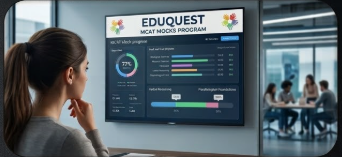
EduQuest provides realistic computer-based MCAT simulations with automated score analytics at our Mock Hub (`/mock_hub/`) alongside 1-on-1 mentor reviews.
6. Frequently Asked Questions (FAQ)
How many full-length mock exams should I take before the MCAT?
Most successful 515+ scoring candidates complete between 8 and 12 full-length practice exams.
Are AAMC official practice tests predictive of real MCAT scores?
Yes, official AAMC practice exams are highly predictive of actual test performance within ±2 to 3 points.
What should I do in the final 48 hours before test day?
Stop heavy testing. Review lightweight flashcards, double-check Pearson VUE center directions, and get full rest.
Simulate the MCAT at EduQuest Mock Hub
Take realistic full-length timed mocks and track your score progress.
Download the Official The Complete MCAT Guide & Pre-Med Preparation Roadmap
Get immediate access to EduQuest’s 8-page comprehensive candidate toolkit with diagnostic benchmarks, step-by-step frameworks, error telemetry logs, and structured preparation timelines.