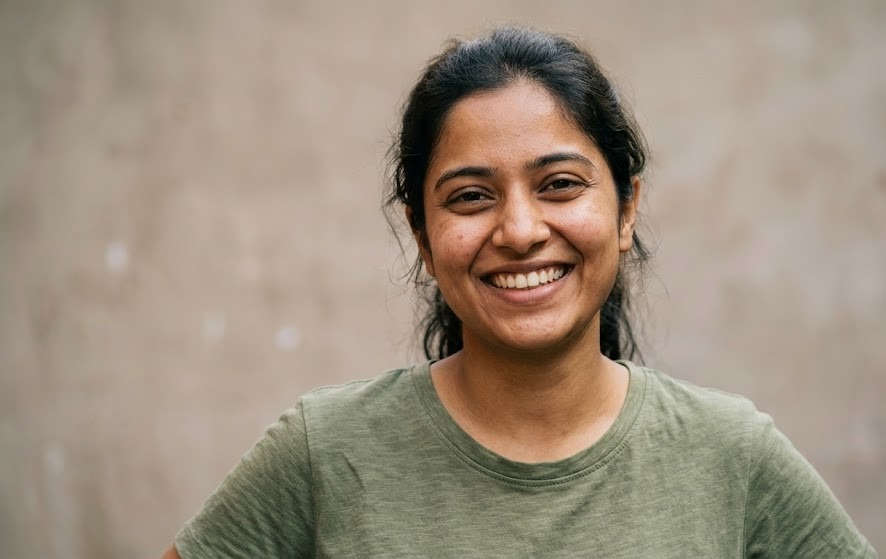
First-Gen Student Profile Snapshot
Starting Psych/Soc Score
122 (First Diagnostic)
Science-heavy background struggled with unfamiliar sociological and psychological jargon.
Final Official Score
516 (Psych/Soc: 128)
A 6-point section jump and high composite score competitive for top global medical schools.
Mentorship Model
EduQuest High-Impact Track
Focused budget-optimized 1-on-1 coaching for weak spots + self-paced science maintenance.
Key Breakthrough
Concept-to-Life Method
Mapped abstract social science theories to relatable real-life community observations.
Some MCAT stories are about beating a stubborn score plateau. Ritik's story is about something a little different — walking into an exam with no one in his family who had ever taken it, no mentor from his community who could explain how the process worked, and a budget that meant every rupee spent on prep had to be justified.
Ritik Malhotra, 23, grew up in a small town outside Jaipur, the son of a government schoolteacher and the first person in his extended family to pursue a path requiring the MCAT. This is the story of how he went from feeling completely lost in a system with no built-in guidance, to scoring a 516 — with EduQuest stepping in as the mentorship structure his own environment simply couldn't provide.

No Roadmap, No Precedent
Fast-Track Your College & Career Strategy
Get immediate, personalized AI insights tailored to your grade, strengths, and dream universities — 100% free with instant reports.
Know Your Personality Type for Free
Take our 18-question AI psychometric test to uncover your cognitive archetype, hidden learning superpowers, and ideal university courses.
Personalized Career & University EduPath
Build a step-by-step Grade 8–12 admissions blueprint with AI-matched target universities, exam schedules, and extracurricular profiles.
For most MCAT aspirants, there's usually someone in their circle — an older sibling, a family friend, a senior from college — who has already gone through the process and can explain, even loosely, what to expect. Ritik had none of that.
"I didn't even know what a 'diagnostic test' was when I started," he admits. "I was Googling basic terms that other students seemed to already know. It made me feel like I was already behind before I'd opened a single book."
His parents were incredibly supportive emotionally, but neither had any frame of reference for standardized testing at this level, let alone the specific demands of the MCAT. Every decision — which books to buy, how many months to prepare, whether to take a gap year — was one Ritik had to figure out entirely on his own, through scattered forum posts and inconsistent advice.
An Engineering-Adjacent Brain Meets a Social Science Section
Ritik's academic background was heavily science-and-math focused — he excelled in Physics and Biochemistry, subjects with clear formulas, mechanisms, and right answers. But the MCAT's Psychological, Social, and Biological Foundations of Behavior section (Psych/Soc) was an entirely different beast.
This section draws on psychology and sociology terminology — concepts like social stratification, symbolic interactionism, cognitive schemas, and various psychological theories — that Ritik had simply never been exposed to in his science-heavy academic track. It wasn't that the concepts were difficult once explained; it was that the vocabulary itself was foreign, and every passage felt like reading in a language he'd only half-learned.
I could balance a redox equation in my sleep, but I didn't know what 'social constructionism' meant. It felt embarrassing, honestly — like everyone else had already read these terms somewhere and I hadn't.
— Ritik Malhotra
The Diagnostic That Exposed the Real Gap
Ritik's first diagnostic test confirmed what he already feared: his Chemistry/Physics and Biology/Biochemistry sections were strong, comfortably above average. But his Psych/Soc score came back at 122 — a significant weak point that, left unaddressed, would drag down his entire composite score regardless of how well he performed elsewhere.
"It was a strange kind of discouraging. I was doing everything right in the sections I understood, and completely lost in the one I didn't even know how to start studying for."
The Budget Problem Nobody Talks About
Compounding the academic gap was a very real financial constraint. Most comprehensive MCAT prep packages — question banks, full course bundles, one-on-one tutoring — carried price tags that felt out of reach for a family running on a single schoolteacher's salary. Ritik spent weeks trying to piece together a study plan using only free resources, which meant inconsistent content quality and no personalised feedback on where he was actually going wrong.
I remember doing the math on tutoring costs and just closing the tab. It felt like good MCAT prep was designed for people who already had more resources than we did.
— Ritik Malhotra
Isolation — Studying Without Anyone Who Understood the Process
Beyond the financial and academic gaps, there was an emotional one. Ritik had no one to talk to who truly understood what he was going through — the stress of an exam that would essentially decide the trajectory of his future, with no family precedent to lean on for reassurance.
"Everyone around me was proud of me for attempting this, but nobody could actually tell me if what I was feeling — the anxiety, the self-doubt — was normal. I felt very alone in it."
Finding EduQuest and a Flexible Mentorship Plan
A turning point came when Ritik came across EduQuest through a student forum post from someone in a similar financial position, who mentioned that EduQuest offered flexible, need-based mentorship plans for students who couldn't afford full-service packages upfront.
His first conversation with an EduQuest counsellor addressed both problems at once — academic and financial. The team worked with him to build a focused, high-impact plan rather than a sprawling, expensive one: prioritising his single biggest weak point (Psych/Soc) with intensive mentorship, while keeping his already-strong science sections on a lighter, self-paced maintenance track. This meant his limited budget went toward the mentorship that would move the needle most, rather than a generic all-inclusive package.
Cracking the Language of Psych/Soc
Ritik's EduQuest mentor took an approach specifically designed for students without a social science background: treating Psych/Soc vocabulary the way you'd treat foreign language acquisition, not fact memorisation.
A "Concept-to-Real-Life" Translation Method
Making Abstract Academic Terminology Tangible
- Connected dry definitions (e.g., symbolic interactionism, cognitive dissonance) to concrete events from his community and family.
- Deconstructed theoretical models into everyday behavioral examples rather than memorizing dry textbook glossaries.
- Created an intuitive mental filing system that eliminated confusion between easily conflated sociological concepts.
Daily Terminology Flashcard Drilling
Systematic Vocabulary Acquisition
- Built a dedicated 900+ high-yield Psych/Soc terminology deck categorized by cognitive psychology, social structure, and developmental theories.
- Committed to a strict 25-minute morning spaced-repetition habit before touching any questions.
- Transformed foreign terms from intimidating barriers into reflexively recognized concepts.
Passage-Based Application, Not Isolated Facts
Bridging Terminology to Real Exam Data Sets
- Shifted rapidly from static flashcards to analyzing how terms were tested within experimental research designs.
- Trained to quickly spot independent vs dependent variables and cognitive biases in passage experiments.
- Practiced eliminating answer choices that used correct psychological terms but misapplied them to the passage context.
Building a Support System From Scratch
Beyond the academic strategy, Ritik says the biweekly check-ins with his EduQuest mentor became something he genuinely looked forward to — not just for content review, but for the reassurance that his stress and self-doubt were a normal part of the process, not a sign he wasn't cut out for it.
Having someone who had guided other students through this exact kind of psychological weight — not just the content, but the loneliness of it — made an enormous difference. I finally had someone in my corner who understood the process.
— Ritik Malhotra
Small Wins That Rebuilt His Confidence
Within a month, Ritik's Psych/Soc practice section scores moved from the low 120s to a 125. It wasn't a dramatic leap yet, but it was the first tangible proof that the vocabulary barrier was breaking down. Each small win — recognising a term instantly instead of guessing, correctly applying a theory to a new passage — chipped away at the isolation and self-doubt that had defined his first few months of prep.
The Final Diagnostic and the Leap
By his second full-length diagnostic, roughly ten weeks into working with EduQuest, Ritik's Psych/Soc score had climbed to 128 — a six-point jump from his original 122, and now comfortably in line with his strong science sections rather than dragging his composite score down.
| MCAT Section | Initial Diagnostic (Self-Study) | Official MCAT Score (With EduQuest) |
|---|---|---|
| Chemical & Physical Foundations (CPBS) | 128 | 130 |
| Critical Analysis & Reasoning (CARS) | 126 | 128 |
| Biological & Biochemical Foundations (BBLS) | 129 | 130 |
| Psychological, Social & Biological Foundations (PSBB) | 122 (Weakest Link) | 128 (+6 Point Surge) |
| Total Composite Score | 505 | 516 (Top 5% Nationally) |
Test Day — Carrying His Family's Hopes and His Own
On test day, I kept thinking about how my parents didn't fully understand what the MCAT even was, but they'd still made every sacrifice to make sure I had what I needed to attempt it. I wanted this score for them as much as for myself.
— Ritik Malhotra
Ritik's final score came back at 516, with his once-weakest section, Psych/Soc, contributing meaningfully rather than holding him back.
Where Ritik Is Now
Ritik is currently preparing his application, and he's become something of an informal guide himself — younger students in his hometown now reach out to him for advice, the same kind of guidance he wished he'd had when he started. "I want to be the person I needed a year ago, for someone else now."
Ritik's Advice to First-Generation MCAT Aspirants
Your Background Gap Is Not a Talent Gap
Unfamiliar vocabulary or an unfamiliar process isn't a sign of inability — it's just an information gap that needs the right structured resources to close.
Look for Mentorship That Fits Your Situation, Not Just Your Budget
A focused, high-impact plan on your weakest area often moves your score far more than an expensive, generic all-in-one package.
Find Someone Who Understands the Emotional Weight
The isolation of being "the first" in your family or community to attempt something like this is real — don't underestimate how much a mentor who gets that can help.
Treat Unfamiliar Terminology Like a Language to Learn
Repetition, real-life connection, and passage application work infinitely better than memorizing dry, disconnected textbook definitions.
How EduQuest Can Help You Too
Ritik's story is a reminder that MCAT success isn't only about closing content gaps — it's also about closing the access gap: the mentorship, the reassurance, and the roadmap that some students start with and others have to build from scratch.
EduQuest works with students exactly like Ritik — building flexible, need-based mentorship plans that prioritise where a student needs help most, without assuming everyone starts from the same place.
If you feel like you're navigating the MCAT process without a roadmap, EduQuest can be the mentorship you didn't have — the way it was for Ritik.
How do STEM and engineering students improve on MCAT Psych/Soc?
STEM students often struggle because Psych/Soc relies on social theories, nuanced terminology, and human experimental design. By treating terminology like vocabulary acquisition and applying concepts to real-life case studies, STEM students can rapidly bridge the gap to 128+.
Does EduQuest offer flexible or scholarship-assisted MCAT coaching?
Yes. EduQuest believes financial constraints shouldn’t dictate admissions outcomes. We offer modular mentorship packages focused strictly on a student’s specific weak sections, along with need-based scholarship options.
What composite score is needed for competitive medical schools?
A score of 510+ is considered strong, while 515+ (like Ritik’s 516) places applicants in the top 5% nationally, opening doors to top-tier MD and international medical programs.
Need a Clear MCAT Roadmap Tailored to Your Goals?
Schedule a free 1-on-1 strategy consultation with EduQuest’s expert admissions mentors and discover personalized, high-yield prep options.
Download the Official The Complete MCAT Guide & Pre-Med Preparation Roadmap
Get immediate access to EduQuest’s 8-page comprehensive candidate toolkit with diagnostic benchmarks, step-by-step frameworks, error telemetry logs, and structured preparation timelines.