

Every week, ambitious Digital SAT students face the same scheduling dilemma: "Should I sit down for a grueling 2-hour 14-minute full-length mock this weekend, or should I spend my time drilling 50 targeted Math and Reading & Writing topic questions?"
Choosing the wrong testing format at the wrong point in your study cycle can stall your progress for weeks. Taking full mocks too early burns through valuable official practice tests before you have the tools to solve them. Conversely, doing only topic tests leaves you blindsided by the cognitive fatigue and pacing pressure of the real adaptive Digital SAT.
Accelerate Your 1550+ Digital SAT Journey with EduQuest
Official Adaptive Interface Simulator
Digital SAT 1600 Mock Suite
Simulate full 2-module adaptive exams with built-in Desmos graphing calculator, question telemetry, and instant 400–1600 scaled scoring.
Launch Free Full MockTargeted Skill Mastery
EduQuest SAT 1550+ Coaching
Master modular topic tests, Desmos shortcuts, grammar rules, and 1-on-1 Ivy League admissions mentoring.
Explore SAT CoachingMulti-Exam Testing Suite
EduQuest Mock Hub
Explore calibrated diagnostic testing platforms for SAT, ACT, AP Exams, UCAT, LSAT, and GMAT Focus with unified analytics.
Explore Mock HubWhat Is an SAT Topic Test?
An **SAT Topic Test** is a focused, micro-targeted problem set containing 10 to 25 questions dedicated exclusively to a single sub-skill or domain on the Digital SAT. Instead of jumping between unrelated question stems, you engage in deliberate practice on one specific mechanic.
Fast-Track Your College & Career Strategy
Get immediate, personalized AI insights tailored to your grade, strengths, and dream universities — 100% free with instant reports.
Know Your Personality Type for Free
Take our 18-question AI psychometric test to uncover your cognitive archetype, hidden learning superpowers, and ideal university courses.
Personalized Career & University EduPath
Build a step-by-step Grade 8–12 admissions blueprint with AI-matched target universities, exam schedules, and extracurricular profiles.
Reading & Writing Topic Tests
Isolates high-frequency sub-domains such as Boundaries (semicolons, colons, dashes), Transitions, Rhetorical Synthesis, Central Ideas, and Command of Evidence (Textual & Quantitative).
Math Topic Tests
Focuses deeply on Algebra (linear equations, systems), Advanced Math (quadratics, polynomials, exponent rules), Problem Solving (ratios, percentages), and Geometry & Trigonometry.
Immediate Feedback Loop
Because topic tests take only 15 to 30 minutes, you can review your mistakes immediately while your reasoning is completely fresh in your working memory.
What Is an SAT Full-Length Mock?
An **SAT Full-Length Mock** is a complete, proctored 2-hour and 14-minute simulation that replicates the exact structure, multistage adaptive algorithm, and scoring matrix of the official Digital SAT delivered via Bluebook.
- Multistage Adaptive Routing: Tests your ability to qualify for the Harder Module 2 in both Reading/Writing and Math by achieving high accuracy on Module 1.
- Cognitive Endurance: Trains your brain to maintain high analytical focus across 98 total questions under strict countdown clocks.
- True 400–1600 Benchmark: Provides a calibrated scaled score that accurately forecasts your current percentile ranking among global test takers.
Topic Test vs Mock Test
Use this quick diagnostic decision matrix to choose the exact testing format you need right now:
| If you need to... | Choose | Recommended Tool / Action |
|---|---|---|
| Find a weak concept | Topic Test | Run a 15-question diagnostic drill on a single domain (e.g. Circles or Transitions). |
| Practise one skill | Topic Test | Complete 3 consecutive sets to automate rule recognition and Desmos shortcuts. |
| Test endurance | Full Mock | Sit a strict 2h 14m timed exam with a 10-minute break between sections. |
| Test timing & pacing | Full Mock | Practice pacing benchmarks (approx. 71 seconds per RW question; 95 seconds per Math question). |
| Measure overall readiness | Full Mock | Generate a calibrated 1200–1600 baseline to evaluate college shortlist cutoffs. |
| Track exam performance | Full Mock | Compare multi-mock trendlines across weeks to ensure consistent 1500+ trajectory. |
The Best SAT Preparation Sequence
Top 1% SAT scorers never take mocks randomly. They follow a synchronized, circular 6-stage mastery cycle:
Learn Core Concept → Topic Test → Fix Weakness → Mixed Question Sprints → Full Mock → Forensic Error Analysis
— EduQuest SAT Academic Board
Stage 1: Master the Fundamental Rule
Learn the Underlying Concept from First Principles
- Understand the exact mechanical rule (e.g. non-essential clauses set off by paired commas/dashes, or the vertex formula -b/2a).
- Do not guess based on "what sounds good"—master the formal grammatical and mathematical architecture.
Stage 2: Execute an Isolated Topic Test
15 to 20 Questions on That Exact Skill
- Solve 15–20 questions of varying difficulty on that single topic.
- Focus entirely on recognizing the question pattern and applying the proven solution algorithm.
Stage 3: Immediate Error Surgery
Diagnose Why Any Question Was Missed
- If you missed 3 questions on Boundaries, write down the exact punctuation error in your Error Log.
- Re-solve those missed questions without looking at the answer key.
Stage 4: Mixed-Domain Mini Sprints
Interleaved Practice (Combining Multiple Topics)
- Combine 10 Math questions (Algebra + Geometry) and 10 RW questions (Grammar + Evidence).
- Trains your brain to switch contexts rapidly without cognitive friction.
Stage 5: Sit a Full-Length Adaptive Mock
Official 2h 14m Exam Simulation
- Take a full 4-module test under strict test-day conditions (9:00 AM, quiet room, official countdown clock).
- Tests whether your newly drilled skills hold up under 70-minute cognitive fatigue.
Stage 6: Forensic Telemetry Review
Identify the Next Weakest Topic
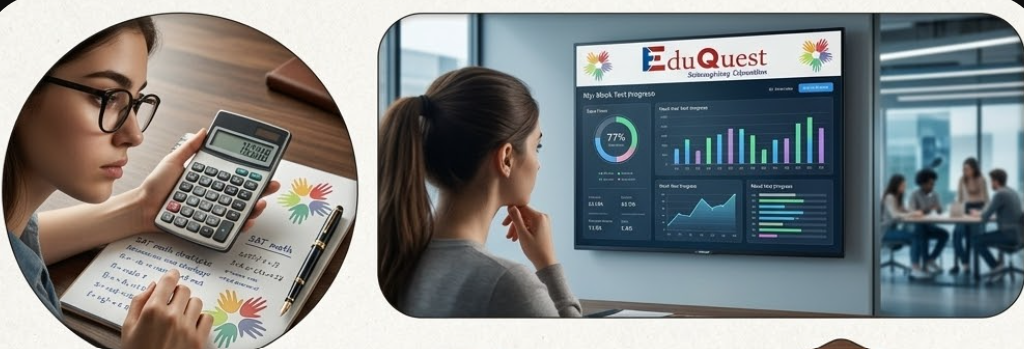
- Use EduQuest’s telemetry dashboard to find your lowest-performing sub-domain.
- Feed that insight back into Stage 1 for the upcoming week’s study plan.
When Should You Take a Full SAT Mock?
Take a **Full-Length Mock** in the following three high-leverage scenarios:
- 1. The Initial Diagnostic Baseline (Day 1): Before you open any prep book, take one full mock to determine your starting baseline, identify natural strengths, and compute your point-gap to your target college cutoffs.
- 2. The Bi-Weekly Benchmark (Every 10–14 Days): After completing 4 to 6 topic tests and fixing specific weak areas, take a full mock to measure net score gain and test adaptive routing qualification.
- 3. The Final 30-Day Endurance Sprints (1 Mock Per Week): In the month leading up to test day, take one full mock every weekend to lock in pacing, Desmos efficiency, and test-day anxiety immunity.
When Should You Take a Topic Test?
Take a **Topic Test** during your day-to-day study sessions under these circumstances:
- Immediately After Learning a New Concept: When you study circle equations, quadratic discriminant, or rhetorical synthesis, take a 15-question topic test within 2 hours to cement the rule into long-term memory.
- When Accuracy in a Domain Drops Below 80%: If your mock exam report reveals you got only 2 out of 5 Transition questions right, drill a 25-question Transition topic set that very evening.
- During Weekday Study Windows (30–45 Minutes): When you do not have a 2.5-hour block for a full mock, completing two 20-minute topic tests keeps your skills sharp without exhausting your stamina.
How EduQuest Combines Both for 1550+ Breakthroughs
The secret to rapid SAT score improvement is the seamless synergy between micro-drilling and macro-testing. EduQuest integrates both products into one unified learning ecosystem:
Granular Topic Test Question Bank (2,500+ Questions)
Filter by specific domain, difficulty (Easy, Medium, Hard), and skill tag to drill exactly where your score is bleeding points.
Adaptive Full-Length Mock Simulator
Experience official-caliber Bluebook adaptive routing, Desmos calculator integration, and instant 400–1600 score report analytics.
Automated Diagnostic Prescription Engine
When you finish a full mock, our platform automatically generates a custom playlist of topic tests targeting the exact questions you missed.
1-on-1 Masterclass Mentorship
Work directly with 1580+ scorers who audit your error logs and teach high-speed Desmos regression tricks and grammar heuristics.
Download the SAT Weekly Practice Planner: Topic Tests + Full Mocks
Get our battle-tested 8-week study template that maps out the exact ratio of weekday topic drills to weekend full mocks for Ivy League & Top 20 admissions.
Frequently Asked Questions About SAT Mocks vs Topic Tests
How many topic tests should I complete before taking my next full mock?
A standard high-yield study cycle includes 4 to 8 topic tests (approx. 80–120 questions total) focused on your 2–3 weakest areas before sitting your next full-length adaptive mock.
Can I get a 1500+ score by doing only topic tests without full mocks?
No. While topic tests build deep conceptual accuracy, full mocks are essential to master the multistage adaptive routing algorithm, manage the strict 71-second/95-second pacing pressure, and build 2-hour cognitive stamina.
How does EduQuest’s Digital SAT mock compare to official Bluebook tests?
EduQuest’s mocks are calibrated to the exact Bluebook interface, including identical Desmos graphing calculator functionality, question timer tools, annotation highlighters, and adaptive difficulty routing.
Should I do topic tests timed or untimed?
When first learning a new concept, do topic tests untimed to master the logical proof. Once your accuracy exceeds 85%, switch to timed sprints (approx. 60–75 seconds per question) to automate speed.
How can I enroll in EduQuest’s SAT preparation courses?
You can explore our full diagnostic mock testing platform at test.eduquest.org.in or connect with our academic directors via our SAT Coaching page to book a 1-on-1 diagnostic consultation.
Ready to Break 1550+ on the Digital SAT? Start with a Free Diagnostic
Join thousands of high-scoring students admitted to Ivy League and Top US universities. Take a calibrated full mock or explore our modular topic test banks today.