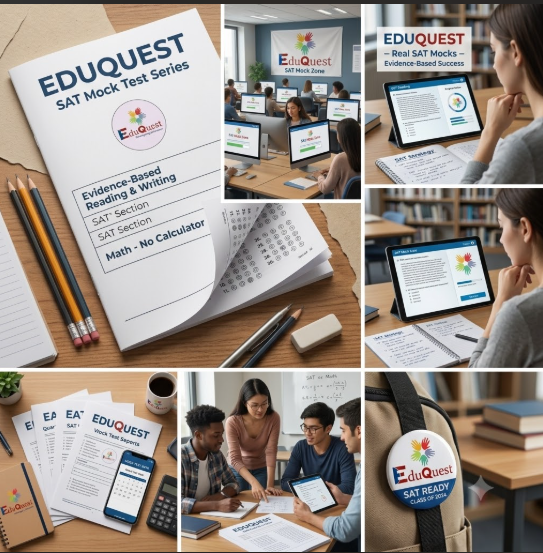

When preparing for the Digital SAT, taking full-length mock tests is essential for measuring stamina, but taking sat topic tests is how you actually learn the underlying academic concepts. If you consistently miss questions on Circle Theorems, Quadratic Discriminants, or Rhetorical Transitions, taking another 2-hour full mock will not fix the issue. You need targeted, topic-specific problem sets.
By isolating individual domains and completing high-density sat topic tests, you can turn your weakest sub-topics into guaranteed point-earning strengths. Powered by the EduQuest SAT Prep Suite and EduPath, this guide breaks down the core SAT domains, the optimal topic test study methodology, and how to combine topic drills with full-length simulations.
Master Specific SAT Topics with EduQuest AI
5,000+ Topic Question Bank
Categorized SAT Drills
Filter practice questions by exact sub-topic, difficulty tier, and question archetype with step-by-step video solutions.
Explore Topic DrillsFree Full-Length Mock
Adaptive SAT Simulation
Test your newly learned topic concepts under authentic 2-hour adaptive testing conditions.
Launch Free SAT MockPersonalized SAT Roadmap
EduQuest EduPath Platform
Create an integrated study calendar balancing weekly practice drills with scheduled milestone mock tests.
Launch EduPath Roadmap1. The 4 Core Digital SAT Domains & Sub-Topic Matrix
The Digital SAT tests eight major content domains across Math and Reading & Writing. Focus your topic tests on these high-yield areas:
Fast-Track Your College & Career Strategy
Get immediate, personalized AI insights tailored to your grade, strengths, and dream universities — 100% free with instant reports.
Know Your Personality Type for Free
Take our 18-question AI psychometric test to uncover your cognitive archetype, hidden learning superpowers, and ideal university courses.
Personalized Career & University EduPath
Build a step-by-step Grade 8–12 admissions blueprint with AI-matched target universities, exam schedules, and extracurricular profiles.
| Exam Section | Core Domain | High-Yield Sub-Topics Tested | Question Weightage |
|---|---|---|---|
| Math | Algebra | Linear equations, systems of linear equations, linear inequalities, linear functions | ~35% of Math |
| Math | Advanced Math | Nonlinear equations, quadratic functions, polynomials, exponential growth/decay | ~35% of Math |
| Math | Problem-Solving & Data Analysis | Ratios, rates, percentages, probability, scatterplots, statistics | ~15% of Math |
| Math | Geometry & Trigonometry | Area/volume, lines, angles, triangles, circle equations, trigonometry | ~15% of Math |
| Reading & Writing | Craft & Structure | Words in context, text structure & purpose, cross-text connections | ~28% of RW |
| Reading & Writing | Information & Ideas | Central ideas, inferences, command of textual/quantitative evidence | ~26% of RW |
| Reading & Writing | Standard English Conventions | Boundaries (punctuation), subject-verb agreement, verb tense, modifiers | ~26% of RW |
| Reading & Writing | Expression of Ideas | Rhetorical synthesis (bullet-point synthesis), transitions | ~20% of RW |
2. The 5-Variation Rule for Topic Mastery
Whenever you get a question wrong during a topic test, execute the **5-Variation Rule**:
Step 1: Understand the Underlying Rule
Review the theoretical principle (e.g., how semicolons connect two independent clauses or how the discriminant b² - 4ac determines real roots).
Step 2: Solve 5 Similar Questions in Immediate Succession
Immediately solve 5 similar questions testing the exact same concept to lock the neural pathway into your long-term memory.
Step 3: Re-Test After 7 Days (Spaced Repetition)
Re-test those 5 concepts one week later in a mixed timed drill to ensure you haven’t forgotten the rule.
3. How EduQuest Powers Your SAT Topic Mastery
At EduQuest, our test preparation ecosystem provides an end-to-end framework to master every SAT topic:
- 1. 5,000+ Categorized Topic Questions: Filter by sub-topic, difficulty tier, and question archetype with step-by-step video solutions.
- 2. Instant AI Heat-Map Diagnostics: Reveal exact sub-topic accuracy percentages and time spent per problem.
- 3. 1-on-1 Mentorship with 1550+ Top Scorers: Review topic test mistake logs with dedicated expert mentors.
4. Frequently Asked Questions (FAQ) About SAT Topic Tests
Should I do topic tests or full mock tests first?
Start with topic tests to build concept foundations and eliminate knowledge gaps. Once you achieve 80%+ accuracy on topic tests, transition to full-length timed mock tests.
How many questions are in a typical SAT topic test?
A standard topic test contains 15 to 25 focused questions on a single concept, designed to be completed in 20 to 30 minutes.
Are EduQuest SAT topic tests free?
Yes! EduQuest provides free access to categorized SAT topic tests and diagnostic quizzes across all Math and Reading & Writing domains.
Download the Complete Digital SAT Topic-by-Topic Formula Cheat Sheet
Get instant access to EduQuest’s 24-page PDF featuring every Math formula, grammar rule, transition word list, and Desmos shortcut tested on the Digital SAT.
Master Every SAT Topic with 99th Percentile Mentors Today
Join thousands of ambitious students who achieved 1500+ on the Digital SAT with EduQuest AI. Start your topic drills now.