

1. Singapore Medical Admissions: NUS Yong Loo Lin vs NTU Lee Kong Chian
Singapore is globally recognized for having one of the most efficient, high-performing healthcare systems in existence. Consequently, undergraduate medical admissions into Singapore’s two premier medical faculties — the Yong Loo Lin School of Medicine at the National University of Singapore (NUS) and the Lee Kong Chian School of Medicine (LKC Medicine) at Nanyang Technological University (NTU) — are intensely competitive, admitting only the top 1% to 2% of applicants.
Both institutions employ multi-station assessment architectures, but with unique institutional flavor: NUS utilizes the Focused Skills Assessment (FSA) alongside a Situational Judgement Test (SJT), while NTU operates an 8-station Multiple Mini Interview (MMI) model developed in collaboration with Imperial College London.
| Medical Institution | Assessment Format | Station Count | Evaluation Focus | Key Milestone Dates |
|---|---|---|---|---|
| NUS Yong Loo Lin School of Medicine | Focused Skills Assessment (FSA) + SJT | 4–5 Stations + Written SJT | Integrity, Empathy, Communication, Resilience | Interviews held in late March / early April |
| NTU Lee Kong Chian School of Medicine | Multiple Mini Interview (MMI) | 8 Stations (7–8 min each) | Teamwork, Ethics, Critical Thinking, Motivation | Interviews held in late March / early April |
| Duke-NUS Medical School | Graduate-Entry MD TeamSTEPPS | Semi-structured MMI + Team Drills | Scholarly Aptitude, Leadership, Clinical Passion | Interviews held rolling from October to March |
2. Singapore Healthcare Philosophy: The "3Ms" Financing Architecture
A fatal error made by international candidates in Singapore medical interviews is applying Western entitlement welfare models. Singapore’s Ministry of Health (MOH) operates on the philosophy of individual responsibility backed by targeted state co-payment, ensuring that no Singaporean is denied necessary healthcare due to inability to pay.
Fast-Track Your College & Career Strategy
Get immediate, personalized AI insights tailored to your grade, strengths, and dream universities — 100% free with instant reports.
Know Your Personality Type for Free
Take our 18-question AI psychometric test to uncover your cognitive archetype, hidden learning superpowers, and ideal university courses.
Personalized Career & University EduPath
Build a step-by-step Grade 8–12 admissions blueprint with AI-matched target universities, exam schedules, and extracurricular profiles.
Medisave (Individual Savings Account)
A compulsory portion of monthly Central Provident Fund (CPF) contributions set aside specifically to cover personal or immediate family hospitalization expenses, day surgery, and approved chronic disease treatments.
MediShield Life (Universal Catastrophic Insurance)
A mandatory national health insurance plan that protects all citizens and permanent residents against massive hospital bills and costly lifelong treatments (such as dialysis or chemotherapy), regardless of pre-existing medical conditions.
Medifund (Statutory Safety Net)
An endowment fund established by the Singapore Government acting as a safety net of last resort. For patients who have exhausted Medisave and MediShield Life, hospital Medifund committees approve financial grants to cover remaining bills.
3. "Healthier SG" & The Rapidly Aging Population
By 2026, Singapore officially becomes a "Super-Aged" nation, with more than 21% of citizens aged 65 and above. This demographic reality underpins every policy station at NUS and NTU interviews.
- Healthier SG Transformation: The national shift from reactive acute hospital care to proactive, relationship-based preventative medicine anchored in General Practice family physicians.
- Chronic Disease Burden: Managing diabetes (War on Diabetes), hypertension, and dementia within community-based active aging centers rather than tertiary hospital wards.
- Advance Medical Directives (AMD) & ACP: The legal and moral frameworks governing advance care planning in Singapore, balancing patient autonomy against traditional Asian filial piety.
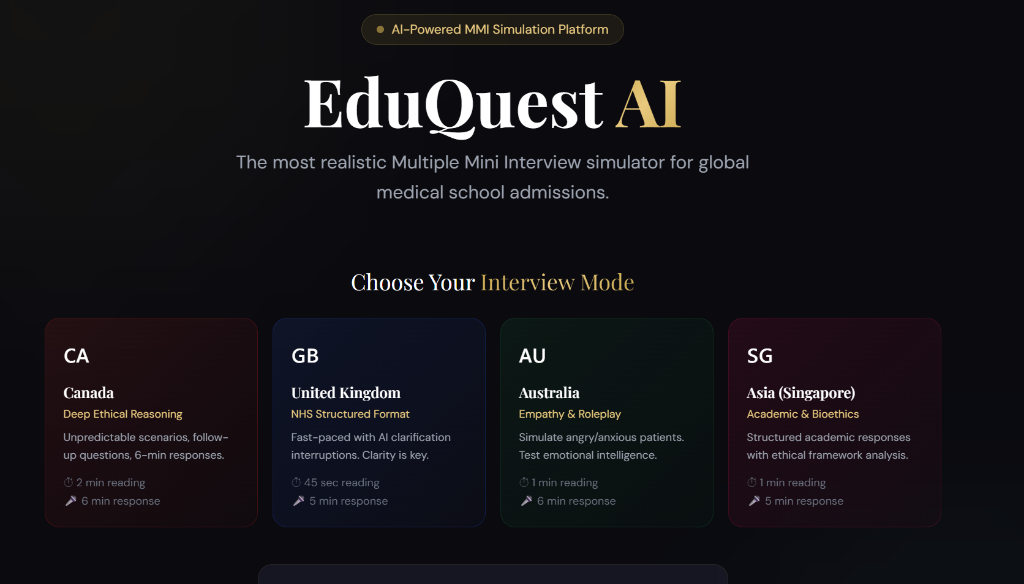
Practice Singapore MMI Stations on EduQuest AI
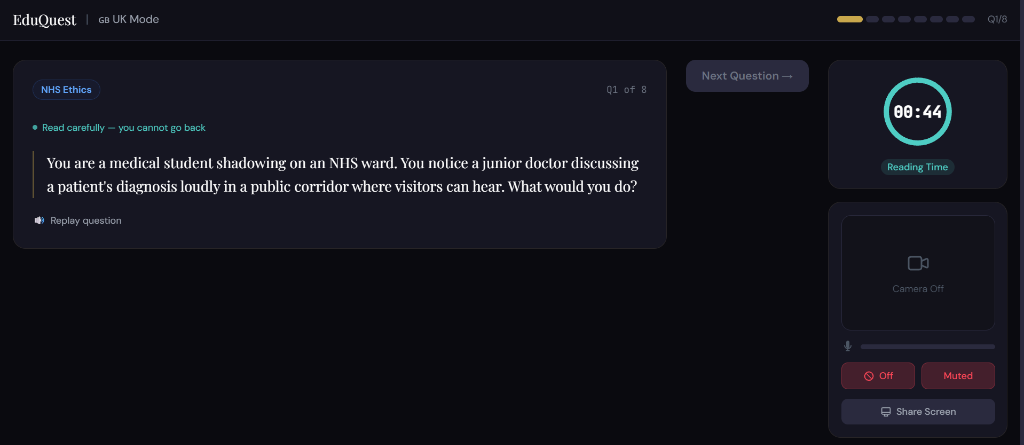
Train on authentic Singapore MMI prompts with our specialized Singapore (SG) mode on EduQuest AI Interview Agent.
Singapore (SG) MMI Mode
Simulate realistic 7-minute stations calibrated to Singapore medical school standards, Asian cultural sensitivities, and clinical ethics.
- ✓ 150+ Singapore medical school prompts
- ✓ MOH ethical criteria feedback
- ✓ Instant verbal pace & empathy score
- ✓ Timed dynamic AI interlocutor
Asian Clinical Nuances Suite
Specialized evaluation analyzing respect for familial dynamics, non-verbal deference, and filial ethics in healthcare.
- ✓ FSA question bank & model answers
- ✓ Filial piety vs autonomy frameworks
- ✓ Healthier SG policy deconstructions
“Select Singapore (SG) Mode to face country-specific stations reflecting MOH guidelines, 3Ms healthcare financing, and Asian doctor-patient communication dynamics.”
4. Cultural Sensitivity & Doctor-Patient Communication in Asia
In Western medical interviews, individual patient autonomy is paramount. In Singapore, healthcare decisions frequently involve multi-generational family dynamics, requiring nuanced cultural diplomacy:
| Communication Dilemma | Cultural Context in Singapore | High-Scoring Candidate Strategy |
|---|---|---|
| Family Protective Deception | Adult children demand doctor withhold cancer diagnosis from elderly parent | Validate children's protective concern; explore reasons; gently explain patient's legal right to know in phased conversation |
| Cross-Cultural Healthcare | Patient prefers traditional Chinese medicine (TCM) over prescribed chemotherapy | Respect cultural belief; avoid dismissal; assess herb-drug interactions; partner with licensed TCM practitioner |
| Interprofessional Hierarchy | Junior doctor notices senior consultant writing incorrect dosage | Speak privately to senior clinician; phrase inquiry constructively ("Could you clarify this dosage for my learning?") |
| Financial Hesitation | Elderly patient refuses surgery fearing burdening family savings | Explain Medisave, MediShield Life, and Medifund; connect with hospital medical social worker immediately |
Targeting NUS Medicine or NTU LKC Medicine?
Sharpen your MMI and Focused Skills Assessment performance with EduQuest's specialized AI simulator and admissions mentors.
Download the Singapore Medical School MMI Guide (2026–2027)
Get instant access to our comprehensive Singapore MMI candidate handbook featuring 10 model station answers, MOH ethical rubrics, and healthcare financing blueprints.
Can international students apply to NUS Medicine and NTU LKC?
Yes, international students with outstanding academic records (CBSE 95%+, IB 43–45, or top A-Levels) and strong UCAT / BMAT / aptitude scores are eligible, though places are highly limited due to national healthcare quotas.
Is there a service bond for studying medicine in Singapore?
Yes, all medical graduates in Singapore sign a service bond with the Ministry of Health: 5 years for Singapore citizens, and 6 years for international students and permanent residents, served within the public healthcare clusters.
What is the format of the NUS Focused Skills Assessment (FSA)?
The FSA consists of interactive stations evaluating empathy, teamwork, problem solving, and resilience, paired with a written Situational Judgement Test (SJT).
How does EduQuest AI prepare me for Singapore MMI stations?
EduQuest AI features a dedicated Singapore (SG) Mode programmed with MOH guidelines, 3Ms financing cases, and Asian communication scenarios, accessible 24/7 on https://mmi-interview.eduquest.org.in/home.