

1. UK Medical School MMI Architecture: How Top British Universities Test Applicants
In the United Kingdom, the Multiple Mini Interview (MMI) has become the gold standard for clinical admissions across prestigious medical faculties including King’s College London, Imperial College London, the University of Manchester, the University of Birmingham, the University of Edinburgh, and UCL. Rather than relying on a singular, subjective 30-minute panel interview, UK medical schools construct an objective, multi-station circuit designed to test non-academic clinical attributes, emotional resilience, ethical maturity, and communication skills.
Each candidate moves through 6 to 10 independent stations. At every station, you encounter a distinct examiner, a standardized prompt card, and an independent scoring rubric. Crucially, scoring is completely segregated: if you experience an unexpected stumble at Station 3, your performance at Station 4 begins on a clean slate with an assessor who has zero knowledge of your earlier score.
| UK Medical School | Number of Stations | Station Duration | Reading Time | Core Focus Areas |
|---|---|---|---|---|
| King's College London | 6–8 Stations | 5–6 Minutes | 1 Minute | Communication, NHS Values, Ethics |
| Imperial College London | 7 Stations | 6 Minutes | 1–2 Minutes | Critical Analysis, Teamwork, Empathy |
| University of Manchester | 7 Stations | 7 Minutes | 2 Minutes | Consultation Role-Play, Resilience |
| University of Birmingham | 6 Stations | 6 Minutes | 1 Minute | Data Interpretation, GMC Guidelines |
| University of Bristol | 7 Stations | 6 Minutes | 1 Minute | Personal Insight, Ethical Problem Solving |
| University of Edinburgh | 8 Stations | 6 Minutes | 1.5 Minutes | Medical Hot Topics, Critical Reasoning |
2. Deconstructing the GMC Good Medical Practice: The Four Ethical Pillars
Every ethical scenario at a UK MMI is anchored directly in the General Medical Council (GMC) Good Medical Practice statutory guidance. Assessors do not look for complex clinical terminology; rather, they evaluate whether you can methodically weigh conflicting ethical principles without jumping to hasty, one-sided conclusions.
Fast-Track Your College & Career Strategy
Get immediate, personalized AI insights tailored to your grade, strengths, and dream universities — 100% free with instant reports.
Know Your Personality Type for Free
Take our 18-question AI psychometric test to uncover your cognitive archetype, hidden learning superpowers, and ideal university courses.
Personalized Career & University EduPath
Build a step-by-step Grade 8–12 admissions blueprint with AI-matched target universities, exam schedules, and extracurricular profiles.
Autonomy (Respect for the Patient's Self-Determination)
A competent adult patient has the legal and moral right to accept or refuse any medical treatment, even if that decision results in fatal outcomes (e.g., Jehovah's Witness refusing packed red blood cells). In MMI stations, always evaluate patient capacity, voluntary consent, and whether Gillick competence applies to minors.
Beneficence (Acting in the Best Interest of the Patient)
Every intervention recommended by a healthcare professional must aim to maximize tangible benefit to the patient’s physical, psychological, or emotional wellbeing. Demonstrate empathy and explore alternative treatment pathways.
Non-Maleficence (Primum Non Nocere — Do No Harm)
Clinicians must balance potential therapeutic benefits against inherent procedural risks or side effects. In clinical trial scenarios or emergency surgeries, articulate risk-benefit ratios clearly.
Justice (Fairness & Healthcare Resource Allocation)
Healthcare resources within the National Health Service are inherently finite. When asked who should receive a single available liver transplant or ICU ventilator, never discriminate based on personal lifestyle or social status. Ground your answer in objective clinical criteria: survival prognosis, post-operative longevity, and multidisciplinary transplant committee protocols.
3. 2026–2027 NHS Hot Topics: What UK Examiners Expect You to Know
A dedicated station at almost every UK medical school probes your awareness of current systemic pressures across the National Health Service. Candidates who recite textbook definitions fail; candidates who demonstrate nuanced, multi-perspective policy understanding score in the top decile.
- NHS Workforce Crisis & Junior Doctor Disputes: Understanding the tension between fair clinical compensation, working conditions, rota gaps, and patient safety backlogs.
- Integrated Care Systems (ICS): How statutory NHS partnerships join primary care, secondary hospitals, social care, and local councils to prevent unnecessary hospital admissions.
- Artificial Intelligence & Digital Diagnostics in the NHS: The ethical balance between AI radiology triage tools, algorithmic bias, data confidentiality, and preserving doctor-patient human empathy.
- Elective Waiting Lists & Private Sector Collaboration: Balancing acute emergency demand against chronic disease backlogs, and evaluating the ethics of NHS-funded private surgical capacity.
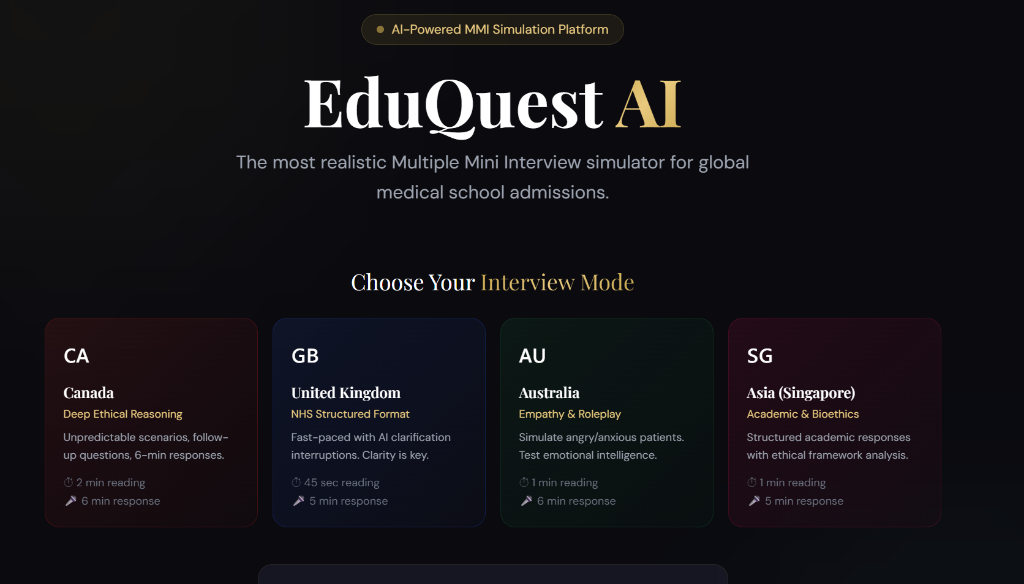
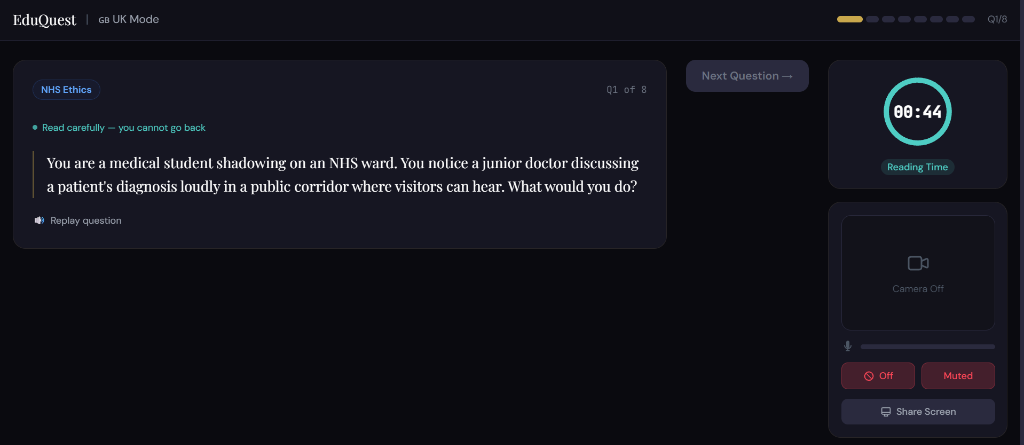
Practice UK MMI Stations on EduQuest AI Interview Agent
Simulate realistic timed UK medical school MMI circuits with country-calibrated AI interlocutors, voice recording, and instant assessor rubrics.
United Kingdom (GB) MMI Mode
Select UK Mode to face country-specific stations including NHS hot topics, GMC ethical dilemmas, and actor role-plays.
- ✓ 150+ UK medical school prompts
- ✓ Real-time 6-minute station timer
- ✓ Voice & typed response evaluation
- ✓ GMC scoring sheet feedback
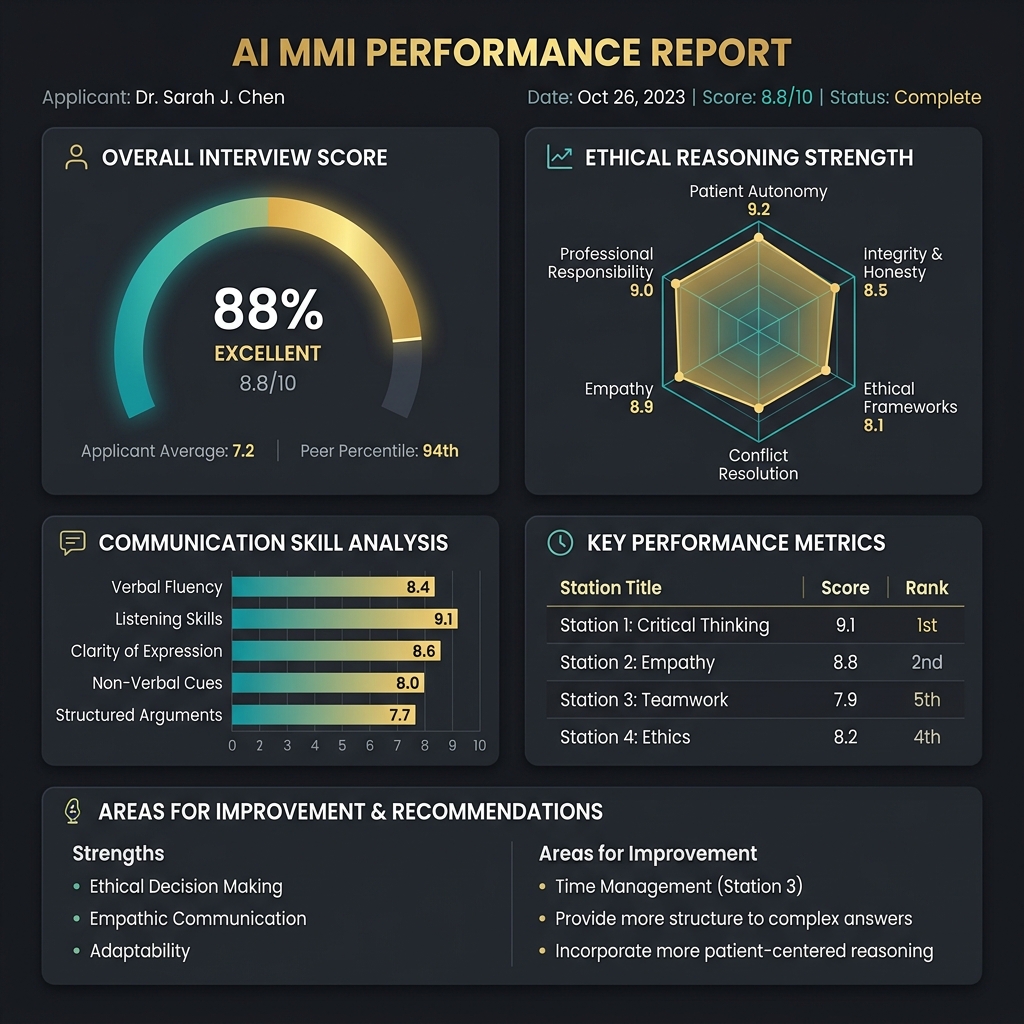
MMI Assessor Feedback Engine
Receive instant scoring across Communication, Empathy, Critical Thinking, and NHS Ethical Alignment.
- ✓ Actionable strengths & weaknesses
- ✓ Model answer benchmarks
- ✓ STARR and SPIKES structural coaching
“Our AI Interview Agent evaluates your spoken responses against official GMC criteria, identifying pauses, filler words, and ethical gaps before your real interview.”
4. Mastering Role-Play Stations: The SPIKES Protocol for Breaking Bad News
Role-play stations involve trained simulation actors playing an emotional patient, an anxious family member, or a distressed colleague. The examiner sits silently in the corner, grading your interpersonal warmth, non-verbal cues, and active listening. To structure difficult conversations seamlessly, medical candidates rely on the clinical SPIKES protocol:
| SPIKES Step | Clinical Objective | High-Scoring Candidate Phrasing |
|---|---|---|
| S — Setting | Create privacy, confirm identity, build comfort | "Thank you for meeting with me, Sarah. Please make yourself comfortable. Is there anyone you would like to join us?" |
| P — Perception | Assess what the patient already understands | "Before we discuss the latest lab results, could you share what the consultant has explained so far?" |
| I — Invitation | Obtain permission to disclose sensitive information | "I have the updated pathology report with me today. Would you like me to go through the findings in detail now?" |
| K — Knowledge | Deliver facts gently using a warning shot | "Unfortunately, the test results show something unexpected that we need to address carefully together." |
| E — Empathy | Acknowledge emotions, validate feelings, allow silence | "I can see how overwhelming and upsetting this news is. Take all the time you need; I am here with you." |
| S — Strategy | Outline clear next steps and arrange follow-up | "Here is our clear action plan for the next 48 hours. Let us schedule our next check-in tomorrow morning." |
Ready to Crack Your UK Medical School MMI?
Join hundreds of successful applicants who trained with EduQuest's AI MMI Interview Agent and senior medical admissions mentors.
Download the UK Medical School MMI Study Guide (2026–2027)
Get instant access to our comprehensive 25-page UK MMI candidate handbook featuring 10 model station answers, GMC scoring sheets, and NHS hot topic analysis.
How do UK medical schools score MMI stations?
Each station is scored independently on a 5-point to 10-point Likert scale assessing Communication Skills, Empathy, Ethical Reasoning, and Critical Thinking. Assessors also award a global suitability grade. Station scores are aggregated, and candidates are ranked against the cohort cutoff.
Can I re-use examples across different MMI stations?
Yes! Because each station features a brand-new examiner with an independent evaluation sheet, you can confidently reference your strongest clinical shadowing, volunteering, or research examples in multiple stations where relevant.
What is the most common mistake applicants make in UK MMI ethics stations?
Taking an aggressive, black-and-white stance immediately. Examiners intentionally present grey dilemmas. High-scoring candidates first explore both sides of the conflict (e.g., patient autonomy vs public health safety) before articulating a reasoned, balanced conclusion.
How does EduQuest AI help with UK MMI prep?
EduQuest AI provides country-calibrated UK mode simulations with timed stations, voice analysis, and instant scoring based on official GMC criteria and NHS values, available 24/7 on https://mmi-interview.eduquest.org.in/home.