

1. The Rapid Adoption of MMI Across Top US Allopathic (MD) Schools
While the Multiple Mini Interview originated in Canada, top-tier American allopathic (MD) and osteopathic (DO) medical schools have increasingly embraced MMI to identify future physicians who possess emotional intelligence, cultural competence, and ethical integrity alongside stellar MCAT scores. Institutions such as the Stanford University School of Medicine, UCLA David Geffen School of Medicine, NYU Grossman School of Medicine, University of Michigan Medical School, UC Davis, and Virginia Tech Carilion now incorporate MMI circuits into their interview days.
Many US medical schools utilize a hybrid interview format: candidates complete a 6-to-8 station MMI circuit in the morning to evaluate critical reasoning and interpersonal instincts, followed by a traditional 30-to-45 minute conversational panel in the afternoon to discuss their AMCAS application, research publications, and personal trajectory.
| US Medical School | Interview Format | MMI Station Count | Station Duration | Admissions Emphasis |
|---|---|---|---|---|
| Stanford Medicine | Hybrid (MMI + 1-on-1 Panel) | 6–8 Stations | 7–8 Minutes | Scholarly Innovation, Empathy, Leadership |
| UCLA David Geffen | MMI Circuit | 8 Stations | 7 Minutes | Cultural Competence, Community Health Advocacy |
| NYU Grossman | MMI Circuit | 7–8 Stations | 6 Minutes | Bioethics, Critical Thinking, Tuition-Free Mission |
| University of Michigan | Hybrid (MMI + Traditional) | 6 Stations | 8 Minutes | Interprofessional Communication, Resilience |
| UC Davis School of Medicine | MMI Circuit | 10 Stations | 7 Minutes | Healthcare Disparities, Rural California Care |
| Virginia Tech Carilion | MMI Circuit | 8–10 Stations | 8 Minutes | Problem-Solving, Ethics, Translational Research |
2. The AAMC 15 Core Pre-Professional Competencies
The Association of American Medical Colleges (AAMC) outlines 15 Core Competencies that admissions committees must assess in entering medical students. In US MMI stations, raters evaluate specific behavioral markers aligned with these competencies:
Fast-Track Your College & Career Strategy
Get immediate, personalized AI insights tailored to your grade, strengths, and dream universities — 100% free with instant reports.
Know Your Personality Type for Free
Take our 18-question AI psychometric test to uncover your cognitive archetype, hidden learning superpowers, and ideal university courses.
Personalized Career & University EduPath
Build a step-by-step Grade 8–12 admissions blueprint with AI-matched target universities, exam schedules, and extracurricular profiles.
Service Orientation & Social Skills
Demonstrating a genuine desire to alleviate suffering, sensitivity to others' needs, and adapting your social demeanor to diverse socioeconomic and cultural backgrounds.
Cultural Competence & Humility
Understanding how structural inequities, systemic racism, and socioeconomic status impact healthcare delivery. Recognizing personal biases and approaching patients with humility.
Ethical Responsibility to Self and Others
Behaving with uncompromised integrity, strictly adhering to ethical standards, and standing up for ethical principles even when confronted by authority figures.
Resilience, Adaptability & Teamwork
Managing high-stress scenarios calmly, bouncing back from setbacks gracefully, and collaborating effectively with peers without seeking solitary credit.
3. US Healthcare System & Bioethics Dilemmas
American healthcare is unique in the developed world: a hybrid model characterized by private health insurance, employer-sponsored plans, Medicare for seniors, and Medicaid for low-income families. US MMI stations frequently place you in dilemmas arising from this complex economic reality.
- Insurance Prior Authorization & Drug Costs: Navigating scenarios where life-saving specialty medications (e.g., biologic therapies, insulin analogues) are denied by an insurance provider, forcing clinicians to advocate through appeals while managing patient despair.
- Reproductive Health & Legal Dilemmas: Exploring state-level regulatory variations in reproductive healthcare, post-Roe legal dynamics, and the physician’s duty to prioritize emergency patient stabilization under EMTALA (Emergency Medical Treatment and Labor Act).
- Healthcare Disparities in Underserved Populations: Evaluating high maternal mortality rates among minority communities, lack of preventative care among undocumented immigrants, and rural hospital closures.
- Physician Burnout & Substance Use: Handling a scenario where a fellow pre-med or clinical resident exhibits signs of alcohol abuse or mental exhaustion during a surgical rotation.
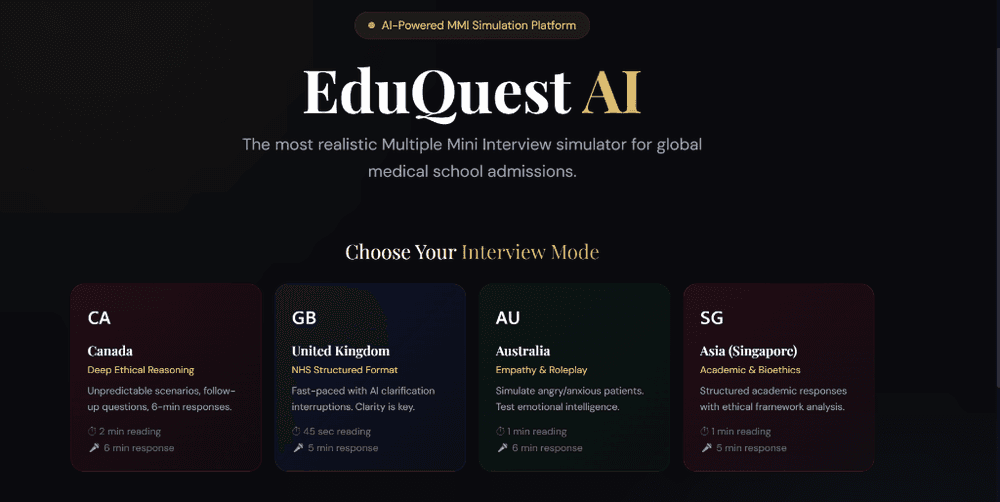
Practice US MMI Stations on EduQuest AI
Prepare for Stanford, UCLA, and NYU medical interviews with country-calibrated AI prompts and instant AAMC competency feedback.
USA / Global MMI Mode
Simulate realistic timed stations addressing US healthcare systemic challenges, patient advocacy, and ethical dilemmas.
- ✓ 150+ US medical school prompts
- ✓ AAMC competency rubric feedback
- ✓ Instant verbal pace & empathy score
- ✓ Timed 7-minute station simulator
Hybrid Interview Mastery Suite
Comprehensive preparation tools covering both multi-station circuits and conventional faculty panel interviews.
- ✓ AMCAS profile-to-MMI mapping
- ✓ Model answers from MD mentors
- ✓ Bioethics deconstruction drills
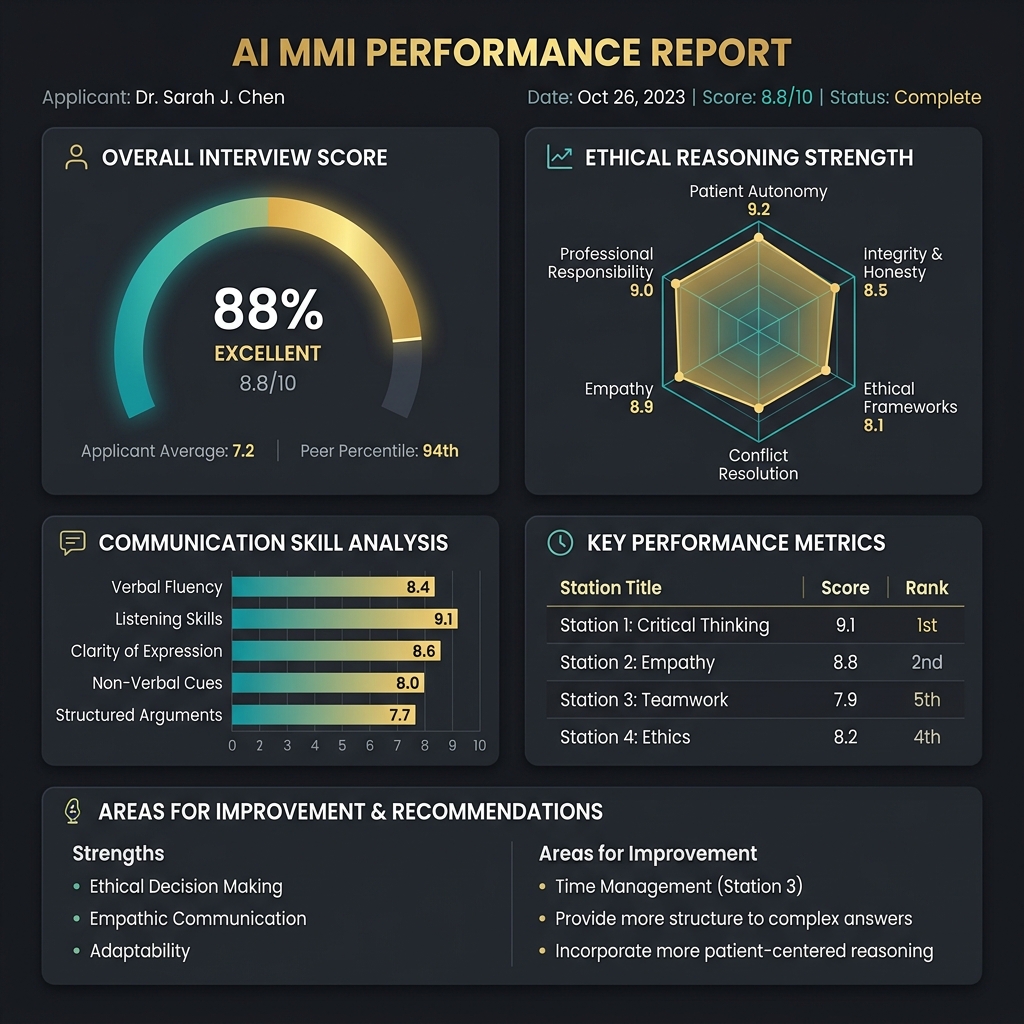
“Our AI Interview Agent evaluates your responses against AAMC pre-professional rubrics, identifying structural weaknesses and ethical ambiguities.”
4. Navigating Hybrid Interview Days (MMI + Traditional Faculty Panel)
Because schools like Stanford and Michigan utilize hybrid interview formats, your preparation must encompass two distinct cognitive mindsets:
| Interview Dimension | MMI Circuit Station | Traditional Faculty Panel |
|---|---|---|
| Primary Assessment Focus | Instinctive ethics, communication, problem-solving | Personal motivation, research depth, institutional fit |
| Examiner Knowledge of File | Closed file: examiner knows nothing about you | Open file: examiner has reviewed your entire AMCAS application |
| Answer Time Management | Precise 5–6 minute structured response | Fluid conversational pacing across 30–45 minutes |
| Best Strategic Mindset | Analyze both sides of the dilemma; show empathy | Share compelling personal stories; express your mission |
Secured an Interview at Stanford, UCLA, or NYU?
Sharpen your MMI performance with EduQuest's specialized AI simulator and seasoned medical admissions mentors.
Download the USA Medical School MMI Guide (2026–2027)
Get instant access to our comprehensive US MMI candidate handbook featuring 10 model station answers, AAMC competency rubrics, and healthcare policy blueprints.
Do US medical schools prefer MMI over traditional interviews?
Admissions research shows that MMI offers substantially higher reliability and predictive validity for clinical clerkship success than traditional interviews. As a result, over 40 US medical schools have adopted MMI or hybrid models.
Should I bring up my research in an MMI station?
Only if it directly answers the specific prompt (e.g., in a station discussing evidence-based medicine or scientific integrity). Never force an unprompted discussion of your resume into an ethical role-play.
How do I handle a station when I am unfamiliar with the specific healthcare policy?
Do not panic or fabricate facts. Acknowledge the complexity, state the foundational ethical principles at play (patient safety, fairness, resource availability), and outline how you would consult multidisciplinary hospital guidelines.
Can international students crack US MMI interviews?
Yes! International candidates who practice structured communication and demonstrate a clear understanding of US healthcare delivery on platforms like EduQuest AI compete exceptionally well.