

For prospective lawyers in India and around the globe targeting premier US and international Juris Doctor (JD) programs, the Law School Admission Test (LSAT) is the single most influential numerical factor in law school admissions. Admissions committees weigh your LSAT score heavily because it provides a standardized, objective benchmark evaluating critical reading, analytical reasoning, and formal argumentation—skills fundamental to legal scholarship.
Understanding what constitutes a strong score requires looking past raw scores and analyzing official percentiles, school-specific median score bands, and holistic application requirements. Below, you will find the complete LSAT score guide, official LSAC percentiles, realistic planning targets for top US law schools, and EduQuest's blueprint for achieving a 170+ milestone.
LSAT Score Guide: What Score Should You Aim For?
Every raw score on the LSAT (the number of questions answered correctly out of roughly 75–76 scored questions across three scored sections) is converted into a scaled score between 120 and 180 through an equating formula established by the Law School Admission Council (LSAC). Because test forms vary subtly in difficulty, scaled scores ensure fair comparison across administrations.
| LSAT Score | Approx. Percentile | Assessment | US Law School Competitiveness |
|---|---|---|---|
| 150 | 37th | Below average | Admission feasible at lower-tier regional law schools |
| 155 | 54th | Around average | Competitive for regional law schools (Top 100–120) |
| 160 | 71st | Good | Competitive for respected state universities (Top 50–70) |
| 165 | 85th | Very good | Strong contender for Tier 1 law schools (Top 25–40) |
| 170 | 94th | Excellent | Highly competitive for Top 15–20 & competitive for lower T14 |
| 175 | 99th | Exceptional | Target range for elite Top 10 law schools (Columbia, Chicago, NYU) |
| 180 | 99.85th | Perfect score | Maximum competitiveness for Harvard, Yale, and Stanford |
Fast-Track Your College & Career Strategy
Get immediate, personalized AI insights tailored to your grade, strengths, and dream universities — 100% free with instant reports.
Know Your Personality Type for Free
Take our 18-question AI psychometric test to uncover your cognitive archetype, hidden learning superpowers, and ideal university courses.
Personalized Career & University EduPath
Build a step-by-step Grade 8–12 admissions blueprint with AI-matched target universities, exam schedules, and extracurricular profiles.
Percentiles are based on LSAC's latest multi-year testing data. Scores above 160 place you comfortably in the upper quartile of all test-takers, while breaking 170 puts you in the prestigious 94th percentile nationally.
What LSAT Score Is Needed for Top US Law Schools?
American Bar Association (ABA) accredited law schools publish annual Standard 509 Information Reports detailing their incoming class statistics, including 25th percentile, median, and 75th percentile LSAT scores. Knowing where your score lands relative to a law school's median is critical:
| Target Institution Tier | Suggested LSAT Target | Representative Institutions |
|---|---|---|
| Competitive US law schools | 160–165+ | American University, Loyola Chicago, Villanova, Baylor |
| Highly selective law schools | 168–172+ | Georgetown, UCLA, Vanderbilt, UT Austin, WashU, USC |
| Top 10 law schools | 172–175+ | Columbia, NYU, UChicago, Penn Carey, Duke, Virginia, Michigan |
| Harvard, Yale, Stanford ambitions | 173–177+ | Yale Law School, Stanford Law School, Harvard Law School |
Best LSAT Score Target for EduQuest Students
At EduQuest, we advise all our law school aspirants targeting elite global legal education to aim for 170+. Scoring 170+ places you in the 94th percentile, placing your candidacy among the strongest in the world. Crucially, a 170+ score not only unlocks admissions offers from T14 institutions but also dramatically increases your likelihood of securing six-figure merit-based scholarships that can offset substantial JD tuition costs.
Breaking through the 170 barrier requires moving beyond surface-level test prep. EduQuest scholars master three systematic pillars:
Flaw & Formal Logic Mastery
Master conditional logic (sufficient vs necessary conditions, biconditionals, contrapositives) and categorize Logical Reasoning flaws (causation vs correlation, sampling bias, false dilemmas) systematically.
Blind Review Methodology
After every timed test section, re-solve every flagged and incorrect question untimed without looking at the answer key. This forces deep cognitive engagement and exposes conceptual vs pacing vulnerabilities.
Structural Reading Comprehension
Stop reading legal and humanities passages for factual details. Focus on viewpoint attribution, authorial tone, argumentative tension, and macro-structural shifts across dense multi-source texts.
Explore LSAT Coaching at EduQuest Gurgaon: Center Details, Schedules & Class Delivery Modes
Preparing for a 170+ score on the post-2024 LSAT requires structured pedagogy, untimed blind review mentorship, and formal logic drills. For candidates in Delhi NCR, EduQuest Gurgaon is the leading center of excellence for law school admissions and legal reasoning prep.
EduQuest Gurgaon LSAT Center & Course Overview
Physical Learning Center
F-45, Baani Square, Sec 50
EduQuest Learning Center, Unit F-45, Baani Square, Sector 50, Gurgaon, Haryana 122018. Easily accessible from Golf Course Road, Sohna Road, Nirvana Country, and South City II.
Batch Timings
Weekday & Weekend Batches
Weekday Batches: Monday to Thursday, 4:00 PM – 7:00 PM (designed for university students & working professionals). Weekend Batches: Saturday & Sunday, 10:00 AM – 2:00 PM. Plus 1-on-1 Fast-Track Bootcamps.
Delivery Modes
Offline, Online & Hybrid
Choose 100% Offline Classroom Coaching at F-45 Gurgaon, Live Interactive Virtual Classes with 2-way audio/video, or Flexible Hybrid Learning to switch based on court/internship schedules.
Elite Cohorts
Small Batches (8–10 Students)
Strict cohort limits ensure rigorous Socratic dialogue, individual Logical Reasoning flaw diagnostic tracking, and direct 1-on-1 legal admissions mentorship.
Offline Classroom Coaching at EduQuest Gurgaon (F-45 Baani Square)
Study at our premier learning center in Sector 50, Gurgaon. Benefit from face-to-face instruction led by Senior LSAT Master Faculty Adv. Raghav Malhotra, live whiteboard logic breakdown, dedicated computer testing terminals for LawHub simulation, and soundproof faculty consultation cabins.
Live Online Interactive Classes (Across India & Global Candidates)
Join high-definition live virtual classes with two-way audio/video interaction, live digital whiteboard annotations for conditional logic and grouping diagrams, recorded session archives for 24/7 revision, and dedicated virtual office hours.
Flexible Hybrid Learning Mode
Seamlessly switch between physical classroom attendance at F-45 Gurgaon and live virtual streaming whenever university exams, moot court competitions, or travel commitments require flexibility.
Download the Official LSAT Score Guide & T14 Admissions Matrix
Get instant access to complete percentile conversion tables, 25th–75th median score bands for all top 25 US law schools, and our step-by-step 170+ study roadmap.
Accelerate Your Legal Admissions with EduQuest AI Diagnostics
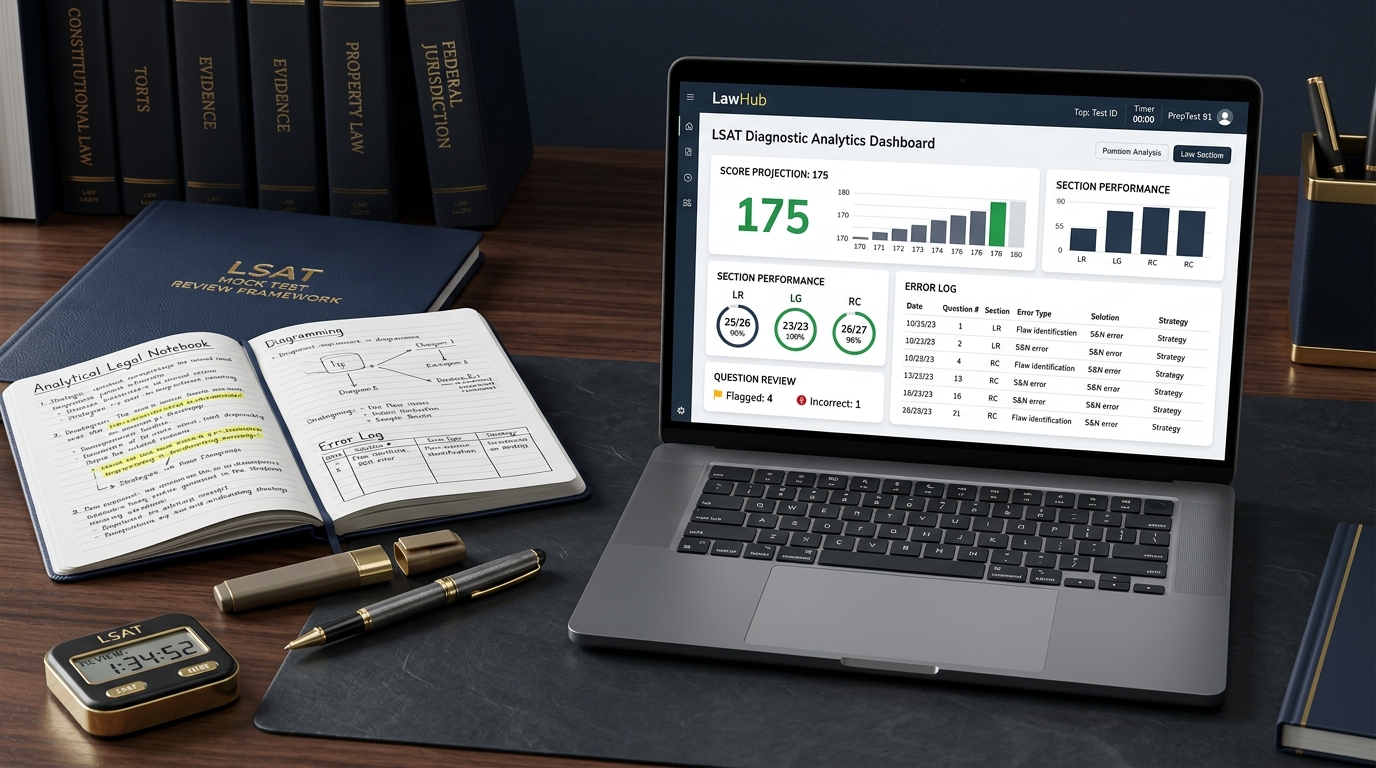
Modern law school preparation requires data-driven feedback. Combine expert human legal instruction with EduQuest's cutting-edge AI diagnostic telemetry to pinpoint pacing inefficiencies, categorize question stem weaknesses, and monitor your score escalation.
EduQuest Legal & Test Intelligence Suite
Leverage predictive analytics, formal logic simulators, and university fit engines to secure your law school seat.
EduQuest Adaptive Mock Hub
Simulate official computer-delivered test interfaces with sub-second question telemetry, difficulty adaptation, and instant scaled score reports.
- ✓ Timed exam simulation with live section clocks
- ✓ Logical Reasoning question-type error breakdown
- ✓ Predictive percentile & score band conversion
TARA Strategic Guide
AI-guided university selection and holistic profile auditing tailored to international law school candidates.
- ✓ T14 vs Regional law school ROI calculator
- ✓ Personal statement theme & narrative alignment
- ✓ Scholarship opportunity matching engine
Narrative Intelligence Test
Evaluate cognitive strengths, advocacy traits, and legal argument archetype to craft compelling admissions narratives.
- ✓ 16-Factor student archetype analysis
- ✓ Authentic legal storytelling framework
- ✓ Uniqueness factor scoring for competitive pools
“Students combining EduQuest blind review coaching with AI diagnostic testing achieve an average 11.4-point LSAT score improvement within 12 weeks.”
Frequently Asked Questions About LSAT Scores
What is a good LSAT score for Harvard Law School?
Harvard Law School’s median LSAT score typically hovers around 174, with the 25th percentile around 171 and the 75th percentile at 176. To be a competitive candidate for Harvard, an applicant should aim for a score of 173 or higher, paired with an outstanding undergraduate academic record and compelling legal narrative.
Is 160 a good LSAT score for international students?
Yes, a 160 places you in the 71st percentile nationally and makes you competitive for many strong, ABA-accredited US law schools ranked within the Top 50 to 80. However, if your ambition is a top 14 (T14) law school or securing substantial merit scholarships to offset international tuition, you should aim for 168–172+.
What percentile is a 170 on the LSAT?
A score of 170 on the LSAT corresponds to approximately the 94th percentile according to recent Law School Admission Council (LSAC) testing data. This means you scored higher than 94% of all test-takers globally over the multi-year testing window.
Can a high LSAT score compensate for a lower undergraduate GPA?
Yes. Law school admissions are known for being numerically driven, and students with high LSAT scores and lower GPAs are often termed "splitters." A 172+ LSAT score can significantly open doors at top 20 law schools even if your GPA is below their median, provided your application explains any discrepancies and demonstrates intellectual rigor.
How many times can you retake the LSAT?
LSAC allows students to take the LSAT up to five times within the current and past five testing years, and a maximum of seven times in a lifetime. Top law schools evaluate your highest score, though admissions officers can see all your scores from the past five years. Preparing thoroughly to hit your peak score within 1 to 3 attempts is highly recommended.