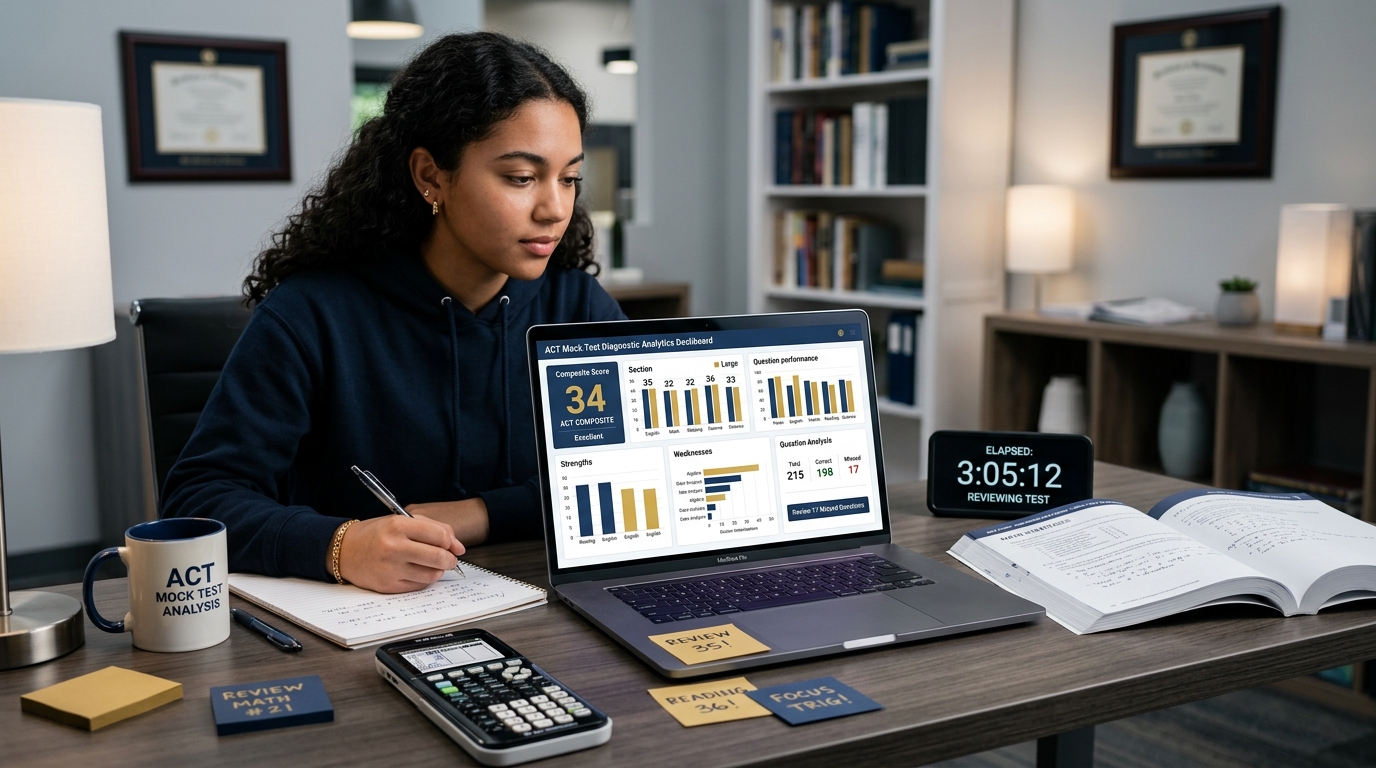

If you are sitting the **University Clinical Aptitude Test (UCAT)** in the 2026 testing cycle, knowing how to interpret your practice test scores is the single most critical factor in planning your revision. Do not get discouraged by a low initial diagnostic—UCAT preparation is not about innate ability; it is about pattern recognition, keyboard shortcuts, and strict pacing discipline. Powered by the EduQuest Official UCAT Practice Portal, the EduQuest Mock Hub, and EduPath, this comprehensive guide breaks down official benchmarks, compares mock vs real scores, outlines university cutoffs, and reveals our 6-point telemetry audit.

Benchmark Your UCAT Mock Score with Official Calibrated Practice Engines
Official UCAT Practice Suite
UCAT Decile Engine
Full-length Pearson VUE simulation for VR, DM, QR, AR, and SJT Band 1–4 grading with instant decile rank.
Launch UCAT MockCambridge & Imperial ESAT
Oxbridge STEM Mock
Pearson VUE simulation for Math 1, Physics, Chem, & Bio with 1.0–9.0 scale analysis.
Launch ESAT MockDigital SAT Adaptive Suite
SAT Ranking Engine
Bluebook-calibrated 2-module tests with question-by-question telemetry & skill breakdown.
Launch SAT MockMCAT Medical Portal
MCAT 528 Engine
Full 230-question diagnostic exam with 472–528 section and composite projections.
Launch MCAT MockCollege Board AP Exams
AP Score 5 Predictor
Diagnostic MCQ and FRQ sets across 12+ AP subjects with official rubrics.
Launch AP MockGMAT Focus Edition
GMAT 805 Engine
Quantitative, Verbal, and Data Insights sections with 205–805 score forecasting.
Launch GMAT MockIELTS Band 7.5–9.0
IELTS Band Rubric
Listening audio, reading passages, and AI-evaluated writing and speaking simulations.
Launch IELTS MockSSAT Boarding School
SSAT Percentile Engine
Elementary, Middle, and Upper Level scaled scoring and national percentile analytics.
Launch SSAT MockTARA Cognitive Aptitude
TARA Aptitude Engine
Abstract, deductive, and numerical problem-solving aptitude benchmarking.
Launch TARA MockLSAT Law School Portal
LSAT 180 Engine
Logical reasoning and reading comprehension with official 120–180 LawHub scoring.
Launch LSAT MockACT Diagnostic Portal
ACT 1–36 Composite
Complete 4-section composite score prediction with sub-score breakdowns.
Launch ACT MockGlobal Mock Test Hub
All-in-One Testing Suite
Central directory for all 12 global admissions mock test engines and analytics.
Explore Mock HubWhat Is Considered a Good UCAT Mock Score? (Benchmark Table)
Your UCAT mock performance will fluctuate depending on your preparation phase. Use this benchmark matrix to assess your trajectory:
Fast-Track Your College & Career Strategy
Get immediate, personalized AI insights tailored to your grade, strengths, and dream universities — 100% free with instant reports.
Know Your Personality Type for Free
Take our 18-question AI psychometric test to uncover your cognitive archetype, hidden learning superpowers, and ideal university courses.
Personalized Career & University EduPath
Build a step-by-step Grade 8–12 admissions blueprint with AI-matched target universities, exam schedules, and extracurricular profiles.
| Mock Score Range | Decile Equivalent | Performance Interpretation | Recommended Strategic Action |
|---|---|---|---|
| Below 2400 | 1st–3rd Decile (Below Average) | Significant foundational & pacing deficits across subtests | Stop full mocks. Do 15-minute untimed subtest drills to master core heuristics. |
| 2400–2580 | 4th–5th Decile (National Median) | Near national average; frequent time-sink errors on VR and DM | Master the "Flag & Skip" rule; build mental math shortcuts for Quantitative Reasoning. |
| 2600–2740 | 6th–7th Decile (Competitive Baseline) | On track for moderate UCAT-weighting medical schools (Liverpool, Plymouth) | Shift to 2 full timed mocks per week; maintain 4-tier error logs. |
| 2750–2880 | 8th Decile (High Scorer) | Highly competitive for top 15 UK medical schools (Birmingham, Manchester) | Refine Abstract Reasoning pattern recognition to bank 750+ section scores. |
| 2900–3100+ | 9th Decile (Elite Top 10%) | Interview-secure tier for Oxford, Cambridge, Imperial, UCL & Bristol | Condition cognitive stamina; practice in noisy environments; target SJT Band 1. |
Does Your First UCAT Mock Score Matter?
The short answer is **NO**. It is completely normal for ambitious students to score between **2100 and 2350** on their very first diagnostic mock exam. Here is why:
- 1. Extreme Time Constraints: The UCAT is unlike school exams. With only 14 seconds per Abstract Reasoning question and 28 seconds per Verbal Reasoning question, initial pacing shock is guaranteed.
- 2. Unfamiliar Interface & On-Screen Calculator: Navigating without keyboard shortcuts (Alt+N, Alt+P, Alt+C, Alt+F) wastes up to 4 minutes per section.
- 3. Diagnostic Value: Your first mock is designed to expose weakness patterns (e.g. inability to skim long texts in VR or getting bogged down in Venn diagrams in DM), not to forecast your test-day limit.
What UCAT Mock Score Should You Target for Medicine?
UK medical schools use UCAT scores in fundamentally different ways. Structure your mock targets according to your desired university tier:
| University Selectivity Tier | Medical Schools Included | Minimum Safe Mock Score Target | Required SJT Band | Application Strategy |
|---|---|---|---|---|
| Tier 1: Ultra-High UCAT Weighting | Oxford, Cambridge, Imperial, UCL, Bristol, King’s | 2950–3050+ | Band 1 (Mandatory for King’s / Oxford) | Strict ranking cutoffs; higher score directly multiplies interview probability. |
| Tier 2: High UCAT Weighting | Manchester, Birmingham, Sheffield, Newcastle, Glasgow | 2780–2880+ | Band 1 or 2 (Band 3 disadvantage) | Competitive applicant pools where top decile guarantees interview invites. |
| Tier 3: Moderate UCAT Weighting | Leicester, Southampton, Liverpool, UEA, Nottingham | 2650–2750+ | Band 1, 2, or 3 accepted | Points-based matrix combining GCSEs/A-Levels with UCAT score. |
| Tier 4: Holistic / Low UCAT Weighting | Cardiff, Keele, Sunderland, Plymouth | 2500–2620+ | Band 1 or 2 preferred | Focuses heavily on personal statements, contextual data, and GCSE grades. |
UCAT Mock Score vs Real UCAT Score: Why Scores Differ
Students frequently ask: *how close are UCAT mock scores to real test-day scores?* Across 10,000+ EduQuest test-takers, final mock scores correlate at **r = 0.89** with real scores. However, individual scores can diverge due to six critical variables:
1. Mock Test Quality & Algorithm Scaling
Uncalibrated free question banks often use flat scoring rather than official IRT equating curves, creating artificial score inflation.
2. Pacing Under Test-Center Stress
Students who pause timers or check answers mid-test at home experience severe time deficits under official proctoring.
3. Keyboard & Mouse Familiarity
Practicing on a laptop trackpad vs taking the real exam with a physical optical mouse and numeric keypad can swing Quantitative Reasoning by 60+ points.
4. Abstract Reasoning Subjectivity
Official AR sections feature clean, standardized geometric sets, whereas poor practice banks include ambiguous multi-rule exceptions.
5. Circadian Test Timing
Taking practice tests at 8:00 PM when your real exam is at 8:00 AM degrades reaction times in morning testing slots.
6. Preparation Fatigue & Burnout
Taking 3 mocks in the final 48 hours causes mental exhaustion. Peak performance requires a 24-hour cognitive taper before test day.
How Many UCAT Mocks Should You Take? (The 5-Step Mastery Cycle)
Top scorers take between **10 to 16 full-length timed mocks** during an 8-week preparation window. Rather than binge-testing, they execute this 5-step cycle:
Diagnostic Baseline (Mock 1)
Take 1 full mock to establish baseline deciles and map sectional error rates.
Surgical Subtest Drills (Weeks 1–3)
Complete 300+ untimed and timed questions on your lowest-scoring subtest (e.g. Syllogisms in DM, Inference in VR).
Weekly Stamina Mock (Weeks 4–6)
Take 1 full-length proctored mock every Saturday morning with zero pauses.
Forensic 4-Tier Error Analysis
Spend 3 hours classifying every incorrect answer and lucky guess into Content, Timing, Stem Distortion, or Careless errors.
Peak Tapering & Retest (Weeks 7–8)
Take 2 mocks per week under Pearson VUE simulation settings, stopping 48 hours prior to test day.
Don't Just Look at Your UCAT Score: The 6-Point Telemetry Audit
A raw scaled score of 2720 does not explain *how* to reach 2950. Top 1% candidates execute a **6-Point Telemetry Audit** after every simulation:
How EduQuest UCAT Mocks Analyse Your Performance
The EduQuest UCAT Practice Portal provides institutional-grade testing telemetry:
- 1. Pearson VUE Interface Clone: Identical font rendering, keyboard shortcut mapping (Alt+N, Alt+P, Alt+C, Alt+F), on-screen calculator, and countdown flags.
- 2. Instant Section-by-Section Deciles: Automatic calculation of VR, DM, QR, and AR scaled scores (300–900 each) and SJT Band 1–4 classification.
- 3. Sub-Topic Vulnerability Heat Maps: Instantly isolates which micro-skills cost you the most points.
- 4. Cohort Percentile Benchmarking: Real-time ranking against 10,000+ verified medical school applicants across the UK, India, UAE, and Australia.
- 5. Automated Surgical Drill Generation: Creates customized 20-minute question queues generated from your specific mock test error log.
Frequently Asked Questions (FAQ)
Is 2800 a good UCAT mock score in 2026?
Yes! A 2800 sits in the 80th–85th percentile (8th Decile) and is highly competitive for the vast majority of UK medical schools, including Manchester, Birmingham, Sheffield, and Liverpool.
What UCAT score is needed for Oxford and Cambridge Medicine?
Oxford and Cambridge Medicine applicants should target a 9th decile score of 2950–3050+ paired with Situational Judgement Band 1 or 2 for a strong interview invitation rate.
How many weeks of prep are needed for the UCAT?
Most successful applicants spend 6 to 8 weeks preparing, dedicating 1.5 to 2.5 hours per day, culminating in 10 to 15 full-length timed mocks.
Can I take a free diagnostic UCAT mock on EduQuest?
Yes! EduQuest provides a free full-length diagnostic UCAT mock test with instant score calculation, decile ranking, and detailed solution explanations.
Download the Official UCAT Mock Score Benchmark & Progress Tracker 2026
Get instant access to EduQuest’s dynamic Excel & Google Sheets UCAT Tracker containing automated decile calculators, sectional score progress charts, 4-tier error logs, and medical school cutoff benchmarks.
Take a UCAT Mock → See Your Score + Performance Ranking
Join thousands of ambitious future medical students worldwide who benchmarked their UCAT deciles and secured dream medical school offers with EduQuest AI. Launch your free diagnostic mock now.