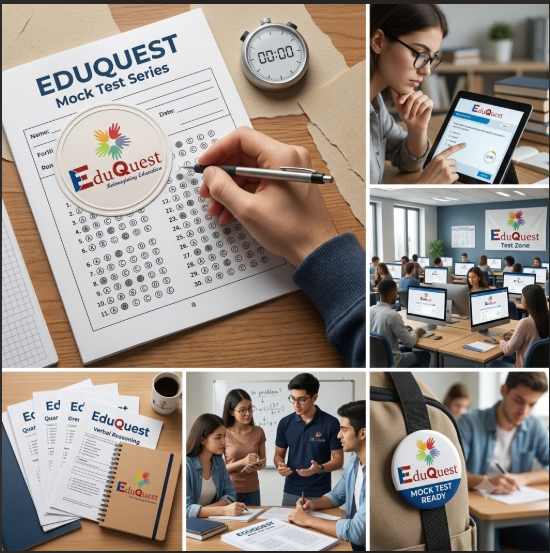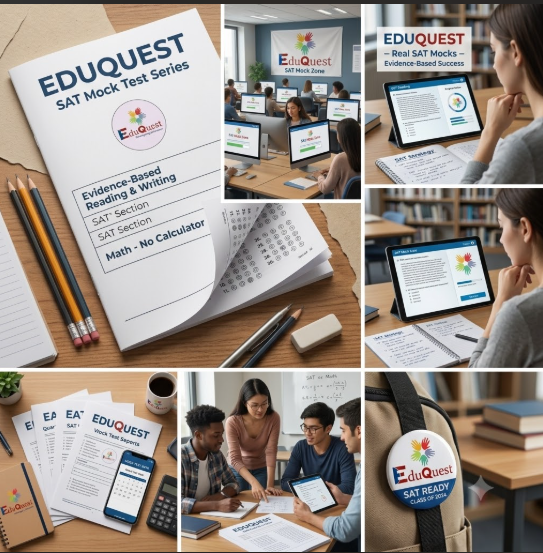

Whether preparing for global standardized admissions exams like the Digital SAT, ACT, UCAT, TMUA, or school board examinations (CBSE, ICSE, IB, Cambridge), students frequently hit a frustrating score plateau. They read textbooks, watch video tutorials, and complete untimed practice worksheets, yet their official scores fall short of expectations. The missing catalyst in their preparation is almost always the strategic execution of a mock test.
So, what is a mock test, and why is it considered the single most predictive indicator of exam-day success? A mock test is a full-scale, timed simulation of an official examination that replicates exact question styles, scoring algorithms, section durations, and psychological pressure. Rather than merely testing theoretical knowledge, mock tests evaluate cognitive stamina, pacing agility, stress resilience, and time management. Powered by EduQuest Mock Hub and EduPath, this comprehensive guide covers the different types of mock tests, the cognitive science behind testing, and the 4-step error analysis system that turns practice into top 1% percentiles.

Take Full-Length Practice Exams with EduQuest Mock Hub
Free Digital SAT Mock Test
Adaptive Full-Length Exam
Simulate the exact Bluebook Digital SAT format with adaptive modules, Desmos calculator, and instant score breakdowns.
Launch Free SAT MockUCAT Medical Mock Hub
Timed Cognitive Practice
Practice 2-hour full-length UCAT simulations with realistic subtest timing, onscreen calculator, and SJT band scoring.
Explore UCAT PracticePersonalized Test Roadmap
EduQuest EduPath Platform
Map your standardized test timeline connecting Class 10/11 subjects, diagnostic baselines, and target exam dates.
Launch EduPath Roadmap1. What Is a Mock Test? The Cognitive Science of Active Retrieval
A **mock test** is a practice examination designed to mirror the structure, timing, difficulty, and environment of an official standardized test. In cognitive psychology, the power of mock tests is grounded in the **Testing Effect** (or *Retrieval Practice*): the scientific finding that actively retrieving information from memory strengthens neural pathways far more effectively than passive re-reading.
Fast-Track Your College & Career Strategy
Get immediate, personalized AI insights tailored to your grade, strengths, and dream universities — 100% free with instant reports.
Know Your Personality Type for Free
Take our 18-question AI psychometric test to uncover your cognitive archetype, hidden learning superpowers, and ideal university courses.
Personalized Career & University EduPath
Build a step-by-step Grade 8–12 admissions blueprint with AI-matched target universities, exam schedules, and extracurricular profiles.
- 1. Diagnostic Baseline: Accurately measures your current standing, pinpointing specific sub-topic strengths and knowledge gaps before wasting months on generic study.
- 2. Cognitive Stamina & Endurance: Standardized exams require 2 to 4 hours of uninterrupted, high-level analytical focus. Mock tests build the neurological stamina needed to prevent mental exhaustion in the final 30 minutes.
- 3. Internal Chronometer Pacing: Trains your brain to instinctively allocate exact seconds per question type (e.g., 71 seconds for SAT Math, 14 seconds for UCAT Quantitative Reasoning).
- 4. Stress Inoculation & Anxiety Reduction: Experiencing the sensory constraints of timed tests eliminates exam-day shock and panic.
2. The 5 Main Types of Mock Tests & When to Take Them
Effective test preparation utilizes five specialized mock test formats across different stages of your study timeline:

| Mock Test Type | Optimal Phase to Use | Primary Objective | Testing Conditions | Expected Outcome |
|---|---|---|---|---|
| 1. Diagnostic Baseline Mock | Week 1 (Day 1 of prep) | Benchmark current score and map knowledge gaps | Full-length, timed, zero prior preparation | Precise baseline score + weak-topic heat map |
| 2. Sectional / Modular Drill | Weeks 2 to 5 (Content Phase) | Master specific domains (e.g., SAT Algebra, UCAT DM) | Timed 20–40 min bursts on single topics | Concept mastery and rapid pattern recognition |
| 3. Adaptive Computer-Based Mock | Weeks 4 to 7 (Bridge Phase) | Simulate multi-stage adaptive difficulty algorithms | Exact official software replica (e.g., Bluebook) | Familiarity with module routing and digital tools |
| 4. Full-Length Proctored Mock | Weeks 6 to 8 (Exam Simulation) | Replicate full physical and mental exam conditions | Strict timing, formal proctoring, exact start time | Stamina calibration and realistic score projection |
| 5. Buffer / Final Polish Mock | 7–10 days before real exam | Calibrate confidence and test-day pacing rhythm | Full-length under calm, low-stress conditions | Confidence lock-in and elimination of careless errors |
3. The 4-Step Scientific Error Analysis System
Top 1% test takers do not achieve high scores because they take more mock tests than everyone else—they achieve high scores because of how they dissect their incorrect answers. Use this 4-step error analysis protocol:
Categorize the Root Cause of Every Error
Classify every missed or guessed question into one of four buckets: (A) Conceptual Knowledge Gap, (B) Time Pressure Rush, (C) Misreading the Question Stem, or (D) Careless Algebraic/Calculation Slip.
Maintain a Dynamic "Mistake Log"
Record the question screenshot, the core concept tested, why your initial thought process failed, and the fastest 30-second shortcut to the correct answer.
Re-Solve Without Looking at Answer Keys
Before checking explanations, attempt the question again untimed. If you solve it correctly, your issue was timing; if you still cannot solve it, you have a foundational conceptual gap.
Complete 5 Similar Variation Drills
Immediately solve 5 similar questions testing the exact same sub-topic to ensure the newly learned concept is permanently locked into your long-term memory.
4. The 8-Week Mock Testing Roadmap: From Baseline to 99th Percentile
Follow this sequential 8-week timeline designed by EduQuest’s test prep faculty to peak on exam day:

Baseline Diagnostic & Heat Map Mapping
Establish Your True Starting Point
- Take a full-length, official diagnostic mock test with zero prior prep.
- Generate an EduQuest diagnostic score report to map topic-wise weaknesses.
Targeted Sub-Topic Drills & Concept Mastery
Eliminate Core Knowledge Gaps
- Focus 80% of study time on learning high-yield rules and formulas.
- Complete 25-minute timed modular drills on identified weak areas.
Adaptive Sectional Mocks & Pacing Calibration
Master Time-per-Question Rhythms
- Take 1 full-length adaptive mock per week under exact exam conditions.
- Spend 3–4 hours conducting rigorous 4-step error analysis for each test.
Full-Length Proctored Mocks Under High Pressure
Build Cognitive Stamina & Test-Day Reflexes
- Take 2 full-length proctored mocks per week at the exact time of your real exam.
- Review your cumulative Mistake Log every Sunday to prevent error repetition.
Final Confidence Polish & Rest Calibration
Lock In Pacing and Optimize Sleep Schedule
- Take one final confidence-building mock 5 days before test day.
- Spend the final 48 hours reviewing your Mistake Log, resting, and hydrating.
5. 5 Golden Rules for High-Yield Mock Testing
Replicate Exact Physical and Environmental Conditions
Take your mock tests at a desk, at the exact time of your real exam (e.g., Saturday at 8:00 AM), with your phone turned off, and using your approved testing device.
Always Use Official or High-Fidelity Adaptive Software
For digital exams like the SAT or UCAT, practice on software that accurately mimics the user interface, highlighter tools, onscreen calculators, and adaptive algorithms.
Never Pause the Timer for Any Reason
Pausing the timer to finish a question completely destroys the psychological pacing fidelity of the simulation. Accept the time pressure.
Treat the Final 30 Minutes with Utmost Respect
Cognitive fatigue peaks in the final section. Practice deep rhythmic breathing and posture adjustments between sections to stay sharp.
Track Error Trends, Not Just Composite Scores
A score fluctuation of ±30 points is normal due to test difficulty variation. Focus on whether your error rate on specific sub-topics is steadily trending toward zero.

6. Common Mock Test Mistakes That Ruin Student Preparation
- The "Quantity Over Quality" Fallacy: Taking 20 mock tests without conducting deep error analysis simply reinforces bad testing habits without improving your score.
- Taking Untimed or Fragmented Mocks: Splitting a 3-hour test across three separate days builds zero cognitive stamina and yields artificially inflated, misleading scores.
- Burning Out with Daily Mocks in the Final Week: Taking a mock test every single day before the exam exhausts your brain, guaranteeing cognitive fatigue on the actual test day.
- Using Unrealistic, Non-Adaptive Practice Materials: Practicing on outdated paper PDFs or poorly formatted online tests leaves you unprepared for official digital testing software.
7. How EduQuest Powers Your Mock Testing & Score Growth
At EduQuest, mastering standardized testing is driven by our integrated global admissions coaching ecosystem:
- 1. Official-Grade Adaptive Mock Hub: Access full-length, timed simulations for Digital SAT, ACT, UCAT, TMUA, and ESAT.
- 2. AI-Driven Sub-Topic Diagnostic Analytics: Receive instant heat-map reports showing exact areas of leakage and time spent per question.
- 3. 1-on-1 Strategy & Error Review with Top 1% Scorers: Work with elite coaches who scored in the 99th percentile to master high-speed shortcuts and pacing.
8. Frequently Asked Questions (FAQ) About Mock Tests
What is a mock test and why is it important?
A mock test is an exact simulation of an official exam with identical time constraints, question formats, and scoring rubrics. It is important because it builds cognitive stamina, improves pacing, inoculates against test anxiety, and provides diagnostic data on knowledge gaps.
How many mock tests should a student take before an exam?
Most successful students take between 6 and 10 full-length mock tests over a 6-to-8 week preparation period, paired with rigorous error analysis after every single test.
How often should I take a full-length mock test?
During the early phase, take 1 mock test every 1 to 2 weeks. In the final 4 weeks before the exam, take 1 to 2 mock tests per week, allowing at least 2 full days between tests for deep review.
What should I do if my score drops on a mock test?
Do not panic. Score fluctuations of ±30–50 points are common due to test difficulty variation and fatigue. Analyze the test to see if the drop was caused by careless errors, time management, or specific hard concepts.
Are EduQuest full-length mock tests free for students?
Yes! EduQuest offers free full-length diagnostic mock tests for the Digital SAT, UCAT, TMUA, and ACT with instant detailed score reports.
Download the 2026 Ultimate Mock Testing & Error Analysis Playbook
Get instant access to EduQuest’s 28-page whitepaper featuring mock testing calendars, error log templates, pacing cheat sheets, and top 1% score-building strategies.
Unlock Your 99th Percentile Test Score Today
Join 10,000+ ambitious students who have achieved top scores on the SAT, UCAT, TMUA, and ACT with EduQuest AI. Take your free full-length mock exam now.