Every major breakthrough in a student’s academic or professional life begins with a single, profound question: “Who am I, and where do my natural cognitive strengths truly belong?” For decades, students and young professionals have been evaluated almost exclusively on standardized test scores, raw marks, and rigid GPA metrics. However, research in cognitive psychology and behavioral science reveals that academic scores only measure past memorization—they fail to predict intrinsic motivation, strategic problem-solving styles, or long-term career fulfillment.
This is where a scientifically constructed personality test becomes transformative. Far from being a casual online quiz or horoscope, a modern personality test is a validated psychometric instrument that decodes how your brain perceives information, makes decisions, manages pressure, and interacts with the world. Whether you are a Class 10 student choosing between Science, Commerce, and Humanities, an undergraduate shortlisting target universities, or a parent guiding your child toward an authentic career, understanding how personality assessments work is the master key to unlocking your full potential.
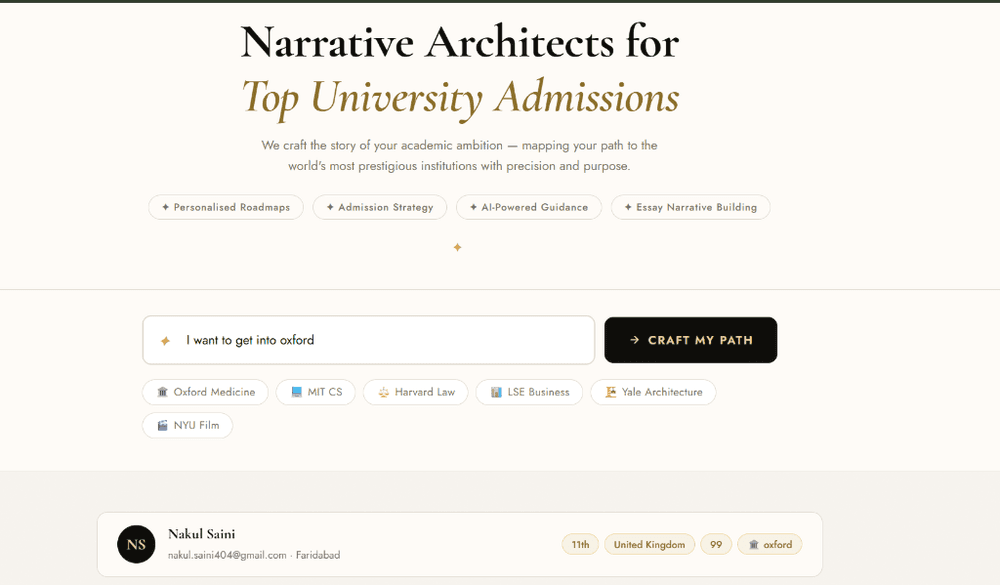
Fast-Track Your Self-Discovery with EduQuest AI
Free AI Assessment
Narrative Intelligence Scan
Take our 18-question psychometric scan to map your 16-type personality archetype, Class 11 stream fit, and university trajectory in 10 minutes.
Take Free Personality TestComprehensive Profile Hub
Student Personality Hub
Explore your cognitive strengths, career match index, and custom exam roadmaps calibrated across 10,000+ student success stories.
Explore Personality HubCareer Cluster AI
Career Cluster Assessment
Align your personality traits with high-growth 2030+ industry clusters spanning AI, Quantitative Finance, Deep Tech, and Bioethics.
Launch Career Cluster Tool1. What Is a Personality Test? Definition & Scientific Foundation
A personality test is a standardized psychological assessment designed to systematically measure an individual’s enduring behavioral patterns, emotional traits, interpersonal preferences, cognitive processing styles, and core motivational drivers. Psychometricians and cognitive scientists utilize these instruments to construct a multi-dimensional portrait of how a person naturally responds to various environmental stimuli, academic challenges, and collaborative dynamics.
Fast-Track Your College & Career Strategy
Get immediate, personalized AI insights tailored to your grade, strengths, and dream universities — 100% free with instant reports.
Know Your Personality Type for Free
Take our 18-question AI psychometric test to uncover your cognitive archetype, hidden learning superpowers, and ideal university courses.
Personalized Career & University EduPath
Build a step-by-step Grade 8–12 admissions blueprint with AI-matched target universities, exam schedules, and extracurricular profiles.
Unlike knowledge-based exams (such as math or physics tests) where there are strictly correct and incorrect answers, a personality assessment test has no passing or failing grades. Instead, it measures preference gradients—identifying where an individual naturally falls along spectrums such as introversion versus extraversion, analytical deduction versus intuitive pattern recognition, and structured execution versus spontaneous exploration.
Modern personality assessment rests upon three indispensable psychometric criteria:
- Construct Validity: The degree to which the assessment accurately measures the specific psychological traits it claims to evaluate (e.g., emotional resilience, analytical rigor, empathy) rather than random noise.
- Test-Retest Reliability: The consistency of results over time. If a student takes the assessment under stable conditions today and retakes it three months later, the underlying dimensional profile should exhibit high correlation.
- Predictive Utility: The statistical capacity of the test results to forecast real-world outcomes, including high school stream satisfaction, university retention rates, leadership efficacy, and career fulfillment.
2. The Major Types of Personality Tests: From MBTI to Narrative Intelligence
Over the past century, developmental psychologists and psychometricians have established diverse frameworks to categorize human behavior. Understanding the distinct types of personality tests allows students, educators, and career counselors to choose the precise diagnostic tool suited to their developmental stage.
A. The Myers-Briggs Type Indicator (MBTI)
Originating from the pioneering analytical psychology of Carl Gustav Jung and developed by Katharine Cook Briggs and Isabel Briggs Myers, the MBTI personality test categorizes individuals across four fundamental dichotomies, resulting in 16 distinct personality types:
- Extraversion (E) vs. Introversion (I): Where do you draw your energy? Extraverts recharge through social interaction and external stimulation; introverts recharge through quiet contemplation and solitary reflection.
- Sensing (S) vs. Intuition (N): How do you absorb information? Sensing types focus on concrete, tangible facts and present realities; intuitive types look for abstract patterns, future possibilities, and underlying theories.
- Thinking (T) vs. Feeling (F): How do you make decisions? Thinking types prioritize objective logic, empirical consistency, and rational deduction; feeling types prioritize personal values, human impact, and empathetic harmony.
- Judging (J) vs. Perceiving (P): How do you orient your lifestyle? Judging types prefer structured timelines, definitive closure, and organized plans; perceiving types thrive with open-ended flexibility, spontaneity, and adaptive pivots.
B. The Big Five Personality Model (OCEAN / Five-Factor Model)
Widely regarded in academic psychology and clinical research as the empirical gold standard, the Big Five model evaluates personality along five continuous spectrums rather than discrete types:
- Openness to Experience: High scorers exhibit strong intellectual curiosity, artistic sensitivity, and creative imagination; low scorers prefer familiar routines and practical pragmatism.
- Conscientiousness: High scorers display exceptional discipline, goal-oriented persistence, and meticulous organization; low scorers are more spontaneous and flexible.
- Extraversion: Evaluates sociability, assertiveness, enthusiasm, and energy directed toward the outer social sphere.
- Agreeableness: Measures cooperativeness, empathy, compassion, and trusting orientation toward peer groups.
- Neuroticism (Emotional Stability): Assesses emotional reactivity, anxiety threshold, and vulnerability to academic or environmental stress.
C. The Enneagram System
The Enneagram classifies human personality into 9 interconnected archetypes based on subconscious fears, core childhood motivations, and internal defense mechanisms (e.g., Type 1 Reformer, Type 3 Achiever, Type 5 Investigator, Type 8 Challenger). It is predominantly used for emotional self-awareness and personal growth.
D. The Holland Code (RIASEC Vocational Inventory)
Developed by psychologist John L. Holland, the RIASEC framework connects personality types directly with occupational environments across 6 themes: Realistic (Doers), Investigative (Thinkers), Artistic (Creators), Social (Helpers), Enterprising (Persuaders), and Conventional (Organizers). It serves as a foundational model for vocational counseling.
E. EduQuest Narrative Intelligence Scan (3rd Generation AI Assessment)
While traditional tests like MBTI and Big Five tell you what your traits are, they fail to connect those traits to modern educational realities—such as choosing between CBSE, ICSE, and IB curricula, selecting Class 11 subject combinations (PCM vs PCB vs Commerce with Applied Math), building a super-curricular research profile, or drafting an Ivy League Common App personal statement.
EduQuest’s Narrative Intelligence Test bridges this critical gap. Powered by advanced psychometric algorithms calibrated on over 10,000 high-achieving student profiles, the Narrative Intelligence Scan evaluates 6 proprietary cognitive vectors across 18 scenario-based questions to generate a complete academic and career intelligence blueprint.
Comparative Matrix: Major Personality Test Frameworks
| Assessment Model | Core Dimensions Evaluated | Psychological Paradigm | Best Used For | EduQuest Integration |
|---|---|---|---|---|
| Myers-Briggs (MBTI) | 4 Dichotomies (16 Archetypes: INTJ, ENFP, etc.) | Jungian Psychological Typology | Self-awareness, team dynamics & communication | Mapped directly into 16 student intelligence profiles |
| Big Five (OCEAN) | 5 Continuous Trait Spectrums (Openness to Neuroticism) | Empirical Factor Analysis | Academic research, psychological profiling & behavioral study | Used in emotional resilience and conscientiousness calibration |
| Holland Code (RIASEC) | 6 Work Themes (Realistic, Investigative, Artistic, etc.) | Vocational Psychology | Occupational matching & vocational stream alignment | Linked to EduQuest AI Career Cluster engine |
| Enneagram | 9 Personality Types & Wings | Motivational & Psycho-spiritual dynamics | Deep emotional healing and leadership coaching | Applied in college essay vulnerability framing |
| EduQuest Narrative Intelligence | 6 Cognitive Dimensions + 16 Archetypes + Story Arc | Adaptive AI Psychometrics & Admissions Science | Class 11 stream selection, Ivy League admissions, SAT/AP roadmap | The central engine powering all EduQuest diagnostics |
3. How Does a Personality Test Work? The Psychometrics & AI Science
Many people wonder how answering a series of multiple-choice questions can accurately reveal their deepest psychological tendencies and intellectual inclinations. Behind every legitimate personality test for students lies sophisticated statistical modeling, psychometric measurement theory, and modern artificial intelligence.
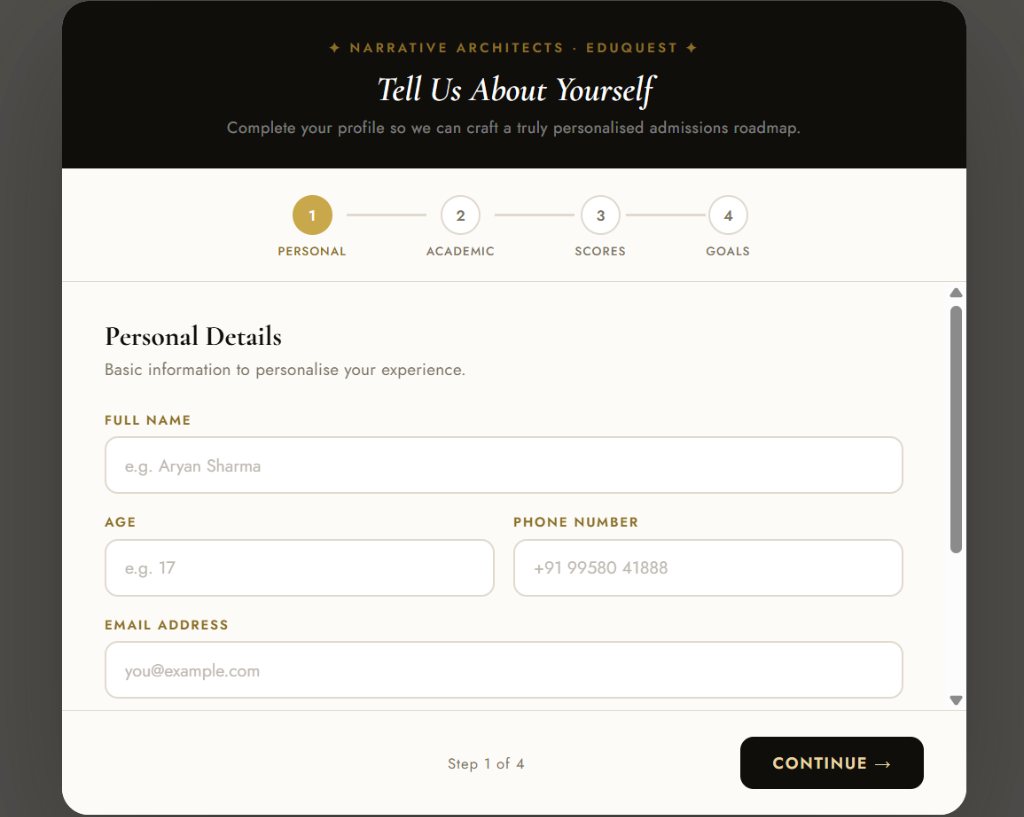
The scientific operation of a modern personality assessment unfolds in four interconnected stages:
Item Presentation & Scenario Prompts
18 Smart Multi-Dimensional Questions
- Rather than asking leading questions (e.g., "Are you smart?"), the test uses situational scenarios (e.g., "When encountering a complex research bottleneck with a tight deadline, what is your instinctive first step?").
- Each answer choice maps to distinct cognitive dimensions: Analytical, Creative, Leadership, Empathy, Ambition, and Resilience.
Neutralizing Social Desirability Bias
AI-Calibrated Response Verification
- Students often subconsciously select answers that portray an idealized version of themselves ("faking good").
- Modern AI psychometric engines employ ipsative cross-verification to detect conflicting response patterns and calibrate the true underlying trait signal.
Multi-Vector Trait Clustering
Mapping to 16 Intelligence Archetypes
- Your answers generate scores across the 6 cognitive vectors.
- The algorithm clusters your dimensional vector into one of the 16 globally recognized MBTI student archetypes (such as INTJ The Architect or ENFP The Campaigner).
Translating Traits into Actionable Roadmaps
Stream, University & Career Intelligence
- The system cross-references your personality archetype with global university admissions criteria (Harvard, Oxford, MIT, NUS, etc.).
- Generates a comprehensive 20+ page intelligence report detailing recommended Class 11 subjects, career matches, standardized exam strategies, and scholarship opportunities.
4. Deep Dive: EduQuest’s Narrative Intelligence Test (The New Frontier)
What makes EduQuest’s Narrative Intelligence Test radically different from standard personality tests found on the internet? The answer lies in the fundamental distinction between raw mental horsepower and narrative direction.
IQ measures your mental processing horsepower; Narrative Intelligence determines the direction you steer the vehicle and the compelling story you build with your life.
— EduQuest Chief Psychometric Officer
Our AI engine deconstructs your cognitive profile across 6 Core Dimensions:
Analytical Rigor (Blue Vector)
Measures logical deduction, quantitative intuition, algorithmic problem-solving, and empirical skepticism. High analytical scorers thrive in STEM, Quantitative Economics, Deep Tech, and Algorithmic Trading.
Creative Divergence (Purple Vector)
Evaluates lateral thinking, conceptual novelty, interdisciplinary synthesis, and creative ideation. Essential for innovators, industrial designers, architectural visionaries, and creative strategists.
Leadership & Agency (Teal Vector)
Assesses executive decision-making under uncertainty, persuasive communication, team orchestration, and intrinsic agency. Predictive of success in venture capital, corporate strategy, law, and entrepreneurship.
Empathy & Social Resonance (Pink Vector)
Measures interpersonal sensitivity, ethical reasoning, active listening, and social impact orientation. Key indicator for clinical medicine, clinical psychology, diplomacy, and bioethics.
Intrinsic Ambition (Orange Vector)
Evaluates long-term vision clarity, milestone persistence, internal drive, and appetite for calculated intellectual risks. Crucial for Ivy League and top-tier global university admits.
Cognitive Resilience (Green Vector)
Assesses stress tolerance, adaptability during unforeseen failures, cognitive agility, and post-adversity rebound. Determines how effectively a student handles high-stakes exams like SAT, UCAT, or APs.
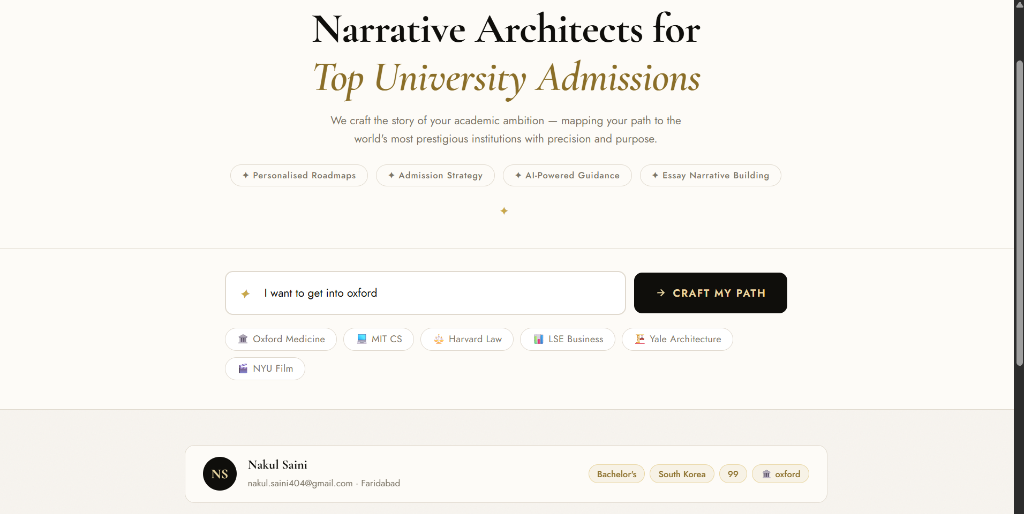
5. The 16 Personality Archetypes: Complete Academic & Career Guide
When you complete the personality test, your cognitive vectors coalesce into one of 16 globally recognized MBTI personality archetypes. These 16 types are organized into 4 distinct temperament families, each embodying unique academic strengths, subject preferences, and optimal career horizons:
Group 1: The Analysts (Intuitive & Thinking — INTJ, INTP, ENTJ, ENTP)
The Analysts are rational, strategic, and relentlessly inquisitive system-builders. They are driven by theoretical mastery, logical consistency, and technological innovation.
- INTJ (The Architect — 📐): Strategic visionaries who build complex future systems. Ideal Stream: Science (PCM with Computer Science). Top Careers: AI Research Scientist, Aerospace Engineer, Quantitative Fund Manager, Chief Strategy Officer. Recommended Exams: Digital SAT, TMUA, AP Computer Science A, AP Calculus BC.
- INTP (The Deviser / Logician — 💡): Deep abstract theorists who solve unsolvable intellectual puzzles. Ideal Stream: Pure Sciences / Advanced Mathematics. Top Careers: Theoretical Physicist, Cryptographer, Bioinformatics Researcher, Software Architect. Recommended Exams: SAT, AP Physics C, Olympiad Math.
- ENTJ (The Director / Commander — 👑): Natural leaders built to organize large-scale institutions and scale ventures. Ideal Stream: Commerce with Mathematics / Economics. Top Careers: Investment Banker, Corporate Litigation Attorney, Venture Capitalist, Tech Founder. Recommended Exams: ACT, AP Microeconomics, LNAT for Law.
- ENTP (The Debater / Visionary — ⚡): Unstoppable idea generators who challenge the status quo. Ideal Stream: Interdisciplinary IB / Economics & Data Science. Top Careers: Startup Founder, Venture Architect, Investigative Journalist, Intellectual Property Lawyer.
Group 2: The Diplomats (Intuitive & Feeling — INFJ, INFP, ENFJ, ENFP)
The Diplomats are empathetic, idealistic, and deeply purpose-driven. They focus on human potential, social ethics, storytelling, and transformative cultural leadership.
- INFJ (The Advocate — 🌿): Quietly powerful visionaries dedicated to elevating human consciousness. Ideal Stream: Humanities / Psychology / International Relations. Top Careers: Clinical Neuropsychologist, Diplomat, Bioethics Counsel, Sustainability Director. Recommended Prep: Study Abroad Counseling, AP Psychology.
- INFP (The Mediator / Dreamer — 🌸): Values-centered creators guided by internal authenticity and artistic empathy. Ideal Stream: Humanities & Literature / Creative Arts. Top Careers: UX/Ethical Tech Designer, Novelist, Human Rights Advocate, Environmental Policy Analyst.
- ENFJ (The Protagonist / Mentor — 🌟): Charismatic and inspiring leaders who bring out the best in communities. Ideal Stream: Social Sciences / Political Science / Pre-Law. Top Careers: UN Diplomat, Non-Profit CEO, Educational Innovator, Public Policy Strategist. Recommended Exams: LNAT, AP Comparative Government.
- ENFP (The Campaigner — 🌈): Enthusiastic trailblazers who see possibilities everywhere. Ideal Stream: Liberal Arts / Media & Global Communications. Top Careers: Brand Strategist, Creative Producer, Social Entrepreneur, Innovation Consultant.
Group 3: The Sentinels (Sensing & Judging — ISTJ, ISFJ, ESTJ, ESFJ)
The Sentinels are practical, orderly, and deeply reliable procedural champions. They preserve institutional integrity, ensure operational excellence, and uphold ethical standards.
- ISTJ (The Inspector / Logistician — 📊): Methodical facts-first analysts with unwavering precision. Ideal Stream: Commerce (Accounting & Finance) / Engineering. Top Careers: Forensic Accountant, Actuary, Civil Engineer, Cybersecurity Compliance Director.
- ISFJ (The Protector — 🛡️): Dedicated guardians who combine meticulous attention to detail with deep compassion. Ideal Stream: Science (PCB / Pre-Med). Top Careers: Physician / Surgeon, Clinical Pharmacist, Healthcare Administrator, Research Scientist. Recommended Prep: UCAT Coaching, MMI Medical Interview Prep.
- ESTJ (The Executive — 🏛️): Exemplary administrators who bring order, efficiency, and clarity to complex structures. Ideal Stream: Business Administration / Commerce with Applied Math. Top Careers: Operations Director, Corporate Auditor, Supply Chain Architect, Civil Services Officer.
- ESFJ (The Provider — 🤝): Collaborative team-builders who create harmonious, high-functioning organizations. Ideal Stream: Healthcare Management / Hospitality / Human Resources. Top Careers: Hospital Director, Corporate HR Head, Public Relations Manager, Clinical Psychologist.
Group 4: The Explorers (Sensing & Perceiving — ISTP, ISFP, ESTP, ESFP)
The Explorers are spontaneous, tactile, and pragmatic problem-solvers who thrive in dynamic environments requiring immediate physical or technical mastery.
- ISTP (The Crafter / Virtuoso — 🛠️): Pragmatic engineers who master tools and understand mechanical systems intuitively. Ideal Stream: Applied Science / Robotics Engineering. Top Careers: Robotics Specialist, Cyber Forensics Investigator, Commercial Pilot, Industrial Designer.
- ISFP (The Artist — 🎨): Aesthetic masters who bring beauty, harmony, and sensory richness to real-world products. Ideal Stream: Architecture / Visual Arts / Product Design. Top Careers: Architectural Designer, Augmented Reality (AR) Artist, Fashion Technologist, Industrial Stylist.
- ESTP (The Persuader — 🔥): High-energy negotiators and action-oriented problem-solvers who excel under high pressure. Ideal Stream: Entrepreneurship / Finance / Sports Science. Top Careers: Derivatives Trader, Venture Dealmaker, Sports Management Executive, Emergency Trauma Specialist.
- ESFP (The Entertainer — 🎭): Vibrant communicators who captivate audiences and bring energy to every room. Ideal Stream: Mass Media / Performing Arts / Event Architecture. Top Careers: Broadcast Journalist, Entertainment Producer, Hospitality Mogul, Creative Director.
Master Guide: The 16 Personality Archetypes at a Glance
| Code | Archetype Name | Dominant Cognitive Strength | Recommended Stream (Class 11) | Top Global University Majors | Target Careers (2030+) |
|---|---|---|---|---|---|
| INTJ | The Architect | Strategic System Design | Science (PCM + CS) | Computer Science, Pure Math, Quant Finance | AI Scientist, Quantum Architect, Quant Trader |
| INTP | The Deviser | Abstract Logic & Theory | Science (PCM / Math) | Theoretical Physics, Philosophy, Software | Bioinformatics Lead, Cryptographer, ML Researcher |
| ENTJ | The Director | Decisive Structural Leadership | Commerce with Math / Pre-Law | Economics, Corporate Law, Business Analytics | Venture Capitalist, M&A Lawyer, Tech Founder |
| ENTP | The Debater | Divergent Innovation | Interdisciplinary IB / Commerce | Economics, Data Science, Media Studies | Product Architect, Startup Strategist, IP Lawyer |
| INFJ | The Advocate | Empathetic Vision & Ethics | Humanities / Psychology | Psychology, Global Affairs, Sustainability | Clinical Neuropsychologist, UN Diplomat, Bioethicist |
| INFP | The Mediator | Values-Driven Authenticity | Humanities & Literature | Literature, UX Design, Environmental Policy | UX Ethicist, Human Rights Advocate, Author |
| ENFJ | The Protagonist | Charismatic Community Building | Social Sciences / Pre-Law | Political Science, Public Policy, Education | Diplomatic Envoy, Non-Profit CEO, Policy Director |
| ENFP | The Campaigner | Creative Possibility Catalysis | Liberal Arts / Media | Global Communications, Marketing, Design | Brand Architect, Creative Producer, Social Innovator |
| ISTJ | The Inspector | Methodical Precision & Duty | Commerce / Engineering | Accounting, Finance, Civil Engineering | Forensic Auditor, Actuary, Cybersecurity Director |
| ISFJ | The Protector | Compassionate Stewardship | Science (PCB / Pre-Med) | Medicine, Biomedical Science, Nursing | Surgeon, Clinical Researcher, Healthcare Executive |
| ESTJ | The Executive | Operational Governance | Commerce with Applied Math | Business Administration, Supply Chain, Law | Operations VP, Corporate Auditor, Civil Services |
| ESFJ | The Provider | Collaborative Team Harmony | Commerce / Healthcare Mgmt | Human Resources, Hospital Administration | Chief People Officer, Clinical Admin, PR Director |
| ISTP | The Crafter | Tactile & Technical Mastery | Applied Sciences / Engineering | Mechanical & Robotics Engineering, Aviation | Robotics Engineer, Cyber Investigator, Pilot |
| ISFP | The Artist | Aesthetic & Spatial Sensibility | Design / Architecture | Architecture, Industrial Design, Fine Arts | AR Product Designer, Architect, Creative Technologist |
| ESTP | The Persuader | Tactical Action under Pressure | Commerce / Sports Science | Finance, Entrepreneurship, Sports Science | Investment Trader, Venture Dealmaker, ER Specialist |
| ESFP | The Entertainer | Dynamic Experiential Engagement | Media / Performing Arts | Mass Media, Entertainment Management | Broadcast Anchor, Creative Director, Event Architect |
6. The 6 Game-Changing Benefits of Taking a Personality Test for Students
Why is taking a high-caliber personality test for students one of the most high-ROI decisions a family can make in high school? Let us examine the six verified benefits backed by psychometric research and admissions statistics:
- Flawless Class 11 Stream Selection: Eliminates the agonizing confusion between Science (PCM/PCB), Commerce, and Humanities. Instead of following peer trends or outdated parental assumptions, students choose streams that resonate with their intrinsic cognitive strengths.
- Eliminating College Major Mismatch & Mid-Degree Burnout: Research shows that nearly 35% of undergraduate students switch majors or regret their degree choice within the first two years. Early personality profiling aligns academic subjects with long-term psychological durability.
- Unlocking Super-Curricular & Research Profile Breakthroughs: Elite universities abroad (Harvard, Stanford, Oxford, Cambridge) do not want one-dimensional high scorers; they seek students with focused intellectual spikes. Personality intelligence guides students toward research paper topics, Olympiads, and capstone projects that genuinely reflect their cognitive DNA.
- Crafting Standout Ivy League & Global Admissions Essays: Admissions officers read tens of thousands of personal statements. Students who understand their Narrative Intelligence archetype write authentic, memorable Common App and UCAS essays that stand out instantly.
- Tailoring Standardized Exam Strategies: An INTJ student requires a different SAT or ACT study roadmap than an ENFP or ESFJ. Understanding your learning archetype allows for personalized preparation in tests like the Digital SAT, UCAT, and TMUA.
- Lifelong Emotional Intelligence & Interpersonal Leadership: Identifying your blind spots, stress triggers, and communication preferences builds self-regulation, empathy, and collaborative maturity—skills vital for 21st-century leadership.
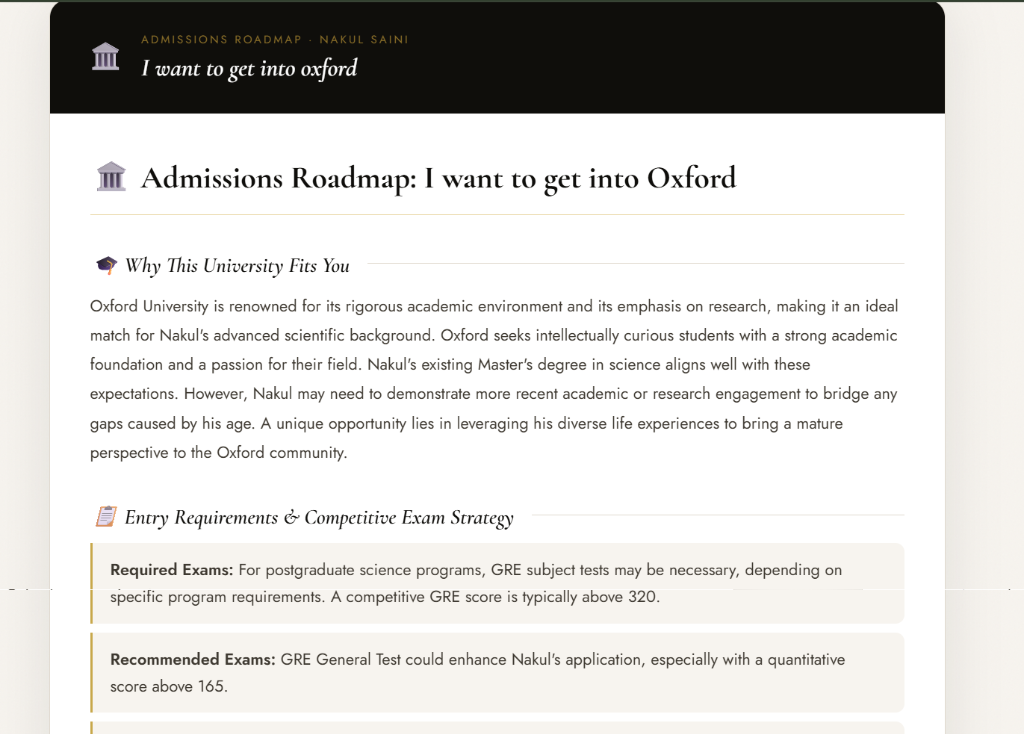
7. How to Take a Personality Test for Accurate Results: 5 Golden Rules
A psychometric assessment is only as accurate as the authenticity of the test-taker’s responses. To ensure you receive actionable, distortion-free guidance, adhere to these five psychometric best practices:
Practice Radical Self-Honesty
Answer based on who you ACTUALLY are in your daily life, not who you wish you were or who your parents want you to be. There are zero wrong answers.
Trust Your First Instinct (Don’t Overthink)
Overanalyzing questions often leads to "social desirability bias," where you attempt to predict the "ideal" response. Your instinctive 3-second gut reaction is usually the most psychologically accurate.
Choose a Calm, Distraction-Free Environment
Dedicate 10 to 12 uninterrupted minutes on a laptop or mobile device. Avoid taking the test when you are rushed, exhausted, or emotionally distressed.
Look at the Dimensional Continuum, Not Just the Letters
Pay close attention to your percentage distributions (e.g., 55% Introvert vs 45% Extravert indicates ambivert balance, whereas 95% Introvert represents intense solitary focus).
Triangulate with a Qualified Education Advisor
Review your full intelligence report alongside an EduQuest counselor to convert theoretical insights into high school course selections and university applications.
Common Pitfalls to Avoid
- The "Horoscope" Fallacy: Treating a personality test as an unchangeable astrological prophecy rather than a dynamic psychometric map of current cognitive tendencies.
- The Peer Conformity Trap: Taking the test together with friends and choosing matching answers to obtain the same personality type.
- The Fixed Mindset Blunder: Using your personality type as an excuse for developmental weaknesses (e.g., "I am an Introvert, so I will never participate in class debates").
- Ignoring Dimensional Nuance: Focusing exclusively on the 4-letter archetype code while overlooking the 6 dimensional scores and career fit percentages.
8. How EduQuest Turns Personality Intelligence into Global Admissions Success
At EduQuest, we believe that psychometrics should not end with an interesting report—it must be the launchpad for world-class educational execution. Our admissions and test prep ecosystem integrates your Narrative Intelligence profile across three pillars:
- 1. Strategic Stream & Curriculum Architecture: We help students in Class 8, 9, 10, and 11 choose the exact subject combinations in CBSE, ISC, Cambridge (IGCSE/A-Levels), or IB Diploma that maximize both board marks and global university prerequisite fulfillment.
- 2. Super-Curricular Spikes & Research Papers: Based on your archetype (e.g., INTJ in Deep Tech, INFJ in Public Health, ENTJ in Economics), we mentor students to write and publish original academic research papers, enter prestigious competitions (Regeneron ISEF, John Locke Essay Prize), and build high-impact capstone initiatives.
- 3. Bespoke Standardized Test Coaching & Essay Crafting: From scoring 1550+ on the Digital SAT to acing the UCAT for Oxford Medicine, LNAT for Cambridge Law, or TMUA for Imperial Computing, our pedagogy is adapted to your learning style.
9. Frequently Asked Questions (FAQ) About Personality Tests
What is a personality test, and how does it help high school students?
A personality test is a standardized psychometric assessment that measures your cognitive preferences, emotional traits, and behavioral patterns. For high school students, it removes guesswork from Class 11 stream selection (Science vs. Commerce vs. Humanities), reveals optimal career pathways, and pinpoints academic subjects that match your natural intellectual strengths.
How long does the EduQuest Narrative Intelligence Test take?
The assessment takes approximately 8 to 12 minutes to complete. It consists of 18 scenario-based psychometric questions across 6 core cognitive dimensions, each with four intuitive response options.
Is the EduQuest personality test free?
Yes! The online Narrative Intelligence Scan is 100% free to take. Upon completion, you receive an instant, comprehensive intelligence report with personality archetype traits, stream recommendations, and university insights at zero cost.
Can my personality test results change over time?
While core cognitive preferences (such as introversion or analytical inclination) remain relatively stable throughout life, your trait expressions, emotional resilience, and leadership maturity evolve as you gain new experiences, overcome challenges, and complete higher education. Retaking the test annually is a great way to track your personal growth.
Which class or age group is this test designed for?
The test is optimized primarily for students in Classes 8, 9, 10, 11, and 12 (ages 13–19), as well as undergraduate university students seeking clarity on graduate studies, competitive exams (SAT, ACT, UCAT, TMUA), and global career choices.
What is the difference between MBTI and the Big Five personality test?
The MBTI categorizes individuals into 16 distinct qualitative archetypes based on 4 dichotomies (e.g., INTJ, ENFP), making it highly accessible for career design and communication. The Big Five measures 5 continuous quantitative trait spectrums (Openness, Conscientiousness, Extraversion, Agreeableness, Neuroticism) and is the standard in academic and clinical psychology research.
How accurate is EduQuest’s AI personality mapping?
Our AI engine utilizes a multi-vector psychometric scoring algorithm calibrated on over 10,000 student success records, board exam performances, and top-tier global university admits, providing exceptionally reliable directional guidance.
How does this test help with foreign university admissions (USA, UK, Canada)?
Top global universities look for authentic self-awareness and intellectual passion. Your Narrative Intelligence report highlights your unique archetype, helping you craft compelling Common App personal statements, UCAS essays, and extracurricular profiles that resonate with Ivy League and Russell Group admissions committees.
Download the 2026 Student Personality & Stream Selection Blueprint
Get instant access to EduQuest’s comprehensive 28-page whitepaper detailing all 16 MBTI student archetypes, Class 11 stream matrices, and Ivy League essay strategies.
Discover Your Authentic Personality & Intelligence Profile Today
Join 10,000+ ambitious students who have transformed their academic and career trajectory with EduQuest AI. Take the free 10-minute scan now.