

Securing an offer from a top-tier medical, dental, or veterinary school in the United Kingdom, Australia, Canada, or the United States is one of the most intellectually demanding admissions journeys in the world. While stellar academic scores (A*s in A-Levels/IB, 95%+ in CBSE/ICSE) and high percentiles on entrance exams like the UCAT or MCAT earn you an interview invitation, they guarantee nothing on decision day. At over 85% of leading medical universities, the final hurdle is the Multiple Mini Interview (MMI).
So, what is an MMI interview, and why has it replaced traditional panel interviews? The MMI interview is a circuit-based assessment designed to evaluate non-cognitive clinical qualities—such as medical ethics, empathy, critical communication, resilience under pressure, and situational judgment. Rather than being evaluated by a single panel for 30 minutes, candidates rotate through 6 to 10 timed, independent stations. Powered by EduQuest MMI Masterclass and EduPath, this comprehensive guide explains the MMI format, station types, evaluator scoring rubrics, and the proven preparation blueprint to secure your place in medical school.

Master the MMI Interview with EduQuest AI
AI MMI Station Simulator
Interactive Station Practice
Simulate real-world ethical dilemmas, actor role-plays, and communication stations with instant clinical feedback.
Launch MMI SimulatorElite UCAT Coaching
Score 3000+ & Band 1 SJT
Master cognitive subtests and Situational Judgement with former top 1% scorers and medical school admissions readers.
Explore UCAT CoachingPersonalized Medical Roadmap
EduQuest EduPath Platform
Map your medical school timeline connecting GCSE/Class 10 subjects, clinical shadow hours, UCAT dates, and MMI circuits.
Launch EduPath Roadmap1. What Is an MMI Interview? History, Purpose & Circuit Mechanics
The **Multiple Mini Interview (MMI)** was pioneered in 2002 by researchers at McMaster University Michael G. DeGroote School of Medicine in Canada. It was developed to solve a critical flaw in traditional panel interviews: *interviewer bias* and *unreliable subjective scoring*.
Fast-Track Your College & Career Strategy
Get immediate, personalized AI insights tailored to your grade, strengths, and dream universities — 100% free with instant reports.
Know Your Personality Type for Free
Take our 18-question AI psychometric test to uncover your cognitive archetype, hidden learning superpowers, and ideal university courses.
Personalized Career & University EduPath
Build a step-by-step Grade 8–12 admissions blueprint with AI-matched target universities, exam schedules, and extracurricular profiles.
In an MMI circuit, candidates move through a series of structured stations. Here is how the standard circuit functions:
- 1. Station Count: Typically consists of 6 to 10 stations (some universities use 8 core stations plus 1 rest station).
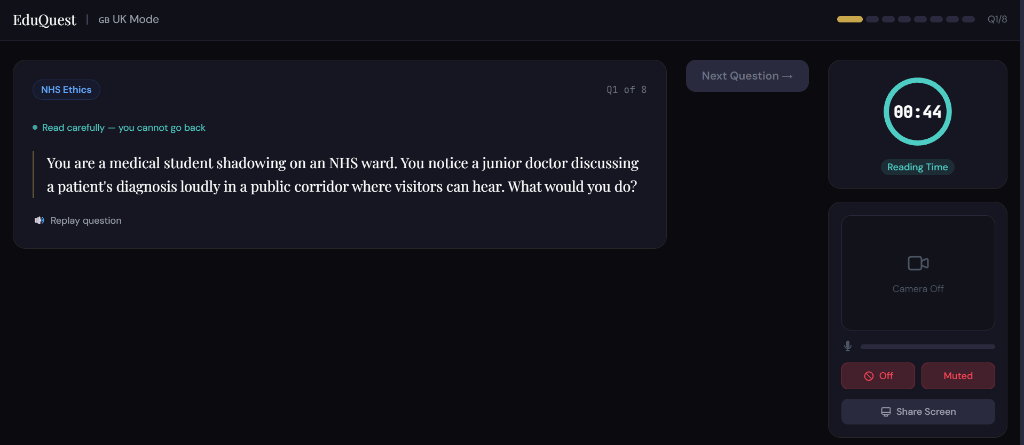
- 2. Reading Time: Candidates get 1 to 2 minutes outside the station door (or virtual breakout room) to read the scenario prompt, absorb constraints, and formulate a structured response.
- 3. Interview Duration: Candidates spend 6 to 8 minutes inside each station answering examiner follow-ups or engaging in live role-play with a trained actor.
- 4. Independent Examiners: Each station is graded independently by a different evaluator (clinical doctor, senior medical student, medical ethicist, or patient representative).
- 5. The "Clean Slate" Reset: If you struggle at one station, your score at that station has zero influence on the next examiner, giving you a fresh opportunity to excel at every turn.
2. The 7 Core Types of MMI Stations (With Real-World Clinical Scenarios)
While every university designs its own circuit, over 95% of MMI stations fall into seven standardized clinical and behavioral categories:

| Station Type | Core Clinical Competency Evaluated | Sample Real-World MMI Scenario Prompt | Key Framework to Apply |
|---|---|---|---|
| 1. Ethical Dilemma | Application of 4 Pillars of Medical Ethics (Autonomy, Beneficence, Non-Maleficence, Justice) | A 15-year-old requests confidential contraceptive advice without parental knowledge. How do you proceed? | 4 Pillars of Ethics + Fraser Guidelines |
| 2. Actor Role-Play | De-escalation, empathy, breaking difficult news, active listening | You are a junior doctor. A distressed patient is angry because their elective surgery was postponed. Speak with them. | SPIKES Protocol + De-escalation steps |
| 3. Motivation & Personal Insight | Authentic desire for medicine, reflection on clinical work experience | Why do you want to be a doctor rather than a clinical nurse or medical researcher? | STARR Reflection + NHS Core Values |
| 4. Prioritization & Critical Thinking | Resource allocation, structured logical triage under time constraints | You have 1 ICU ventilator and 2 critically ill patients (a 24yo athlete and a 65yo surgeon). Who receives it? | Clinical Utility + Transparent Criteria |
| 5. Calculation & Data Interpretation | Mental math, drug dosage accuracy, graph analysis under stress | Calculate the required infusion rate in ml/hr for a 70kg patient needing 5mg/kg/hr of medication. | Units Conversion + Step-by-Step Working |
| 6. Teamwork & Communication | Giving clear instructions, active collaboration, humility in leadership | Guide a blindfolded teammate to assemble a specific Lego model using only verbal directions. | Clear Spatial Terms + Feedback Loops |
| 7. Current Healthcare Policy | Awareness of NHS challenges, global healthcare equity, medical technology | Should the NHS fund expensive experimental gene therapies for rare diseases? | Economic Justice + Health Equity Analysis |
3. MMI Scoring Criteria: What Evaluators Secretly Look For
MMI examiners use standardized rubric sheets to grade candidates across specific behavioral domains rather than gut feeling:

- 1. Communication & Articulation (25%): Clear, structured language, appropriate pace, professional tone, and avoidance of medical jargon when speaking to patients.
- 2. Ethical Reasoning & Balance (25%): Exploring both sides of a dilemma, acknowledging conflicting ethical duties, and justifying decisions rationally.
- 3. Empathy & Interpersonal Warmth (20%): Validating emotional distress, maintaining empathetic eye contact, and showing genuine compassion in role-plays.
- 4. Critical Thinking & Problem Analysis (15%): Identifying missing information, asking clarifying questions, and demonstrating logical deduction.
- 5. Professional Demeanor & Composure (15%): Handling challenging follow-up questions calmly without becoming defensive or argumentative.
4. The 4-Stage MMI Preparation Blueprint: From Novice to Confident Medic
Follow this proven preparation timeline developed by EduQuest’s medical school faculty to master the MMI circuit:

Ethics Foundations & Healthcare Literacy
Master the 4 Pillars & GMC Good Medical Practice
- Study the 4 Pillars of Medical Ethics: Autonomy, Beneficence, Non-Maleficence, and Justice.
- Read GMC Good Medical Practice guidance and understand Gillick competence / Fraser guidelines.
Framework Mastery & Behavioral Scenarios
Learn Structured Response Frameworks
- Master communication frameworks: SPIKES for breaking bad news and CAMP for personal insight questions.
- Practice structured thinking: state the core conflict ➡️ analyze perspective A ➡️ analyze perspective B ➡️ propose a nuanced resolution.
Timed Circuit Simulations & AI Practice
Execute Full 8-Station Timed Circuits
- Simulate realistic 7-minute stations with 1-minute reading times using the [EduQuest AI MMI Simulator](/mmi-interview).
- Practice role-plays with mentors and former admissions readers to eliminate filler words and hesitation.
Mindset Calibration & Clean Slate Readiness
Polish Non-Verbal Cues & Stress Management
- Review current NHS hot topics (junior doctor strikes, AI diagnostics, waiting list backlogs).
- Practice deep breathing and master the "reset button" mentality between stations.
5. 5 Golden Rules to Score in the Top 5% at Any MMI Station
Use the 1-Minute Reading Time Strategically
Do not panic. Identify the core ethical dilemma, determine which stakeholder perspectives matter, and organize your response into three clear points before entering the room.
Anchor in the 4 Pillars, but Avoid Buzzword Dumping
Do not just say "This relates to autonomy." Explain *why* the patient’s right to self-determination conflicts with non-maleficence in this specific clinical context.
Treat Every Station as a Clean Slate
If you feel you gave a poor answer at Station 3, leave it behind completely. Station 4 is graded by an independent examiner who has no idea what happened previously.
Demonstrate Active Listening in Role-Plays
In role-plays with distressed actors, stop speaking and listen. Validate their emotions first ("I hear how upsetting this must be for you") before offering solutions.
Acknowledge Nuance—Avoid Rigid Extremes
Real medicine is full of grey areas. High-scoring candidates show humility, weigh competing considerations, and propose safe, balanced, patient-centered conclusions.
6. Common MMI Mistakes That Lead to Instant Rejection
- Memorizing Scripted Answers: Reciting rehearsed responses makes you sound robotic and prevents you from adapting when examiners introduce sudden twists to the scenario.
- Taking an Aggressive or One-Sided Moral Stance: Declaring an ethical dilemma "simple" and ignoring the valid perspective of the other party demonstrates dangerous dogmatism.
- Breaking Character in Actor Role-Plays: Looking at the examiner for help or laughing nervously during a simulation breaks the clinical reality and lowers communication scores.
- Neglecting NHS Core Values: Failing to demonstrate respect, dignity, compassion, and working together for patients in every scenario leads to low score bands.
7. How EduQuest Empowers Your Medical School Journey
At EduQuest, mastering the **MMI interview** is part of our integrated global medical school admissions coaching ecosystem:
- 1. AI MMI Simulation Circuits: Practice over 100+ validated ethical scenarios, role-plays, and calculation stations with real-time scoring.
- 2. 1-on-1 Mock Panels with Former Interviewers: Receive detailed qualitative debriefs from clinical doctors, NHS consultants, and admissions readers.
- 3. Elite Test Prep & Admissions Strategy: Comprehensive coaching for UCAT Preparation, super-curricular research, and Global Study Abroad Medical Placement.
8. Frequently Asked Questions (FAQ) About MMI Interviews
What is an MMI interview and how is it different from a traditional interview?
An MMI (Multiple Mini Interview) is a circuit-based interview format where candidates rotate through 6–10 timed stations, each graded independently by a different evaluator. Unlike traditional panel interviews, MMIs evaluate ethical reasoning, empathy, communication, and situational judgment with minimal interviewer bias.
How long does an MMI station last?
A standard MMI station lasts 6 to 8 minutes, preceded by 1 to 2 minutes of dedicated reading time outside the station to review the prompt and formulate a structured plan.
Can I prepare for an MMI interview by myself?
Yes, by practicing timed ethical frameworks (like the 4 Pillars), recording yourself, and using the EduQuest AI MMI Simulator. However, practicing role-plays with experienced mentors gives critical qualitative feedback on tone and body language.
Are MMI interviews conducted virtually or in person?
Both! Many UK and Australian universities use online virtual MMIs via platforms like Microsoft Teams or bespoke software, while others host in-person circuits on campus.
What happens if I perform poorly on one MMI station?
Each station is scored independently. Examiners have no knowledge of your performance at previous stations, allowing you to reset and achieve full marks on subsequent stations.
Download the 2026 MMI Medical Interview Master Guide
Get instant access to EduQuest’s 32-page whitepaper featuring 50 high-yield ethical scenarios, model role-play transcripts, SPIKES frameworks, and scoring rubrics.
Master Your Medical School MMI Interview Today
Join hundreds of successful medical students who secured offers at Oxford, Cambridge, Imperial, Monash, and KCL with EduQuest AI. Book your mock circuit now.