Indian students are used to marks. A CBSE or ISC board exam has a total of 80 or 100. An engineering or medical entrance test has a maximum of 300 or 720. A school term test is out of 50. So when students and parents first explore the ACT, the questions naturally take the same shape: How many marks is the ACT exam? What is the pass mark? What is full marks? Is 28 good or bad?
The ACT does not operate the way Indian board or entrance exams do, and understanding why will completely transform the way you prepare. There are no "marks" in the traditional sense, no minimum pass threshold, and no negative deduction for wrong guesses. Instead, your raw correct answers are statistically equated into standardized scale scores on a 1 to 36 continuum, combined into a Composite, and evaluated by global admissions committees in the context of their applicant pool.
This guide explains ACT exam scores from the ground up for the Enhanced ACT of 2026: the ACT exam score range, how raw answers become scale scores, how the composite is calculated (and how you can calculate it yourself), what STEM, ELA and Writing scores mean, how superscoring works, what the ACT exam highest score really signifies, how to set a realistic score for ACT exam applications, and how the calculator you bring fits into all of this.
Fast-Track Your College & Career Strategy
Get immediate, personalized AI insights tailored to your grade, strengths, and dream universities — 100% free with instant reports.
Know Your Personality Type for Free
Take our 18-question AI psychometric test to uncover your cognitive archetype, hidden learning superpowers, and ideal university courses.
Personalized Career & University EduPath
Build a step-by-step Grade 8–12 admissions blueprint with AI-matched target universities, exam schedules, and extracurricular profiles.
1. The Short Answer: What Is the ACT Exam Score Range?
Here are the foundational numbers you need to understand the scoring scale:
| Score Parameter | Reporting Scale | What It Measures & How It Is Derived |
|---|---|---|
| Section Scores (English, Math, Reading, Science) | 1 to 36 | Each test subject is scored individually based on equated raw correct answers. |
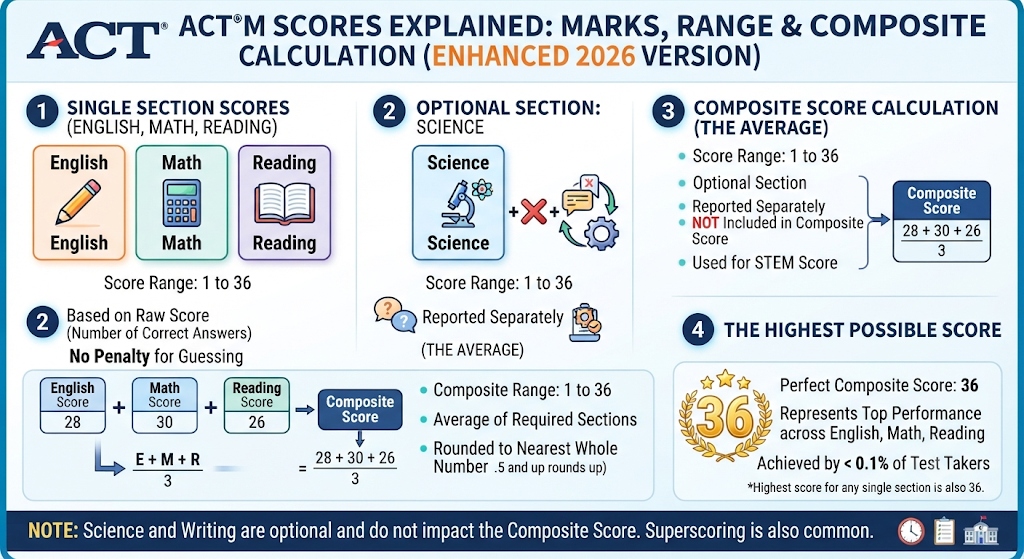
| Composite Score | 1 to 36 | The primary headline score: the rounded average of English, Math, and Reading. |
| STEM Score | 1 to 36 | The rounded average of your Math and Science scores (reported only if you take Science). |
| ELA Score | 1 to 36 | The rounded average of your English, Reading, and Writing scores (reported only if you take Writing). |
| Writing Score | 2 to 12 | The optional essay, scored by two independent readers across four analytical domains. |
So the ACT exam score range is 1 to 36 for all multiple-choice sections and the Composite, and 2 to 12 for the optional Writing essay. The lowest possible composite is 1, and the maximum ceiling is 36.
In one sentence: a 36 is the maximum on the ACT, and almost everything university admissions officers evaluate sits squarely on that 1 to 36 scale.
2. How Many Marks Is the ACT Exam? Understanding "Total Marks" and "Full Marks"
Students and parents routinely search for ACT exam total marks, how many marks is ACT exam, and ACT exam full marks. Let us address this directly:
The ACT does not have "marks" in the Indian academic framework. There is no cumulative score of 100, 300, or 800, no passing grade, and no division into distinction or first class. What you receive is an equated scale score from 1 to 36 for each section, along with a Composite score on the exact same scale.
If you require a benchmark to designate as "full marks," it is 36. A composite score of 36 represents the absolute top of the ACT scoring rubric. For the optional Writing essay, full marks is 12.
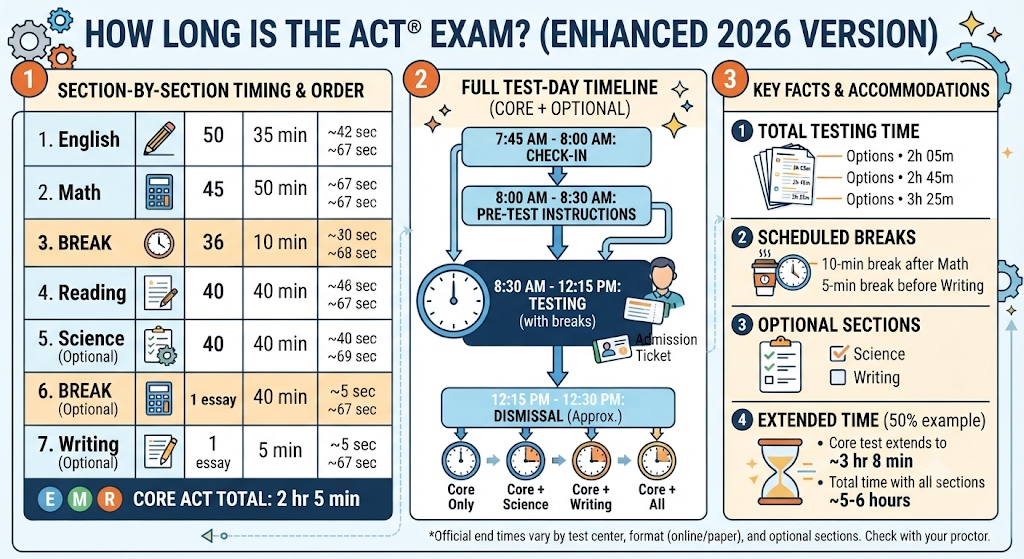
Raw Scores Behind the Scenes: When you complete your computer-based exam, the testing system calculates your raw score — the exact count of questions you answered correctly. Only operational scored questions count towards your raw score; experimental field-test items do not. Based on ACT's published Enhanced ACT specifications, here is the approximate breakdown of scored questions:
| Section | Total Questions on Test | Field-Test (Unscored) Questions | Scored Operational Questions |
|---|---|---|---|
| English | 50 questions | 10 questions | 40 scored questions |
| Math | 45 questions | 4 questions | 41 scored questions |
| Reading | 36 questions | 9 questions | 27 scored questions |
| Science (Optional) | 40 questions | 6 questions | 34 scored questions |
Across the three core sections, there are approximately 108 scored questions out of 131 total questions. If you include Science, there are roughly 142 scored questions out of 171. These operational counts explain how raw scores are tallied, but your official ACT score report will never display "108 marks." It will display scaled scores from 1 to 36.
No Negative Marking: Unlike the JEE, NEET, or older SAT formats, there is zero penalty for incorrect answers on the ACT. An incorrect guess and a blank question both receive zero points. Therefore, you must ensure that every single question is answered before the timer expires.
What About "Pass Marks"? There is no passing or failing grade on the ACT. A score of 21 is not a failure, and a 30 is not an automatic pass. A "good score" is defined solely by how your numbers align with the middle 50% admitted profile of your target universities.
3. From Raw Score to Scale Score: How Equating Works
If the ACT simply reported raw percentages, a candidate taking an easier test form on one date would possess an unfair advantage over a candidate facing a more rigorous form on another date. To ensure absolute parity, ACT converts raw scores to scale scores through an advanced statistical procedure known as equating.
Equating ensures that a scale score of 32 represents the exact same standard of academic proficiency regardless of whether the exam was administered in September, December, or April, or whether one test form was slightly more challenging than another.
An Illustration from Official Enhanced ACT Materials: ACT's published Enhanced ACT practice materials include an authentic conversion curve for the Reading section (27 scored questions). This demonstrates the steepness of the curve at the high end:
| Reading Raw Score (Correct out of 27) | Equated Reading Scaled Score (1 to 36) |
|---|---|
| 27 correct | 36 |
| 26 correct | 35 |
| 25 correct | 34 |
| 24 correct | 32 |
| 23 correct | 30 |
| 22 correct | 28 |
| 21 correct | 26 |
| 20 correct | 25 |
| 18 correct | 23 |
| 15 correct | 20 |
| 12 correct | 16 |
| 9 correct | 13 |
Two Crucial Lessons from This Equating Curve:
- 1. Mistakes are extraordinarily costly at the top: Dropping from 24 correct to 22 correct reduces your scaled score from 32 down to 28 — a 4-point penalty for just two missed questions. This is why careless reading errors must be eliminated.
- 2. Conversion tables vary by test date: The conversion curve is calibrated uniquely for every test form. Never memorize a single practice test's conversion table as an absolute truth; use it to understand the geometry of the curve.
4. How the Composite Score Is Calculated (and How to Do It Yourself)
The Composite score is the headline number that university admissions officers evaluate first. On the Enhanced ACT, the Composite score calculation is clean and transparent:
Notice that Science does NOT factor into the Composite score on the Enhanced ACT. Writing also does not impact the Composite.
Worked Examples:
- Example 1 (Standard Rounding Down): English = 32, Math = 29, Reading = 33. Sum = 32 + 29 + 33 = 94. Divide by 3 = 31.33. Rounded to the nearest whole number, your Composite is 31.
- Example 2 (Exact Integer): English = 30, Math = 28, Reading = 32. Sum = 30 + 28 + 32 = 90. Divide by 3 = 30.00. Your Composite is 30.
- Example 3 (Rounding Up on .67): English = 33, Math = 33, Reading = 32. Sum = 33 + 33 + 32 = 98. Divide by 3 = 32.67. Rounded up, your Composite is 33.
Your Own ACT Exam Calculator: Many students search online for an ACT exam calculator. You do not need a third-party app or paid widget. Simply take an official practice mock, convert your raw section scores using that test's specific equating table, sum the English, Math, and Reading scale scores, divide by 3, and round.
5. STEM and ELA Scores: What They Mean for Admissions
The Enhanced ACT makes Science and Writing optional sections. Choosing to take either section unlocks specialized domain scores on your official report:
- STEM Score (Scale 1–36): Reported if you take the optional Science section. It is the rounded average of your Math and Science scale scores:
STEM = (Math + Science) ÷ 2. For example, a Math score of 34 and a Science score of 32 produce a STEM score of 33. This score provides a targeted indicator of quantitative aptitude for engineering, computer science, physics, and pre-med programs. - ELA Score (Scale 1–36): Reported if you complete the optional Writing section. It represents the combined composite of your English, Reading, and Writing competencies.
- Writing Score (Scale 2–12): The essay itself is evaluated by two trained graders who award 1 to 6 points across four criteria: Ideas and Analysis, Development and Support, Organization, and Language Use. The domains are combined to produce a scaled score between 2 and 12.
- Should You Take Science or Writing? Over 90% of US universities do not require the ACT Writing section. However, students targeting competitive STEM disciplines (e.g. Purdue Engineering, UIUC CS, Georgia Tech, CMU) strongly benefit from taking Science to showcase rigorous analytical data interpretation.
6. Superscoring: Turning Several Attempts into One Better Score
Because most ambitious students sit for the ACT two or three times, universities increasingly evaluate applicants using an ACT Superscore. ACT provides an official superscore report that combines your highest individual section scores across all your testing dates into a single, unified composite.
Worked Superscore Example: Notice how a candidate's performance across three testing dates produces a superscore composite that surpasses any single test sitting:
| Testing Sitting | English | Math | Reading | Single-Sitting Composite |
|---|---|---|---|---|
| Test 1 (September 2026) | 30 | 28 | 32 | 30 (90 ÷ 3) |
| Test 2 (December 2026) | 33 (Highest) | 30 | 31 | 31 (94 ÷ 3) |
| Test 3 (February 2027) | 31 | 33 (Highest) | 32 (Highest) | 32 (96 ÷ 3) |
| Official ACT Superscore | 33 | 33 | 32 | 33 COMPOSITE (98 ÷ 3 = 32.67) |
By taking the best English (33 from Test 2), best Math (33 from Test 3), and best Reading (32 from Test 1 or 3), the candidate achieves a 33 Superscore — higher than the 32 achieved on their best single day. Note: Verify each institution's superscoring policy on their admissions website, as a handful of institutions still evaluate only single-sitting composites.
7. What Is the ACT Exam Highest Score?
The ACT exam highest score is 36. Achieving a 36 composite means your rounded average across English, Math, and Reading is 36, which typically permits at most 1 or 2 minor errors across the entire exam.
- Extreme Rarity: Fewer than 0.1% of the roughly 1.4 million students who take the ACT globally each year achieve a perfect 36 composite score.
- Not a Prerequisite for Elite Admissions: No university — including MIT, Stanford, Harvard, or Princeton — requires a 36. The vast majority of admitted students at top-10 universities have composites in the 33 to 35 range.
- A 36 Does Not Guarantee Admission: Holistic admissions evaluate academic transcripts, AP scores, essays, extracurricular leadership, research portfolios, and letters of recommendation. A 36 guarantees that your academic threshold is met, but not that you will be admitted.
- The Strategic Takeaway: Treat 36 as a mathematical ceiling, not an emotional prerequisite. Focus on reaching your target institution's 75th percentile benchmark.
8. What Is a Good Score for ACT Exam Applications?
Because there is no universal pass mark, a "good score" is defined strictly by the institutions on your college list. Use this four-step framework to determine your target:
| Score Band | National Percentile | Admissions Competitiveness Tier | Representative Target Universities |
|---|---|---|---|
| 34 – 36 | Top 1% (99th+) | Elite / Ivy League Tier | Harvard, MIT, Stanford, Yale, Princeton, Columbia, CMU, Duke |
| 31 – 33 | Top 2–5% (95th–98th) | Highly Selective Tier | UC Berkeley, UCLA, Michigan, NYU, Georgia Tech, UIUC, UNC |
| 27 – 30 | Top 6–15% (85th–94th) | Selective & Flagship Tier | Purdue, UW Madison, Ohio State, Penn State, Texas A&M, Maryland |
| 22 – 26 | Top 16–35% (65th–84th) | Competitive State Tier | Arizona State, CU Boulder, Iowa State, UT Dallas, Michigan State |
| Below 21 | Below National Average | Developing Foundation | Requires targeted diagnostic intervention to clear university cutoffs |
Merit Scholarship Thresholds: Beyond admissions, standardized test scores unlock institutional merit scholarships. Many prominent US public and private universities offer automatic full-tuition or partial waivers for non-resident and international students who present an ACT composite of 31+ or 33+ paired with strong high-school marks.
9. Understanding Your Official ACT Exam Scores Report
When your ACT score report becomes available on MyACT (typically 1 to 2 weeks post-exam for computer-based testing in India), you will receive a comprehensive data profile:
- Composite Score (1–36): Your prominent headline composite.
- Section Scaled Scores (1–36): Individual scaled scores for English, Math, and Reading (plus Science if sat).
- STEM and ELA Scores: Reported if you completed the respective optional tracks.
- National & State Percentile Ranks: Showing the exact percentage of global test takers whose scores you equaled or exceeded.
- College Readiness Benchmarks: ACT's empirical benchmarks indicating a 75% probability of achieving a grade of 'C' or higher in credit-bearing first-year university courses (English: 18, Math: 22, Reading: 22, Science: 23).
- Score Sending: ACT sends all section scores from a chosen test date together. When colleges superscore, ACT combines your highest individual sections into an official Superscore report.
10. The Calculator and Your Score: Rules and Strategic Impact
Calculators are authorized exclusively on the Math section. Understanding how to deploy your calculator directly preserves points at the top of the curve:
- Permitted Devices: Standard graphing calculators such as the TI-84 Plus, TI-84 Plus CE, or scientific models like the Casio fx-991EX and fx-991CW. Ensure all memories and programs are compliant with ACT regulations.
- Prohibited Devices: Calculators with Computer Algebra Systems (CAS) that perform algebraic equation solving (e.g. TI-89, TI-Nspire CAS, HP Prime), laptops, tablet computers, and mobile phone apps.
- Preventing Careless Arithmetic Slips: Because losing a single question at the top of the curve can drop your scaled score by 1 to 2 points, verify complex polynomial division, radical simplifications, and trigonometric ratios on your calculator.
- Avoid Over-Reliance: Many ACT Math questions are designed to be solved in under 30 seconds via logical number substitution, symmetry, or conceptual estimation. Punching basic arithmetic into a calculator repeatedly wastes precious seconds.
Download the ACT Exam Scores & Composite Calculation Blueprint (PDF)
Get immediate access to the official 2026 Enhanced ACT raw-to-scale conversion curves, 3-section Composite calculator worksheet, university percentile matrices, and scholarship score tiers.
11. Top 10 Common Misunderstandings About ACT Scores
- 1. Believing There Is a "Pass Mark": There is no pass or fail threshold; scores are evaluated competitively.
- 2. Expecting Negative Marking: There is zero penalty for wrong guesses. Never leave blanks.
- 3. Assuming Science Impacts the Composite: On the Enhanced ACT, Science is optional and does not count towards the 1–36 Composite.
- 4. Obsessing Over a 36 Composite: A 34 or 35 puts you in the top 1% and is competitive for any university in the world.
- 5. Treating Practice Scores as Guarantees: Practice curves are sample estimates; test-day equating adjusts for form difficulty.
- 6. Assuming All Universities Superscore: While widely adopted, verify whether your target colleges superscore or evaluate single sittings.
- 7. Believing Writing Alters the Composite: Writing produces a distinct 2–12 score that has zero effect on your 1–36 Composite.
- 8. Thinking a One-Point Difference Decides Admissions: Standard error of measurement means colleges treat small point fluctuations as statistically equivalent.
- 9. Believing Old and New ACT Scores Conflict: ACT psychometric equating confirms that 2026 Enhanced ACT composites are fully concordant with prior composites.
- 10. Delaying Preparation Until Class 12: Starting prep in Class 10 or early Class 11 gives you multiple testing windows and superscore advantages.
12. Roadmap to a 34+ ACT Composite Score
Raising your score from a 26 to a 34+ requires shifting from passive question-solving to strategic error analysis:
- 1. Take a Timed CBT Diagnostic: Establish your baseline in English, Math, and Reading under authentic Prometric conditions.
- 2. Target High-Yield English Grammar: English is the most coachable section. Mastering 12 core grammar rules (comma splices, apostrophes, parallelism, modifiers) can lift an English score from 24 to 34 in 4 weeks.
- 3. Eliminate Math Careless Slips: Classify every math mistake in an error log: was it a Formula Gap, a Reading Error, or a Computation Mistake?
- 4. Master Reading Structural Skimming: Stop trying to memorize every detail. Read for passage architecture, main claim, and paragraph transitions.
- 5. Plan for Two to Three Testing Windows: Leverage superscoring by focusing on specific sections in consecutive testing cycles.
What is the ACT exam score range?
The score range is 1 to 36 for individual sections (English, Math, Reading, Science) and the Composite score. The optional Writing test is scored from 2 to 12.
How many marks is the ACT exam?
The ACT does not use marks. It uses scaled scores from 1 to 36. Full marks on the ACT is a Composite score of 36.
How is the ACT composite score calculated in 2026?
On the Enhanced ACT, the Composite score is the rounded average of the three core sections: Composite = (English + Math + Reading) ÷ 3. Science does not count towards the Composite.
Is there negative marking on the ACT?
No. There is no negative marking on the ACT. Your raw score is simply the total number of correctly answered questions, so you should always guess rather than leave an item blank.
What is the highest possible ACT score?
The highest possible score is 36 for each individual section and for the Composite score. Fewer than 0.1% of global examinees achieve a 36.
What is a good score for the ACT exam?
A score of 24–28 is above the national average and competitive for many universities. A score of 30–33 is very strong for selective US universities, while 34–36 is elite and competitive for Ivy League and Top 20 institutions.
What is an ACT Superscore?
An ACT Superscore is the rounded average of your highest English, Math, and Reading section scores across all test dates you have taken.
Does the Science section affect my Composite score?
No. On the Enhanced ACT, Science is optional and does not impact your 1–36 Composite. If you take Science, you receive a separate STEM score (average of Math and Science).
How long does it take to get ACT exam results in India?
Because students in India take the computer-based ACT, multiple-choice scores are typically posted online within 1 to 2 business weeks (5 to 10 business days). Writing scores take an additional 2 to 3 weeks.
Which calculators are permitted on the ACT Math section?
Standard graphing calculators like the TI-84 Plus and scientific calculators like the Casio fx-991EX are permitted. Calculators with CAS capabilities (such as TI-89 or TI-Nspire CAS) and phone calculators are strictly prohibited.
14. Master ACT Scoring & Diagnostics at EduQuest Gurgaon
Achieving a 34+ ACT Composite requires more than generic practice questions. At EduQuest's dedicated learning center in Gurugram, students work directly with 99th-percentile faculty mentors, analyzing question-by-question telemetry in an authentic Prometric-style computer laboratory.
EduQuest Gurugram ACT Coaching Center & Academic Batches
📍 Location
F-45 Baani Square, Sec 50
Unit F-45, Baani Square, Sector 50, Gurugram, Haryana 122018. Conveniently accessible from Golf Course Extension, Sohna Road, and Nirvana Country.
⏰ Batches
Weekday & Weekend
Weekday Batches (Mon–Thu 4:00 PM – 7:00 PM) and Weekend Intensive Batches (Sat–Sun 10:00 AM – 2:00 PM) in Offline and Hybrid formats.
🧪 CBT Lab
Diagnostic Score Report
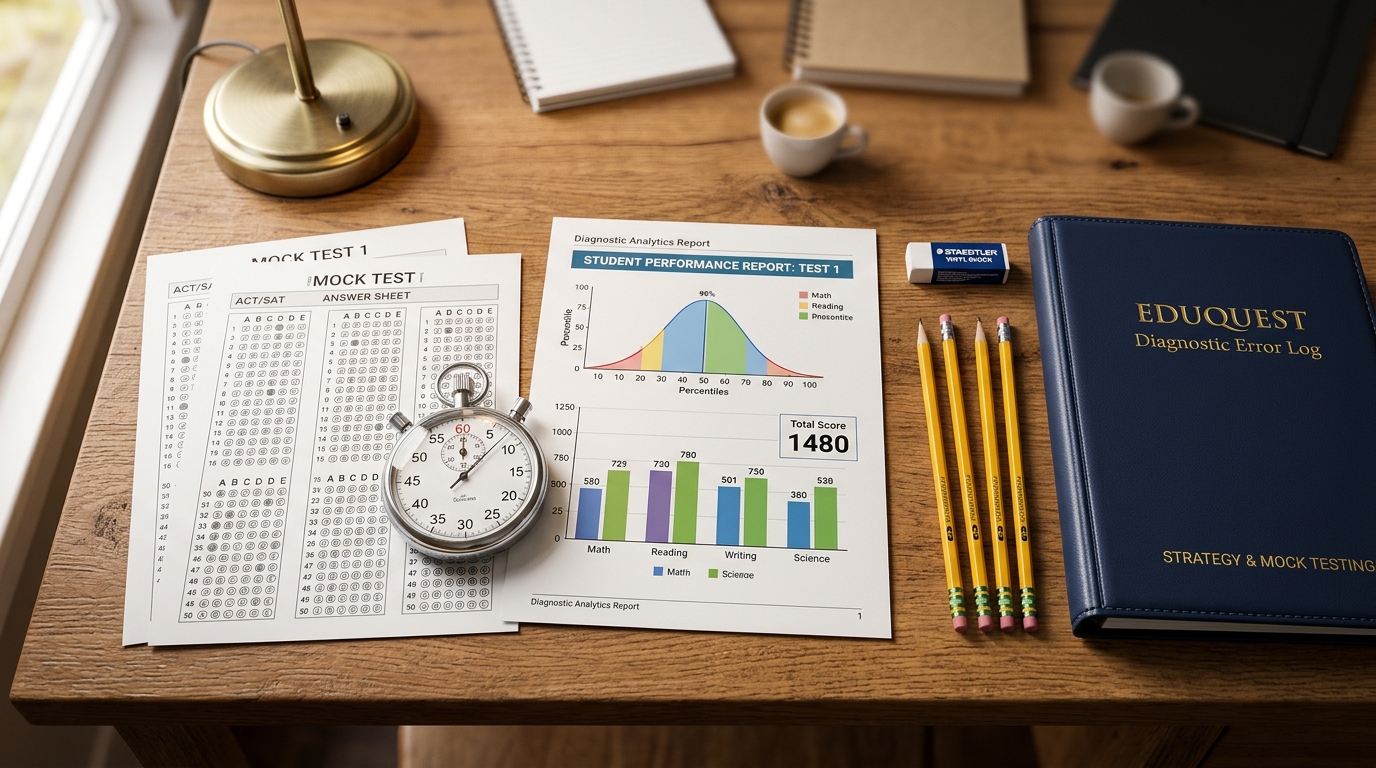
Take a timed CBT mock test with question telemetry, section raw-to-scale mapping, and personal admissions roadmap counseling.
Transform Your ACT Potential into a 34+ Composite Score
Join Gurgaon's premier ACT prep program. Book a proctored CBT diagnostic test at Baani Square or schedule a consultation with our senior mentors.