
Ask a student how long the ACT takes and you will usually hear, "about three hours." That answer was roughly right for the older version of the test. It is no longer accurate. The Enhanced ACT has changed the clock, and the right answer now depends on which optional sections you choose, how long your breaks last and when you are asked to arrive.
This guide gives you every number you need. We explain how long the ACT exam is in minutes and in hours, show the ACT exam duration for each section, calculate the real time per question, walk through a realistic test-day timeline from arrival to departure, and cover the rules about calculators, watches and security that decide whether your hard-earned score is ever reported.
One note on sources: Section timings and question counts come directly from ACT's own published materials for the Enhanced ACT. Break lengths, start times and check-in timing can vary by test centre, so treat those as typical and always confirm them on your admission ticket and in the instructions from your centre.
Fast-Track Your College & Career Strategy
Get immediate, personalized AI insights tailored to your grade, strengths, and dream universities — 100% free with instant reports.
Know Your Personality Type for Free
Take our 18-question AI psychometric test to uncover your cognitive archetype, hidden learning superpowers, and ideal university courses.
Personalized Career & University EduPath
Build a step-by-step Grade 8–12 admissions blueprint with AI-matched target universities, exam schedules, and extracurricular profiles.
1. The Short Answer: ACT Exam Length in 2026
Here is the quick reference for the ACT exam length and ACT exam time on the Enhanced ACT:
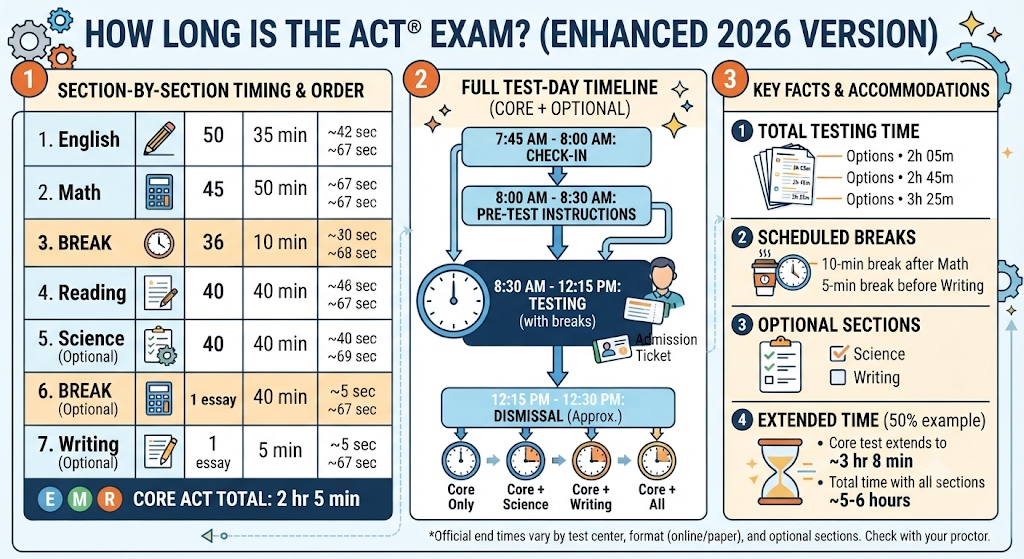
| Section | Questions | Time | Status | Average Time / Question |
|---|---|---|---|---|
| English | 50 questions | 35 minutes | Core (Mandatory) | ~42 seconds |
| Math | 45 questions | 50 minutes | Core (Mandatory) | ~67 seconds |
| Standard Break | — | 10–15 minutes | Mandatory Break | — |
| Reading | 36 questions | 40 minutes | Core (Mandatory) | ~67 seconds |
| Science | 40 questions | 40 minutes | Optional Section | 60 seconds |
| Short Break | — | 5 minutes | Optional Track | — |
| Writing | 1 essay prompt | 40 minutes | Optional Section | 40 minutes total |
And here is what those sections add up to depending on which package you select during registration:
| What You Take | Testing Time (Without Breaks) | Total Questions |
|---|---|---|
| Core only (English, Math, Reading) | 125 minutes (2 hours 5 minutes) | 131 questions |
| Core + Science | 165 minutes (2 hours 45 minutes) | 171 questions |
| Core + Writing | 165 minutes (2 hours 45 minutes) | 131 questions + 1 essay |
| Core + Science + Writing | 205 minutes (3 hours 25 minutes) | 171 questions + 1 essay |
So if you are asking how many hours is ACT exam in plain terms: the core test is a little over two hours of actual testing, and the full test with everything is a little over three and a half hours, before breaks and check-in time are added.
2. How Long Does the ACT Exam Take on Test Day? The Real Total
The numbers above represent testing time only. Real life includes check-in, instructions, security screening, breaks and the transition between sections. If you want to know how long does ACT exam take from the moment you enter the building to the moment you leave, plan around these ranges:
| Testing Package Option | Actual Testing Time | Approximate Total Time at the Centre |
|---|---|---|
| Core only (E, M, R) | About 2 hours 5 minutes | Roughly 3 to 3.5 hours (e.g. 7:45 AM to 11:15 AM) |
| Core + Science or Writing | About 2 hours 45 minutes | Roughly 3.5 to 4 hours (e.g. 7:45 AM to 12:00 PM) |
| Core + Science + Writing | About 3 hours 25 minutes | Roughly 4.5 to 5 hours (e.g. 7:45 AM to 1:00 PM) |
These are planning estimates, not official figures. They include a typical early arrival, a check-in process that can take a while when many students arrive together, one standard break and short transitions. Your actual ACT exam hours at the centre depend on how many students are in your room, how smoothly check-in goes and whether there are any center delays.
A practical rule for families: If parents are picking up a student after the exam, tell them to expect a finish time around late morning or midday for the core test, and early afternoon if Science and Writing are included. Do not schedule flights, appointments, or important family gatherings immediately after.
3. Section-by-Section ACT Exam Duration
Knowing the ACT exam duration per section matters far more than knowing the total duration, because you cannot borrow time from one section for another. Each section is strictly timed separately. When time is up, you must stop immediately, even if you finished early on another section.
- English: 35 minutes, 50 questions (~42 seconds per question): English is the fastest-paced multiple-choice section on the exam. It rewards candidates who can read fluidly, instinctively spot grammar patterns (comma splices, misplaced modifiers, pronoun-antecedent agreement), and move decisively. Questions appear alongside reading passages with underlined text references.
- Math: 50 minutes, 45 questions (~67 seconds per question): You have a little over a minute per question. On the Enhanced ACT, each Math question features four answer choices (A, B, C, D) instead of the older 5 choices. A permitted calculator may be used throughout this entire section. Because questions generally progress from foundational to advanced, lingering over early problems can cost you easy points later.
- Reading: 40 minutes, 36 questions (~67 seconds per question): You have 67 seconds per question, but Reading time cannot be spent solely on questions. You must read four distinct passages (or paired passage sets). Most high scorers allocate roughly 9 minutes per passage (~3.5 minutes for active skimming and 5.5 minutes for answering items).
- Science (Optional): 40 minutes, 40 questions (60 seconds per question): You have exactly one minute per question. ACT Science does not test rote science memorization; it evaluates experimental logic, hypothesis testing, and rapid data interpretation across tables, scatter plots, and conflicting scientific viewpoints.
- Writing (Optional): 40 minutes, 1 argumentative essay: Candidates are provided with an issue prompt and three distinct perspectives. You have 40 minutes to brainstorm, construct a clear thesis, support your stance with concrete evidence, and proofread your prose.
- Keep in Mind — Unscored Field-Test Questions: Each section includes a small number of unscored experimental questions used by ACT psychometricians to calibrate future test forms. You cannot identify which questions are field-test items, so you must treat every single problem with equal diligence.
4. Old ACT vs Enhanced ACT: How the Clock Changed
If you are preparing using older test prep textbooks (published prior to 2025) or watching outdated YouTube videos, the timings will not match what you will face on test day. This is one of the most common reasons students feel panicked about pacing. Here is how the clock officially changed:
| Section Parameter | Older Legacy ACT | Enhanced ACT 2026 | Net Difference |
|---|---|---|---|
| English | 75 questions in 45 minutes (~36 sec/Q) | 50 questions in 35 minutes (~42 sec/Q) | +17% more time per question (25 fewer questions) |
| Math | 60 questions in 60 minutes (60 sec/Q, 5 choices) | 45 questions in 50 minutes (~67 sec/Q, 4 choices) | +12% more time per question (4 choices reduce clutter) |
| Reading | 40 questions in 35 minutes (~53 sec/Q) | 36 questions in 40 minutes (~67 sec/Q) | +26% more time per question (4 fewer questions, 5 more mins) |
| Science | 40 questions in 35 minutes (~53 sec/Q) [Mandatory] | 40 questions in 40 minutes (60 sec/Q) [Optional] | +13% more time; completely optional for non-STEM |
| Core Testing Time | 175 minutes (Science included) | 125 minutes (Science omitted) | 50 minutes shorter testing experience |
The Headline: The Enhanced ACT has 44 fewer questions if you take all four multiple-choice sections, and it grants you more time per question in every single section. The test is shorter overall and significantly less rushed. However, "less rushed" does not mean "easy." Because question counts are lower, each mistake carries higher mathematical weight on the 1–36 scaling curve.
So if you are searching for ACT exam time length because you remember the older three-hour marathon, update your mental model. Practise strictly with current 2026 format materials.
5. A Realistic Test-Day Timeline for Indian Test Takers
Every Prometric test centre runs its own operational schedule within ACT guidelines. The timeline below represents a typical morning session in India. Always adhere to the reporting time stamped on your official MyACT admission ticket.
| Clock Time | Test-Day Phase | What Happens at the Center |
|---|---|---|
| 06:30 AM | Wakeup & Fuel | Wake up, eat a light protein breakfast (eggs, oats, fruit), double-check ticket, original passport, approved calculator and watch. |
| 07:15 AM | Transit | Leave for the test centre with adequate buffer for morning traffic. Target arrival by 07:30 to 07:45 AM. |
| 07:30 – 08:00 AM | Arrival & Check-in | Arrive at the centre; doors open. Show your printed admission ticket and unexpired original passport. Biometrics and locker assignment. |
| 08:00 – 08:30 AM | Room Seating & Instructions | Security screening with metal detectors. Proctors escort you to your assigned computer terminal. Verification of candidate profile on screen. |
| 08:30 – 09:05 AM | Section 1: English | 35 Minutes (50 Questions). Timed electronically on screen. |
| 09:05 – 09:55 AM | Section 2: Math | 50 Minutes (45 Questions). Permitted calculator active. |
| 09:55 – 10:10 AM | Standard Break | 10 to 15 Minute Mandatory Break. Leave the computer room, use the restroom, drink water, and eat your snack. |
| 10:10 – 10:50 AM | Section 3: Reading | 40 Minutes (36 Questions). High-focus passage analysis. |
| 10:50 – 11:30 AM | Section 4: Science | 40 Minutes (40 Questions). Core examinees are dismissed after Reading; Science candidates remain. |
| 11:30 – 11:35 AM | Short Transition Break | 5-Minute stretch break for Writing candidates. |
| 11:35 – 12:15 PM | Section 5: Writing | 40 Minutes (1 Essay). Type essay into secure browser interface. |
| 11:00 AM – 12:30 PM | Dismissal | Sign out, surrender scratch paper, collect passport and belongings from lockers, exit building. |
Four Vital Rules About This Timeline:
- Arrive early: Test center doors lock promptly at the designated time (often 8:00 AM). Late arrivals are strictly barred from entry, and registration fees are non-refundable.
- Fixed Section Order: Sections are always administered in this precise sequence: English, Math, Break, Reading, Science (if selected), Break, Writing (if selected).
- The Break Is Mandatory: The standard 10–15 minute break between Math and Reading is non-negotiable. Proctors cannot shorten or eliminate it.
- Morning vs Afternoon Sessions: Some high-volume Prometric centres in Delhi NCR, Mumbai, and Bangalore operate afternoon sessions (typically reporting at 1:00 PM). Check your ticket carefully.
6. Breaks, Food and Water: Sustaining Focus
Because the total ACT exam time at the testing centre is extensive, how you handle breaks directly dictates your score endurance:
- The Standard 10–15 Minute Break: Positioned between Math and Reading. Stand up, stretch, walk in the hallway, and let your eyes relax from computer monitor glare.
- Strategic Snacking: Food and beverages are prohibited inside the computer lab. Leave snacks in your locker or designated waiting area. Bring slow-burning complex carbs and healthy fats: almonds, walnuts, bananas, a peanut butter sandwich, or an electrolyte bar. Avoid sugary energy drinks or heavy, greasy meals that trigger post-prandial cognitive sluggishness.
- Hydration Discipline: Hydrate moderately in the morning. Do not gulp large quantities of water right before testing. If you must use the washroom during an active testing section, the clock keeps running and no extra time is granted.
- Absolute Prohibition on Mobile Phones: Phones must remain switched completely off inside lockers during the break. Accessing your phone, texting parents, or checking social media during break time results in immediate disqualification and score cancellation.
7. Digital Testing and the On-Screen Timer
International candidates in India test on dedicated computer terminals. The testing interface features an integrated digital clock. Here is how to leverage it without letting it induce panic:
- Hide / Unhide Functionality: You can hide the countdown timer if the second-by-second ticking elevates your anxiety. However, ensure you unhide it when you reach the halfway mark to verify your pacing.
- Automatic 5-Minute Warning: The software automatically displays an on-screen warning when 5 minutes remain in each section. When this pop-up appears, ensure every remaining question has an answer bubbled in.
- Question Navigator & Flagging Tool: You can flag difficult items and jump directly back to them via the question review grid before submitting.
- Analog Watch as Redundant Backup: Although the computer clock is official, bringing a simple non-smart wristwatch helps you track break durations in hallways where wall clocks may be absent.
8. Rules That Affect Your Test Time: Calculators, Watches and Prohibited Items
Pacing is not only about managing the clock; it is about adhering to equipment regulations. Inadvertent violations can cause proctors to terminate your test on the spot.
- Calculator Regulations: Permitted on the Math section ONLY. Permitted devices include standard scientific calculators (e.g. Casio fx-991EX, fx-991CW) and graphing calculators (e.g. TI-84 Plus CE). Strictly Prohibited: Models with Computer Algebra Systems (CAS) like TI-89, TI-92, TI-Nspire CAS, HP Prime, tablet calculators, and smartphone apps.
- Wristwatch Regulations: Standard analog or basic digital watches without alarms are allowed. Strictly Prohibited: Smartwatches (Apple Watch, Fitbit, Garmin), fitness bands, and watches with audible beeps. If your watch alarm chirps during an exam section, proctors are instructed to dismiss you immediately.
- Prohibited Belongings: Scratch paper from home (prometric proctors issue official scratch paper or dry-erase boards), pens/highlighters, books, notes, cameras, and recording devices.
- Required Documentation: (1) Printed MyACT Admission Ticket with clear photo, (2) Valid unexpired government passport (for Indian test takers), (3) Permitted calculator with fresh batteries, (4) Personal snack/water for breaks.
9. Exam Cheating on the ACT: Why It Is Never Worth It
Students frequently search for exam cheating ACT out of anxiety, curiosity, or academic desperation. Let us be unequivocal: ACT maintains extraordinary test security, and the repercussions of any compromise are devastating.
Prohibited Actions Include:
- Peeking at another candidate's screen or sharing test materials.
- Using an unapproved calculator model or utilizing a calculator during English, Reading, Science, or Writing.
- Possessing unauthorized electronic devices inside the testing room.
- Discussing test questions post-exam: Sharing specific questions, prompts, answers, or form identification numbers on WhatsApp, Discord, Telegram, or Reddit violates examinee terms. ACT's security team actively monitors forums and cross-references usernames with test schedules.
The Severe Consequences of Violations:
- Immediate expulsion from the test centre.
- Permanent score cancellation with zero refund.
- Formal notification sent to colleges and universities where you have submitted applications.
- Multi-year or lifetime bans from future ACT testing administrations.
The "Leaked Exam Papers" Scam: Telegram and Instagram channels regularly advertise "leaked ACT papers" or "guaranteed 35+ proxy test takers." These are criminal syndicates running phishing scams. Even attempting to access illicit materials jeopardizes your academic future. Authentic preparation and deliberate pacing drills remain the only legitimate path to a competitive score.
10. Extended Time and Accommodations: When the Clock Is Different
Not every candidate tests under standard time limits. Students with documented learning differences, visual impairments, or medical conditions may apply for official ACT accommodations.
- National Extended Time (Time-and-a-Half / 50% Extra Time): Core testing extends from 125 minutes to approximately 3 hours and 8 minutes. Students receive 53 minutes for English, 75 minutes for Math, and 60 minutes for Reading.
- Double Time (100% Extra Time): Administered across multiple days for candidates with significant documented medical or learning needs.
- Accommodated Breaks: "Stop-the-clock" breaks or additional rest intervals as medically necessary.
- Advance Application Mandatory: Accommodations cannot be requested on test day. Applications must be submitted through your school coordinator and approved by ACT weeks before registration closes. For full eligibility criteria, read our dedicated guide on extended time and accommodations on the ACT.
11. Pacing Strategies: Turning the Clock into a Competitive Edge
Understanding ACT exam time is beneficial only when translated into actionable section-by-section routines:
- English (35 mins, 50 Qs): Target completing the 50 questions in 30 minutes, keeping 5 minutes for flagged items. Read the sentence containing the underlined segment plus one sentence before/after for context. Never deliberate over a punctuation question for more than 40 seconds.
- Math (50 mins, 45 Qs): Implement the Rule of Thirds: Questions 1–15 in 12 minutes (easy foundations), Questions 16–30 in 17 minutes (intermediate algebra/geometry), Questions 31–45 in 21 minutes (complex trigonometry, functions, and word problems).
- Reading (40 mins, 36 Qs): Strict 9-minute benchmark per passage. Spend 3.5 minutes on structural skimming (identifying main thesis, tone, and paragraph roles) and 5.5 minutes executing questions. Answer factual line-reference items first.
- Science (40 mins, 40 Qs): Spend ~5 minutes per passage. Never read full introductory experimental passages upfront; jump immediately to the graphs, identify the variables on the X and Y axes, and consult the text only when questions ask about experimental rationale.
- Writing (40 mins): The 5-30-5 formula: 5 minutes outlining perspectives and thesis, 30 minutes writing 4–5 robust paragraphs, and 5 minutes editing syntax and transitions.
- Zero Guessing Penalty: The ACT does not penalize wrong answers. If the proctor announces one minute remaining, bubble in your predetermined letter of the day for every blank item.
12. Training Your Stamina: Building the Habit of a Full-Length Test
Sitting for a concentrated test requires physical and cognitive conditioning comparable to athletic endurance. High school students accustomed to 45-minute school periods frequently suffer mental fatigue by the time they reach Reading.
- Weeks 1–3: Practise individual sections strictly against the clock (35m English, 50m Math).
- Weeks 4–6: Pair two sections back-to-back (English + Math) followed by a 10-minute break.
- Weeks 7–10: Complete full-length simulated CBT diagnostics on Saturday mornings starting promptly at 08:30 AM.
- Error Analysis: Categorize mistakes into Knowledge Gaps vs Timing Panics vs Careless Blunders. Notice whether your error density spikes in the final 10 questions of each section.
Download the ACT Exam Duration, Section Timings & Test-Day Blueprint (PDF)
Get immediate access to the official 2026 Enhanced ACT section pacing chart, Prometric center arrival checklist, calculator compatibility guide, and stamina roadmap.
13. Top 10 Common Mistakes About ACT Timing
- 1. Preparing for the Legacy 3-Hour Format: Studying with 215-question older tests skews your pacing metrics.
- 2. Overlooking Optional Sections: Failing to plan travel pickup schedules for Science and Writing add-ons.
- 3. Trying to Borrow Time: Finishing English 5 minutes early does not add 5 minutes to your Math clock.
- 4. Cutting Arrival Times Close: Arriving at 08:05 AM guarantees locked doors and wasted fees.
- 5. Wearing Smart or Alarm Watches: An accidental watch beep causes automatic expulsion.
- 6. Omitting Full-Length Mocks: Sectional drills cannot simulate the cumulative cognitive drain of test day.
- 7. Skipping Breakfast or Overeating: Both induce severe blood sugar fluctuations that hamper Reading comprehension.
- 8. Checking Mobile Phones During Breaks: Even opening WhatsApp to message parents triggers instant score cancellation.
- 9. Leaving Questions Unanswered: Never leave blanks when there is zero negative marking.
- 10. Neglecting Eye Care: Staring at a computer monitor for 3 hours requires blinking drills and screen familiarity.
How long is the ACT exam in 2026?
The core Enhanced ACT exam takes 125 minutes (2 hours and 5 minutes) of testing time covering English, Math, and Reading. Adding optional Science brings testing time to 2 hours 45 minutes, while adding Science and Writing totals 3 hours 25 minutes.
How many hours is the ACT exam including breaks?
Including arrival security check-in, instructions, and standard breaks, plan for about 3 to 3.5 hours at the test centre for the core test, and 4.5 to 5 hours if you sit for Science and Writing.
How long does the ACT exam take with the optional Science section?
Actual testing time is 165 minutes (2 hours 45 minutes). Total time at the test centre is roughly 3.5 to 4 hours.
What is the ACT exam duration for each section?
English is 35 minutes (50 questions), Math is 50 minutes (45 questions), Reading is 40 minutes (36 questions), Science is 40 minutes (40 questions, optional), and Writing is 40 minutes (1 essay, optional).
How much time per question do I get on the Enhanced ACT?
You have approximately 42 seconds per question in English, 67 seconds in Math, 67 seconds in Reading, and 60 seconds in Science.
Is the Enhanced ACT shorter than before?
Yes. The Enhanced ACT has 44 fewer questions across the multiple-choice sections and is 50 minutes shorter than the legacy test when Science is omitted.
How long is the break during the ACT?
There is a mandatory scheduled break of 10 to 15 minutes between Math and Reading. Candidates taking Writing receive an additional 5-minute transition break.
Can I use a calculator throughout the entire ACT?
No. Permitted calculators are authorized on the Math section only. Calculators cannot be used on English, Reading, Science, or Writing.
What happens if someone cheats on the ACT?
Cheating leads to immediate dismissal, permanent cancellation of test scores, multi-year bans, and reporting of the incident to undergraduate admissions offices.
Does extended time change the duration of the ACT?
Yes. Students approved for standard extended time receive time-and-a-half (50% extra time), extending the core test to approximately 3 hours and 8 minutes.
15. Experience Full-Length CBT Testing at EduQuest Gurgaon
Mastering ACT pacing requires authentic computer-based diagnostic testing in real exam conditions. At EduQuest's dedicated center in Gurugram, students train in an authorized Prometric-style computer testing lab, learning question triage and time-management telemetry from 99th-percentile faculty.
EduQuest Gurugram ACT Training Center & Academic Batches
📍 Location
F-45 Baani Square, Sec 50
Unit F-45, Baani Square, Sector 50, Gurugram, Haryana 122018. Centrally situated near Golf Course Extension, Sohna Road, and Nirvana Country.
⏰ Batches
Weekday & Weekend
Weekday Cohorts (Mon–Thu 4:00 PM – 7:00 PM) and Weekend Intensive Batches (Sat–Sun 10:00 AM – 2:00 PM).
🧪 CBT Lab
Timed Diagnostic
Complete full-length Enhanced ACT computer mocks with immediate 1–36 score predictions, question pacing analysis, and error log reviews.
Transform Your ACT Pacing into a 34+ Composite Score
Join Gurgaon's premier ACT prep program. Book a proctored diagnostic test at Baani Square or consult with our senior admissions advisors.