Before you even open a textbook, you need to understand what the College Board actually expects from you. The AP Chemistry Course and Exam Description (CED) is a 200+ page document that lays out every concept, every skill, and every type of question you will face. Let us distill it into what actually matters.
Exam Format at a Glance
The AP Chemistry exam is 3 hours and 15 minutes long. It is split into two sections of equal weight: Multiple Choice (50%) and Free Response (50%). Both sections test your ability to apply concepts, not just recall them.
Multiple Choice (Section I)
90 Minutes — 60 Questions
- 60 multiple-choice questions total.
- Questions 1–40: No calculator allowed. Tests mental math and conceptual understanding.
- Questions 41–60: Calculator permitted. Tests quantitative problem-solving.
Free Response (Section II)
105 Minutes — 7 Questions
- 3 long FRQs (worth 10 points each) — multi-part, multi-concept questions.
- 4 short FRQs (worth 4 points each) — focused, targeted questions.
- All 7 FRQs require written explanations, not just calculations.
The 6 Science Practices
Models & Representations
You must be able to create and interpret particulate-level diagrams, Lewis structures, and graphs. The College Board loves testing whether you can translate between macroscopic observations and atomic-level models.
Mathematical Routines
Dimensional analysis, significant figures, logarithms (for pH), and algebraic manipulation are non-negotiable. You will use math in every single unit.
Experimental Design & Analysis
Expect questions about designing experiments, identifying variables, analyzing data tables, and evaluating sources of error. Lab skills are explicitly tested even if you never set foot in a lab.
Fast-Track Your College & Career Strategy
Get immediate, personalized AI insights tailored to your grade, strengths, and dream universities — 100% free with instant reports.
Know Your Personality Type for Free
Take our 18-question AI psychometric test to uncover your cognitive archetype, hidden learning superpowers, and ideal university courses.
Personalized Career & University EduPath
Build a step-by-step Grade 8–12 admissions blueprint with AI-matched target universities, exam schedules, and extracurricular profiles.
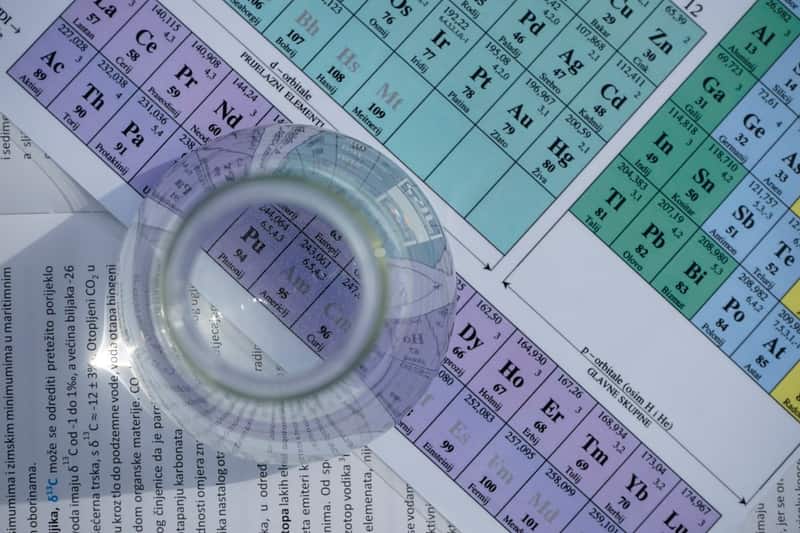
A critical detail many students miss: the AP Chemistry exam provides a formula and constants sheet AND a periodic table. You do not need to memorize formulas like ΔG = ΔH - TΔS or the Nernst equation. But you DO need to know when and how to apply them instantly.
What the Syllabus Does NOT Cover
- Organic Chemistry: AP Chemistry does not cover organic chemistry reactions, nomenclature, or functional groups. If your teacher spends weeks on organic chem, they are going beyond the AP scope.
- Nuclear Chemistry: Nuclear reactions (fission, fusion, radioactive decay) are NOT on the AP Chemistry exam as of 2026. Do not waste study time here.
- Memorizing Solubility Rules: While helpful, the exam focuses on understanding WHY certain compounds are soluble based on intermolecular forces, not on rote memorization of solubility tables.
Knowing what is excluded is just as important as knowing what is included. Students who waste weeks on organic chemistry or nuclear decay are stealing time from the high-yield topics like equilibrium and acid-base chemistry that dominate the exam.
The AP Chemistry syllabus is not a suggestion — it is a contract. The College Board will test exactly what is in the CED, nothing more and nothing less.
— EduQuest AP Chemistry Lead
Curriculum Map: Unit by Unit
| Unit | Topic | Key Concepts | Approx. Weight |
|---|---|---|---|
| 1 | Atomic Structure | Electron config, PES, isotopes | 7–9% |
| 2 | Compound Structure | Lewis structures, VSEPR, hybridization | 7–9% |
| 3 | IMFs & Properties | Boiling points, solubility, chromatography | 18–22% |
| 4 | Chemical Reactions | Stoichiometry, net ionic, redox | 7–9% |
| 5 | Kinetics | Rate laws, mechanisms, Arrhenius | 7–9% |
| 6 | Thermodynamics | ΔH, ΔS, Hess's Law, calorimetry | 7–9% |
| 7 | Equilibrium | ICE tables, Le Chatelier, Ksp | 7–9% |
| 8 | Acids & Bases | pH, Ka/Kb, buffers, titrations | 11–15% |
| 9 | Applied Thermo | Gibbs, electrochemistry, Nernst | 7–9% |
The total exam weight adds up to approximately 100%, with Unit 3 and Unit 8 being the heaviest hitters. Your study plan should reflect this weighting — spend proportionally more time on these two units.
Need the Full Syllabus Decoded?
Our tutors walk you through every learning objective in the College Board CED, so you never study the wrong material.
Lab Requirements
The College Board recommends a minimum of 16 hands-on labs throughout the course. While the specific labs are no longer prescribed (the old 'AP Chemistry Lab Manual' was retired), the exam tests lab skills extensively through both MCQs and FRQs. You need to understand experimental design, data analysis, and sources of error.
- Read the entire College Board CED before the course begins. Highlight the learning objectives for each unit.
- Cross-reference your teacher's syllabus with the CED to identify any gaps. If your teacher skips a topic, you must self-study it.
- Practice with official College Board released exams — they are the only materials that perfectly match the syllabus scope.
Choosing the Right Textbook
The two most popular textbooks are Zumdahl's 'Chemistry' and Brown's 'Chemistry: The Central Science.' Both are excellent, but Zumdahl is slightly better aligned with the AP exam format. Supplement with a review book like Barron's or Princeton Review for practice questions.
Final Thoughts
The syllabus is your roadmap. Students who study without consulting it are driving blindfolded — they might arrive, but they will waste enormous amounts of time and energy on wrong turns.
FAQs: AP Chemistry Syllabus
Is a calculator allowed on the entire exam?
No. The first 40 MCQs are no-calculator. Only questions 41–60 and the entire FRQ section allow a calculator. Practice mental math for stoichiometry and pH calculations.
Do I need to memorize the periodic table?
No, it is provided. However, you should know the trends (electronegativity, ionization energy, atomic radius) cold. Knowing where elements are on the table saves time.
Is AP Chemistry harder than AP Biology?
They are different. AP Chemistry is more mathematically demanding, while AP Biology requires more memorization. Chemistry has a lower pass rate historically, suggesting it is harder for most students.
Decode the AP Chemistry Syllabus
Join EduQuest's AP Chemistry program. We align every lesson directly to the College Board CED so you study smarter, not harder.
Accelerate Your College Prep
Evaluate Your Profile
AI Profile Evaluator
Submit your academic scores, AP results, and extracurriculars to get instant feedback on your chances for top universities.
Evaluate ProfileDiscover Your True Potential
Narrative Intelligence Scan
Personality Tester
Uncover your hidden strengths and cognitive profile with our scientifically backed assessment.
Take the TestFind Your Path
Career Cluster AI
Explore the best career pathways perfectly aligned with your unique personality and goals.
Check ProfileTake an AP Mock Test
Download the Official AP Exam Mastery & 5-Score Strategy Blueprint
Get immediate access to EduQuest’s 8-page comprehensive candidate toolkit with diagnostic benchmarks, step-by-step frameworks, error telemetry logs, and structured preparation timelines.