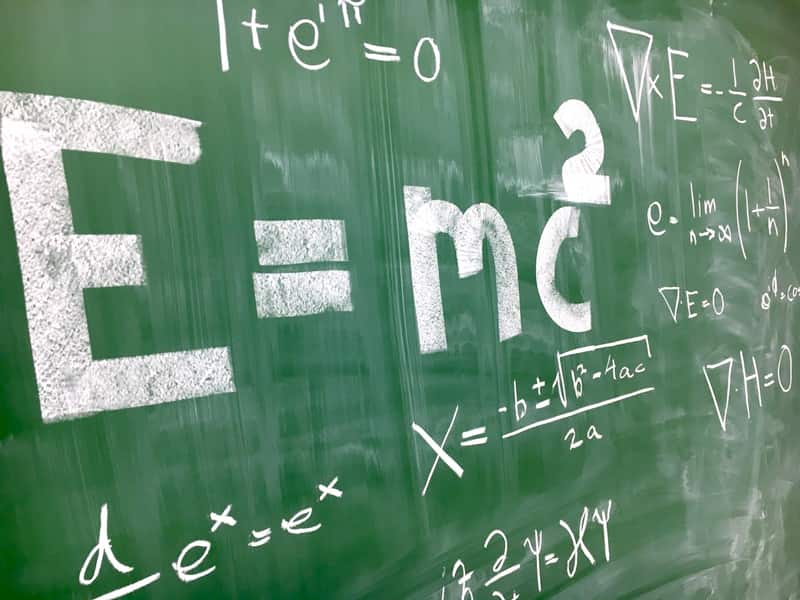
The 'C' in AP Physics C stands for Calculus. The number one question students ask before enrolling is: 'Am I good enough at math to pass this class?' The good news is that the calculus applied in Physics C is very specific, highly repetitive, and much easier than the abstract problems you face in AP Calculus BC.
The Core Math Skills Needed
You do not need to know Taylor Series, L'Hôpital's Rule, or complex trigonometric substitutions to get a 5 in AP Physics C Mechanics. The math is practical and tool-oriented.
Basic Differentiation
The Power Rule
- Power rule: d/dx (x^n) = nx^(n-1).
- Chain rule for composite functions.
- Used constantly to find velocity from position graphs.
Basic Integration
Area Under the Curve
- Reverse power rule: ∫ x^n dx = [x^(n+1)]/(n+1) + C.
- Definite integrals with limits (evaluating from 0 to t).
- Used to calculate Work from a Force-vs-Distance graph.
Separable Differential Equations
Air Resistance
- Separating variables (getting v with dv, and t with dt).
- Integrating 1/v to get ln(v).
- Solving for v using exponentials.
Where Calculus Appears in the Curriculum
Kinematics
If position x(t) = 3t³ - 2t, then velocity v(t) = 9t² - 2. It is that simple.
Center of Mass
For a rod with non-uniform density λ(x), you must integrate ∫x λ(x) dx to find the center.
Moment of Inertia
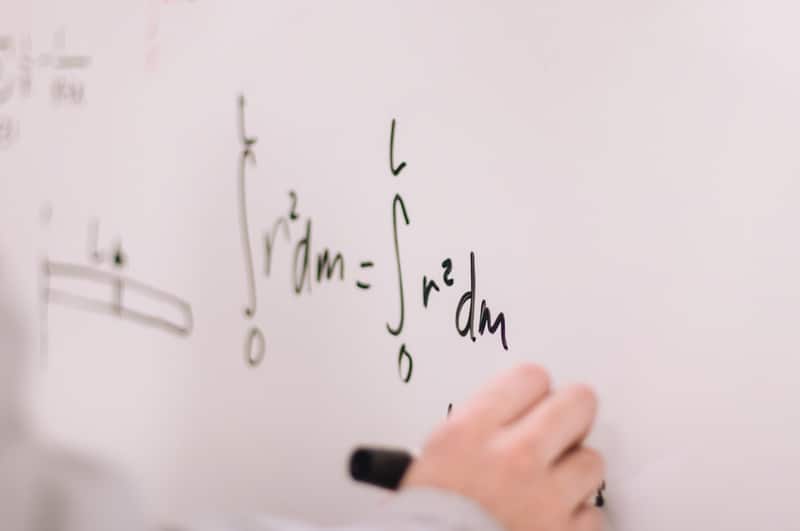
You will integrate ∫r² dm to find how hard it is to spin continuous objects like cylinders.
Fast-Track Your College & Career Strategy
Get immediate, personalized AI insights tailored to your grade, strengths, and dream universities — 100% free with instant reports.
Know Your Personality Type for Free
Take our 18-question AI psychometric test to uncover your cognitive archetype, hidden learning superpowers, and ideal university courses.
Personalized Career & University EduPath
Build a step-by-step Grade 8–12 admissions blueprint with AI-matched target universities, exam schedules, and extracurricular profiles.
The hardest calculus you will do all year involves setting up the integrals. Doing the actual integration is usually straightforward (just polynomial power rules). The challenge is figuring out what 'dm' (a tiny slice of mass) means in terms of 'dx' (a tiny slice of length).
Should You Take AP Calculus Concurrently?
- The Timing Issue: Physics C requires you to use integrals in October (for Work/Energy), but AP Calculus AB doesn't teach integrals until February.
- Self-Studying is Required: If you are taking them concurrently, you must self-study the basics of integration in the first month of school.
- AB vs BC: AP Calculus AB is perfectly fine for Physics C Mechanics. AP Calculus BC is helpful for E&M, but not strictly required.
Many Physics C teachers spend the first two weeks of class doing a 'Calculus Boot Camp'. If your teacher does not do this, you must learn the power rule for derivatives and integrals on EduQuest before the school year starts.
Physics C teaches you what calculus is actually for. Sir Isaac Newton didn't invent calculus to pass a math test; he invented it to solve physics problems.
— EduQuest Math Mentor
Calculus vs. Algebra Approximations
| Concept | Algebra (Physics 1) | Calculus (Physics C) |
|---|---|---|
| Velocity | v = Δx / Δt | v = dx / dt |
| Work | W = Fd cosθ | W = ∫ F(x) dx |
| Impulse | J = F_avg Δt | J = ∫ F(t) dt |
| Center of Mass | Σ (m_i x_i) / M_total | ∫ x dm / ∫ dm |
| Air Resistance | Ignored | ΣF = mg - kv = m(dv/dt) |
As you can see, the formulas are fundamentally the same. Calculus just allows you to deal with variables that are constantly changing (like a force that gets stronger as you stretch a spring).
Bridge the Math Gap
Struggling to apply Calculus to your Physics homework? Our specialized tutors teach you the exact math tricks you need for the AP exam.
The Dreaded 'U-Substitution'
You rarely need complex integration techniques, but you MUST know basic u-substitution. This is heavily tested when integrating a force equation like F(x) = C / (ax+b)² to find potential energy.
- Identify the inner function 'u'.
- Take the derivative 'du'.
- Substitute into the integral to simplify it.
- Integrate and substitute back.
Vectors and Dot Products
While not strictly calculus, vector mathematics is the other pillar of Physics C. You must know how to multiply vectors using dot products (which yield scalars like Work) and cross products (which yield vectors like Torque and Angular Momentum).
Final Thoughts
Calculus is just a tool in your toolbox. Focus on the physics concepts first, and let the math handle the heavy lifting.
FAQs: Math in Physics C
Do I need to know integration by parts?
No. The College Board explicitly states that integration by parts, partial fractions, and trig substitution are not required for Physics C.
How much of the exam is calculus?
Roughly 20% of the questions explicitly require you to take a derivative or integral, but 100% of the exam requires calculus-based conceptual thinking.
Can I use my graphing calculator?
Yes, you can use it on both sections. However, the questions are designed so that calculators rarely help with the actual calculus derivations.
Master Calculus-Based Physics
Join EduQuest's elite AP prep program to seamlessly integrate your math skills with advanced physics concepts.
Accelerate Your College Prep
Evaluate Your Profile
AI Profile Evaluator
Submit your academic scores, AP results, and extracurriculars to get instant feedback on your chances for top universities.
Evaluate ProfileDiscover Your True Potential
Narrative Intelligence Scan
Personality Tester
Uncover your hidden strengths and cognitive profile with our scientifically backed assessment.
Take the TestFind Your Path
Career Cluster AI
Explore the best career pathways perfectly aligned with your unique personality and goals.
Check ProfileTake an AP Mock Test
Download the Official AP Exam Mastery & 5-Score Strategy Blueprint
Get immediate access to EduQuest’s 8-page comprehensive candidate toolkit with diagnostic benchmarks, step-by-step frameworks, error telemetry logs, and structured preparation timelines.