

AP Course Load Command Centre (Grades 9–12)
Research Finding
1st & 2nd APs
College Board research confirms the largest academic gains occur moving from 0 to 1 and 1 to 2 AP courses.
View Research Summary1-on-1 AP Advisory
Custom Load
Diagnostic subject calibration to determine your optimal course load without risking GPA or health.
Explore AP CoachingFree Download
Workload Guide (PDF)
Download the complete course count decision framework, grade-wise plans, and warning sign checklists.
There is no magic number of AP courses, and research suggests that more is not automatically better. College Board research found that the **largest college-success gains come from a student's first and second AP courses**, while academic program leaders frequently describe one to two AP courses a year as the sweet spot that optimizes college readiness. For students aiming at selective global universities, the practical answer is not an arbitrary number but a contextual test: **take the most challenging courses available to you that fit your goals, and perform well in them**.
Download the Complete High School AP Workload & Decision Guide (PDF)
Get the printable master guide: College Board research summaries, recommended course totals by student profile, 4-year grade-by-grade planning tables, and the 6-point burnout prevention checklist.
What Does the Research Say About the Number of AP Courses?
| Research Source / Citation | What it found or concluded | What it does NOT say |
|---|---|---|
| College Board Research Summary (June 2023, Beard et al.) | The largest college-outcome gains come from moving from 0 to 1 and from 1 to 2 AP courses. | It studied college graduation outcomes, not competitive admission odds. |
| College Board Policy Brief (2019) | Students who complete their first AP course are ~3 percentage points more likely to graduate college in 4 years. | It does not say that adding 10 more APs continues to add proportional gains. |
| Education Week Coverage (October 2023) | The College Board actively discourages overloading schedules; counsellors confirm there is no magic number. | Selective universities have never published an arbitrary minimum threshold. |
| Inside Higher Ed (October 2026) | A private counselling survey found 6 AP courses correlated with admissions advantages. | The data does not prove causality; stronger students naturally take more APs. |
**What this means in plain language:** 1. **Starting AP matters enormously:** Taking one or two well-chosen AP courses yields the single highest leap in academic preparation. 2. **More APs do not guarantee a stronger outcome:** Taking 12 APs with mediocre scores (2s and 3s) damages an application compared to taking 6 APs with 5s. 3. **Admissions offices look at rigor in context:** Admissions readers evaluate you based on what your high school offers. Five APs at a school offering six is viewed as maximum rigor, whereas five at a school offering twenty-five shows average participation.
Fast-Track Your College & Career Strategy
Get immediate, personalized AI insights tailored to your grade, strengths, and dream universities — 100% free with instant reports.
Know Your Personality Type for Free
Take our 18-question AI psychometric test to uncover your cognitive archetype, hidden learning superpowers, and ideal university courses.
Personalized Career & University EduPath
Build a step-by-step Grade 8–12 admissions blueprint with AI-matched target universities, exam schedules, and extracurricular profiles.
So, How Many AP Courses Should You Take?
| Student Situation / Profile | Sensible Total Across High School | Strategic Context & Advice |
|---|---|---|
| New to AP, building confidence | 3 to 5 APs | Start with one accessible subject in Grade 10, add carefully. |
| Strong all-round student, moderate goals | 5 to 7 APs | Align subjects strictly with academic strengths and major interests. |
| Targeting highly selective universities (Top 20 / Ivy League) | 6 to 10 APs (where offered) | Only take this load if high school GPA and mental wellbeing remain flawless. |
| Heavy extracurricular commitment (Olympiads, Athletics, Startup) | 4 to 6 APs | Protect time for deep, tangible achievements outside the classroom. |
| School offers few or no AP courses | Take what is available | Supplement with strong board grades, competitions, and targeted self-study. |
How Many APs Per Year? A Grade-wise Workload Plan
| Grade | Light Plan (Foundation) | Balanced Plan (Recommended) | Ambitious Plan (Upper Tier) |
|---|---|---|---|
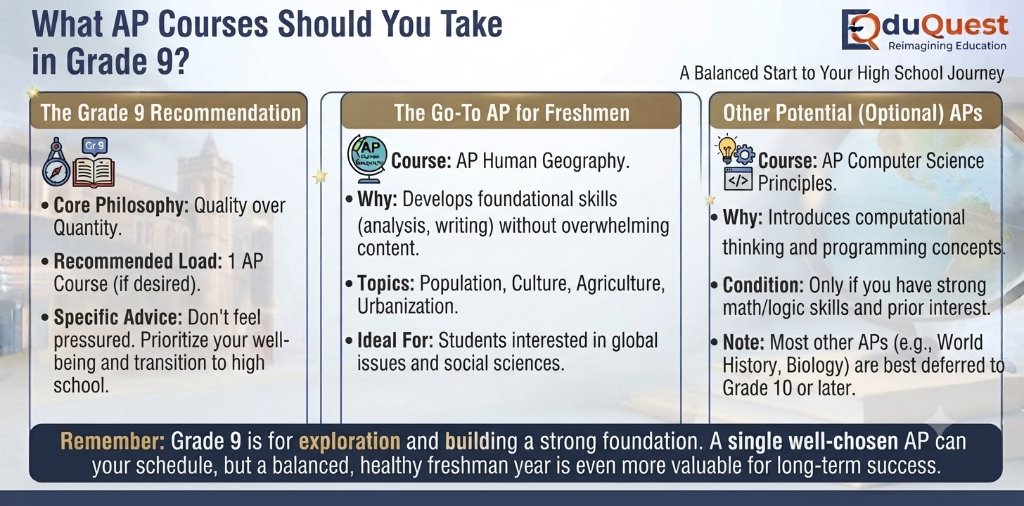
| Grade 9 | 0 APs | 1 AP (e.g. Human Geography) | 2 APs (e.g. Bio + Human Geo) |
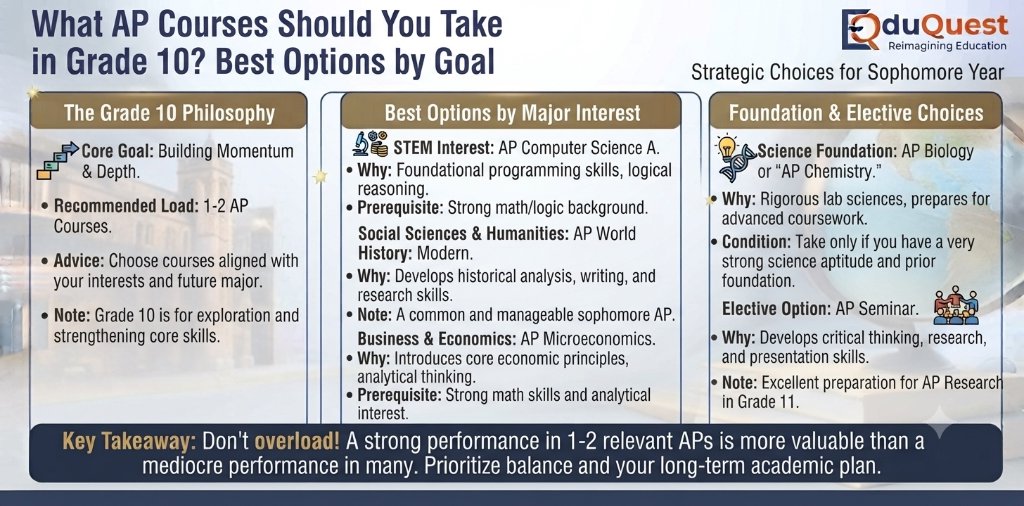
| Grade 10 | 1 AP | 2 APs (e.g. Chemistry + Lang) | 3 APs (e.g. Chem + Lang + Seminar) |
| Grade 11 | 2 APs | 3 APs (e.g. Calc BC + Physics + Research) | 4 APs (Calc BC + Physics C + CSA + Stats) |
| Grade 12 | 1 AP | 2 APs (major-specific capstone) | 3 APs (Lit, Econ, Stats) |
| Total Across High School | 4 AP Courses | 8 AP Courses | 12 AP Courses |
A Simple 6-Point Decision Checklist: Should I Add This AP?
Core School Grade Protection
Can I maintain straight As in regular school board courses (CBSE/ISC/IB) while taking this AP? If regular marks drop, do not add it.
Direct Major Alignment
Does this AP subject directly build foundations for my intended university major or reflect authentic intellectual curiosity?
Extracurricular Breathing Room
Will I still have at least 5 to 8 hours weekly to dedicate to a meaningful research paper, coding build, or community initiative?
Prerequisite Readiness
Have I mastered the required foundations (e.g. solid algebra and trigonometry before attempting AP Physics or Calculus)?
Intrinsic Learning Motivation
Am I choosing this course because I want to learn the subject, or solely because I think it looks impressive on paper?
Physical Health & Sleep Stability
Will I consistently maintain 7+ hours of sleep per night and keep stress levels manageable? If health suffers, lighten the load.
Signs You Are Taking Too Many AP Courses
| Warning Sign | What It Indicates | Immediate Strategic Action |
|---|---|---|
| Grades dropping across other school subjects | Cognitive overload and divided focus | Drop or defer one non-essential AP subject. |
| Zero time left for extracurricular projects | Unbalanced application profile | Cut back course count and protect one long-term project. |
| Chronic sleep deprivation and burnout | Unsustainable schedule harming health | Treat sleep as non-negotiable; reduce examination commitments. |
| Relying on rote memorization without understanding | Superficial learning curve | Slow down and focus deeply on mastering fewer core subjects. |
How many AP classes should I take?
For most students, a balanced plan of 5 to 8 AP courses spread across high school (1 in Grade 9/10, 2–3 in Grade 11, and 1–2 in Grade 12) provides the optimal balance of academic rigor and extracurricular depth.
How many AP classes do you need for the Ivy League?
Ivy League and top 20 universities look for maximum rigor in context. At schools offering numerous APs, competitive applicants typically present 7 to 10 AP courses with scores of 4 and 5, paired with exceptional profile depth.
Is it bad to take too many AP classes?
Yes. Overloading often causes a drop in GPA, lowers AP exam scores to 2s and 3s, and eliminates the time needed for authentic leadership, research, and extracurricular achievements.
How many AP classes should I take in Grade 10?
One to two AP courses (such as AP Chemistry, AP English Language, or AP Psychology) is the ideal workload for Grade 10, leaving ample time to launch a long-term passion project.
Do I need AP courses if my school doesn't offer them?
No. Admissions committees evaluate you within your school's curriculum context. If your school does not offer APs, excelling in your national board (CBSE/ICSE) and taking 2–3 self-studied APs through open test centres is plenty to prove rigor.
How EduQuest Helps You Choose the Right Course Load
Determining the right number of AP courses requires balancing academic ambition with personal capacity and university selectivity. EduQuest mentors evaluate each student's baseline through diagnostic tests, map balanced 4-year subject sequences, and provide targeted 1-on-1 coaching so every AP taken yields a top score of 5.
Book a 1-on-1 AP Workload & Strategy Consultation
Review your current grades, school curriculum offerings, and target universities with senior College Board advisors to build a burnout-free roadmap.
Related Reading
- [AP Courses for Grades 9–12: A Year-by-Year Academic Roadmap](/blog/ap-course-roadmap-grades-9-12)
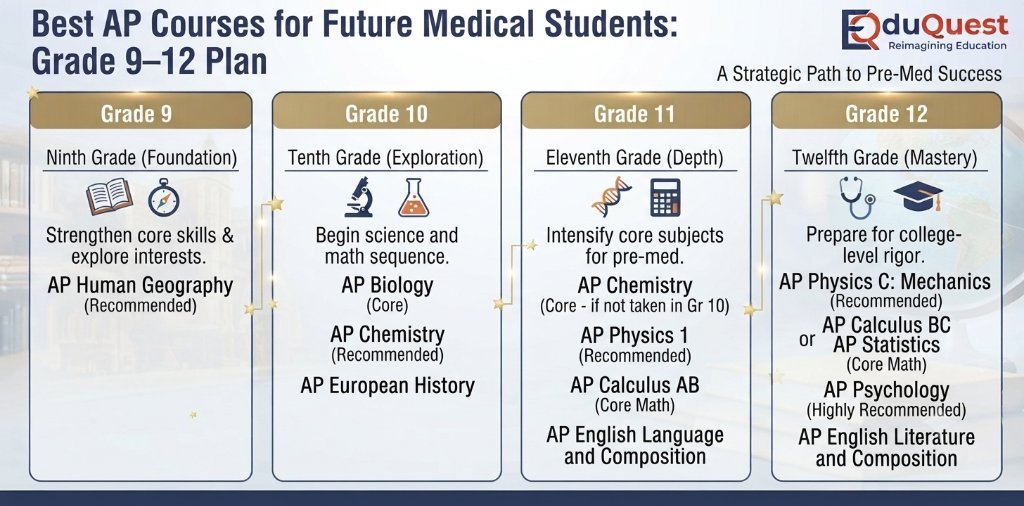
- [Best AP Courses for Future Medical Students: Grade 9–12 Plan](/blog/ap-courses-for-future-medical-students)
- [Best AP Courses for Engineering Students: Grade 9–12 Plan](/blog/ap-courses-for-engineering-students)
- [AP Exam Fees 2027: Cost of Each AP Exam in India and Worldwide](/blog/ap-exam-fees)
- [EduQuest AP Coaching & Diagnostic Hub](/ap-coaching/)
How EduQuest Helps You in How Many AP Courses Should You Take in High School? at Our Gurugram Centre (F-45, South City II)
Mastering AP and securing competitive global university admissions demands structured instruction, diagnostic error post-mortems, and proven testing frameworks. At EduQuest Gurugram, we deliver bespoke test preparation and holistic admissions consulting designed specifically for Indian and NRI high school students.
🏫 Offline Classroom Coaching
Study at our premier learning centre: F-45, First Floor, South City II, Sector 50, Gurugram, Haryana 122018. Small cohorts (8–10 students) ensure interactive whiteboard problem breakdowns, physical testing terminals, and immediate face-to-face mentor doubt resolution.
💻 Live Online Interactive Classes
Join high-definition two-way interactive classes via EduQuest LMS with live digital whiteboards, screen-shares, session video recordings for revision, and 1-on-1 virtual office hours for students across India, Dubai, Singapore, and the US.
🔄 Seamless Flexible Hybrid Mode
Transition effortlessly between classroom sessions at our Gurugram F-45 centre and live virtual classes whenever school exams, projects, or travel require flexibility, ensuring zero interruption to your preparation.
Batch timings are scheduled collaboratively around high school hours (CBSE, ICSE, IB, and Cambridge), featuring personalized 1-on-1 mentorship and small batches (8–10 students). A free diagnostic demo class is scheduled prior to enrollment. Weekday batches run in the afternoon and evening after school hours (Mon–Thu), alongside weekend intensive drill bootcamps (Sat–Sun). We invite parents and students for a complimentary 1-on-1 diagnostic evaluation before enrollment.
F-45, First Floor, South City II, Sector 50, Gurugram, Haryana 122018