

Pre-Med AP Strategy Command Centre (Grades 9–12)
Core Sciences
Bio + Chem + Phys
Structured sequencing from introductory biology to rigorous chemistry and physics mechanics.
View 4-Year Sequence1-on-1 Pre-Med Prep
Lab & Theory
Diagnostic subject calibration, Free-Response clinical problem solving, and medical profile alignment.
Explore AP CoachingFree Download
Pre-Med Guide (PDF)
Download the complete Grade 9–12 medical roadmap, clinical research checklist, and BS/MD requirements.
The best AP courses for future medical students are **AP Biology, AP Chemistry, AP Psychology, AP Physics 1 and AP Statistics**, ideally sequenced across Grades 9 to 12 and supported by real clinical research and community healthcare exposure. While no specific AP course is legally required to enter medicine and no curriculum guarantees admissions, the right academic sequence demonstrates coursework rigor, establishes the biochemical foundations medical schools demand, and frees up time for extracurriculars that make an application authentic.
Download the Complete Grade 9–12 AP Roadmap for Future Medical Students (PDF)
Get the printable master guide with year-by-year pre-med timelines, clinical exposure benchmarks, AP Capstone research ideas, and BS/MD program prerequisite matrices.
Why Should Future Medical Students Plan Their Academics Early?
Medicine is a demanding, long-term educational commitment. A student who begins planning in Grade 9 can build scientific depth systematically, avoid prerequisite bottlenecks (such as requiring advanced algebra before AP Chemistry), and maintain dedicated time for sustained hospital volunteering and research. Conversely, students who delay planning until Grade 11 often face intense academic stress by compressing multiple lab sciences into two short years.
What admissions committees look for in a medical-track applicant
Fast-Track Your College & Career Strategy
Get immediate, personalized AI insights tailored to your grade, strengths, and dream universities — 100% free with instant reports.
Know Your Personality Type for Free
Take our 18-question AI psychometric test to uncover your cognitive archetype, hidden learning superpowers, and ideal university courses.
Personalized Career & University EduPath
Build a step-by-step Grade 8–12 admissions blueprint with AI-matched target universities, exam schedules, and extracurricular profiles.
| What committees look at | What it signals about the applicant |
|---|---|
| Rigorous science coursework | Demonstrated readiness for fast-paced college-level biology and biochemistry. |
| Consistent grades and test results | Academic resilience and reliability under high examination pressure. |
| Research or sustained inquiry | Intellectual curiosity and capacity for evidence-based scientific methodology. |
| Healthcare or community exposure | First-hand understanding of clinical realities and patient empathy. |
| Reflective writing and communication | Emotional maturity, ethical awareness, and clarity of professional motivation. |
The Grade 9–12 Medical Academic Roadmap
| Grade | AP courses to consider | Main academic goal | Clinical & Extracurricular Focus |
|---|---|---|---|
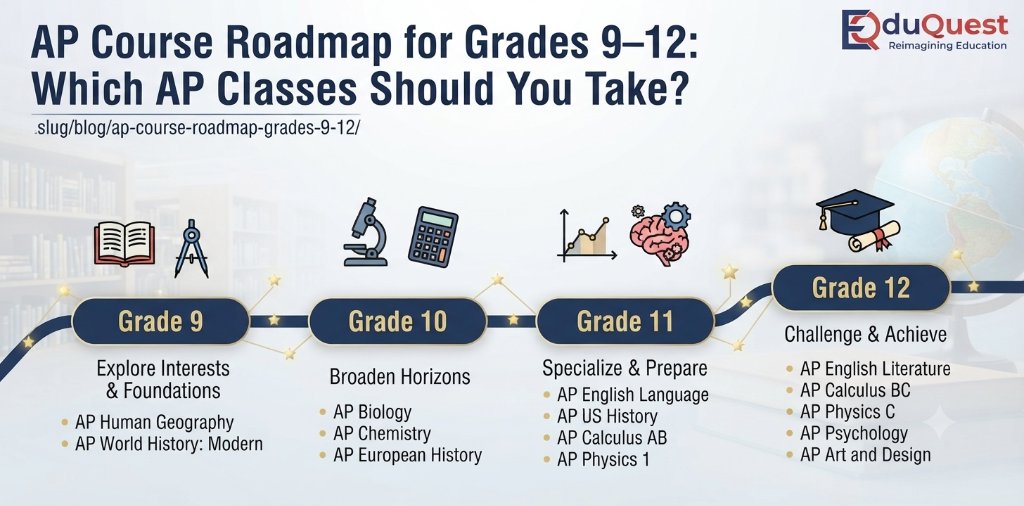
| Grade 9 | AP Biology (strong science students) or AP Psychology | Foundation & scientific reading habits | Science club, medical webinars, first-aid training. |
| Grade 10 | AP Chemistry, AP English Language, AP Seminar | Lab depth, stoichiometry, analytical writing | Hospital/clinic volunteering, health awareness initiative. |
| Grade 11 | AP Physics 1, AP Statistics, AP Research | Advanced sciences & quantitative data analysis | Independent research paper, science olympiad entries. |
| Grade 12 | Protect GPA; remaining APs only if aligned | College applications & narrative defense | Personal statement essays, medical interviews, UCAT prep. |
Grade 9 — Foundation and Exploration
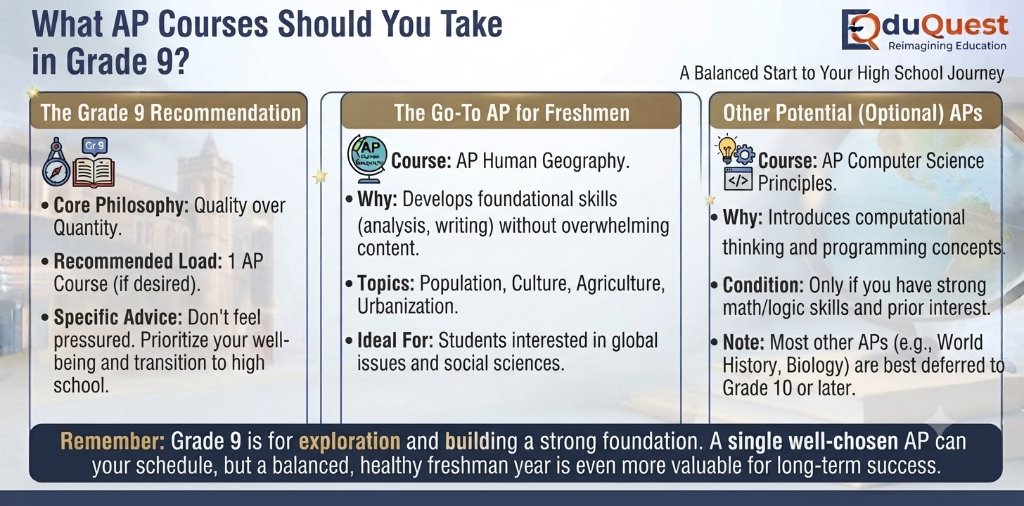
Grade 9 is about establishing study stamina and testing genuine interest in the biological sciences. A student who is strong in science can take **AP Biology**. Students seeking a gentler transition into College Board courses often begin with **AP Psychology**, which provides an accessible introduction to experimental methodology, neuroanatomy, and behavioral health. Taking more than one AP in Grade 9 is rarely advisable.
Grade 10 — Chemistry and Academic Development
**AP Chemistry** is the cornerstone Grade 10 milestone for pre-med aspirants. It demands strong algebraic reasoning and serves as the prerequisite foundation for undergraduate organic chemistry and biochemistry. Pair it with **AP English Language & Composition** to hone the rhetorical argument and analytical writing skills vital for medical research papers. Grade 10 is also the time to launch a long-term community health initiative.
Grade 11 — Advanced Sciences and Research
Grade 11 represents the most academically rigorous transcript year. **AP Physics 1** introduces algebra-based mechanics and fluid dynamics relevant to physiology, while **AP Statistics** equips students to interpret clinical trials, p-values, and epidemiological models. Students who took AP Seminar in Grade 10 can pursue a formal medical research paper through **AP Research**.
Grade 12 — Applications and Academic Completion
Grade 12 is for finalizing applications, not taking unnecessary academic gambles. Maintain strong board grades, finalize Common App personal statements, complete UCAT testing for UK/Commonwealth medical universities, and polish healthcare exposure reflections.
Which AP Courses Are Most Relevant for Future Medical Students?
| AP course | Why it matters for medicine | Best grade | Typical workload | Watch out for |
|---|---|---|---|---|
| AP Biology | Core life sciences, molecular genetics & cell pathways | Grade 9 or 10 | Heavy, content-dense | Memorizing terms without understanding graphs |
| AP Chemistry | Foundation for general chemistry & biochemistry | Grade 10 | Heavy, problem-solving | Underestimating algebra & reaction kinetics |
| AP Psychology | Behavior, cognition, neuroscience & psychiatric links | Grade 9 or 12 | Moderate, reading-heavy | Treating it as a soft subject; heavily tested on MCAT |
| AP Physics 1 | Fluid dynamics, pressure, mechanics & reasoning | Grade 11 | Moderate to heavy | Formula plugging without conceptual mechanics |
| AP Statistics | Interpreting clinical trials, data & epidemiology | Grade 11 | Moderate | Often skipped by pre-meds; highly valuable |
| AP Seminar / Research | Independent research paper, methodology & oral defense | Grades 10 & 11 | Heavy, project-based | Requires commitment to official Capstone program |
| AP English Language | Scientific writing, evidence synthesis & essays | Grade 10 | Moderate | Underrated for pre-med communication |
What AP Courses Cannot Do for a Medical Profile
| Common student misconception | The reality in medical admissions |
|---|---|
| 'Taking 10+ APs guarantees pre-med admission' | Quality, high 5 scores, and subject alignment matter far more than sheer volume. |
| 'AP credit lets me skip college pre-med classes' | Most US medical schools require college-level lab coursework regardless of AP credit. |
| 'High AP scores prove I understand medicine' | Classroom scores cannot substitute for hospital volunteering, shadowing, and patient exposure. |
| 'All AP science courses are equally weighted' | Biology and Chemistry form the core academic spine; other APs should support that narrative. |
Extracurricular Activities That Complement a Medical Profile
| Activity type | High school examples | What it demonstrates to admissions |
|---|---|---|
| Mentored Research | AP Research paper, university lab internship, science fair | Sustained intellectual curiosity, methodology, resilience. |
| Clinical Exposure | Hospital or hospice volunteering, shadowing where permitted | Practical awareness of clinical realities, patient empathy. |
| Community Health | Local health camps, first-aid campaigns, school wellness lead | Grassroots leadership, civic responsibility, initiative. |
| Academic Contests | USABO, USNCO, Brain Bee, National Biology Olympiads | Mastery of advanced scientific concepts under time limits. |
Sample AP Exam Schedule for Medical-Track Students (May 2027)
These core pre-med exams feature zero schedule clashes in the official College Board May 2027 calendar:
| Pre-Med Exam | Official 2027 Date | Session Time |
|---|---|---|
| AP Biology | Monday, May 3, 2027 | Session 2 (12:00 PM Local) |
| AP Physics 1 | Wednesday, May 5, 2027 | Session 2 (12:00 PM Local) |
| AP Chemistry | Thursday, May 6, 2027 | Session 2 (12:00 PM Local) |
| AP Statistics | Tuesday, May 11, 2027 | Session 2 (12:00 PM Local) |
| AP Psychology | Friday, May 14, 2027 | Session 2 (12:00 PM Local) |
What AP courses should I take to become a doctor?
The recommended sequence includes AP Biology, AP Chemistry, AP Physics 1, AP Statistics, and AP Psychology. Supplementing these with AP English Language and AP Research provides the writing and scientific inquiry depth top medical tracks expect.
Should I take AP Biology or AP Chemistry first?
Most students take AP Biology first (in Grade 9 or 10) because it introduces experimental processes with lighter quantitative demands. AP Chemistry is best taken in Grade 10 after solid algebra foundations are established.
Is AP Chemistry critical for pre-med applicants?
Yes. General chemistry and organic chemistry represent the most demanding academic filters in university pre-med programs. Excelling in AP Chemistry in high school provides a massive competitive advantage.
How many AP courses do pre-med students need?
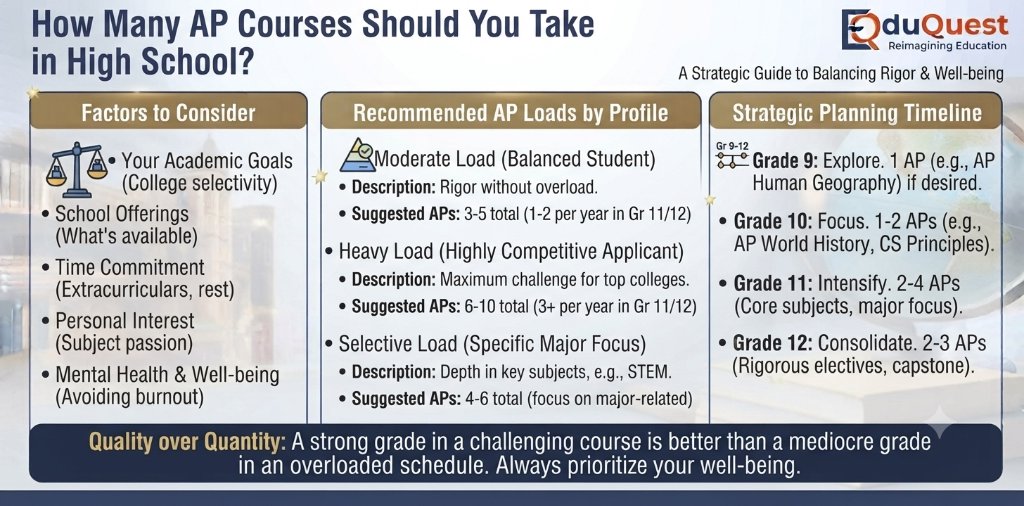
Typically, 5 to 7 well-chosen AP courses with scores of 4 or 5 are more than sufficient. Admissions committees prioritize strong core grades and substantial healthcare exposure over an excessive course count.
Do AP credits fulfill medical school prerequisites?
Policies vary widely. While undergraduate universities may grant general credit, many top US medical schools require college-level lab courses. Always verify institutional policies.
How EduQuest Helps Aspiring Medical Students
Gaining admission to top undergraduate pre-med and direct medical programs requires more than coursework alone. EduQuest mentors guide students through comprehensive diagnostic assessments, 1-on-1 subject coaching across AP Biology and Chemistry, healthcare exposure planning, and targeted medical research mentoring.
Book a 1-on-1 Pre-Med Academic & Profile Strategy Session
Connect with senior mentors to review your AP subject progression, healthcare volunteering plan, and university admission targets.
Related Reading
- [AP Courses for Grades 9–12: A Year-by-Year Academic Roadmap](/blog/ap-course-roadmap-grades-9-12)
- [AP Exam Dates 2027: Full Subject-wise Schedule](/blog/ap-exam-dates/)
- [AP Exam Registration in India 2027: Step-by-Step Guide, Fees & Deadlines](/blog/ap-exam-registration-india/)
- [EduQuest AP Coaching & Diagnostic Hub](/ap-coaching/)
How EduQuest Helps You in Best AP Courses for Future Medical Students: A Grade 9–12 Roadmap at Our Gurugram Centre (F-45, South City II)
Mastering AP and securing competitive global university admissions demands structured instruction, diagnostic error post-mortems, and proven testing frameworks. At EduQuest Gurugram, we deliver bespoke test preparation and holistic admissions consulting designed specifically for Indian and NRI high school students.
🏫 Offline Classroom Coaching
Study at our premier learning centre: F-45, First Floor, South City II, Sector 50, Gurugram, Haryana 122018. Small cohorts (8–10 students) ensure interactive whiteboard problem breakdowns, physical testing terminals, and immediate face-to-face mentor doubt resolution.
💻 Live Online Interactive Classes
Join high-definition two-way interactive classes via EduQuest LMS with live digital whiteboards, screen-shares, session video recordings for revision, and 1-on-1 virtual office hours for students across India, Dubai, Singapore, and the US.
🔄 Seamless Flexible Hybrid Mode
Transition effortlessly between classroom sessions at our Gurugram F-45 centre and live virtual classes whenever school exams, projects, or travel require flexibility, ensuring zero interruption to your preparation.
Batch timings are scheduled collaboratively around high school hours (CBSE, ICSE, IB, and Cambridge), featuring personalized 1-on-1 mentorship and small batches (8–10 students). A free diagnostic demo class is scheduled prior to enrollment. Weekday batches run in the afternoon and evening after school hours (Mon–Thu), alongside weekend intensive drill bootcamps (Sat–Sun). We invite parents and students for a complimentary 1-on-1 diagnostic evaluation before enrollment.
F-45, First Floor, South City II, Sector 50, Gurugram, Haryana 122018