

AP Course Roadmap Planning Hub (Grades 9–12)
Progression Model
4-Year Roadmap
From foundation reading in Grade 9 to advanced calculus, physics, and Capstone research in Grades 11–12.
View Roadmap Table1-on-1 AP Coaching
28+ Subjects
Tailored coaching mapped to CBSE/ISC/IB boards, full Bluebook digital simulators, and 5-score rubric training.
Explore AP CoachingFree Download
Roadmap Guide (PDF)
Download the complete 4-year AP subject progression matrix, major pathways, and College Board checklist.
If you are wondering **which AP courses to take from Grade 9 to Grade 12**, the honest answer is that the best plan depends on the student's interests, strengths, workload and target universities. Still, a clear year-by-year AP course roadmap helps students avoid two common mistakes: loading up on APs too early without a strategy, or starting too late and running out of time. This guide covers what to take in each grade, how AP choices change by intended major, how many APs are enough, and how to balance APs with profile building, SAT preparation and applications.
Download the Complete Grade 9–12 AP Course Roadmap & Selection Guide (PDF)
Get the printable master roadmap with grade-by-grade course progressions, stream-specific combinations for medicine, engineering, CS, finance, and the official 2026–2027 College Board calendar.
What Are AP Courses and Why Should Students Plan Them Early?
Advanced Placement (AP) courses are college-level courses offered to high school students, each ending with a standardized AP Exam scored from 1 to 5 by the College Board. Strong scores can support college applications and, at many universities, may earn credit or advanced placement.
Why AP planning matters for US university admissions
Fast-Track Your College & Career Strategy
Get immediate, personalized AI insights tailored to your grade, strengths, and dream universities — 100% free with instant reports.
Know Your Personality Type for Free
Take our 18-question AI psychometric test to uncover your cognitive archetype, hidden learning superpowers, and ideal university courses.
Personalized Career & University EduPath
Build a step-by-step Grade 8–12 admissions blueprint with AI-matched target universities, exam schedules, and extracurricular profiles.
Admissions officers at selective US universities look at the **rigor of a student's coursework in context**. That means they consider what was available at the student's school and whether the student chose challenging options that fit their interests. Random AP selection does not tell a story. A planned sequence does.
What students often miss when they start planning late
Many AP courses have prerequisites in practice, such as strong algebra before AP Physics or AP Statistics, and AP Seminar before AP Research. If a student does not plan in Grade 9, the sequence they want for Grade 11 may simply not be possible.
**AP scores at a glance** Every AP Exam is scored on a 1–5 scale. The College Board describes the levels as follows:
| AP Score | Meaning | What it usually signals |
|---|---|---|
| 5 | Extremely well qualified | Mastery of college-level content; benchmark for Ivy League & top 20 universities |
| 4 | Well qualified | Strong performance; competitive for college credit and advanced placement |
| 3 | Qualified | Solid pass; credit policies vary widely by university |
| 2 | Possibly qualified | Limited credit or placement value |
| 1 | No recommendation | Content not yet mastered |
AP Course Roadmap from Grade 9 to Grade 12
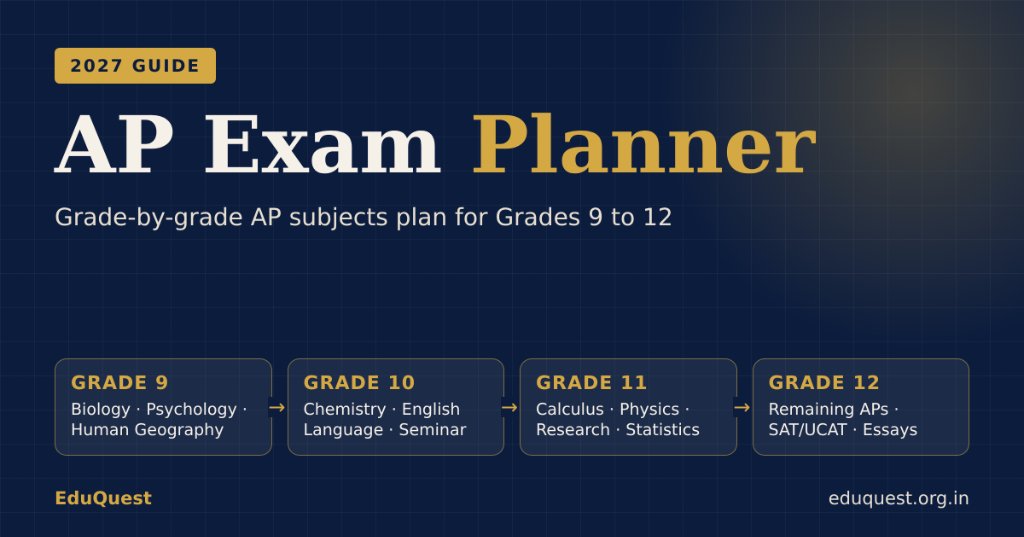
The table below is a sample plan for a student **entering or currently in Grade 9–10**. Treat it as a starting framework, not a fixed prescription.
| Grade | Suggested AP Plan |
|---|---|
| Grade 9 | AP Biology, AP Psychology or AP Human Geography (Explore 1, max 2) |
| Grade 10 | AP Chemistry, AP English Language & Composition, AP Seminar |
| Grade 11 | AP Calculus AB/BC, AP Physics 1/2, AP Research (if Seminar was taken), AP Statistics (optional) |
| Grade 12 | Any remaining APs, plus focus on UCAT/SAT preparation and application essays |
Grade 9 — Explore and Build Foundations
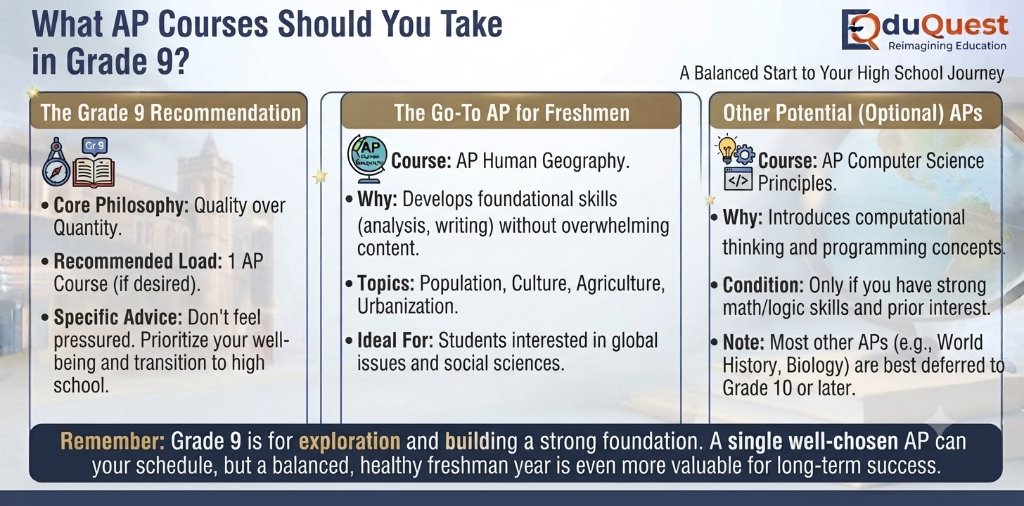
Grade 9 is about **exploration, not accumulation**. One AP course, at most two, is a sensible starting point.
- **AP Biology:** suited to students who enjoy science and are comfortable with reading dense material and lab-style reasoning.
- **AP Psychology:** a more accessible introduction to college-level work, with a lighter mathematical load. It builds study habits, vocabulary retention, and reading stamina.
- **AP Human Geography:** a good first AP for students who want to develop writing, demographic analysis, and data-interpretation skills in a social science context.
The goal is to test whether the student can handle college-level pace while still maintaining strong grades in regular school courses and having time for interests outside school.
**Choosing your first AP: Grade 9 comparison**
| Factor | AP Biology | AP Psychology | AP Human Geography |
|---|---|---|---|
| Best for | Future medical and life science students | Medicine, psychology, social science aspirants | Students building writing and data skills |
| Workload | Heavy: content-dense with lab-style reasoning | Moderate: reading and memory heavy | Moderate: reading, maps and data interpretation |
| Math needed | Basic algebra | Minimal | Minimal |
| Leads to later | AP Chemistry, AP Research | AP Statistics, AP Research | AP Government, AP Seminar |
| Good if the student | Is strong in science and highly organized | Wants a gentle start to college-level work | Prefers humanities, politics or social science |
Grade 10 — Develop Academic Depth
Grade 10 is where students typically add depth and begin signalling a clear academic direction:
- **AP Chemistry:** a natural progression for future medical, engineering and science students. It demands strong algebra skills, conceptual stoichiometry grasp, and consistent practice.
- **AP English Language & Composition:** valuable for **every** stream, because argument analysis, rhetorical devices, and analytical synthesis writing directly support college essays, research papers, and digital SAT reading comprehension.
- **AP Seminar:** the first half of the AP Capstone programme. It develops inquiry, collaboration, team presentation, and defense skills, and crucially unlocks AP Research in the next grade.
Grade 10 is also when students should start one **meaningful project or activity** (research paper, social impact initiative, coding project, or competition) that can grow over the next two years.
Grade 11 — Advanced Academic Challenge
Grade 11 is typically the most demanding year, and the one admissions officers evaluate most closely:
- **AP Calculus AB or BC:** essential for engineering, computer science, economics, data science, and physical sciences. BC is significantly more comprehensive (covers Taylor/Maclaurin series and polar curves) and fits students strong in math.
- **AP Physics 1 or 2:** algebra-based physics, a foundational fit for medical, engineering and life science students.
- **AP Research:** a year-long independent research project ending in an academic thesis paper and oral defense, available to students who completed AP Seminar. It is one of the strongest ways to demonstrate intellectual initiative to Ivy League admissions committees.
- **AP Statistics (optional):** valuable for economics, finance, psychology, biology, medicine, and big-data fields.
Grade 11 is also the prime year to begin serious digital SAT/ACT preparation and build a targeted university shortlist.
Grade 12 — Complete Your Academic Plan
In Grade 12, students should complete any remaining APs that directly fit their intended major, while giving absolute priority to:
- Final SAT/ACT attempts (and UCAT for UK/Australian medical pathways)
- College application essays (Common App Personal Statement + university supplements)
- Securing impactful academic recommendation letters
- Finalizing university deadlines (Early Decision, Early Action, Regular Decision)
Students should **avoid overloading** on brand new APs in Grade 12. Strong performance in current school courses matters, and universities actively review mid-year and final transcripts.
**Grade-by-grade priorities at a glance**
| Grade | Academic focus | Testing focus | Profile and activities | Applications |
|---|---|---|---|---|
| Grade 9 | 1 accessible AP, strong school fundamentals | Build reading and math habits | Explore interests, try 2–3 activities | None yet |
| Grade 10 | AP Chemistry, English Language, Seminar | Plan the SAT/ACT diagnostic timeline | Start one long-term passion project | None yet |
| Grade 11 | Calculus, Physics, Research, Statistics | Main SAT/ACT attempts (target 1500+) | Research, competitions, leadership | Build the university list |
| Grade 12 | Finish remaining APs, protect board grades | Final testing attempts (UCAT where needed) | Maintain and deepen commitments | Essays, recommendations, deadlines |
Which AP Courses Should You Choose by Academic Interest?
The exact same Grade 9 foundation can lead to very different AP plans depending on future career aspirations. Here is how the roadmap shifts by major:
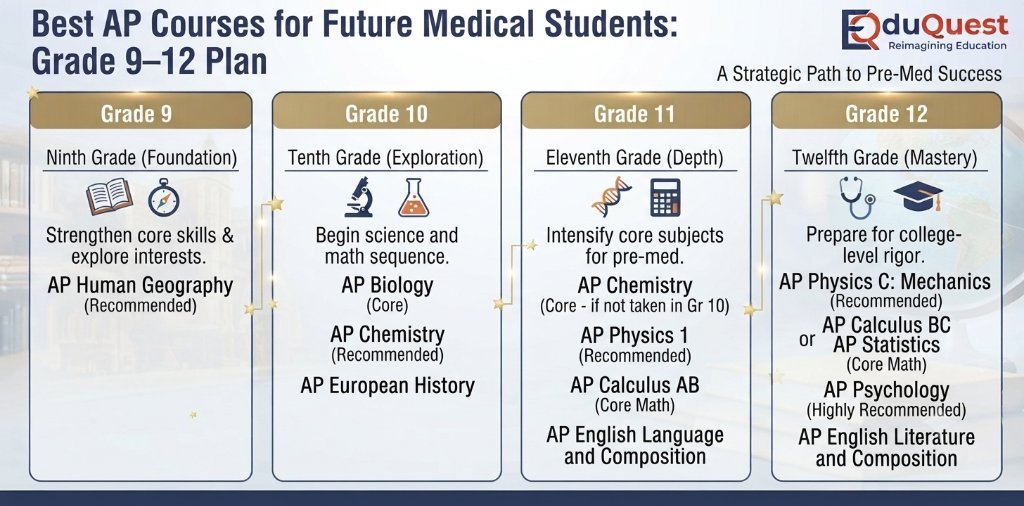
AP courses for future medical students
Core options: **AP Biology, AP Chemistry, AP Psychology, AP Physics 1, AP Statistics**, plus AP Seminar and AP Research for students aiming to demonstrate published clinical or wet-lab research acumen. Chemistry is typically a Grade 10 target, and Biology a Grade 9 or 10 start.
AP courses for engineering students
Priority is **advanced math and calculus-based physics**: AP Precalculus (where needed), AP Calculus AB/BC, AP Physics 1 and then AP Physics C (Mechanics and Electricity & Magnetism) where available, AP Chemistry, and AP Computer Science A for software or robotics tracks.
AP courses for computer science students
Start with **AP Computer Science Principles** for architectural exploration or **AP Computer Science A** for object-oriented Java programming, followed by AP Calculus and AP Statistics. Independent open-source coding projects, GitHub repositories, and hackathons matter just as much as the course list.
AP courses for economics and finance students
Combine **AP Microeconomics and AP Macroeconomics** with AP Calculus AB/BC and AP Statistics, and add AP English Language for analytical rhetoric and econometric paper writing.
AP courses for humanities and social sciences
Build around **AP English Language, AP English Literature, AP US or World History, AP Government and Politics, AP Psychology, AP Human Geography**, concluding with AP Seminar and AP Research for a comprehensive capstone-style intellectual narrative.
| Intended Major | Foundation (Gr. 9–10) | Depth (Gr. 11–12) |
|---|---|---|
| Medicine / Life Sciences | AP Biology, AP Psychology | AP Chemistry, AP Physics 1, AP Statistics, AP Research |
| Engineering | AP Precalculus, AP Physics 1 | AP Calculus BC, AP Physics C, AP Chemistry |
| Computer Science / AI | AP CS Principles or CS A | AP Calculus BC, AP Statistics, AP Research |
| Economics / Finance | AP Human Geography, AP Statistics | AP Micro, AP Macro, AP Calculus AB/BC |
| Humanities / Law / IR | AP English Language, AP World History | AP Government, AP Literature, AP Research |
How Many AP Courses Should a Student Take?
There is no magic number. Highly selective universities generally want to see that a student **took the most challenging courses available to them and performed well**. For many students, roughly 5 to 8 well-chosen APs over four years, aligned with their intended major, is far more persuasive than 12 scattered APs with uneven scores. Always check what your school offers and what your target universities state about course rigor.
**A simple 4-step decision framework:**
Maintain Strong Core Grades
Can I maintain consistent A/A* marks in regular school board classes (CBSE/ISC/IB) while taking this AP? If regular grades drop, the AP course does more harm than good.
Strategic Narrative Alignment
Does this AP subject directly support my intended university major or demonstrate genuine intellectual depth? Avoid taking subjects at random.
Extracurricular & Project Space
Do I still have adequate time (5–8 hours weekly) for my primary extracurricular commitment, research project, sports, or leadership activity?
Prerequisite Sequences
Will this course help me build toward a crucial later AP in the sequence (e.g. AP Seminar unlocking AP Research, or Precalculus unlocking Calculus BC)?
**Indicative AP load by student profile** These are planning guides, not rigid rules. Adjust them to your school's offerings and the student's capacity.
| Student profile | Grade 9 | Grade 10 | Grade 11 | Grade 12 |
|---|---|---|---|---|
| Comfortable, strong in most subjects | 1 | 2–3 | 3–4 | 1–3 |
| Strong in one stream, average in others | 1 | 2 | 2–3 | 1–2 |
| Needs time to adjust to high school | 0–1 | 1–2 | 2–3 | 1–2 |
| Heavy extracurricular or research commitment | 1 | 2 | 2–3 | 1–2 |
Should You Take AP Courses in Grade 9?
Yes, **but selectively**. One accessible AP such as AP Psychology or AP Human Geography, or AP Biology for a strong science student, is a good start. Taking three or four APs in Grade 9 usually backfires because students are still adjusting to high school expectations. Grade 9 is also the best year to build reading habits, strengthen math fundamentals and begin exploring interests.
AP Courses vs. Extracurricular Activities: How Should Students Balance Them?
APs show academic rigor. Extracurricular activities show **who the student is beyond the classroom**. Strong applicants usually have both, connected by a coherent theme. A student who takes AP Biology and AP Psychology and also carries out a health-related community project presents a persuasive, authentic profile. A student with eight unrelated APs and no depth outside class does not.
A useful rule of thumb: if AP workload leaves no time for one meaningful project, reduce the course load.
| Grade | AP share of time | Activity share of time | Smart move |
|---|---|---|---|
| Grade 9 | Light | Exploration | Try several interests, commit to none permanently yet |
| Grade 10 | Moderate | Growing | Pick one primary activity or project to deepen |
| Grade 11 | Highest | Focused | Protect time for one sustained research or impact project |
| Grade 12 | Reduced | Maintain | Prioritize college applications over launching new commitments |
AP Exam Basics Students Should Know (Registration, Fees and Dates)
| Item | Detail for the 2027 exams |
|---|---|
| Exam window | May 3–7 and May 10–14, 2027 (late testing May 17–21) |
| Exam fee at schools outside the US | $129 per exam (published College Board base fee) |
| Late order fee | $40 per exam on top of the base fee (past mid-November) |
| Unused or cancelled exam fee | $40 per exam deduction |
| Authorized test centres outside the US | Fees may vary; private centres in India charge ~₹16,000–₹17,500 |
Common Mistakes in AP Course Selection
**AP selection mistakes: quick fix table**
| Mistake | Why it hurts | Better approach |
|---|---|---|
| Too many APs, no strategy | Uneven scores, lowered GPA and severe burnout | Fewer APs, strictly aligned with the intended major |
| Picking only 'easy' APs | Weak signal of academic rigor or genuine passion | Choose courses that build prerequisites for your target career |
| Ignoring prerequisites | Blocks later APs (e.g. needing Seminar for Research) | Map the entire 4-year sequence from Grade 9 |
| Copying a friend's plan | Different strengths, learning curves and university goals | Build a bespoke plan around your own profile |
| Neglecting SAT and projects | Unbalanced application lacking narrative depth | Schedule structured time blocks for test prep and one research project |
Which AP courses should I take from Grade 9 to Grade 12?
A common, balanced progression is AP Biology, Psychology or Human Geography in Grade 9; AP Chemistry, English Language and Seminar in Grade 10; AP Calculus, Physics, Research and optional Statistics in Grade 11; and remaining major-specific APs in Grade 12. Always tailor the exact sequence to your intended field of study.
Can a Grade 9 student take AP courses?
Yes, provided the student has the academic maturity and prerequisite foundations. Starting with one accessible subject like AP Psychology or AP Human Geography is usually far wiser than attempting three or four simultaneously.
How many AP courses do I need for top US universities?
There is no rigid cutoff. Highly selective US colleges look for course rigor within the context of what your school offers. Quality (scoring 5s and 4s) and subject alignment matter much more than a sheer count of scattered exams.
Is AP Psychology a good first AP course?
For many Grade 9 and 10 students, yes. It introduces college-level reading stamina, psychological experimental methodologies, and memory concepts with minimal advanced mathematics prerequisites.
Do I need AP Seminar to take AP Research?
Yes. AP Seminar is the mandatory prerequisite for AP Research within the official College Board AP Capstone diploma programme. Self-study is not permitted for either course.
Should engineering students take AP Calculus AB or BC?
AP Calculus BC is strongly preferred for engineering, computer science, and physics majors because it covers both single-variable differential/integral calculus and advanced series/polar topics. AB is a good stepping stone if BC is not offered.
Can Indian students take AP exams without attending AP classes?
Yes. Indian students enrolled in CBSE, ISC, state board, or non-AP schools can take AP exams as external candidates through authorized open AP test centres in India by securing unique Join Codes.
Are AP courses enough to get into Ivy League universities?
No. AP scores demonstrate academic capability, but Ivy League admissions require a holistic profile including top GPA, high SAT scores (1520+), compelling essays, stellar recommendations, and deep extracurricular impact.
How EduQuest Helps Students Plan Their Academic Journey
Every student begins with different strengths, interests and goals. A future medical student, an aspiring economist and a computer science enthusiast should not follow the same course list. EduQuest mentors work with students and parents to build a personalized AP and academic roadmap, connect it to a meaningful extracurricular profile, and plan SAT, application and university strategy step by step.
Schedule a 1-on-1 AP Course & University Advisory Session
Discuss your subject choices, board curriculum overlap (CBSE/ISC/IB), and diagnostic test readiness with our senior AP faculty.
Related Reading
- [AP Exam Registration in India 2027: Step-by-Step Guide, Fees & Deadlines](/blog/ap-exam-registration-india/)
- [AP Exam Planner: Grade 9–12 AP Subjects Plan for 2027](/blog/ap-exam-planner)
- [EduQuest AP Coaching & Diagnostic Hub](/ap-coaching/)
- [Digital SAT Preparation & 12-Week Study Plan](/blog/psat-vs-sat-comparison-study-plan-guide-2026)
How EduQuest Helps You in AP Courses for Grades 9–12: A Year-by-Year Academic Roadmap at Our Gurugram Centre (F-45, South City II)
Mastering AP and securing competitive global university admissions demands structured instruction, diagnostic error post-mortems, and proven testing frameworks. At EduQuest Gurugram, we deliver bespoke test preparation and holistic admissions consulting designed specifically for Indian and NRI high school students.
🏫 Offline Classroom Coaching
Study at our premier learning centre: F-45, First Floor, South City II, Sector 50, Gurugram, Haryana 122018. Small cohorts (8–10 students) ensure interactive whiteboard problem breakdowns, physical testing terminals, and immediate face-to-face mentor doubt resolution.
💻 Live Online Interactive Classes
Join high-definition two-way interactive classes via EduQuest LMS with live digital whiteboards, screen-shares, session video recordings for revision, and 1-on-1 virtual office hours for students across India, Dubai, Singapore, and the US.
🔄 Seamless Flexible Hybrid Mode
Transition effortlessly between classroom sessions at our Gurugram F-45 centre and live virtual classes whenever school exams, projects, or travel require flexibility, ensuring zero interruption to your preparation.
Batch timings are scheduled collaboratively around high school hours (CBSE, ICSE, IB, and Cambridge), featuring personalized 1-on-1 mentorship and small batches (8–10 students). A free diagnostic demo class is scheduled prior to enrollment. Weekday batches run in the afternoon and evening after school hours (Mon–Thu), alongside weekend intensive drill bootcamps (Sat–Sun). We invite parents and students for a complimentary 1-on-1 diagnostic evaluation before enrollment.
F-45, First Floor, South City II, Sector 50, Gurugram, Haryana 122018