
Profile Building Strategic Portals & Diagnostic Tools
Profile Evaluation
1-on-1 Ivy Spiking Audit
Get your high school resume and activity list rigorously graded across the 4-tier Ivy League admissions matrix by seasoned US counselors.
Book Profile AuditStandardized Rigor
Digital SAT 1550+ Accelerator
Anchor your academic spike with a 99th percentile test score to guarantee your profile passes the initial academic index screening.
Explore SAT PrepOfficial Dossier
Free 2027 Profile Blueprint
Download the comprehensive 4-Tier Extracurricular Rubric, Cold Outreach Email Templates to University Professors, and Activity Log Tracker.
1. Executive Overview: Demystifying Profile Building for US University Admissions
Gaining admission to an Ivy League institution (Harvard, Yale, Princeton, Columbia, UPenn, Brown, Dartmouth, Cornell) or top-tier US universities like Stanford, MIT, Caltech, Duke, and Northwestern has become the most competitive academic challenge in the world. Acceptance rates for international applicants frequently hover between 3% and 5%. For decades, Indian students were taught that academic perfection—scoring 98% in CBSE/ISC board exams or achieving a 1550+ Digital SAT score—was the golden key to an Ivy League admit. However, in modern holistic review, top grades are merely the baseline table stakes.
When thousands of applicants present near-identical 4.0 GPAs and 99th percentile SAT scores, admissions officers make their final selections based on profile building for US university admissions. A compelling student profile is not a random laundry list of certificates; it is a coherent, deeply persuasive narrative demonstrating authentic intellectual curiosity, sustained commitment, measurable leadership, and community impact.
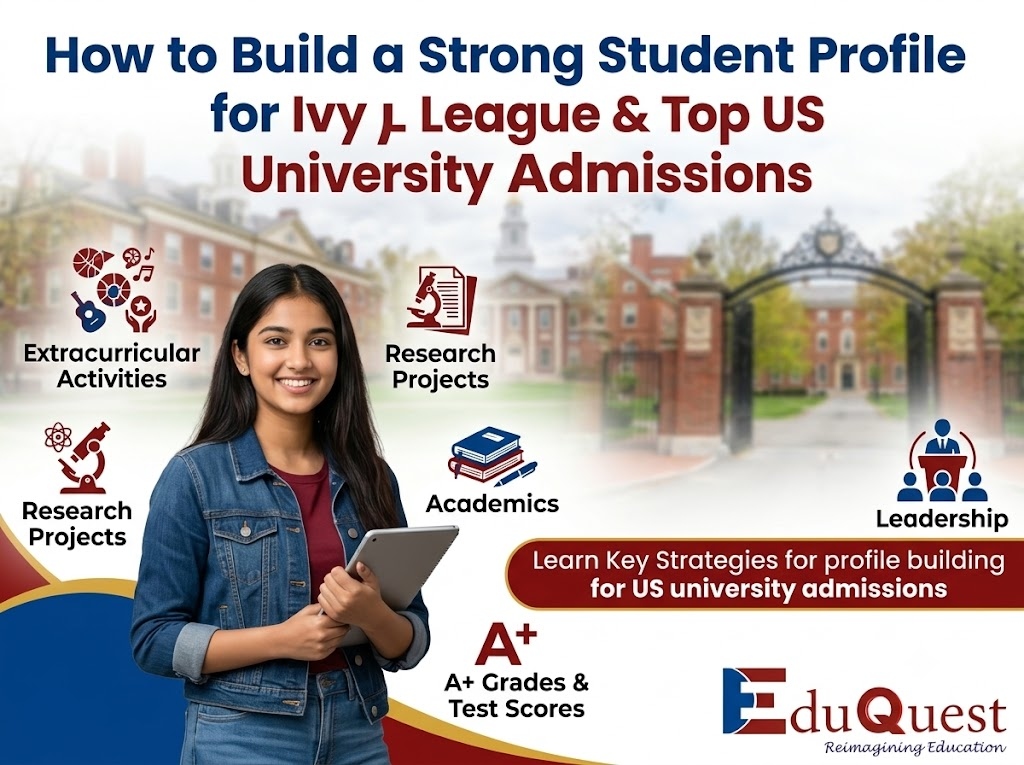
In this master guide, we deconstruct exactly how American admissions committees evaluate candidates, how to curate extracurricular activities for Ivy League applicants across the four recognized tiers, how to design and publish high school research projects for US college applications, and concrete steps on how to improve a university application profile starting from Class 9 through Class 12.
2. The "Well-Rounded" Fallacy: Why Ivy League Colleges Seek "Pointy" Spikes
Fast-Track Your College & Career Strategy
Get immediate, personalized AI insights tailored to your grade, strengths, and dream universities — 100% free with instant reports.
Know Your Personality Type for Free
Take our 18-question AI psychometric test to uncover your cognitive archetype, hidden learning superpowers, and ideal university courses.
Personalized Career & University EduPath
Build a step-by-step Grade 8–12 admissions blueprint with AI-matched target universities, exam schedules, and extracurricular profiles.
The single most costly mistake high school students and parents make is attempting to be "well-rounded." Students often try to juggle 10 distinct activities: playing the guitar, running track, participating in Model UN, learning French, doing occasional beach cleanups, writing poetry, and leading a school robotics club. While this produces a pleasant, versatile individual, it is an admissions disaster for elite institutions.
Top US universities do not want well-rounded students. Instead, they want to assemble a well-rounded incoming class composed of deeply "pointy" specialists. A "spike" is a defined area of singular excellence and authentic obsession where you have pushed far beyond your high school curriculum, created tangible output, and achieved regional, national, or international distinction. When an admissions officer presents your file to the admissions committee, they must be able to summarize you in one punchy sentence: "This is the computational biology prodigy who built an AI model for malaria detection" or "This is the youth activist who changed regional textile labor laws." If you are a Jack-of-all-trades, your file will be categorized as "competent but unmemorable."
3. Anatomy of Holistic Admissions: What Goes on Inside the Committee Room
To excel at profile building for US university admissions, you must understand the two distinct phases of application reading:
- Phase 1 — The Academic Threshold (Academic Index): Your transcripts from Grades 9, 10, 11, and 12, course rigor (AP exams, IB Higher Level subjects, Honors courses), and Digital SAT/ACT scores are evaluated. If you meet the university’s academic bar, your file moves to holistic review.
- Phase 2 — Holistic Character & Spike Assessment: Two admissions officers review your Common App Activities List (10 activities), Honors List (5 awards), personal statement (650 words), university-specific supplemental essays, and Counselor/Teacher Letters of Recommendation (LORs). Here, candidate ratings from 1 (highest) to 4 (lowest) are assigned across Non-Academic Merit, Intellectual Vitality, and Personal Qualities.
4. The 4-Tier Extracurricular Activities Classification Rubric
Admissions evaluators mentally sort your 10 Common App activities into four distinct tiers based on scale, selectivity, and impact. Understanding this hierarchy is central to designing extracurricular activities for Ivy League applicants.
| Tier Level | Exclusivity & Scale | Typical Examples | Admissions Impact |
|---|---|---|---|
| Tier 1 (Rare / Transformative) | Top 0.1% nationally or internationally | International Olympiad Medalist (IMO, IPhO, IBO, IOI); ISEF Grand Award Winner; Founder of a funded startup ($25K+ raised) or registered NGO impacting 10,000+ people; Published first-author paper in a recognized peer-reviewed journal; Nationally ranked athlete. | Instantly commands committee-wide advocacy; overcomes minor application imperfections. |
| Tier 2 (High Distinction) | Top 1%–2% regionally or state-wide | State or National Debate Champion; All-State Orchestra Concertmaster; Student Body President of a 2,500+ student school; Founder of a recognized regional community project with verified metrics; Winner of prestigious national essay contests. | Very strong competitive asset; anchors applications to Top 20 US universities. |
| Tier 3 (Institutional Leadership) | School-wide or local leadership | School Club President (Robotics, Model UN, Economics Club); Varsity sports team captain; Editor-in-Chief of school newspaper; Volunteer coordinator with 200+ documented hours. | Shows commendable involvement, but common among 70% of Ivy League applicants. Cannot serve as your sole spike. |
| Tier 4 (General Participation) | General club membership / hobbies | General club member; informal hobbyist (painting, casual coding); sporadic volunteering; attended summer camp as a general participant. | Fills empty slots on the Common App; contributes minimal weight in elite admissions decisions. |
5. Architecting Tier 1 Extracurricular Activities: From Idea to National Scale
Many Indian students mistakenly assume Tier 1 activities require immense financial resources or elite family connections. In reality, what admissions officers respect most is initiative taken within your local context. You do not need to solve world hunger; you need to identify a specific, hyper-local friction point and build an authentic, verifiable solution.
Consider the difference between a generic Tier 3 activity and an architected Tier 1 activity in economics:
- Tier 3 Approach: "President of the high school Economics Club. Hosted weekly quizzes and attended school Model UN conferences."
- Tier 1 Approach: "Founded the Micro-Finance Literacy Initiative. Designed a vernacular WhatsApp audio curriculum on micro-loans for 420 rural women artisans; partnered with a regional cooperative bank to disburse ₹18 Lakhs in collateral-free working capital; published a policy case study in an academic journal."
6. High School Research Projects for US College Applications: The Ultimate Intellectual Spike
Among all profile elements, high school research projects for US college applications offer the highest return on investment for demonstrating intellectual vitality. Top universities like Stanford and MIT explicitly evaluate an applicant’s capacity to formulate original hypotheses, read dense academic literature, analyze data, and contribute novel insights.
However, admissions committees are increasingly skeptical of "pay-to-play" high school research companies where families pay $3,000–$5,000 for a guaranteed publication on an obscure blog. Real academic research requires rigor, genuine faculty mentorship, and verifiable methodology.
7. The Cold Outreach Formula: How High Schoolers Land University Professor Mentorship
Landing a research mentorship with a professor at an IIT, IISc, Ashoka, or international university requires strategic communication. Follow this proven 4-step outreach protocol:
Review Professor Publications
Identify 15–20 professors whose recent papers align with your interests. Read 2 of their published papers thoroughly, taking notes on their methodology and open research questions.
Draft a Hyper-Personalized Email
Never send generic mass emails. Specifically cite a finding from their recent paper, articulate what intrigued you, and propose a specific modest question or data analysis task you can contribute to.
Demonstrate Pre-Existing Competence
Highlight foundational skills you already possess (e.g., Python, R, data cleaning, literature synthesis, LaTeX formatting) so the professor knows you will not be a logistical burden.
Propose a Low-Commitment Conversation
Ask for a 15-minute Zoom call or offer to assist unpaid on an existing research initiative. Persistence is key—expect a 10%–15% response rate.
8. Where to Publish High School Research: Legitimate Journals vs. Predatory Outlets
Submitting your research to a predatory journal that publishes any paper within 48 hours for a fee will severely damage your credibility. Admissions officers maintain blacklists of vanity publishers. Focus on verified, rigorous avenues:
- Journal of Emerging Investigators (JEI): Peer-reviewed science journal founded by Harvard graduate students, specifically dedicated to secondary school STEM research.
- The Concord Review: The gold standard international quarterly journal for high school history and humanities research essays.
- National & International Conferences: Submitting poster presentations to IEEE student symposiums, ACM workshops, or regional economics colloquiums.
- Open Science Preprints (arXiv, bioRxiv, SSRN): Uploading complete, preprint manuscripts with complete code repositories on GitHub for full academic transparency.
9. National and International Olympiads: Concrete Proof of Academic Mastery
Standardized school exams evaluate memorization; competitive olympiads evaluate pure problem-solving aptitude under unfamiliar constraints. Winning or qualifying for national rounds in recognized competitions provides indisputable objective validation on your profile:
| Academic Domain | Premier Competitions in India | Global Competitions | Target Milestone |
|---|---|---|---|
| Mathematics | IOQM, RMO, INMO (HBCSE / TIFR) | American Invitational Math Exam (AIME), USAMO | INMO qualifier or AIME qualification (top 2.5% globally) |
| Physics & Chemistry | NSEP / INPhO, NSEC / INChO | International Physics / Chemistry Olympiad | State Top 1% or National Olympiad Camp selection |
| Computer Science | ZIO, ZCO, INOI (IARCS) | USACO (USA Computing Olympiad), IOI | USACO Gold/Platinum division or INOI Medalist |
| Debate & Public Speaking | Indian National Debating Championships (INDC) | World Schools Debating Championship (WSDC) | National Team Squad or Quarter-Finalist |
| Social Sciences | National Economics Olympiad (SRCC) | John Locke Essay Prize, Harvard International Review Contest | High Commendation or Global Top 10 Finalist |
Download the Ivy League Profile Building Blueprint (2027 Entry)
Get instant access to our comprehensive 4-Tier Extracurricular Rubric, High School Research Launchpad, Cold Outreach Professor Templates, and Grade 9–12 Milestone Tracker.
10. Community Service That Stands Out: Moving from Passive Hours to Quantifiable Change
Every Indian applicant has certificates for collecting clothes, planting saplings, or tutoring underprivileged children for 20 hours. When hundreds of thousands of applicants submit similar claims, admissions committees treat passive volunteering as background noise.
To transform community engagement into a core pillar of profile building for US university admissions, focus on three principles: (1) Longevity (sustained over 2+ years rather than a one-week sprint), (2) Systemic Problem Solving (building a reusable tool, process, or organization rather than doing episodic manual labor), and (3) Measurable Metrics (dollars raised, laws influenced, beneficiaries served, or data tracked).
11. Decoding "Intellectual Vitality": The Trait Stanford, Harvard, and Yale Prize Most
Stanford University explicitly assigns every applicant an Intellectual Vitality (IV) rating from 1 to 5. Intellectual vitality is defined as the passion for ideas, the curiosity to explore subjects beyond the confines of a syllabus, and the drive to create intellectual capital for its own sake.
How do you prove intellectual vitality on your application? Through independent self-directed learning: self-studying advanced multivariable calculus or econometrics online, building open-source software libraries, running a niche academic substack that analyzes international monetary policy, or translating ancient Sanskrit manuscripts into modern computational databases.
12. Mastering the Common App Activities Section: The 150-Character Impact Formula
On the Common Application, you are granted exactly 10 activity slots. For each activity, you have only 50 characters for the Position/Leadership Description, 100 characters for the Organization Name, and 150 characters for the Activity Description. Wasting this precious real estate on vague descriptions is a critical error.
Compare these real examples:
- Before (Weak): "Head of school robotics team. Built robots for competitions and mentored younger students in programming." (102 characters, zero metrics, passive tone)
- After (Optimized): "Captain, Team 402; built 15kg autonomous bot (CAD/Python); won 1st/48 teams at Nat'l FIRST Tech; mentored 35 junior coders; secured $4K corporate sponsorship." (149 characters, rich metrics, power verbs)
13. Strategic Sequencing: How to Order Your 10 Common App Activities
Admissions officers read your activities in the exact order you submit them. The sequence must reinforce your narrative spike immediately:
- Slots 1 & 2 (Primary Spike Anchors): Your Tier 1 achievements directly connected to your intended major (e.g., independent research paper, international olympiad medal, high-impact venture).
- Slots 3 & 4 (High-Level Leadership / Tier 2): Major school-wide or regional leadership roles (e.g., Student Body President, Varsity Captain, Founder of regional non-profit).
- Slots 5 & 6 (Secondary Academic Interests): Interdisciplinary pursuits demonstrating multidimensional curiosity (e.g., debate captain, school newspaper editor, competitive coder).
- Slots 7 & 8 (Community & Civic Contributions): Sustained service projects with documented volunteer hours and measurable beneficiaries.
- Slots 9 & 10 (Personal Passions & Character Builders): Meaningful personal commitments (e.g., marathon running, family responsibilities, part-time work, creative arts) that reveal your grounded humanity.
14. Maximizing the 5 Common App Honors Slots
While the Activities section captures your actions, the Honors Section allows you to list up to 5 academic awards, including their scope (School, State/Regional, National, International) and the grade levels received (9, 10, 11, 12). Prioritize nationally accredited honors (Olympiad ranks, AP Scholar with Distinction, National Merit, published paper awards, international essay prizes) over internal school prizes like "Best Student in Biology."
15. The 4-Year Profile Building Roadmap: Class 9 to Class 12 Master Calendar
Timing is everything when planning how to improve a university application profile. Beginning in Grade 11 or 12 leaves too little runway to create authentic national impact. Follow this structured 4-year trajectory:
Class 9: Exploration, Foundation & Broad Sampling
Establish pristine academic GPA habits and explore 5–6 diverse interest areas.
- Maintain 90%+ scores in CBSE/ICSE or 7s in MYP/IGCSE; build strong study routines.
- Sample 5–6 extracurricular clubs (robotics, debate, writing, music, athletics).
- Read voraciously outside the textbook; identify 2 academic subjects you love.
- Begin learning foundational research tools (Python, statistics, advanced writing).
Class 10: Narrowing Focus & Defining the Spike Hypothesis
Cut low-impact activities and commit deeply to 2 primary domains.
- Eliminate 3–4 peripheral clubs; focus 80% of free time on your primary spike.
- Compete in foundational national olympiads (IOQM, NSEP, regional debates).
- Initiate your first independent project (small-scale community pilot or software tool).
- Complete diagnostic Digital SAT test; identify score gaps early.
Class 11: Scaling to Tier 1 Impact, Research & National Distinction
The most decisive profile building year in high school.
- Execute high school research projects for US college applications with university faculty.
- Submit paper to peer-reviewed student journals (JEI, Concord Review) or conferences.
- Scale community initiative to regional/national levels with verified beneficiaries.
- Target 1520+ Digital SAT score by August or October of Grade 11.
- Secure major leadership positions (President, Captain, Founder).
Class 12: Application Architecture, Storytelling & Final Polish
Synthesize your achievements into a cohesive Common App narrative.
- Finalize Common App personal statement (650 words) linking your spike to future aspirations.
- Condense 10 activities into high-impact 150-character descriptions using the Power Verb formula.
- Secure detailed, glowing Letters of Recommendation (LORs) from 2 subject teachers.
- Submit Early Action / Early Decision applications by November 1.
16. Navigating Summer Programs: Free Merit-Based Programs vs. $10,000 "Camps"
Every spring, Indian families receive glossy brochures inviting high schoolers to attend summer courses on Harvard or Columbia campuses for $8,000–$12,000. Admissions officers place almost zero admissions weight on pay-to-play summer programs. Any student whose parents can afford the tuition gets in.
In contrast, ultra-competitive, merit-based summer programs (many of which are free or offer full need-based financial aid) carry massive weight in Ivy League admissions. Admittance rates for these elite institutes are often lower than 5%:
| Prestigious Program | Academic Discipline | Selectivity | Cost & Location |
|---|---|---|---|
| RSI (Research Science Institute) | STEM & Advanced Scientific Research | ~3% (Top 100 students globally) | Free (Full fellowship at MIT) |
| TASP / Telluride Association Summer Program | Humanities, Philosophy & Social Inquiry | ~4% (Ultra-selective humanities) | Free (Tuition, room & board covered) |
| PROMYS / Ross Mathematics Program | Advanced Pure Number Theory & Proofs | ~10% (Rigorous problem set entrance) | Need-based aid available; Boston / Ohio |
| SSP (Summer Science Program) | Astrophysics, Biochemistry, Genomics | ~8% (Hands-on laboratory research) | Generous need-based financial aid |
| MIT Beaver Works Summer Institute (BWSI) | Quantum Computing, Autonomous Robotics, AI | ~12% (STEM pre-requisites required) | Free or minimal fee |
17. Leveraging Arts, Athletics, and Niche Spikes for University Admissions
A spike does not need to be confined to STEM or finance. Elite universities are eager to recruit talented artists, classical musicians, filmmakers, and competitive athletes. However, the standard for external validation remains high:
- Arts & Music Portfolio: Submit an optional arts supplement via SlideRoom. Portfolios are reviewed by university fine arts faculty, who submit a formal numerical rating to the admissions committee.
- Athletic Recruitment: If you compete at national or international levels in rowing, squash, tennis, or track, you can reach out directly to Ivy League varsity coaches for potential athletic recruitment support.
18. High School Entrepreneurship: How to Build a Startup Admissions Officers Believe
Calling yourself "CEO & Founder" of a company with no revenue, no users, and an empty Instagram page will invite skepticism from admissions officers. Legitimate student entrepreneurship must demonstrate traction:
- Product Validation: An active software product with verified monthly active users (MAUs), customer reviews, or enterprise pilot contracts.
- Financial Transparency: Verified revenue figures, grants won (such as 1517 Fund, Emergent Ventures, or youth innovation challenges), or non-profit budget disclosures.
- Third-Party Recognition: Press coverage in legitimate publications, incubators attended, or patent applications submitted.
19. Standardized Tests: The Academic Anchor That Validates Your Extracurriculars
While test-optional policies emerged in recent years, leading universities—including MIT, Dartmouth, Yale, UT Austin, Georgetown, Purdue, and Florida—have reinstated mandatory standardized testing for 2026/2027. Even at test-optional Ivy League colleges, over 75% of admitted international students submit top-percentile scores.
A high Digital SAT score (1530–1580) or ACT score (34–36) serves as the objective validator of your school transcript. It proves that your school grades were not inflated and that you possess the quantitative and analytical reading horsepower required for elite coursework.
20. Teacher & Counselor Letters of Recommendation (LORs): The Secret Third-Party Endorsement
Extracurricular achievements tell admissions officers what you achieved; Letters of Recommendation tell them who you are in the classroom when nobody is grading your personality. A generic letter stating "Rahul is a disciplined student who always submits homework on time" earns a mediocre rating.
To cultivate tier-1 LORs: (1) Actively participate in class discussions with thoughtful, probing questions, (2) Share your outside research or reading with your teachers during office hours, and (3) Provide your recommenders with a comprehensive "Brag Sheet" highlighting specific class moments, papers you wrote, and projects where you demonstrated leadership.
21. Aligning Your Personal Statement with Your Extracurricular Spike
Your Common App Personal Statement (650 words) should not simply rehash your activities list. Your activities list covers what you did; your essay must reveal why you do it, how you process intellectual failure, and the ethical core driving your ambition.
22. The "Why Us?" and Community Supplemental Essays: Tailoring Your Spike to Each Campus
Every top university requires institution-specific supplemental essays. For your primary spike, you must demonstrate intimate knowledge of each university's academic ecosystem:
- Name specific professors whose ongoing research labs you plan to join (e.g., "Working in Professor Bertozzi's chemical biology lab to investigate synthetic glycans").
- Reference distinctive undergraduate research programs (e.g., MIT UROP, Harvard PRISE, Stanford ChEM-H).
- Identify campus student organizations where you will continue your leadership initiatives from high school.
23. Profile Archetypes: STEM vs. Business/Economics vs. Humanities/Law
Depending on your intended field of study, admissions committees look for different combinations of evidence:
| Intended Major | Core Spike Deliverables | Essential Competitive Honors | Ideal Profile Archetype |
|---|---|---|---|
| Computer Science & AI | Open-source software repos with real users; published AI/ML research paper; competitive coding ranks (USACO, Codeforces). | IOI/INOI qualification, ISEF finalist, national hackathon champion. | The Problem-Solving Architect who builds software to resolve civic inefficiencies. |
| Biomedical & Pre-Med | Laboratory bench research; clinical shadowing; public health outreach data analysis. | Olympiad medals (IBO/INBO), Brain Bee champion, published biology case study. | The Empathetic Scientific Investigator bridging molecular biology and community health. |
| Business & Economics | Micro-finance initiative, equity research substack, student-run venture with verified revenue, policy paper. | National Economics Olympiad top rank, Wharton High School Investment Challenge finalist. | The Quantitative Economic Strategist combining mathematical modeling with entrepreneurial drive. |
| Humanities & Law | Published long-form historical monograph, national debate titles, legal aid clinic volunteer coordinator. | John Locke Essay Prize Winner, The Concord Review publication, National debate champion. | The Articulate Policy Advocate deconstructing institutional history and constitutional justice. |
24. The Top 8 Profile Building Pitfalls That Derail Ivy League Aspirants
- 1. The "Resume Padding" Syndrome Joining 12 school clubs in Grade 11 solely to add names to your CV. Admissions officers see through superficial involvement within 30 seconds.
- 2. Pay-to-Play Research Services Paying thousands of dollars to agencies guaranteeing an online paper. Elite universities verify journal prestige and easily spot canned research.
- 3. Starting Non-Profits That Disappear After Submitting Founding an NGO that has no registered entity, no audited financials, and goes dormant immediately after college application deadlines.
- 4. Sacrificing Academic GPA for Extracurriculars Allowing your school board marks to drop from 95% to 80% while pursuing activities. Extracurriculars never compensate for failing academic index thresholds.
- 5. Over-reliance on Passive Model UN Certificates Listing 10 school MUN delegate certificates as your primary spike. Unless you serve on national executive boards or win international championships, MUN is viewed as a standard hobby.
- 6. Lack of Verifiable Digital Footprint Claiming you built a platform impacting 50,000 users, yet having no active website, code repository, news mention, or digital evidence.
- 7. Missing Teacher Engagement Focusing exclusively on solo achievements while ignoring classroom relationships, resulting in cold, generic teacher recommendation letters.
- 8. Waiting Until Grade 11 Summer to Build a Profile Attempting to cram 4 years of intellectual discovery, community service, and research into 6 weeks. Real depth requires cumulative development.
25. The Digital Footprint: Personal Websites, GitHub, and LinkedIn for High Schoolers
In the modern admissions landscape, admissions officers frequently click links or review supplementary materials submitted via your Common Application. A sleek, well-maintained personal website (e.g., yourname.com) hosting your research papers, blog posts, project demos, and portfolio builds immense credibility.
For coders and engineers, an active GitHub repository with clear commit histories and README documentation is far more convincing than a certificate of completion from an online video course.
26. How Financial Aid Needs Impact Profile Standards for International Students
Only a select group of US colleges are need-blind for international students (Harvard, Princeton, Yale, MIT, Dartmouth, Amherst, Bowdoin). This means requesting financial aid does not affect your admission chances at these institutions.
However, at need-aware universities (such as Columbia, UPenn, Cornell, Stanford, Duke, and Northwestern), requesting substantial financial aid increases the competitive bar. For international students requiring 80%–100% scholarship support, your profile must not just be competitive—it must stand firmly in the top 0.5% of the worldwide applicant pool.
27. Real Case Studies: Deconstructing 3 Admitted Ivy League Profiles from India
Examining real profiles illustrates how different components synthesize into a cohesive spike:
| Student Archetype | Curriculum & Scores | Primary Spike Activities | Outcome |
|---|---|---|---|
| Case Study A: Aarav (AI & Linguistics) | CBSE (96.4%), Digital SAT: 1570 | Built an open-source NLP translator for underrepresented tribal languages; published research in IEEE student paper; USACO Platinum; conducted coding workshops for 120 rural students. | Admitted to MIT & Stanford |
| Case Study B: Ananya (Econ & Public Policy) | ISC (97.2%), Digital SAT: 1540 | Initiated policy analysis on female rural self-help groups; published policy brief in regional journal; won National Economics Olympiad; President of State Debate Team. | Admitted to Harvard (ED) & Princeton |
| Case Study C: Rohan (Mechanical & Energy) | IB Diploma (43/45), SAT: 1520 | Engineered low-cost solar grain dryer for local farmers (patent filed); FIRST Robotics Team Captain; organized regional science fair for 600 students; varsity swimmer. | Admitted to Cornell & UPenn |
28. The EduQuest Profile Architecture Methodology
At EduQuest, our global admissions mentors work 1-on-1 with ambitious high school students from Grades 8 through 12 to transform raw academic potential into world-class admissions files. Our structured methodology follows four proprietary phases:
- Diagnostic Spike Discovery: Administering advanced narrative intelligence and psychometric diagnostics to uncover the student's natural intellectual passions and academic strengths.
- Milestone-Driven Execution: Pairing students with verified research mentors, structuring independent capstone initiatives, and preparing for national olympiads.
- Leadership Scaling: Guiding students to elevate local initiatives to verifiable regional or national impact with measurable stakeholders and public recognition.
- Narrative Synthesis: Crafting memorable Common App activity descriptions, securing strategic letters of recommendation, and polishing narrative essays that stand out in the admissions committee room.
29. Frequently Asked Questions (FAQs) on Profile Building for US University Admissions
When is the best time to start profile building for US university admissions?
The ideal window to begin structured profile building is between Grade 8 and Grade 10. Starting early allows students to explore multiple interests broadly in Grade 9, narrow down to a high-impact spike in Grade 10, and execute tier-1 research and national leadership across Grade 11 without compromising board exams.
What are the most impactful extracurricular activities for Ivy League applicants?
The most impactful activities are Tier 1 achievements that demonstrate national or international rarity: qualifying for international olympiads (IMO, IOI, IPhO), publishing genuine peer-reviewed scientific or humanities research, launching scalable non-profits or startups with verified metrics, or reaching national mastery in debate, athletics, or the arts.
Can I get into an Ivy League university without high school research projects?
Yes, research is not mandatory for every applicant. You can anchor your profile with exceptional competitive olympiads, entrepreneurship, artistic mastery, or high-impact community leadership. However, for STEM and social science applicants, authentic high school research projects for US college applications remain the most effective method to demonstrate intellectual vitality.
How do American admissions officers verify my activities and awards?
Admissions officers verify claims through multiple channels: counselor reports (which must certify your achievements), teacher recommendations, school profile documents, links to public news coverage, official competition rosters, and occasional spot-check audits conducted by the admissions office directly contacting your high school.
How many extracurricular activities should I list on the Common App?
The Common Application provides space for up to 10 activities and 5 honors. It is far better to submit 6–8 deeply developed, sustained activities with significant leadership than to pad 10 slots with superficial, one-week memberships.
How can an Indian student improve their university application profile if their school has limited clubs?
US universities evaluate students within the context of their environment. If your school has few clubs, that is your greatest opportunity: take initiative to found the school's first debate society, robotics league, or science journal. Founding and institutionalizing a new activity in a resource-limited school demonstrates extraordinary leadership.
30. Your 7-Day Action Plan: Concrete Steps to Improve Your Profile Starting Tomorrow
Transforming your profile does not require waiting for next semester. Take these concrete actions over the next 7 days:
Conduct an Activity Audit
List every activity you currently participate in. Classify each into Tiers 1 through 4. Identify the 1–2 activities with the potential to scale into a Tier 1 spike.
Prune the Deadweight
Politely resign from low-interest Tier 4 clubs that consume hours without yielding genuine leadership or personal fulfillment.
Formulate a Research Question
Draft 3 specific questions at the intersection of your favorite school subject and a real-world dilemma. Begin reading 3 recent academic papers in that domain.
Schedule an Expert Profile Review
Connect with EduQuest admissions mentors to pressure-test your activity list, identify hidden narrative spikes, and design your multi-year admissions roadmap.
31. Summary Matrix: Key Profile Elements vs. Admissions Evaluation Weight
| Profile Component | Evaluation Weight | Minimum Target Benchmark | Primary Admissions Purpose |
|---|---|---|---|
| Academic Rigor & GPA | Essential Baseline (Gatekeeper) | Top 1%–5% in school; 93%+ in CBSE/ISC or 39+ in IB | Proves you can survive the intellectual intensity of Ivy League coursework. |
| Digital SAT / ACT Score | High Validator | 1520–1580 SAT / 34–36 ACT | Standardizes academic evaluation across disparate international grading boards. |
| Tier 1/2 Extracurricular Spike | Highest Differentiator | 1–2 National/Global achievements with verified metrics | Provides the primary reason for committee-wide advocacy and selection. |
| Intellectual Vitality & Research | High Differentiator | Independent research, publications, olympiad honors | Demonstrates authentic self-driven passion for knowledge creation. |
| Common App Essays & Voice | Decisive Qualitative Metric | Vulnerable, reflective, sensory storytelling | Reveals personal maturity, ethical foundation, and community culture fit. |
| Letters of Recommendation | Crucial Endorsement | Specific, glowing anecdotes from 2 academic teachers | Third-party corroboration of character, curiosity, and classroom leadership. |
32. Final Conclusion: Building a Profile That Leaves No Doubt
Securing an acceptance letter from an Ivy League university or top US institution is never the result of luck or eleventh-hour resume embellishment. It is the culmination of intentional, years-long intellectual curiosity, courageous initiative, and disciplined execution. By transitioning from a well-rounded participant into a pointy, high-impact specialist, you distinguish yourself from thousands of applicants worldwide.
Remember: the goal of profile building for US university admissions is not merely to craft an attractive application—it is to develop the intellectual resilience, leadership acumen, and problem-solving drive that will define your career for decades to come.
Ready to Architect Your Ivy League Profile?
Book a comprehensive 1-on-1 profile evaluation with former Ivy League and top US university admissions counselors at EduQuest. We evaluate your activities, curate your academic spike, and design your grade-by-grade roadmap.