
USA Undergraduate Admissions Strategic Cluster Hub (2027)
Ivy League Audit
1-on-1 Profile Diagnostic
Benchmark your CBSE/ISC transcripts, Digital SAT scores, and extracurricular spike against Top 20 US university rubrics.
Audit US ProfileAI SAT Predictor
Diagnostic Score Engine
Evaluate target SAT percentiles and university admission probabilities across Harvard, Stanford, MIT, and UC Berkeley.
Launch SAT EngineFree Master Dossier
Download Master PDF
Get our 50-page USA Undergraduate Admissions Master Guide featuring Common App timelines, essay frameworks, and STEM OPT rules.
1. Executive Overview: The American Undergraduate Value Proposition
The United States remains the undisputed global gold standard for undergraduate education. With over 4,000 degree-granting institutions—including the historic **Ivy League**, elite technological titans such as **MIT, Stanford, and Caltech**, and world-renowned public flagship systems like the **University of California (UC)**—the American higher education ecosystem offers intellectual freedom, research funding, and career mobility unmatched by any other nation.
What makes studying in the US fundamentally different from the UK, Canada, or India is the **Liberal Arts and Sciences philosophy**. In the US, undergraduates do not apply to study a rigid single subject for three or four years. Instead, students are admitted to a university or college as a whole, spending their first two years exploring general education across humanities, quantitative sciences, social sciences, and philosophy before officially declaring their academic major at the end of their sophomore year. This enables students to double major across seemingly disparate disciplines—such as Computer Science and Economics, or Neuroscience and Philosophy.
Furthermore, international graduates from STEM-designated degree programs benefit from the **36-Month STEM OPT (Optional Practical Training)** extension, allowing 3 full years of lawful, full-time employment in the United States on an F-1 student visa. To navigate this transformative pathway, Indian high school students must understand how the core components of the US admissions cluster interconnect.
2. Admission Criteria: Grades, Standardized Tests, Essays & Holistic Evaluation
Fast-Track Your College & Career Strategy
Get immediate, personalized AI insights tailored to your grade, strengths, and dream universities — 100% free with instant reports.
Know Your Personality Type for Free
Take our 18-question AI psychometric test to uncover your cognitive archetype, hidden learning superpowers, and ideal university courses.
Personalized Career & University EduPath
Build a step-by-step Grade 8–12 admissions blueprint with AI-matched target universities, exam schedules, and extracurricular profiles.
Unlike European and Asian systems that rely strictly on final board examination cutoffs, the US operates on a **holistic admissions model**. Selective US admissions committees evaluate who you are as an intellectual, a leader, and a community contributor across five pillars:
| Admissions Component | Weightage & Focus | Indian Board Benchmark (CBSE/ISC) | Detailed Strategic Analysis |
|---|---|---|---|
| **High School GPA & Academic Rigor** | Highest Weight (~40%) | Consistent 90% – 98% across Classes 9, 10, 11, and 12 | Admissions deans examine your 4-year transcript. A continuous upward grade trajectory and rigorous subject choices (Core Math, Physics, Economics) are crucial. |
| **Standardized Testing (Digital SAT / ACT)** | High Weight (~25%) | Target: 1480 – 1560+ (SAT) or 33 – 35 (ACT) | While many institutions maintain test-optional policies, submitting a 1500+ SAT provides objective third-party validation for Indian board students. |
| **Extracurricular Spikes & Leadership** | High Weight (~20%) | Tier 1 & Tier 2 initiatives (Research, Olympiads, Ventures) | Evidence of sustained commitment, independent initiative, peer-reviewed research, or national-level competitions far outweighs passive club memberships. |
| **Common App Personal Statement & Supplements** | Critical Gatekeeper (~10%) | Authentic intellectual voice, self-awareness, storytelling | Reveals your personal values, curiosity, and writing mastery. Supplemental essays must demonstrate deep institutional alignment with specific professors and labs. |
| **Letters of Recommendation (LORs)** | Substantiating Proof (~5%) | 2 Subject Teachers + 1 School Counselor LOR | Confidential evaluations contextualizing your classroom contributions, intellectual resilience, and ethical character. |
For a comprehensive, subject-by-subject breakdown of board mark conversions, documents required, and financial solvency rules, consult our dedicated child guide: [US Undergraduate Admission Requirements for Indian Students (2027)](/blog/us-undergraduate-admission-requirements-indian-students-2027/).
3. Application Deadlines: Intakes, Early Decision, Early Action & Regular Cycles
US universities operate multiple admission rounds, each with distinct contractual obligations, acceptance rate dynamics, and strategic trade-offs:
Early Decision 1 (ED1) – Deadline: November 1
A legally binding agreement where a student commits to matriculating if admitted. Acceptance rates for ED1 can be 2x to 3x higher than Regular Decision at institutions like Cornell, Columbia, Duke, and Northwestern.
Early Action (EA) & Restrictive Early Action (REA) – Deadline: November 1
Non-binding early rounds. Restrictive Early Action (Harvard, Yale, Princeton, Stanford) prohibits applying early to other private US institutions but allows public universities. Unrestricted EA (MIT, Purdue, Georgia Tech) allows multiple early applications.
Early Decision 2 (ED2) – Deadline: January 1
A second binding early round for students deferred from ED1 or who need extra time to finalize their standardized test scores and first-term Class 12 marks.
Regular Decision (RD) – Deadline: January 1 to January 15
The primary competitive application round. Students can apply to up to 20 universities on the Common Application. Decisions are announced in late March (Ivy Day).
For complete portal schedules, financial aid filing deadlines (CSS Profile / FAFSA), and decision windows, explore our in-depth child guide: [US University Application Deadlines Fall 2027](/blog/when-do-us-university-applications-open-fall-2027-deadlines/).
4. Strategic Profile Building: Moving Beyond Certificates to Genuine Academic Spikes
A central premise of EduQuest's admissions philosophy is that **collecting certificates is not the same as building a compelling student profile**. Elite universities reject thousands of students with 98% in Class 12 because their extracurricular lists are fragmented and superficial.
| Profile Building Tier | Typical Activity Type | Admissions Committee Perception | EduQuest Recommended Strategy |
|---|---|---|---|
| **Tier 4: Generic Participation** | Standard school debate club member, school football team player, 20-hour NGO volunteer | Shows basic socialization; zero differentiating value for Top 30 universities. | Focus energy on leadership or specialized execution rather than passive membership. |
| **Tier 3: School-Level Leadership** | Head Boy/Girl, School House Captain, President of Science Club | Good evidence of leadership within your school; common among top applicants. | Leverage this platform to launch regional or state-level initiatives. |
| **Tier 2: Regional / National Distinction** | State-level sports finalist, national Olympiad top percentile (NSEP/NSEB), founded student startup reaching 2,000 users | Demonstrates exceptional talent, initiative, and focus far beyond the classroom. | Document impact with quantitative metrics, letters of support, and live digital links. |
| **Tier 1: Global / National Academic Spike** | Published research paper in peer-reviewed journal under university faculty, International Olympiad medalist (IMO/IPhO), patent holder | Unbeatable differentiator. Signals that the student is already operating at the collegiate research level. | EduQuest's Research Paper Incubator pairs candidates with PhD mentors to build verified academic publications. |
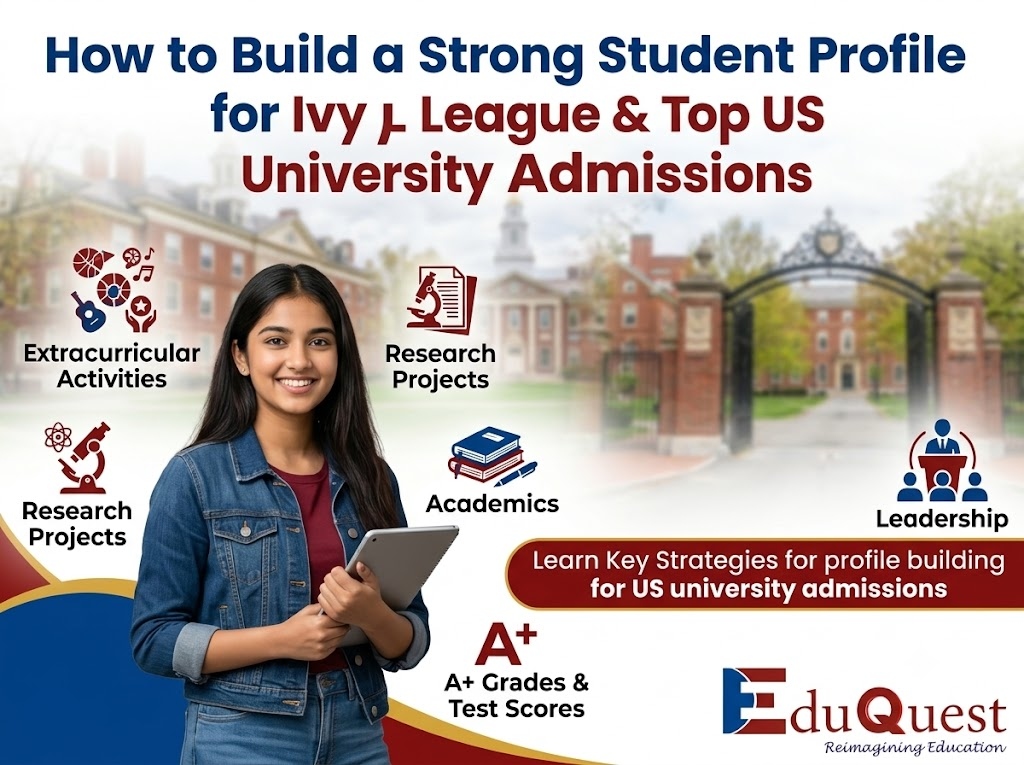
To master the exact methodology of crafting a Tier 1 spike for Harvard, Stanford, and Princeton, read: [How to Build a Strong Student Profile for Ivy League Admissions](/blog/how-to-build-a-strong-student-profile-for-ivy-league-and-top-us-university-admissions/).
5. Top US Universities: Institutional Tiers & Subject Excellence
The United States offers diverse institutional ecosystems. Finding the right balance between reach, target, and safety universities is vital for a successful admissions campaign:
| Institutional Group | Exemplar Universities | Core Subject Superpowers | Typical Class 12 Target |
|---|---|---|---|
| **The Ivy League & Stanford / MIT** | Harvard, Princeton, Yale, Columbia, Penn, Cornell, Brown, Dartmouth, Stanford, MIT | Economics, Computer Science, Government, Biomedical Engineering, Theoretical Physics | 96% – 99% CBSE/ISC + SAT 1520–1580+ |
| **Elite STEM & Tech Powerhouses** | Carnegie Mellon, Georgia Tech, Caltech, UIUC, Purdue, Michigan Ann Arbor | Artificial Intelligence, Robotics, Software Engineering, Aerospace, Electrical Engineering | 94% – 98% (Class 12 Core Math 96%+) |
| **Premier Business Undergraduate (BBA/BS)** | UPenn (Wharton), NYU (Stern), UC Berkeley (Haas), Michigan (Ross), UT Austin (McCombs) | Investment Banking, Quantitative Finance, Venture Capital, Corporate Strategy | 95% – 98% + strong analytical leadership |
| **Top Liberal Arts Colleges (LACs)** | Williams, Amherst, Swarthmore, Wellesley, Bowdoin, Carleton, Claremont McKenna | Philosophy, Politics & Economics (PPE), Pre-Med, Cognitive Science, Pure Mathematics | 93% – 97% + deep writing and seminar engagement |
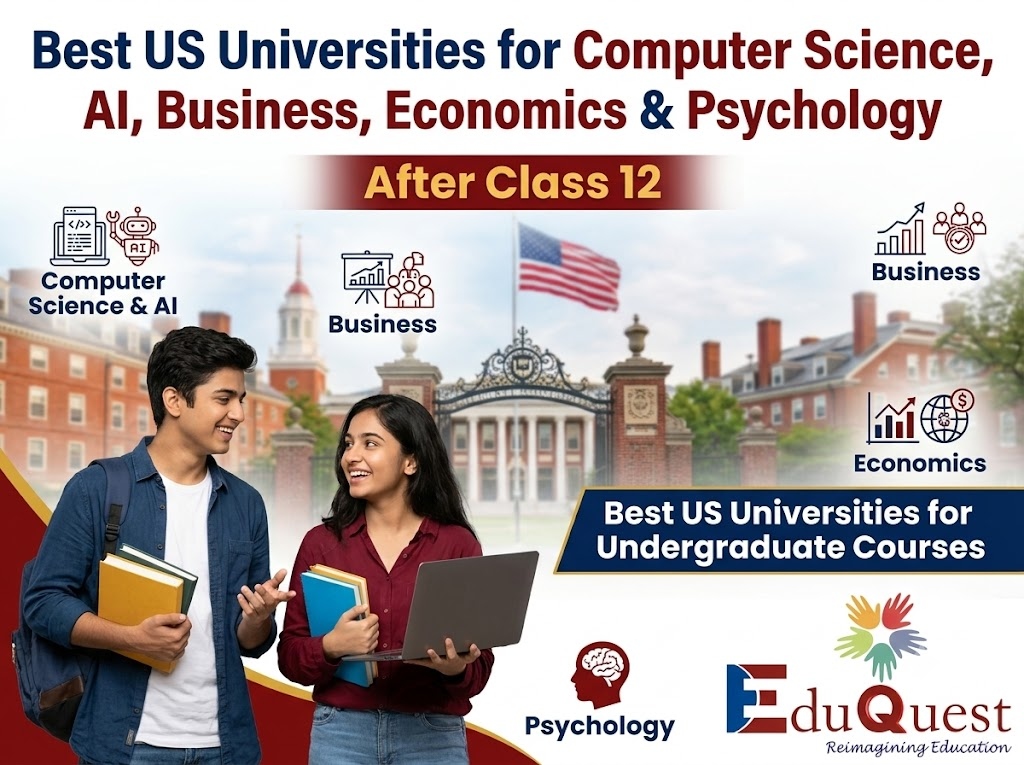
For complete subject-by-subject faculty rankings, lab profiles, and university comparisons, view: [Best US Universities for Undergraduate Courses After 12th](/blog/best-us-universities-for-undergraduate-courses-after-12th/).
6. Career ROI: High-Demand Degrees, Salaries & The 3-Year STEM OPT Pathway
The financial return on investment of a US undergraduate degree is exceptional, particularly in STEM and quantitative business disciplines:
| Academic Major | Average Starting Salary (USD) | INR Equivalent (Annual) | STEM OPT Eligibility | Key Corporate Employers |
|---|---|---|---|---|
| Computer Science & Artificial Intelligence | $95,000 – $135,000 / year | ~₹80 Lakhs – ₹1.15 Crores | **Yes (36 Months)** | Google, Meta, Apple, Microsoft, NVIDIA, Databricks, OpenAI |
| Quantitative Finance & FinTech | $105,000 – $150,000 / year | ~₹88 Lakhs – ₹1.28 Crores | **Yes (36 Months)** | Jane Street, Citadel, Jump Trading, Goldman Sachs, Morgan Stanley |
| Electrical & Aerospace Engineering | $85,000 – $115,000 / year | ~₹72 Lakhs – ₹98 Lakhs | **Yes (36 Months)** | Tesla, Boeing, Lockheed Martin, Intel, Qualcomm, SpaceX |
| Management Consulting & Analytics | $90,000 – $120,000 / year | ~₹76 Lakhs – ₹1.02 Crores | Select programs qualify | McKinsey & Company, BCG, Bain, Deloitte Consulting, Strategy& |
For detailed post-study work authorization guides, H-1B lottery mechanics, and 5-year graduate earnings trajectories, see: [Best Undergraduate Degrees in the USA for Jobs, Careers & Salaries](/blog/best-undergraduate-degrees-in-the-usa-for-future-jobs-careers-salaries/).
7. Financial Aid & Scholarships: Need-Blind vs Need-Aware Policies
Understanding how US university financial aid works is critical for Indian families. Unlike Indian scholarships based purely on entrance exam rank, US private universities distinguish between **Merit Scholarships** and **Need-Based Financial Aid**:
| Financial Aid Policy | US Universities Practicing Policy | Impact on Indian Applicant Admissions Odds | Average Financial Grant Value |
|---|---|---|---|
| **Need-Blind for International Students** | Harvard, Princeton, Yale, MIT, Amherst, Dartmouth, Bowdoin | **Zero Negative Impact:** Your ability to pay tuition is NOT factored into your admissions decision. If admitted, the university meets 100% of demonstrated family financial need. | **$70,000 – $92,000 / year** (covers full tuition, food, residential housing, books, and international airfare) |
| **Need-Aware with Full Need Met** | Columbia, Stanford, Penn, Duke, Northwestern, Cornell, Williams, Swarthmore | **Moderate to High Impact:** Requesting large financial aid increases selectivity threshold. An applicant requiring $80k/yr aid must demonstrate a stronger profile than a full-paying peer. | **$50,000 – $85,000 / year** grant packages upon admission |
| **Merit-Based Presidential & Dean's Scholarships** | USC, Boston University, Vanderbilt, Emory, Tulane, Case Western Reserve | **Merit-Only:** Awarded strictly on academic excellence, top 1% SAT scores (1540+), and extraordinary leadership, regardless of family income. | **$25,000 / yr to Full Tuition ($65,000/yr)** |
| **Public State Universities (Out-of-State Rates)** | UC Berkeley, UCLA, Michigan, UIUC, Texas Austin, Georgia Tech | State-funded institutions offer virtually zero need-based aid to international undergraduates. Families must budget full out-of-state tuition ($45k–$65k/yr). | Limited partial merit awards ($5,000 to $15,000 / year max) |
8. Strategic Planning Questions for Indian Families
When should Indian students begin profile planning: Class 9, 10, 11, or 12?
Class 9 and 10 are foundational exploratory years where students explore academic interests and establish high baseline GPAs. Class 11 is the execution year where the student's unique academic spike (research paper, major project, leadership initiative) must be brought to completion. Waiting until Class 12 is the single most common reason high-scoring Indian students underperform in US admissions.
What is the difference between extracurricular and supercurricular activities?
Extracurriculars are activities outside academia (football, piano, dance). Supercurriculars are academic pursuits beyond the school syllabus (advanced reading of peer-reviewed economic papers, building machine learning models, taking college-level math courses). Top US universities value supercurricular depth far more than unrelated hobbies.
Can a student with strong marks but limited activities get into competitive US universities?
At large public research universities (Purdue, Penn State, Wisconsin), high board marks and a 1500+ SAT score can secure admissions for engineering or business. However, at Ivy League and Top 20 private universities, high marks without distinctive extracurricular impact will almost certainly result in rejection.
How to demonstrate intellectual curiosity in applications?
Intellectual curiosity is proven through self-directed scholarship: reading university syllabi, writing independent literature syntheses, auditing advanced edX/Coursera courses, and producing original artifacts (code repositories, economic models, historical essays) without school mandate.
9. Frequently Asked Questions (FAQs)
Are SAT or ACT scores mandatory for Indian students applying to US universities?
While many US universities remain test-optional, elite institutions (including MIT, Dartmouth, Yale, Purdue, and Georgetown) have reinstated mandatory standardized testing. Submitting a 1500+ Digital SAT provides substantial competitive advantage for Indian board applicants.
Can Indian students receive full scholarships or financial aid at US universities?
Yes. Top US universities (Harvard, Princeton, Yale, MIT, Amherst, Dartmouth, Bowdoin) practice Need-Blind admissions for international students, covering 100% of demonstrated financial need, including tuition, room, board, and flights.
How do US universities convert CBSE and ISC marks into a 4.0 GPA?
US admissions offices have regional specialists who evaluate Indian transcripts within their own context. They do not convert marks to a 4.0 scale using simple arithmetic formulas; instead, an aggregate of 90%+ in CBSE/ISC is typically recognized as equivalent to an 'A' grade (4.0 unweighted GPA).
What is the Common Application and how many colleges can I apply to?
The Common App is the primary undergraduate application platform accepted by over 1,000 US colleges. Students can apply to a maximum of 20 universities through the Common App, submitting one central personal essay alongside university-specific supplemental responses.
What are the rules of the 3-Year STEM OPT extension?
Graduates of STEM-designated bachelor's degrees on an F-1 visa receive an initial 12-month Optional Practical Training (OPT) work authorization, followed by a 24-month STEM extension, granting 36 months of lawful full-time employment without an H-1B visa.
How does EduQuest assist Indian students with US undergraduate admissions?
EduQuest provides end-to-end strategic mentorship: 4-year academic roadmap design, Digital SAT coaching, faculty-guided research paper publishing, Common App personal statement crafting, university list curation, and financial aid CSS Profile guidance.
Do Indian students need to take the TOEFL or IELTS for US universities?
Most top US universities waive English proficiency testing if you score 650+ on the Digital SAT Reading and Writing section or if your medium of instruction throughout high school was 100% English. Otherwise, an IELTS 7.5 or TOEFL 100+ is recommended.
Power Your US Admissions Strategy with EduQuest AI
Diagnose your profile competitiveness, simulate SAT targets, and practice high-stakes admissions interviews with our integrated intelligent platforms.
Ivy League Profile Diagnostic
Evaluates your 4-year transcript, SAT score, extracurricular tiers, and leadership impact against historical Ivy League admit rubrics.
- ✓ Tier 1 to 4 Activity Classification
- ✓ Academic Rigor & GPA Indexing
- ✓ Need-Blind Scholarship Eligibility
Common App Admissions Navigator
Builds a customized 12-month calendar managing ED1, EA, ED2, and Regular Decision deadlines across your 20 target universities.
- ✓ Automated Essay Countdown
- ✓ LOR Recommendation Tracker
- ✓ CSS Profile & Financial Aid Deadlines
Research Paper & Project Incubator
Guides high school students through independent academic research, methodology, and peer-reviewed journal publication under PhD mentorship.
- ✓ Faculty-Guided Topic Matching
- ✓ Peer-Reviewed Journal Publication
- ✓ Academic GitHub & Demo Portfolio
STEM OPT Career & Salary Engine
Calculates starting salaries ($85k to $150k), tax liabilities, and 3-year net wealth accumulation across US tech and Wall Street hubs.
- ✓ 36-Month STEM OPT Cashflow Model
- ✓ H-1B Visa Transition Rubric
- ✓ Top Corporate Recruiter Index
“Admissions to top US universities is an art of authentic positioning. When exceptional academic performance is paired with a distinct, faculty-guided intellectual spike, doors to the Ivy League swing wide open.”
Download the Complete Study in the USA Master Guide (PDF)
Get our 50-page master guide detailing CBSE/ISC grade conversions, Common App strategic checklists, Tier 1 extracurricular frameworks, and STEM OPT work visa rules.