

US Undergraduate Admissions Strategic Portals for 2027 Aspirants
Admissions Consulting
1-on-1 Ivy & Top 30 Mentorship
Build an extraordinary profile with personalized spike ideation, Common App essay architecture, and balanced school list calibration.
Explore Admissions MentorshipStandardized Test Prep
Digital SAT 1500+ Accelerator
Target 99th percentile SAT scores with adaptive AI question banks, timing drills, and personalized module telemetry.
Start SAT PracticeOfficial Dossier
Download 2027 PDF Roadmap
Get the complete 4-year document checklist, CBSE-to-GPA converter, and month-by-month application tracker.
1. Executive Overview: Navigating US Undergraduate Admission Requirements in 2027
Securing admission to a top-tier American university is a transformative milestone for ambitious Indian high school students. The United States hosts over 4,000 degree-granting institutions, including world-renowned Ivy League universities, leading research powerhouses (such as MIT, Stanford, UC Berkeley, Georgia Tech, and Purdue), and elite liberal arts colleges (such as Williams, Amherst, and Swarthmore). However, successfully navigating the US undergraduate admission requirements requires an entirely different mindset from the traditional Indian higher education system.
In India, admission to premier institutions like IITs, AIIMS, Delhi University, or NLUs hinges almost exclusively on a single high-stakes entrance exam (JEE Advanced, NEET, CUET, CLAT) or Class 12 board percentages. In stark contrast, US colleges evaluate applicants through a sophisticated, multidimensional framework known as Holistic Admissions Review. Understanding USA university eligibility after 12th for Indian students means recognizing that top grades are merely the baseline ticket to the table—what distinguishes an admitted candidate from tens of thousands of rejected applicants is intellectual vitality, extracurricular leadership, compelling personal storytelling, and documented character.
For the Fall 2027 admissions cycle, the competitive landscape has evolved further. More leading universities (such as MIT, Dartmouth, Yale, UT Austin, Georgetown, Purdue, and Florida) have reinstated mandatory standardized testing, while institutional expectations for verified academic rigor, ethical AI usage, and independent research have reached unprecedented heights. This comprehensive guide details every dimension of the US admissions dossier, the exact documents required for US undergraduate admission, grade-by-grade timelines, financial aid rules, and strategic application secrets tailored specifically for Indian applicants from CBSE, ISC, State Boards, and International Baccalaureate (IB) / Cambridge (A-Levels) curricula.
2. The Holistic Admissions Paradigm: How American Admissions Officers Read Your File
Fast-Track Your College & Career Strategy
Get immediate, personalized AI insights tailored to your grade, strengths, and dream universities — 100% free with instant reports.
Know Your Personality Type for Free
Take our 18-question AI psychometric test to uncover your cognitive archetype, hidden learning superpowers, and ideal university courses.
Personalized Career & University EduPath
Build a step-by-step Grade 8–12 admissions blueprint with AI-matched target universities, exam schedules, and extracurricular profiles.
To craft a winning application, Indian students and their parents must look inside the admissions committee room. When an application lands on the desk of an American Regional Admissions Officer (the officer responsible for South Asia and India), it is not assigned a purely algorithmic score. Instead, the admissions officer builds a comprehensive profile summary evaluating six interlocking dimensions of candidate merit:
- Academic Track Record (30–35%): Four consecutive years of secondary school performance (Grades 9, 10, 11, and 12). Admissions committees scrutinize year-on-year trajectory, rigor of course selection relative to what is available at your school, and performance in core prerequisite subjects.
- Standardized Testing & Academic Rigor (15–20%): Digital SAT or ACT composite scores, Advanced Placement (AP) Exam scores, and English language proficiency exam scores (TOEFL, IELTS, or Duolingo English Test).
- Extracurricular Profile Spike (20–25%): Deep engagement outside the classroom demonstrating national or international impact, self-initiated ventures, academic research, sports, arts, or community activism rather than passive club memberships.
- Essays & Narrative Voice (15–20%): The 650-word Common Application Personal Statement plus institution-specific supplemental essays that reveal intellectual curiosity, resilience, values, and community impact.
- Letters of Recommendation (10%): Confidential evaluations submitted by high school counselors and two core academic subject teachers providing firsthand testimony regarding the student's classroom engagement, integrity, and peer collaboration.
- Institutional Fit & Demonstrated Interest (5%): Evidence that the applicant understands the university's specific culture, pedagogy, and offerings, communicated through articulate "Why This College?" essays, alumni interviews, and campus engagement.
3. Core Academic Eligibility: Converting CBSE, ICSE, and State Boards to US 4.0 GPA
One of the most persistent anxieties among Indian applicants centers on USA university eligibility after 12th for Indian students and how Indian percentage marks translate into the American 4.0 Grade Point Average (GPA) system. It is vital to clarify a fundamental truth: US universities do not expect Indian high schools to calculate a 4.0 GPA, nor should students self-convert their scores on application portals.
American admissions officers who evaluate applications from India possess intimate knowledge of Indian grading realities. They understand that an 88% in CBSE Science stream or ISC Humanities often reflects significantly higher academic rigor than an 88% in an uncalibrated international syllabus. Most US universities recalculate internal GPAs using established comparative metrics. Below is the standard comparative conversion benchmark utilized by leading American admissions offices:
| Indian Board Score (CBSE / ICSE / State) | US Letter Grade Equivalent | US 4.0 Scale GPA (Unweighted) | Target US University Tier Alignment |
|---|---|---|---|
| 93% – 100% | A+ / A | 4.00 | Ivy League, MIT, Stanford, Caltech, Top 15 US Universities |
| 85% – 92% | A / A- | 3.70 – 3.90 | Top 20–40 Universities (UCs, NYU, Michigan, Purdue, Georgia Tech) |
| 78% – 84% | B+ / B | 3.30 – 3.60 | Top 45–80 Universities (Penn State, Ohio State, Rutgers, Minnesota) |
| 70% – 77% | B / B- | 2.80 – 3.20 | Competitive Regional US State Universities & Mid-tier Colleges |
| 60% – 69% | C+ / C | 2.30 – 2.70 | Pathway Programs, Regional Colleges, Community College 2+2 Route |
| Below 60% | D / F | Under 2.00 | Academic probation risk; preparatory foundation prerequisite |
4. The 4-Year Secondary School Trajectory: Why US Colleges Scrutinize Grades 9 through 12
In the Indian education system, Grades 9 and 11 are largely treated as "internal transition years," where schools deliberately grade harshly and parents often overlook internal school report cards in favor of Class 10 and 12 Board Results. However, for US undergraduate admission requirements, this represents the single biggest blind spot for Indian families.
American secondary education spans four full years (Grade 9 through Grade 12). Consequently, every US university requires official transcripts covering all four years. When admissions officers examine an Indian applicant's academic history, they look for three distinct patterns:
- Consistent Excellence: Steady grades of 90%+ across all four academic sessions demonstrates emotional maturity, discipline, and sustained scholarly focus.
- Upward Grade Trajectory: A student who scored 82% in Grade 9, 88% in Grade 10, 91% in Grade 11, and has a 96% Grade 12 predicted score displays progressive academic acceleration—a trend viewed highly favorably.
- The Dangerous "Grade 11 Dip": Indian schools frequently grade Class 11 internal examinations severely, causing students with 95% in Class 10 to plummet to 72% in Class 11. To a US admissions officer without context, an unexplained drop from an A to a C looks like academic struggle or senioritis. School counselors must explicitly clarify your school's Grade 11 grading deflation in the official School Profile.
5. The Digital SAT & ACT in 2027: Test-Required vs Test-Optional Policies
Following several years of pandemic-era test-optional policies, the American higher education landscape has experienced a decisive return to standardized testing. Elite institutions—including MIT, Dartmouth, Yale, UT Austin, Georgetown, Purdue, University of Florida, and Georgia Tech—have officially reinstated mandatory SAT or ACT submissions for all undergraduate applicants.
Even at institutions that remain nominally "test-optional" (such as Columbia, NYU, Stanford, and the University of Chicago), standardized test scores serve as an essential equalizer for Indian applicants. Because Indian high schools vary radically in grading standards, a score of 1520+ on the Digital SAT provides unquestionable, objective proof of college readiness.
| University Tier / Target Group | Recommended Digital SAT Range | Recommended ACT Composite | Test Submission Policy (2027 Entry) |
|---|---|---|---|
| Ivy League, MIT, Stanford, Caltech | 1530 – 1580 (Math 790–800) | 34 – 36 Composite | Required at MIT, Dartmouth, Yale; Highly Recommended at others |
| Top 20–35 (CMU, Georgia Tech, Purdue, NYU, Michigan) | 1480 – 1540 (Math 770–800) | 32 – 35 Composite | Required at Purdue, Georgia Tech, UT Austin; Recommended at others |
| Top 35–60 (UIUC, UW Madison, Penn State, Ohio State) | 1400 – 1490 | 30 – 33 Composite | Test-Optional with score advantages for STEM & Business |
| Top 60–100 Regional State Universities | 1280 – 1390 | 27 – 30 Composite | Test-Optional; SAT used primarily for merit scholarship awards |
6. English Language Proficiency Benchmarks: TOEFL iBT, IELTS Academic & Duolingo
Even though English is the medium of instruction across Indian CBSE, ICSE, and IB schools, US immigration and university accreditation guidelines classify India as a non-native English speaking territory. Therefore, proving English language proficiency is a mandatory component of US undergraduate admission requirements for almost all Indian passport holders.
Universities accept three primary standardized English proficiency assessments:
- TOEFL iBT (Test of English as a Foreign Language): Target score of 100–105+ out of 120 for Top 30 universities, with minimum sub-scores of 25 in Reading, Listening, Speaking, and Writing.
- IELTS Academic: Target band score of 7.5 overall (with no individual section score below 7.0) for elite institutions; 6.5–7.0 for mid-tier institutions.
- Duolingo English Test (DET): Target score of 130–135+ out of 160. Widely accepted across hundreds of US universities due to its affordability and at-home computerized delivery.
- English Proficiency Waivers: Many US universities will automatically waive the TOEFL/IELTS requirement if you score 650+ (or 700+ for Ivies) on the Reading and Writing section of the Digital SAT, or if your high school counselor submits an official letter certifying English as the exclusive medium of instruction for at least 4 consecutive years.
7. Advanced Placement (AP) Exams: The Secret Weapon for CBSE and ISC Students
Unlike American high schools that offer AP courses, or international schools following the International Baccalaureate (IB) Diploma Programme, standard CBSE and ISC schools do not inherently feature university-level AP course tracks. However, the College Board allows Indian students to register for AP Exams independently every year in May.
Taking 3 to 5 AP Exams and earning top scores of 4 or 5 offers three transformative advantages for Indian applicants:
- Demonstrates Unrivaled Academic Rigor: Scoring a 5 in AP Calculus BC, AP Physics C: Mechanics, AP Chemistry, or AP Computer Science A proves that you can master university-level coursework while completing your standard Class 11 and 12 syllabus.
- Earns University Course Credits: At public flagships and private institutions (including Purdue, Georgia Tech, Michigan, and NYU), high AP scores translate into direct college credits, allowing students to skip introductory college courses and graduate up to one year early, saving tens of thousands of dollars in tuition.
- Distinguishes You from 50,000 Indian Competitors: When thousands of Indian candidates present identical 95% board scores, AP credentials provide the deciding differentiator in the admissions room.
8. Extracurricular Profile Architecture: The 4 Tiers of High School Activities
The Common Application allows candidates to list up to 10 extracurricular activities. Admissions committees categorize these activities into four distinct tiers based on exclusivity, scale of impact, and demonstrated initiative:
- Tier 1: Rare National & International Eminence (Top 1%): Representing India at the International Science Olympiads (IMO, IPhO, IChO), winning national awards (Pradhan Mantri Rashtriya Bal Puraskar), publishing original peer-reviewed research in IEEE or Springer journals, or founding a venture that raises significant venture capital or generates verified societal impact ($50,000+ raised or 50,000+ lives impacted).
- Tier 2: State-Level Leadership & Significant Achievement (Top 5%): State-level sports championship medalists, Student Council President (Head Boy / Head Girl) at a prominent institution, founder of a registered NGO with regional chapters, or winning prestigious national competitions (IRIS National Science Fair, CBSE National Science Exhibition).
- Tier 3: School-Level Leadership & Active Involvement: Captain of a school sports team, President of the Robotics Club or Model United Nations (MUN) Secretariat, editor of the school magazine, or sustained local community volunteering (100+ hours).
- Tier 4: General Participation & Club Membership: General club memberships, occasional volunteer days, participation in school plays, or casual hobbies with no leadership or measurable outcomes.
9. Academic Spikes vs Well-Rounded Profiles: What Top US Colleges Prioritize
A common misconception among Indian parents is that top American colleges seek "well-rounded" students—individuals who play the violin, run track, debate, volunteer at an orphanage, and maintain high grades all at once. In reality, modern elite admissions favors well-rounded classes composed of deeply pointed ("spiky") individuals.
An applicant with an "angular profile" or "academic spike" channels 80% of their extracurricular energy into one or two interconnected disciplines. For example, a prospective Computer Science major shouldn't simply participate in five unrelated clubs; they should build assistive software for visually impaired communities, publish a research paper on edge computing, lead their school's hackathon team, and run free coding workshops for underprivileged students. This focused trajectory makes your application immediately memorable to admissions officers.
10. Scientific Research, Academic Publications & Independent Projects
Engaging in rigorous, independent research before graduating high school has emerged as one of the most potent profile builders for STEM, Economics, and Social Science applicants aiming for Top 20 US universities. However, admissions officers are increasingly skeptical of "pay-to-publish" predatory journals or superficial lab shadowing where the student performed mere clerical tasks.
Legitimate research must demonstrate:
- Originality: A clearly defined hypothesis addressing a genuine problem in computer vision, renewable energy, computational biology, behavioral economics, or public health.
- Methodological Rigor: Utilization of proper scientific methodology, statistical modeling (Python, R, MATLAB), and scholarly citation conventions.
- Peer Review or Presentation: Presentation at peer-reviewed international symposiums, submission to competitive pre-college science competitions (such as the Regeneron ISEF pipeline or IRIS Fair), or publication in recognized student research journals (such as the Journal of Emerging Investigators or Columbia Junior Science Journal).
11. Leadership Roles, Social Ventures & Impact-Driven Community Initiatives
American universities place profound value on civic responsibility and ethical leadership. Admissions officers evaluate not just what you achieved for yourself, but how you utilized your talents to elevate those around you. When evaluating US undergraduate admission requirements, community service must go beyond a signed certificate of attendance.
When describing leadership and social impact on the Common App, always quantify your results using the Action + Metric + Impact framework:
- Weak Description: "Volunteered at local NGO teaching underprivileged children math."
- Strong Leadership Description: "Founded Project Ganit: Developed a bilingual STEM curriculum adopted by 12 government schools across Delhi NCR; mentored 450+ middle school students, resulting in a 34% improvement in standardized mathematics assessment scores; mobilized 25 student volunteers."
12. Summer Programs, Olympiads & Global Competitions: What Moves the Needle
Indian families often invest heavily in summer programs, but not all summer activities carry equal weight in the admissions room. Admissions officers clearly distinguish between merit-selective, tuition-free summer programs and pay-to-play "paywall" pre-college camps.
Highly prestigious, transformative summer programs include MIT RSI (Research Science Institute), Stanford SUMaC, MIT PROMYS, SSP (Summer Science Program), and TASP/Telluride. These programs have sub-5% acceptance rates and cost zero dollars to attend; admission to these programs virtually guarantees consideration at Ivy League institutions. Conversely, attending a generic paid summer school on a famous campus carries little to no admissions weight because it reflects financial capability rather than exceptional academic selection.
13. Navigating Application Portals: Common App, Coalition with Scoir, and UC System
To apply to US universities, international students utilize standardized online portals rather than applying through individual college websites:
- The Common Application (Common App): The premier undergraduate portal, accepted by over 1,050 universities (including all Ivy League colleges, NYU, CMU, Michigan, and Stanford). It enables students to complete one unified biographical profile, activities list, and personal essay, alongside individual university supplemental questions.
- Coalition Application (with Scoir): Accepted by over 150 top US institutions, emphasizing college access and financial affordability.
- The University of California (UC) Application: A distinct, proprietary portal required for all nine undergraduate UC campuses (UC Berkeley, UCLA, UC San Diego, UC Santa Barbara, UC Irvine, UC Davis, UC Santa Cruz, UC Riverside, and UC Merced). The UC system does not use the Common App, does not accept LORs or SAT scores, and features four 350-word Personal Insight Questions (PIQs).
14. The Common App Personal Essay: Narrative Architecture, Prompts & Tone
The Common Application Personal Statement is a 650-word essay sent to every university on your Common App list. It is your single greatest opportunity to speak directly to the admissions committee in your authentic voice. Unlike Indian school essays, which often prioritize elevated vocabulary, formal rhetoric, or philosophical summaries, American college essays demand vulnerability, self-reflection, and authentic narrative storytelling.
Effective essays reveal core values (curiosity, empathy, resilience, humor, cultural bridge-building) through a specific, illuminating personal experience. Admissions officers look for intellectual vitality and personal maturity—an insight into who you will be in a seminar discussion, a research lab, or a late-night dorm conversation.
15. University-Specific Supplemental Essays: Cracking the "Why Us?" & "Why This Major?" Prompts
In addition to the main personal statement, almost all selective US universities require 1 to 4 institutional supplemental essays. These typically range between 150 and 400 words and evaluate your specific institutional alignment. The two most ubiquitous supplemental essay prompts are:
- The "Why Us?" Supplemental Essay: Tests whether you have conducted deep, granular research on the university. Never mention generic factors like university rankings, weather, or campus beauty. Name specific professors whose research aligns with your projects, upper-level courses you intend to enroll in, interdisciplinary academic institutes, and student organizations where you will contribute.
- The "Why This Major?" Essay: Traces the intellectual origin story of your academic passion. Discuss the exact questions that keep you awake at night, independent experiments you conducted, books you read beyond the syllabus, and the specific academic problems you intend to solve during your undergraduate years.
16. Letters of Recommendation (LORs): Counselor Report & Teacher Evaluations
Standard US undergraduate admission requirements stipulate three distinct letters of recommendation submitted directly via the Common App recommender portal:
- The Counselor Recommendation: Written by your school principal, vice-principal, or dedicated college counselor. It evaluates your overall standing, character, ethical integrity, and academic trajectory within the context of your entire graduating class.
- Academic Subject Teacher Evaluation 1: Written by a teacher in a core STEM subject (Mathematics, Physics, Chemistry, Biology) who can attest to your problem-solving stamina, conceptual mastery, and intellectual curiosity.
- Academic Subject Teacher Evaluation 2: Written by a teacher in Humanities, Social Sciences, or Languages (English, History, Economics) who can speak to your communication skills, debate contributions, and critical analysis.
- Confidentiality (FERPA Waiver): Always check the box to waive your right to inspect your recommendation letters under FERPA. Waiving your rights assures the admissions committee that your recommenders provided 100% candid, authentic appraisals.
17. The High School Profile: Translating the Indian Educational Context
One of the most overlooked documents required for US undergraduate admission is the official High School Profile. This is a 2-to-4 page document created by your high school administration and uploaded alongside your transcripts by your school counselor.
The High School Profile provides vital context that enables American admissions officers to evaluate your achievements fairly. It must outline: your school's curriculum offerings (CBSE, ISC, IB, Cambridge), class size, historical grade distribution, grading scale (explaining why an 85% represents high academic distinction), whether class rank is awarded, and previous university placement history. Without a robust school profile, an admissions officer cannot contextualize whether your 90% was the top mark in the class or the median score.
18. Master Document Checklist: All Documents Required for US Undergraduate Admission
To ensure zero delays during the high-stress application season, compile this master dossier during Grade 11 and early Grade 12:
| Document Name | Issuing Authority / Format | Key Verification & Requirements | Submission Window |
|---|---|---|---|
| Grade 9 & 11 Internal Transcripts | High School Principal / Counselor | Official stamped and signed annual marksheets. No self-attestations. | August – October (Grade 12) |
| Grade 10 Board Certificate & Marksheet | CBSE / ICSE / State Board | Official board passing certificate showing subject-wise marks. | August – October (Grade 12) |
| Grade 12 Mid-Term & Predicted Scores | School Examination Controller | Official school letterhead certifying expected Class 12 board marks. | October – November (Grade 12) |
| Digital SAT / ACT Score Reports | College Board / ACT Inc. | Official electronic score reports sent via 4-digit college DI codes. | September – December (Grade 12) |
| English Proficiency Score Report | ETS (TOEFL) / British Council (IELTS) | Official electronic transmission directly to university admissions. | September – December (Grade 12) |
| School Counselor Recommendation | School Counselor / Principal | Submitted electronically via Common App portal directly by school. | September – October (Grade 12) |
| Two Teacher Evaluations (LORs) | Academic Subject Teachers | Confidential teacher submissions via Common App portal. | September – October (Grade 12) |
| Official High School Profile | School Administration | PDF detailing school curriculum, grading scale, and cohort statistics. | October (Grade 12) |
| Financial Affidavit & Bank Statements | Bank Manager / Chartered Accountant | Liquid proof of 1st-year total cost of attendance ($65k–$95k USD). | November (ED) / January (RD) |
| Valid Indian Passport | Regional Passport Office (Govt of India) | Must have minimum 18-month validity beyond the program start date. | Must be ready by Grade 11 |
Download the Official US Undergraduate Admissions Master Roadmap (2027 Entry)
Get immediate access to EduQuest's 4-year candidate workbook featuring the complete document verification checklist, CBSE-to-GPA conversion calculator, testing target matrix, and 24-month milestone calendar.
19. Financial Documentation: ISFAA, CSS Profile & International Certification of Finances
Navigating financial documentation is an indispensable part of US undergraduate admission requirements. To issue an I-20 document (required for your F-1 student visa), US federal law mandates that universities verify your family's ability to fund your educational and living expenses.
Indian applicants must prepare three critical financial dossiers:
- International Student Certification of Finances (COF): A standardized form where your parents declare their available liquid funds (savings accounts, fixed deposits, mutual funds, education loan sanctions) verified by official bank certification letters.
- The CSS Profile (College Scholarship Service Profile): Administered by the College Board, this detailed financial aid application is required by over 400 private US universities (including Harvard, Stanford, Yale, and Columbia) to determine eligibility for need-based institutional financial aid. It requires detailed disclosure of family income tax returns, real estate equity, assets, and annual living expenditures in Indian Rupees.
- International Student Financial Aid Application (ISFAA): A paper- or PDF-based institutional financial aid form utilized by universities that do not participate in the CSS Profile system.
20. Scholarships, Financial Aid, and Need-Blind vs Need-Aware Admissions Policies
Understanding how applying for financial aid impacts your chance of acceptance is vital for every Indian family. American universities fall into two distinct admissions categories for international students:
- Need-Blind Admissions for International Students: The university evaluates your application entirely on academic and personal merit, with zero regard for whether you need $0 or $80,000 per year in financial aid. Furthermore, if admitted, the institution commits to meeting 100% of your demonstrated financial need. Currently, only eight elite US institutions are fully need-blind for international applicants: Harvard, Princeton, MIT, Yale, Dartmouth, Amherst, Bowdoin, and Brown.
- Need-Aware Admissions (The Vast Majority): Almost all other US universities (including Stanford, Columbia, UPenn, Duke, Cornell, Northwestern, and NYU) are "need-aware" for international candidates. This means that requesting substantial financial aid increases the difficulty of gaining admission. An Indian applicant requesting $60,000/year in aid faces a significantly more competitive threshold than a full-pay applicant with identical credentials.
- Merit-Based Scholarships: Merit awards are based purely on academic and extracurricular excellence, regardless of family income. Many top public flagships (e.g., Purdue, UT Dallas, Arizona State, Michigan State, Indiana University) offer generous merit scholarships ($10,000 to full tuition) based on Digital SAT scores (1450+) and 95%+ board marks.
21. Application Cycles and Deadlines: Early Decision (ED), Early Action (EA), and Regular Decision (RD)
US university applications feature distinct application rounds with very specific strategic implications for Indian candidates:
| Application Round | Standard Deadline | Binding vs Non-Binding Policy | Notification Timeline |
|---|---|---|---|
| Early Decision I (ED I) | November 1, 2026 | BINDING: Must attend if admitted; withdraw all other applications | Mid-December 2026 |
| Early Action (EA) | November 1 – 15, 2026 | NON-BINDING: Apply early, receive early decision, choose by May 1 | Mid-December to Jan 2027 |
| Restrictive Early Action (REA) | November 1, 2026 | NON-BINDING but restrictive (Harvard, Stanford, Princeton, Yale) | Mid-December 2026 |
| UC Application (All UCs) | November 30, 2026 | Single comprehensive application round for all 9 UC campuses | March 2027 |
| Early Decision II (ED II) | January 1 – 15, 2027 | BINDING: Second-chance binding round (NYU, UChicago, Vanderbilt) | Mid-February 2027 |
| Regular Decision (RD) | January 1 – 15, 2027 | NON-BINDING: Standard application pool for all institutions | Late March – Early April 2027 |
| Rolling Admissions | Ongoing (Oct – May) | Applications reviewed as received until capacity is filled (Penn State, Pitt) | 4–6 weeks post-submission |
22. The 24-Month Strategic Application Roadmap for Fall 2027 Entry
Grade 11 Spring (Jan – April 2026)
Diagnostic Testing & Academic Rigor Calibration
- Take a timed diagnostic Digital SAT or ACT test to establish baseline benchmark scores.
- Register for May AP Exams (Calculus BC, Physics C, Chemistry, or Computer Science).
- Maintain 90%+ in Class 11 school exams; identify an authentic academic spike area.
Grade 11 Summer (May – July 2026)
High-Impact Extracurricular Execution & Testing
- Execute an independent research paper, selective internship, or social impact project.
- Take the Digital SAT (Attempt 1) in June (target score 1500+).
- Conduct thorough university research; assemble a balanced 15-college shortlist.
Grade 12 Fall (August – October 2026)
Common App Launch, Essays & Recommender Briefing
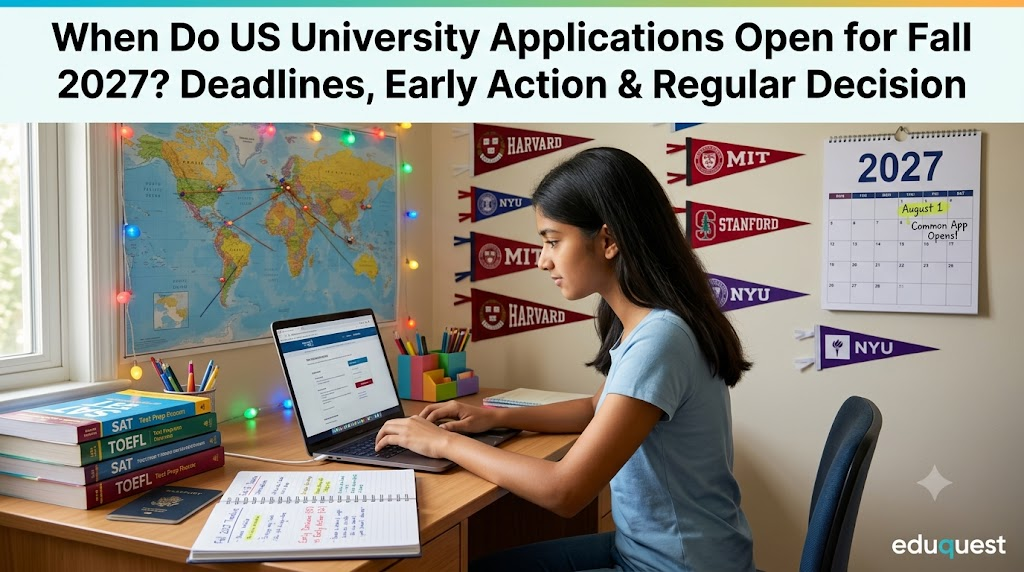
- Common App opens on August 1: Complete profile details and 10 activities entries.
- Draft and polish the 650-word Common App personal statement through multiple iterations.
- Request letters of recommendation from high school teachers and counselor with brag sheets.
- Finalize all Early Decision (ED) and Early Action (EA) supplemental essays before school pre-boards.
Grade 12 Winter (November 2026 – January 2027)
Application Submissions (ED/EA/UC/RD)
- Submit Early Decision and Early Action applications by November 1; submit financial documentation.
- Submit University of California (UC) application by November 30.
- Submit Regular Decision applications by January 1–15; manage ED decision outcomes.
Grade 12 Spring (Feb – April 2027)
Board Exams & Decision Releases
- Excel in CBSE / ISC / IB Board examinations; maintain strong final marks to protect conditional offers.
- Receive admissions decisions during March (Ivy Day in late March); evaluate financial aid offers.
Summer 2027 (May – July 2027)
Visa Processing & Pre-Departure
- Receive Form I-20 from university; pay I-901 SEVIS fee.
- Complete DS-160 and attend F-1 visa interview at US Embassy/Consulate.
- Attend EduQuest pre-departure orientation; book flights for August orientation.
23. Choosing the Right Majors: Direct-Admit STEM vs Undecided
In the US university system, degree structure varies dramatically from India. At many private liberal arts colleges and universities (such as Harvard, Yale, and Williams), students apply to the college as a whole and do not officially declare their major until the end of sophomore (second) year. You are free to explore diverse classes before committing to a discipline.
However, for hyper-competitive technical disciplines—most notably Computer Science, Artificial Intelligence, and Mechanical/Electrical Engineering at institutions like Carnegie Mellon (SCS), UC Berkeley (EECS), UIUC (Grainger), Georgia Tech, and Purdue—students must apply directly to the specific major. Acceptance rates for direct-admit Computer Science programs are often 3x to 5x lower than the university's overall acceptance rate. If you choose a direct-admit STEM path, your high school profile must reflect deep, unequivocal mastery of advanced mathematics and computational problem-solving.
24. School List Architecture: Building a Balanced Reach, Target, and Safety Portfolio
The single most common mistake among Indian applicants is building a top-heavy, unrealistic college list consisting entirely of Ivy League universities and Stanford. A strategically calibrated college portfolio contains 12 to 16 universities distributed across three distinct tiers:
- Reach Universities (4–5 Schools): Institutions with sub-15% acceptance rates (Harvard, MIT, Stanford, Columbia, UPenn, Caltech, Duke, UC Berkeley). Even with a 1570 SAT and 98% board marks, these institutions remain statistical reaches for every international applicant.
- Target Universities (5–6 Schools): Institutions where your GPA, SAT scores, and profile align closely with the median 50% of admitted students (e.g., NYU, Georgia Tech, Purdue, University of Michigan, UIUC, University of Wisconsin-Madison). Acceptance rates range between 20% and 40%.
- Likely / Safety Universities (3–4 Schools): Institutions where your academic credentials sit well above the 75th percentile of admitted students and acceptance rates exceed 50% (e.g., Penn State, Ohio State, Rutgers, Arizona State, UT Dallas, Minnesota). These schools guarantee that you will have exceptional, high-ranking collegiate options with high merit scholarship probability.
25. Transcript Authentication: When Are WES and ECE Evaluations Required?
The vast majority of top-tier US universities (including all Common App members) accept official transcripts directly uploaded by your Indian high school counselor in PDF format without requiring third-party evaluation. However, a select group of public state universities and regional colleges require an external credential evaluation by services like WES (World Education Services) or ECE (Educational Credential Evaluators).
Credential evaluators authenticate Indian marksheets and convert CBSE, ICSE, and State Board grading into US equivalent semester hours and cumulative GPAs. Always verify whether your target institutions require external evaluation well in advance, as the WES evaluation process for Indian boards can take 4 to 8 weeks.
26. Managing Indian Board Exams (CBSE/ISC) Alongside US Application Deadlines
For Indian high schoolers, the autumn of Grade 12 represents an intense academic collision. Between September and December, students face school half-yearly exams, pre-board examinations, practical evaluations, and tuition coaching, coinciding precisely with November 1 (Early Decision) and January 1 (Regular Decision) deadlines.
To avoid academic burnout and disastrous application errors, adopt the "Summer Completion Rule": complete your Common App main essay, activities section, and standardized testing by August 31 before Grade 12 school exams begin. When October arrives, your sole task will be writing supplemental essays and coordinating recommender submissions.
27. The US Student Visa (F-1) Pathway: I-20 Issuance, SEVIS Fee & Embassy Interview
Securing university admission is the first major milestone; securing your F-1 Student Visa is the legal authorization that enables your studies. The visa pathway involves four sequential phases:
- Form I-20 Issuance: Once you accept an admission offer and submit verified financial affidavits, the university's International Students Office generates your Form I-20 (Certificate of Eligibility for Nonimmigrant Student Status).
- SEVIS I-901 Fee Payment: Pay the mandatory $350 SEVIS fee to the US Department of Homeland Security via the official FMJfee portal.
- Form DS-160 Submission: Complete the comprehensive online non-immigrant visa application on the US Department of State portal.
- Visa Appointments (OFC & Consular Interview): Schedule your biometric appointment at the Visa Application Center (VAC) and your in-person consular interview at the US Embassy in New Delhi or Consulates in Mumbai, Chennai, Hyderabad, or Kolkata. Consular officers evaluate two fundamental criteria: (1) Legitimate academic intent and preparedness; (2) Unambiguous financial capability without intent to immigrate permanently.
28. Campus & Alumni Interviews: InitialView, Vericant, and Alumni Conversations
Interviews provide a valuable forum to showcase interpersonal charisma, spoken English fluency, and intellectual curiosity. In the US admissions ecosystem, interviews take three forms:
- Evaluative Alumni Interviews: Conducted via Zoom by alumni volunteers from Ivy League and selective colleges. These are largely conversational and evaluative, lasting 30 to 45 minutes. Prepare articulate responses explaining your intellectual passions, why you chose that college, and meaningful questions for the alumnus.
- Third-Party Video Interviews (InitialView & Vericant): Unscripted, proctored 15-minute video interviews plus a timed writing sample. Highly recommended for international applicants applying to institutions like Georgia Tech, Duke, NYU, and Columbia to prove unassisted English fluency.
- Informational Interviews: Offered by liberal arts colleges to answer your questions and gauge mutual fit.
29. Top 10 Costly Application Mistakes Indian High Schoolers Make
- Treating the Common App Essay like an Indian School Elocution Speech Using high-sounding archaic vocabulary and generic philosophical preachiness instead of personal storytelling, vulnerability, and concrete anecdotes.
- Relying Solely on Class 10 and 12 Marks and Neglecting Grades 9 and 11 Allowing an unexplained drop in internal Grade 11 marks, which severely damages academic credibility in the eyes of American admissions officers.
- Listing Shallow, Passive Club Memberships Without Measurable Impact Packing the activities list with 10 generic clubs with zero leadership, initiative, or quantified community impact.
- Submitting Generic, Copied "Why Us?" Supplemental Essays Submitting essays that could apply to any college by changing the university name, failing to cite specific professors, courses, or labs.
- Underestimating Standardized Testing Requirements in 2027 Assuming all universities are permanently test-optional, only to discover too late that top institutions have reinstated mandatory SAT/ACT submissions.
- Applying to an Entirely Top-Heavy List of Only Ivy Plus Institutions Applying to 15 reach schools with zero balanced target and safety universities, leading to catastrophic all-rejection outcomes.
- Using Generative AI to Write Essays Without Personal Authenticity Submitting AI-generated text that admissions officers detect instantly due to repetitive sentence structures and lack of idiosyncratic human voice.
- Late Financial Aid and CSS Profile Document Submissions Missing institutional financial aid deadlines, resulting in disqualification from need-based grants and merit scholarships.
- Failing to Waive FERPA Rights on Letters of Recommendation Selecting "No" on the FERPA waiver, which signals to the admissions committee that recommendation letters may not be honest and unbiased.
- Procrastinating Until the Final Hour on Submission Night Submitting minutes before the deadline, risking portal crashes, time-zone calculation errors (EST vs IST), and international card payment declines.
30. Real Case Studies: Indian Students Admitted to Stanford, UC Berkeley & Purdue
To illustrate how holistic admissions works in practice, examine these real-world candidate profiles mentored by EduQuest:
- Case Study 1: Rohan S. (Admitted to Stanford University – Computer Science & AI): CBSE Student (Delhi). Academic Record: Grade 9: 94%, Grade 10: 97%, Grade 11: 93%, Grade 12 Predicted: 98%. Digital SAT: 1570 (Math 800, RW 770). AP Exams: AP Calculus BC (5), AP Physics C (5), AP CS A (5). Academic Spike: Built an open-source low-resource speech recognition library for regional Indian dialects; published research in an IEEE student symposium; hosted national hackathon with 800+ participants. Common App Essay: Humorous, reflective essay on dissecting vintage clocks with his grandfather and connecting mechanical gears to algorithmic optimization.
- Case Study 2: Ananya M. (Admitted to UC Berkeley – Molecular Biology / Pre-Med): ISC Student (Bengaluru). Academic Record: Grade 9: 91%, Grade 10: 95%, Grade 11: 90%, Grade 12 Predicted: 96%. Digital SAT: 1530. Extracurriculars: Interned at a genomic research lab studying drought-resistant millets; founded a district-wide menstrual hygiene education initiative impacting 4,000 rural teenagers; classical Bharatanatyam dancer for 10 years. UC PIQs: Grounded, analytical essays detailing lab setbacks and community mobilization.
- Case Study 3: Kabir V. (Admitted to Purdue University – Mechanical Engineering): CBSE Student (Gurgaon). Academic Record: Grade 9: 86%, Grade 10: 91%, Grade 11: 85%, Grade 12 Predicted: 92%. Digital SAT: 1480 (Math 790, RW 690). Extracurriculars: Captain of school Robotics Team; built an autonomous solar-powered water filtration prototype for local farming communities; certified SolidWorks 3D modeler. Why Purdue Essay: Highly technical breakdown of Purdue's Maurice J. Zucrow Laboratories and specific rocketry design teams.
31. Post-Offer Protocol: Managing Conditional Offers, Deferrals & Waitlists
Once decision letters arrive between December (Early round) and late March (Regular Decision), your application journey enters its final phase:
- Conditional Offers & Final Transcripts: Unlike UK universities that issue formal conditional grade cutoffs (e.g., "Must achieve 95% in Class 12"), US universities extend offers that are implicitly conditional on maintaining your academic standing. A catastrophic drop in your final Class 12 board marks (e.g., dropping from a 95% predicted score to 68%) can result in an offer being rescinded.
- Managing Application Deferrals (Early to Regular Pool): If your Early Decision or Early Action application is deferred, your file is rolled into the Regular Decision pool. Submit a compelling Letter of Continued Interest (LOCI) in January detailing updated mid-year marks, new competition honors, and reaffirming your passion.
- Navigating the Waitlist: If waitlisted in March, accept your spot on the waitlist immediately, submit an enrollment deposit to your best target or safety school by May 1, and submit a focused update letter.
32. Frequently Asked Questions (FAQs): US Undergraduate Admission for Indian Students
Can Indian students get admission to US universities without taking the SAT or ACT in 2027?
Yes, some US universities remain test-optional for Fall 2027. However, institutions like MIT, Dartmouth, Yale, Purdue, Georgetown, UT Austin, and Georgia Tech require standardized tests. Furthermore, for Indian applicants from CBSE, ICSE, or State boards, submitting a competitive Digital SAT score (1480–1550+) provides essential standardized proof of academic excellence and dramatically improves scholarship and admission odds.
What is the minimum percentage required in Class 12 for US undergraduate admission?
There is no official national minimum percentage. Top 20 universities and Ivy League colleges generally expect 92%–95%+ across Grades 9 through 12. Top 30–60 institutions typically seek 82%–90%, while numerous quality regional universities accept students with 70%–80%. US admissions is holistic, meaning strong essays, high SAT scores, and leadership can balance lower marks.
Do US universities consider Class 11 internal marks for Indian applicants?
Yes, absolutely. US universities evaluate transcripts across all four years of high school (Grades 9, 10, 11, and 12). Grade 11 marks are heavily scrutinized because they represent the most recent completed academic year at the time you submit your application in the autumn of Grade 12.
Can Indian students get 100% scholarships in the USA for undergraduate studies?
Yes. Full-ride need-based financial aid covering 100% of tuition, room, and board is offered by elite institutions with need-blind admissions (Harvard, Princeton, MIT, Yale, Dartmouth, Amherst, Bowdoin, Brown) and need-aware institutions that meet full demonstrated need. Competitive merit scholarships covering full or partial tuition are also available at institutions like Vanderbilt, USC, Emory, UT Dallas, and Indiana University.
When should Indian students begin preparing for US university admissions?
The ideal time to start profile building, extracurricular planning, and academic rigor calibration is in Grade 9 or Grade 10. Intensive standardized test preparation (Digital SAT) should begin in Grade 11, with college essay drafting, school list curation, and application completion taking place between the summer of Grade 11 and autumn of Grade 12.
Are Advanced Placement (AP) exams mandatory for Indian students?
AP exams are not officially mandatory, but they are highly advantageous for CBSE, ICSE, and State Board applicants. Earning scores of 4 or 5 in 3 to 5 AP subjects proves your ability to succeed in rigorous university-level coursework and provides college credits that can reduce your graduation timeline.
Turn Your Dream of Studying in the USA into Reality for 2027
Join hundreds of ambitious Indian students who have secured admissions and millions in scholarships at Harvard, Stanford, MIT, UC Berkeley, Purdue, and NYU with EduQuest mentorship.