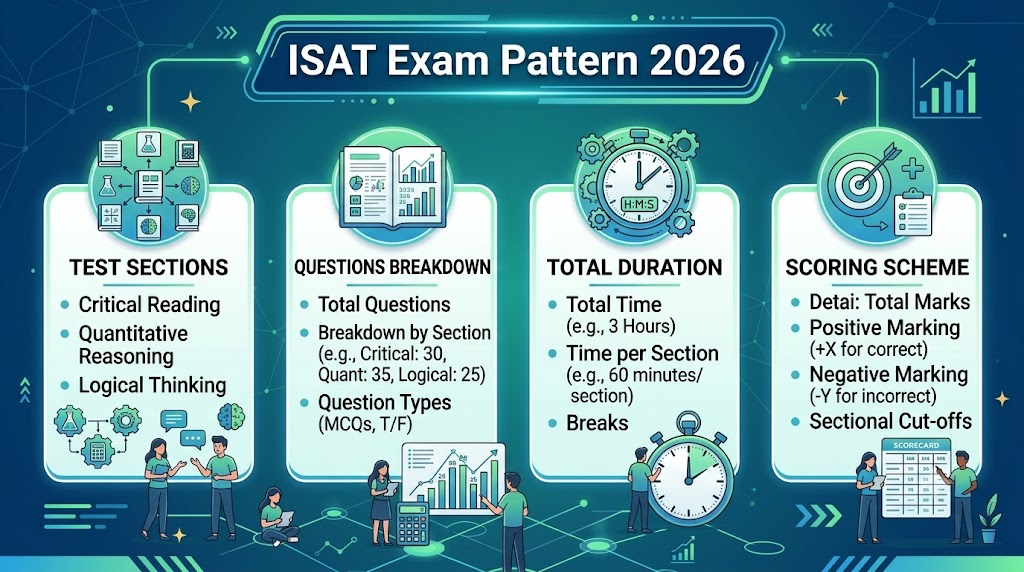

ISAT Practice Test Architecture & Pacing Snapshot
Total Questions
100 MCQs
50 Critical Reasoning + 50 Quantitative Reasoning questions presented in mixed sequence.
Time Limit
180 Minutes
Continuous 3-hour test via ProctorU. Average time available is exactly 1.8 minutes (108s) per item.
Calculator Rule
STRICTLY PROHIBITED
No handheld or on-screen calculator is permitted. Mental math and estimation are vital.
Scoring Metric
100 – 200 Scale
Item Response Theory (IRT) scaled scoring. No penalty for wrong answers (no negative marking).
Achieving a competitive score on the ISAT practice test is the cornerstone of gaining admission into premier undergraduate medicine and dental surgery programs in Australia and Ireland. Because the Australian Council for Educational Research (ACER) does not test standard high school biology, chemistry, or physics recall, students cannot succeed by memorizing textbook facts. Instead, the ISAT assesses raw cognitive processing: how effectively you can deconstruct an unfamiliar philosophical premise, spot logical fallacies, decode complex multi-axis biological graphs, and solve proportional calculation problems under pressure.
Understanding the Two ISAT Cognitive Domains
The 100 questions on the ISAT are split evenly between two distinct cognitive faculties. Unlike traditional standardized tests where sections are compartmentalized into distinct timed halves, ACER distributes Critical Reasoning and Quantitative Reasoning units in an interleaved fashion throughout the 3-hour sitting. This design intentionally tests cognitive flexibility — forcing your brain to switch rapidly from literary and ethical analysis to mathematical problem-solving.
Fast-Track Your College & Career Strategy
Get immediate, personalized AI insights tailored to your grade, strengths, and dream universities — 100% free with instant reports.
Know Your Personality Type for Free
Take our 18-question AI psychometric test to uncover your cognitive archetype, hidden learning superpowers, and ideal university courses.
Personalized Career & University EduPath
Build a step-by-step Grade 8–12 admissions blueprint with AI-matched target universities, exam schedules, and extracurricular profiles.
| Cognitive Domain | Question Count | Primary Abilities Assessed | Typical Stimulus Materials |
|---|---|---|---|
| Critical Reasoning (CR) | 50 Items | Comprehension, deductive analysis, unstated assumption identification, evaluating argument validity, ethical reasoning | Short essays, philosophical treatises, legal dilemmas, sociological dialogues, literary excerpts |
| Quantitative Reasoning (QR) | 50 Items | Data interpretation, spatial reasoning, rate of change analysis, proportional reasoning, pattern recognition | Scientific tables, pharmacokinetic curves, multi-variable scatter graphs, epidemiology matrices |
Section 1: Critical Reasoning Sample Questions & Worked Explanations
In the Critical Reasoning section, ACER presents passage-based stimuli where every piece of information required to solve the question is contained within the text. Outside factual knowledge should never be imported. Let us examine three representative question archetypes.
Question 1 (Main Conclusion / Core Dilemma):
Which of the following statements best articulates the primary philosophical conflict outlined in the passage?
(A) Utilitarian maximization of total life-years versus deontological protection of equal human dignity.
(B) The financial cost-effectiveness of modern ventilators versus traditional palliative emergency care.
(C) Whether clinical triage decisions should be made by attending physicians or hospital administrative committees.
(D) The scientific inaccuracy of calculating Quality-Adjusted Life Years in elderly cohorts.
Question 2 (Unstated Assumption):
The utilitarian argument presented in the passage relies fundamentally on which unstated assumption?
(A) Elderly patients generally consume more hospital resources per day than younger patients.
(B) A life-year experienced by a younger individual has identical moral worth to a life-year experienced by an older individual.
(C) Public health crises cannot be mitigated through preventative epidemiological lockdowns.
(D) Doctors are legally protected from malpractice claims during declared health emergencies.
Section 2: Quantitative Reasoning Sample Questions & Worked Explanations
ISAT Quantitative Reasoning does not require advanced calculus, but it rigorously evaluates mental numeracy, proportional scaling, graph gradient comparison, and mathematical modeling under strict time constraints.
Question 3 (Pharmacokinetic Half-Life Calculation):
After how many hours from the initial administration will Medizone-B first drop below the minimum effective therapeutic threshold of 50 mg?
(A) 12 hours
(B) 18 hours
(C) 24 hours
(D) 30 hours
Question 4 (Proportional Mixture & Dilution):
A laboratory technician must prepare 10 liters of an antiseptic solution containing 12% active iodine. The laboratory has unlimited supplies of two stock solutions: Stock A (contains 8% active iodine) and Stock B (contains 28% active iodine). How many liters of Stock B must be blended with Stock A to achieve the desired 10-liter 12% solution?
(A) 2.0 Liters
(B) 2.5 Liters
(C) 3.0 Liters
(D) 4.0 Liters
Core Solving Strategies for 99th Percentile Performance
Read the Question Stem Before the Passage
In Critical Reasoning, always inspect the question prompt first. Knowing whether ACER demands an unstated assumption, conclusion, or counter-argument allows you to filter the stimulus with targeted precision.
Master Boundary Estimation in Quantitative Reasoning
Since calculators are banned, avoid tedious multi-digit long division. Round numbers to convenient benchmark percentages (e.g., 25%, 33.3%, 10%) to quickly eliminate 2 out of the 4 answer choices.
Implement the 120-Second Drop Rule
Never spend more than 2 minutes struggling with a convoluted data set. If you are stuck after 90 seconds, make an educated guess, flag the item in the online test interface, and move forward immediately.
Eliminate Extreme Distractor Language
Options featuring absolutist modifiers like “entirely”, “never”, “invariably”, or “solely” are statistically incorrect on ACER tests unless the author explicitly used identical restrictive wording.
How to Calibrate Your Score Using Official Test Modes
Practicing questions in isolation is not enough. You must experience realistic exam pressure by progressing through the three standardized preparation modes available on our portal:
- 1. ISAT Diagnostic Test: A 50-question timed diagnostic test designed to establish your baseline scaled score and identify your Critical vs Quantitative delta.
- 2. ISAT Topic Tests: Modular drills focusing exclusively on graph interpretation, premise mapping, or non-calculator numerical estimation.
- 3. ISAT Full Mock Test: Full-length 100-question, 180-minute simulations mirroring the exact ProctorU interface and test-day fatigue.
- 4. Complete ISAT Exam Guide: Comprehensive breakdown of test dates, registration fees, and Australian medical school cutoffs.
Download Free ISAT Sample Question Workbook with Worked Explanations (PDF)
Get 40+ original ACER-calibrated practice items with complete worked rationales, speed reading templates, and non-calculator arithmetic cheat sheets.
Frequently Asked Questions (FAQ)
How many questions are on the real ISAT exam?
The ISAT consists of exactly 100 multiple-choice questions with 4 options each (A, B, C, D). There are 50 Critical Reasoning and 50 Quantitative Reasoning questions presented in mixed order over 3 continuous hours (180 minutes).
Is there negative marking on the ISAT?
No. There is no negative marking on the ISAT. Every question carries equal initial weight before Item Response Theory (IRT) scaling. You should never leave any question blank.
Can I use a calculator during the ISAT?
No. ACER strictly bans all handheld, phone, and on-screen computer calculators. All numerical computations must be performed mentally or using blank scratch paper under the ProctorU proctor’s view.
What is considered a competitive ISAT score for Monash or UNSW Medicine?
Competitive applicants targeting Monash University Bachelor of Medical Science / MD or UNSW Medicine typically require an overall scaled score of 170+ (which usually translates to an 85th–95th percentile ranking), alongside minimum sub-scores of 165 in both Critical and Quantitative Reasoning.
Ready to Test Your Real ISAT Readiness?
Take our free, calibrated ISAT online practice test with instant raw-to-scaled score conversion, percentile analytics, and topic heatmaps.