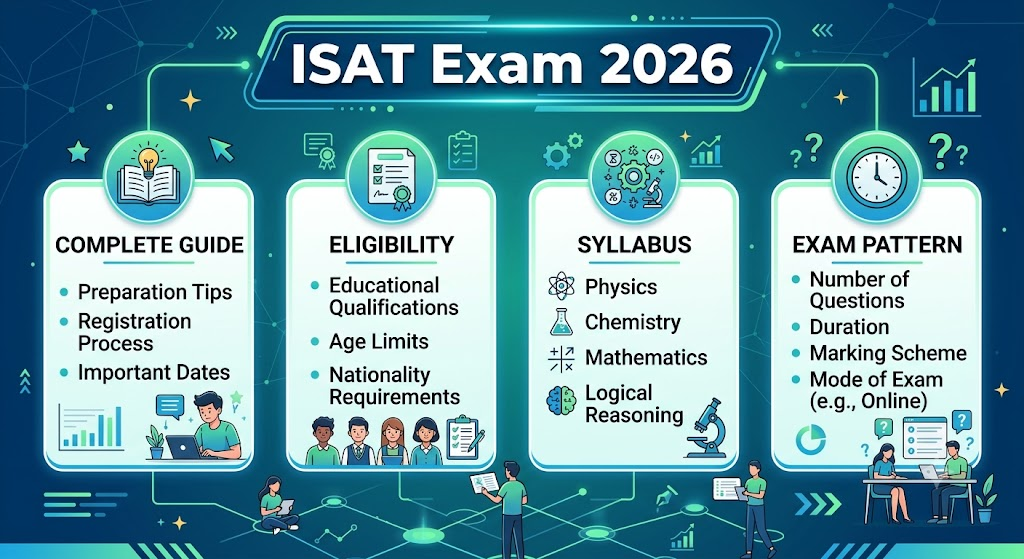
ISAT Exam 2026 Quick Snapshot
Administering Body
ACER (Australia)
Conducted globally via secure remote proctoring on ProctorU.
Exam Format
100 MCQs | 3 Hours
Continuous 180-minute test. Strictly NO calculator and NO negative marking.
Scoring Scale
100 – 200 Scaled
IRT scaled scores reported for Critical Reasoning, Quantitative Reasoning & Overall.
Target Programs
Medicine & Dentistry
Required by Monash, UNSW, UWA, Flinders, and University of Limerick (Ireland).
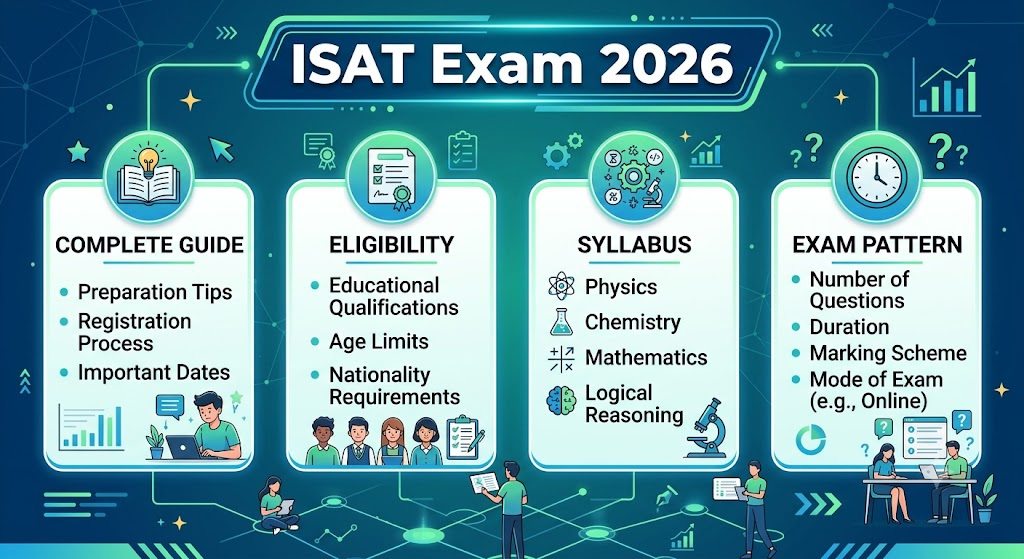
Entering an undergraduate medical or healthcare program in Australia is one of the most competitive academic pursuits for international students. Unlike domestic applicants who sit the UCAT ANZ, international candidates face a different, specialized standardized hurdle: the ISAT exam 2026. Before you open a textbook or solve practice questions, understanding the precise test architecture, eligibility boundaries, and syllabus expectations is critical to crafting an effective score-maximization strategy.
What Is the ISAT Exam?
Fast-Track Your College & Career Strategy
Get immediate, personalized AI insights tailored to your grade, strengths, and dream universities — 100% free with instant reports.
Know Your Personality Type for Free
Take our 18-question AI psychometric test to uncover your cognitive archetype, hidden learning superpowers, and ideal university courses.
Personalized Career & University EduPath
Build a step-by-step Grade 8–12 admissions blueprint with AI-matched target universities, exam schedules, and extracurricular profiles.
The ISAT exam does not test curriculum recall from high school physics, chemistry, or biology textbooks. Instead, ACER explicitly designs the test to evaluate a candidate’s cognitive aptitude: the ability to understand complex arguments, deduce hidden assumptions, spot logical fallacies, evaluate experimental scientific datasets, and interpret quantitative information under strict time constraints.
Because international applicants come from diverse schooling curriculums — including CBSE, ICSE, IB Diploma, Cambridge A-Levels, and US High School Diplomas — universities use the ISAT as an objective, cross-comparable benchmark. A standout score on the ISAT 2026 directly determines whether an applicant receives an invitation for the Multiple Mini Interview (MMI) and secures a coveted international medical quota seat.
ISAT Exam 2026 at a Glance
Here is a verified, comprehensive overview of the ISAT test specifications sourced from official ACER examination protocols:
| Feature | Official Specification Details | Strategic Preparation Note |
|---|---|---|
| Exam Name | International Student Admissions Test (ISAT) | Official psychometric assessment for international pre-med candidates. |
| Exam Year | 2026 Admissions Cycle (Windows 1–4) | Scores generally valid for up to 2 years depending on university rules. |
| Administering Body | Australian Council for Educational Research (ACER) | Official examination authority; portal at isat.acer.org. |
| Exam Mode | Online Remote Proctored (via ProctorU) | Taken from candidate’s laptop or desktop in a secure, private room. |
| Exam Duration | 3 Hours (180 Minutes) Continuous | No scheduled breaks; active webcam and microphone proctoring. |
| Number of Questions | 100 Multiple Choice Questions (MCQs) | Questions have 4 or 5 options with equal weighting. |
| Test Sections | Critical Reasoning & Quantitative Reasoning | Interspersed throughout the 100 questions or presented in blocks. |
| Pacing Allocation | 1.8 Minutes (108 seconds) per question | Strict time triage required to attempt all 100 questions. |
| Calculator Policy | STRICTLY PROHIBITED | No on-screen or physical calculator; mental arithmetic & estimation. |
| Negative Marking | NO Negative Marking | Unanswered questions earn 0 marks; never leave any question blank. |
| Scoring Scale | 100 to 200 Scaled Score (Mean: ~150) | Subscores for CR, QR, and Overall with global percentile ranks. |
| Registration Fee | AUD 435 (Subject to official confirmation) | Paid online through the official ACER registration portal. |
ISAT 2026 Eligibility Criteria
Before registering, candidates must verify that they fulfill both ACER testing criteria and the specific admission regulations of their target medical schools.
Academic Eligibility
To be eligible to use ISAT scores for medical school admissions, students must meet the following academic conditions:
- High School Completion: Candidates must have completed or be currently enrolled in their final year of secondary education (Class 12 CBSE/ICSE, Year 12, IB Diploma, Cambridge GCE A-Levels, or equivalent international qualifications).
- Prerequisite Science Subjects: Most participating Australian medical programs (such as Monash and UWA) require candidates to have studied Chemistry and either Mathematics or Biology at the senior secondary level. (Note: These prerequisites are university-specific rather than an ACER test registration barrier).
- Minimum Academic Cutoffs: Universities require high academic achievement (e.g., ATAR equivalent 90.00+ or 95.00+, CBSE 90%+, IB 36–39+ points) in addition to competitive ISAT scores.
Age Requirements
ACER does not impose a rigid minimum or maximum age limit to register for the ISAT. However, individual universities typically mandate that admitted medical students must be at least 17 years of age at the time of program commencement due to clinical hospital training regulations.
Other Eligibility Requirements
- International Student Status: The ISAT is exclusively intended for international citizens. Australian citizens, Australian permanent residents, and New Zealand citizens are ineligible to use ISAT for domestic medical quotas and must sit the UCAT ANZ or GAMSAT.
- English Language Proficiency: While the ISAT itself tests advanced reading comprehension, universities require valid English language certifications (e.g., IELTS Academic overall 7.0 with no band below 7.0, or equivalent TOEFL/PTE Academic scores) prior to visa and enrollment confirmation.
- Identification: A valid, unexpired international passport is mandatory for identity verification during ProctorU test room checks.
Who Should Take the ISAT?
The ISAT test is specifically designed for international students targeting direct-entry undergraduate degrees in:
- Bachelor of Medical Science & Doctor of Medicine (BMedSci/MD) — Monash University (Melbourne & Malaysia)
- Direct Pathway to Doctor of Medicine (MD) & Dental Medicine (DMD) — University of Western Australia (UWA)
- Bachelor of Medical Studies / Doctor of Medicine (BMed/MD) — University of New South Wales (UNSW Sydney)
- Bachelor of Clinical Science / Doctor of Medicine (MD) — Flinders University (Adelaide)
- Bachelor of Medical Science & Doctor of Medicine — University of Tasmania (UTAS)
- Undergraduate Medical & Healthcare programs — University of Limerick (Ireland)
ISAT Exam Pattern 2026
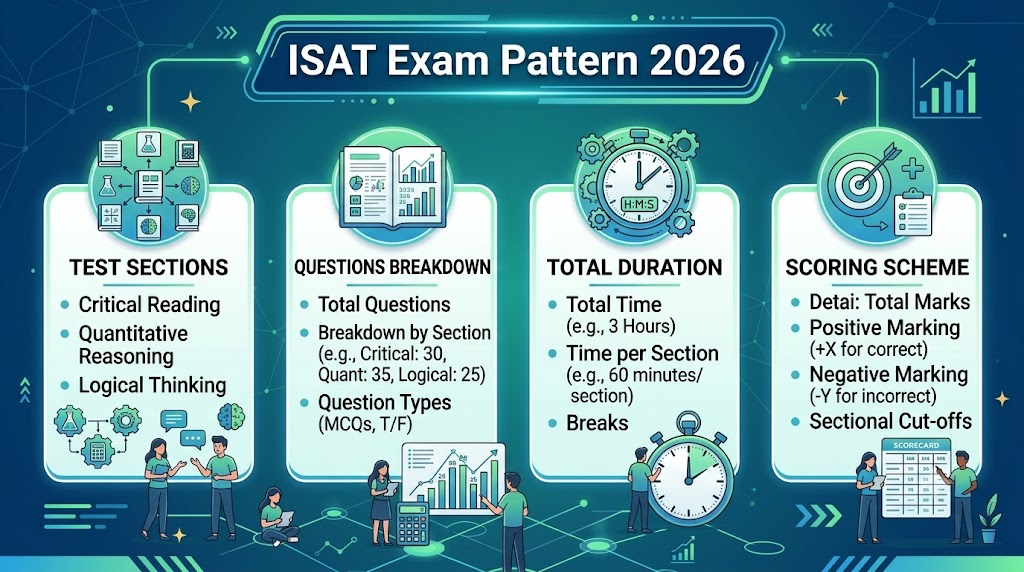
Understanding the ISAT exam pattern is essential to managing the intense pace of the exam. The test comprises 100 questions to be answered in 180 continuous minutes:
| Section / Domain | Questions | Timing Budget | Question Type | Scoring & Weighting |
|---|---|---|---|---|
| Critical Reasoning (CR) | ~50 Questions | ~90 Minutes (108 sec/q) | Multiple Choice (4–5 options) | Scaled independently (100–200); equal weighting |
| Quantitative Reasoning (QR) | ~50 Questions | ~90 Minutes (108 sec/q) | Multiple Choice (4–5 options) | Scaled independently (100–200); equal weighting |
| Overall Composite Exam | 100 Questions | 180 Minutes (3h 00m) | Computer-Based (ProctorU) | Reported on 100–200 scale (Mean: 150) |
Key operational rules you must know about the ISAT exam pattern:
- Navigation Freedom: Candidates can move backward and forward between questions, flag items for review, and change previously selected answers at any time during the 180 minutes.
- No Negative Marking: Every correct response adds raw points; incorrect answers do not subtract marks. Never leave any question unanswered.
- Continuous Administration: There are NO scheduled bio-breaks. The timer will not stop for any reason. If you leave your workstation, the clock keeps ticking, and you may trigger proctor security warnings.
- No Calculators: Calculators (both physical and on-screen) are strictly prohibited. ACER assesses mental agility, estimation, and ratio conversions.
- Rough Paper Allowance: ACER permits candidates up to two sheets of blank A4 scratch paper and a pen/pencil, which must be verified by the proctor before and after testing.
ISAT Syllabus 2026
Unlike school examinations, the ISAT syllabus is not defined by a list of textbook chapters. It is an aptitude-based syllabus evaluating intellectual processing skills across two equal broad domains:
Critical Reasoning (CR) Domain
Critical Reasoning questions are based on written stimulus passages drawn from the humanities, social sciences, media, philosophy, literature, and medical ethics. You do not need prior knowledge of the topic discussed. Tested concepts include:
- Reading Comprehension & Synthesis: Extracting core arguments and secondary evidence from dense, multi-paragraph texts.
- Premise & Conclusion Analysis: Distinguishing between what the author assumes, what is demonstrated, and what is merely asserted.
- Evaluating Arguments & Flaws: Detecting logical fallacies, scope shifts, false dichotomies, and correlation-versus-causation traps.
- Tone, Stance & Perspective: Identifying the author’s attitude (e.g., skeptical, ambivalent, supportive, pragmatic) and analyzing underlying biases.
- Hypothetical Application: Deducing how new external evidence would strengthen, weaken, or wholly undermine the author's conclusion.
Quantitative Reasoning (QR) Domain
Quantitative Reasoning questions draw on scientific scenarios, experimental data, charts, mathematical relationships, and biological/chemical observations. Tested concepts include:
- Data Interpretation: Analyzing complex multi-variable tables, scatter plots, dual-axis graphs, and clinical trial results.
- Scientific Logic & Deduction: Identifying dependent and independent variables, control groups, and valid experimental deductions.
- Proportional & Ratio Reasoning: Scaling dilution assays, enzyme kinetics, half-lives, and unit conversions without a calculator.
- Rate, Time & Kinematics: Calculating velocities, flow rates, geometric growth, and decay curves.
- Probability & Combinatorics: Determining independent event probabilities, risk ratios, and conditional outcomes in medical settings.
Important Topics to Prepare for ISAT
While the test covers broad aptitude, certain reasoning archetypes appear with high frequency across ACER test forms:
| Reasoning Topic | Priority / Frequency | Core Concept Evaluated | What to Practise |
|---|---|---|---|
| Multi-Variable Data Tables | High (Essential) | Percentage change, weighted averages, and rate comparisons across clinical sets. | Column differencing, baseline subtraction, and fast decimal approximations. |
| Argument Assumption & Flaw Detection | High (Essential) | Unstated logical leaps between factual premises and the author’s conclusion. | Identifying extreme language ("always", "never") and isolating causality vs correlation. |
| Scientific Kinetics & Dilution Graphs | High (Essential) | Enzyme saturation curves, half-lives, and axes inflection points. | Graph slope reading, asymptotes, and mental unit conversions. |
| Tone & Perspective Attribution | Medium (High-Yield) | Differentiating author’s personal voice from counter-arguments cited in text. | Identifying structural transition markers ("however", "conversely", "paradoxically"). |
| Probability & Risk Ratios | Medium (High-Yield) | Independent event calculations, false-positive rates, and contingency tables. | Tree diagrams, complementary probability (1 - P(none)), and proportional grids. |
Download the Official ISAT 2026 Complete Guide (PDF)
Get EduQuest's authoritative 8-page preparation toolkit covering ACER scoring scales, Critical Reasoning trap avoidance, Quantitative mental estimation heuristics, and Australian medical cutoff benchmarks.
How to Prepare for ISAT 2026: Step-by-Step Blueprint
Succeeding on the ISAT preparation journey requires a structured, multi-phase methodology rather than haphazard question slogging. Follow this seven-step master plan:
Step 1 – Understand the Exam Pattern & Testing Environment
Familiarize yourself with the 180-minute non-stop format and ProctorU remote proctoring guidelines. Understanding that you only have 108 seconds per question prevents early pacing complacency.
Step 2 – Diagnose Baseline Weaknesses
Take a full-length diagnostic test without checking the answers. Audit your performance: are you losing marks to conceptual misinterpretations, ACER trap distractors, or clock panic?
Step 3 – Build Fundamentals in Verbal & Quantitative Logic
Develop formal argument deconstruction habits for Critical Reasoning. In Quantitative Reasoning, master mental estimation, order-of-magnitude calculations, and proportional scaling.
Step 4 – Execute Sectional & Timed Drills Regularly
Practise 20-to-25 question blocks under a strict 45-minute timer. This conditions your mind to make rapid 60-second elimination decisions.
Step 5 – Maintain an Error Analysis Log
Every incorrect or flagged question must be cataloged in a review journal. Note: (1) What was the question asking? (2) Why was the distractor appealing? (3) What textual clue did you miss?
Step 6 – Take Full-Length Proctored Mocks with Blind Review
Complete at least 8 to 12 full-length, 3-hour computer-based mocks under realistic test conditions. Conduct a "Blind Review" before looking at the score key to distinguish speed errors from knowledge gaps.
Step 7 – Calibrate Test-Day Pacing Checkpoints
Divide the 180-minute exam into four 45-minute quarters (25 questions each). If you encounter an intractable question after 75 seconds, eliminate, guess, flag, and protect your momentum.
30-Day ISAT Preparation Plan
If you have approximately one month before your scheduled testing window, this intensive 4-week calendar ensures balanced mastery across both sections:
| Phase & Days | Primary Focus Area | Daily Practice Cadence & Core Milestone |
|---|---|---|
| Days 1–7 (Foundation) | Exam Architecture & Logic Diagnostics | Complete diagnostic test; master premise-conclusion identification; review mental math estimation rules; complete 30 mixed practice items daily. |
| Days 8–15 (Topic Mastery) | Sectional Question Drills & Trap Elimination | Focus on multi-variable data tables, scientific kinetics, and ethical texts; practise 40 questions daily in timed 45-minute blocks. |
| Days 16–23 (Timed Sectionals) | Pacing Conditioning & Speed Optimization | Complete 2 full-length sectionals per day; enforce the 75-second triage rule; maintain detailed error log reviews. |
| Days 24–30 (Full Simulation) | Full-Length Mocks & Final Telemetry | Sit for 3 full-length 3-hour simulated mocks under exam conditions; conduct blind review; rest mind 24 hours prior to test day. |
10 Actionable ISAT Preparation Tips
- Understand the exam before starting: Never treat ISAT like school biology or math; it is purely an aptitude and reasoning test.
- Practise consistently rather than cramming: Reasoning circuits require weeks of cognitive habituation. Dedicate 2 hours daily rather than 10-hour weekend marathons.
- Focus on accuracy before speed: Early in prep, solve questions untimed to understand how ACER writes distractors before turning on the stopwatch.
- Inspect charts before reading questions: In Quantitative Reasoning, check the axes, legends, and inflection slopes first. Pre-digesting the data cuts reading time in half.
- Quarantine personal biases: In Critical Reasoning, answers must rely strictly on the text provided. Never let outside ethical or scientific opinions override the author's premises.
- Master approximation: Because calculators are forbidden, round numbers aggressively to calculate orders of magnitude in under 20 seconds.
- Beware of extreme qualifiers: Words like "invariably", "wholly", "never", and "solely" are reliable indicators of ACER trap options.
- Enforce the 75-second bailout rule: If you haven’t unlocked a solution path after 75 seconds, make an educated elimination guess, flag, and move on.
- Build 3-hour screen stamina: Staring at complex data on a laptop screen for 180 minutes causes severe cognitive decline. Take mocks at the exact time of your scheduled test.
- Simulate actual ProctorU conditions: Practise with a clear desk, two sheets of blank paper, and zero interruptions to eliminate test-day nervousness.
Common ISAT Preparation Mistakes & How to Avoid Them
- Memorizing School Science Textbooks: Rote-memorizing physics formulas or organic chemistry mechanisms won’t help on ISAT. Focus your energy on data interpretation, graph slope analysis, and verbal deduction.
- Getting Bogged Down in Complex Calculations: Spending 3+ minutes doing manual long division is a fatal mistake. Train on percentage scaling, order-of-magnitude bounds, and ratio cancellation.
- Taking Mocks Without In-Depth Error Analysis: Completing 10 mock tests without analyzing why you made mistakes is useless. You must spend twice as much time reviewing an exam as you spent taking it.
- Second-Guessing and Changing Correct Answers: Never change an answer choice based on vague anxiety. Only change a selected option if you locate concrete textual proof that disproves your first choice.
- Leaving Questions Blank at the End: Because there is no negative marking, unanswered questions represent wasted scoring opportunities. Always allocate the final 2 minutes to select options for all remaining items.
ISAT Mock Test and Practice Questions on EduQuest
Because ACER releases very limited official past papers, high-fidelity practice simulations are the single most important asset in an applicant's toolkit. At EduQuest, our international test prep division provides candidates with comprehensive practice resources:
- Full-Length ACER-Calibrated Mock Tests: 12 full-length, 3-hour computer-based exams matching real ACER difficulty distributions and interface pacing.
- Sectional Drills & Topic Tests: Targeted question banks focusing specifically on multi-graph data interpretation and argument deconstruction.
- Detailed Score Telemetry & Percentile Predictions: Automated scoring converting raw accuracy into verified 100–200 scaled bands and Australian university cutoff benchmarks.
- 1-on-1 Faculty Mentorship: Direct question-by-question coaching with senior verbal and quantitative reasoning specialists to eliminate personal error patterns.
Ready to test your ISAT preparation under real exam conditions? Try an authentic ISAT mock test on EduQuest to benchmark your scaled score, identify cognitive blind spots, and master pacing before test day.
— EduQuest Test Prep Faculty
How to Improve Your ISAT Score: The 5 Pillar Method
| Improvement Pillar | Tactical Focus Area | Expected Score Impact |
|---|---|---|
| Pillar 1: Accuracy Auditing | Eliminating careless misreads of negative words ("EXCEPT", "NOT"). | +6 to +8 Scaled Points |
| Pillar 2: Visual Pre-Computation | De-layering graphs and axes before reading complex word prompts. | +8 to +12 Scaled Points |
| Pillar 3: Distractor Elimination | Disqualifying scope-shifted and causal fallacy options in Critical Reasoning. | +10 to +15 Scaled Points |
| Pillar 4: Triage & Pacing Cadence | Enforcing the 25-questions-per-45-minutes checkpoint rule. | +8 to +10 Scaled Points |
| Pillar 5: Blind Review Journaling | Re-solving every flagged question untimed to convert slips into mastery. | +10 to +14 Scaled Points |
Frequently Asked Questions (FAQs) About ISAT 2026
What is the ISAT exam?
The ISAT (International Student Admissions Test) is a 3-hour, 100-multiple-choice aptitude assessment developed by ACER. It evaluates international students’ critical and quantitative reasoning skills for entry into Australian and Irish undergraduate medical and healthcare programs.
When is the ISAT 2026 exam conducted?
ACER conducts the ISAT in four designated testing windows annually: Window 1 (January–February), Window 2 (April–May), Window 3 (July–August), and Window 4 (October–November). Specific window dates are announced on the official ACER website (isat.acer.org).
Who is eligible to take the ISAT 2026?
Any international student who has completed or is in their final year of secondary education (Class 12, Year 12, IB, A-Levels) applying to participating international medical programs is eligible. Australian and New Zealand citizens must take the UCAT ANZ instead.
What is the ISAT 2026 syllabus?
The ISAT does not test high school science facts. Its syllabus comprises two broad aptitude domains: Critical Reasoning (~50 questions covering humanities, ethical logic, and argument analysis) and Quantitative Reasoning (~50 questions covering scientific data, charts, rates, and mathematical deduction).
What is the ISAT exam pattern?
The exam consists of 100 multiple-choice questions (with 4 or 5 answer options) to be completed in 180 continuous minutes (3 hours) via online remote proctoring on ProctorU. There are no scheduled breaks.
Is there negative marking in the ISAT exam?
No. There is no penalty for incorrect answers. All 100 questions carry equal weight, so candidates should ensure they attempt every question before the timer expires.
Are calculators permitted in the ISAT?
No. Calculators of any kind (physical or computer-based) are strictly forbidden. Students must use mental approximation, ratio heuristics, and proctor-approved scratch paper.
How is the ISAT scored?
Raw scores are converted via Item Response Theory (IRT) into scaled scores ranging from 100 to 200 with an international cohort mean of 150. Reports provide scaled subscores for Critical Reasoning and Quantitative Reasoning, an Overall score, and percentile ranks.
What is considered a good ISAT score for Monash or UNSW Medicine?
For top medical schools like Monash University, UNSW Sydney, and UWA, a competitive score is generally 175 or higher (85th+ percentile), with scores of 180 to 186+ (95th–99th percentile) offering a strong admissions advantage.
How can I take an ISAT mock test?
Candidates can practice full-length, timed ACER-standard simulated mocks on EduQuest with automated scaled scoring, percentile benchmarks, and question-by-question diagnostic telemetry.
Final Preparation Checklist for ISAT 2026
- ☑ Understand Official Exam Architecture: 100 questions, 180 minutes, no calculator, no negative marking.
- ☑ Verify University Eligibility & Prerequisites: Confirm senior secondary Chemistry/Math requirements with target institutions.
- ☑ Review the Aptitude Syllabus: Master premise-conclusion logic for CR and graph inflection scanning for QR.
- ☑ Establish a 30-to-60 Day Study Plan: Allocate daily time for timed sectional sets and error journaling.
- ☑ Master Mental Math & Estimation: Practise order-of-magnitude bounds and ratio cancellations without a calculator.
- ☑ Complete 8–12 Full-Length Proctored Mocks: Condition your mind to sustain 180 minutes of continuous screen focus.
- ☑ Audit All Errors with Blind Review: Re-solve missed questions untimed to eradicate recurring trap patterns.
- ☑ Prepare ProctorU Testing Environment: Check laptop compatibility, 360-degree webcam, reliable 5+ Mbps internet, and clear workspace.
- ☑ Register Early: Complete ACER registration and ProctorU appointment booking at least 5 weeks in advance of your window.
Ready to Master the ISAT & Secure Your Dream Medical Seat?
Get 1-on-1 personalized mentorship, official ACER-calibrated mock tests, and diagnostic coaching from EduQuest’s premier test prep faculty.