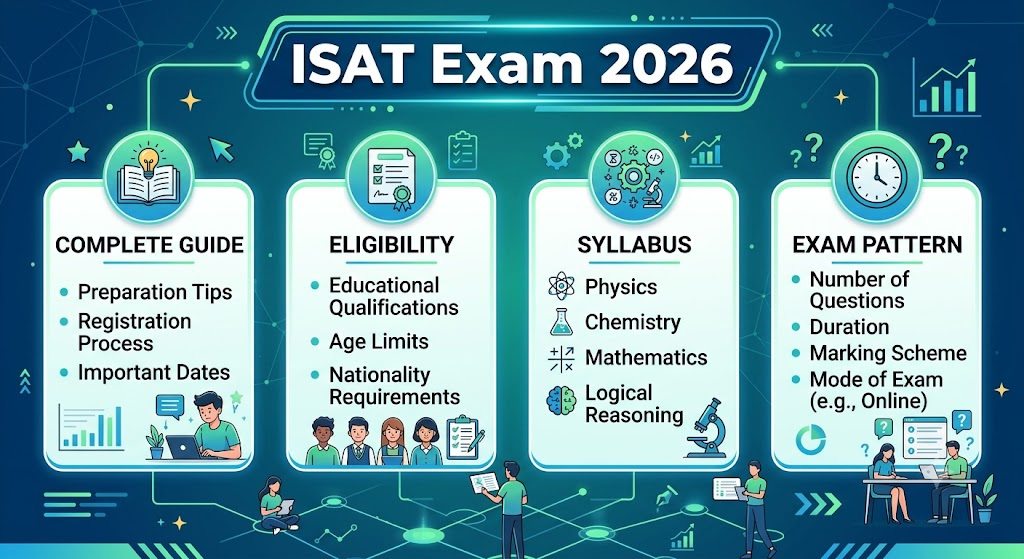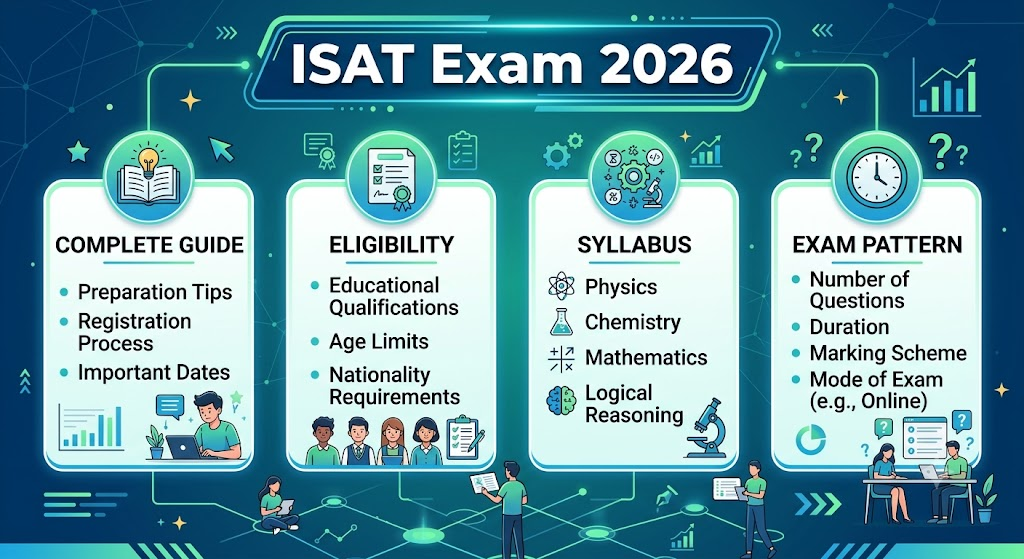

For international applicants targeting high-demand undergraduate medicine, dentistry, and healthcare programs in Australia and Ireland, understanding the ISAT exam pattern 2026 is the fundamental first step toward an effective preparation strategy. Unlike school-leaving examinations that evaluate recall of textbook facts, the International Student Admissions Test (ISAT) developed by ACER measures cognitive reasoning under strict, continuous time pressure.
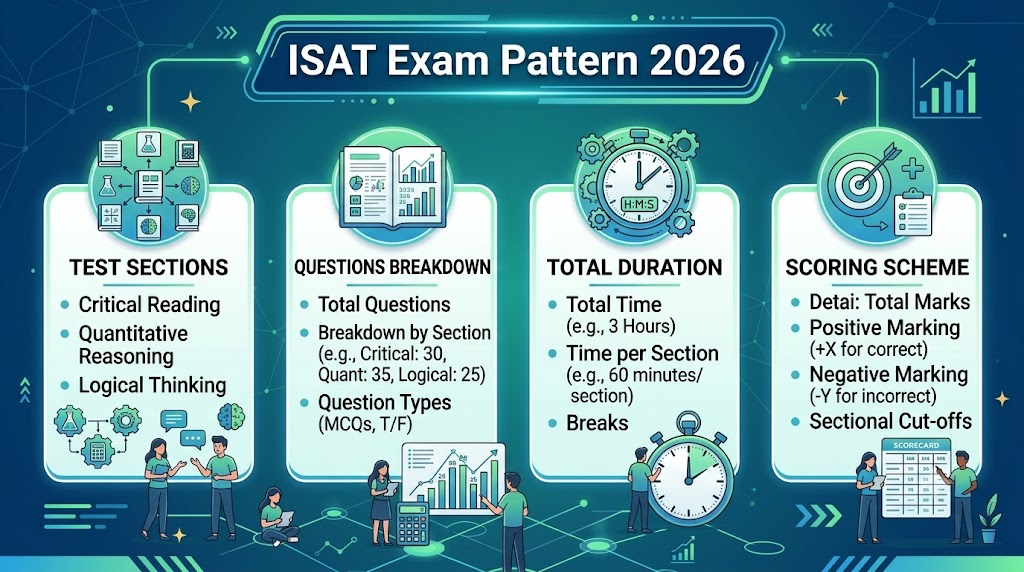
ISAT Exam Pattern 2026 at a Glance
The table below presents the verified, official examination specifications for the ISAT 2026 exam pattern:
| Exam Feature | Official ISAT 2026 Details | Strategic Preparation Note |
|---|---|---|
| Exam Name | International Student Admissions Test (ISAT) | Official ACER aptitude assessment for international pre-med. |
| Conducting Organisation | Australian Council for Educational Research (ACER) | Official examination authority (isat.acer.org). |
| Exam Mode | Online / Computer-based | Administered remotely via ProctorU with live webcam surveillance. |
| Number of Questions | 100 Questions | Continuous pool; all items carry equal point value. |
| Question Type | Multiple Choice Questions (MCQs) | Each item contains 4 or 5 options with one correct answer. |
| Total Duration | 3 Hours / 180 Minutes | Continuous testing; strictly NO scheduled bio-breaks. |
| Main Skills Evaluated | Critical Reasoning & Quantitative Reasoning | Equal emphasis on verbal-logical and numerical-analytical deduction. |
| Average Pacing Reference | 1.8 Minutes (108 Seconds) per question | General guideline, not an official per-question countdown timer. |
| Negative Marking | NO Negative Marking | No marks deducted for wrong answers; attempt every single question. |
| Calculator Policy | STRICTLY FORBIDDEN | Mental arithmetic, proportional reasoning, and estimation required. |
| Scratchpad Allowance | Up to 2 sheets of blank A4 paper | Must be inspected by proctor before and destroyed after test. |
Fast-Track Your College & Career Strategy
Get immediate, personalized AI insights tailored to your grade, strengths, and dream universities — 100% free with instant reports.
Know Your Personality Type for Free
Take our 18-question AI psychometric test to uncover your cognitive archetype, hidden learning superpowers, and ideal university courses.
Personalized Career & University EduPath
Build a step-by-step Grade 8–12 admissions blueprint with AI-matched target universities, exam schedules, and extracurricular profiles.
What Is the ISAT Exam?
The International Student Admissions Test (ISAT) is an objective, standardized test designed by ACER to assess the intellectual capabilities of international candidates applying to university courses in Medicine, Dentistry, Occupational Therapy, and Speech Pathology.
Participating universities — including Monash University, University of Western Australia (UWA), University of New South Wales (UNSW Sydney), Flinders University, and the University of Limerick — utilize the ISAT because academic grading systems vary wildly across different countries. The ISAT measures general cognitive and reasoning abilities that indicate whether an applicant can handle the intense, analytical demands of a modern medical curriculum.
How Many Questions Are There in ISAT 2026?
Questions are presented on a computer interface where candidates possess complete navigation flexibility. Test-takers can move forward and backward between items, flag uncertain questions for later review, and modify previously chosen answers at any point before the 180 minutes expire.
ISAT Exam Duration 2026 & Pacing Economics
The official ISAT exam duration is 3 hours (180 minutes) without any pauses or scheduled breaks. This establishes a straightforward mathematical pacing baseline:
Important Distinction: 1.8 minutes is an average pacing reference, NOT an official time limit per question. ACER allows you to allocate your 180 minutes however you wish. Straightforward reasoning items may take only 45–60 seconds, allowing you to bank valuable time for intricate, multi-graph data interpretation questions that require 2 to 2.5 minutes.
ISAT Sections 2026: The Two Core Reasoning Domains
The ISAT test format is divided into two core conceptual areas that assess cross-curricular abilities:
1. Critical Reasoning (CR)
Critical Reasoning evaluates your ability to comprehend, interpret, and critically dissect complex texts drawn from the humanities and social sciences. Core competencies evaluated include:
- Comprehension & Synthesis: Extracting core theses, subtle nuances, and implicit viewpoints from multi-paragraph prose.
- Argument Evaluation: Differentiating between sound deductive arguments, unproven assertions, and logical fallacies.
- Inference & Extrapolation: Identifying conclusions that are strictly warranted by the text while rejecting plausible-sounding assumptions.
- Perspective & Bias Detection: Recognizing authorial stance, underlying skepticism, and counter-arguments.
2. Quantitative Reasoning (QR)
Quantitative Reasoning evaluates your ability to extract meaning from numerical, experimental, and graphical information drawn from sciences and mathematics. Core competencies evaluated include:
- Data Interpretation: Analyzing complex tables, scatter plots, kinetic curves, and clinical trial datasets.
- Proportional Thinking & Rates: Solving dilution scenarios, growth-decay rates, and ratio conversions without a calculator.
- Experimental Deduction: Interpreting scientific hypotheses, experimental controls, and anomalous observations.
- Decision Making: Reaching mathematically sound conclusions from multi-variable data constraints.
Download the Official ISAT Exam Pattern 2026 Guide (PDF)
Get our comprehensive 8-page examination guide covering 100-question distribution, timing checkpoints, distractor avoidance, and university cutoffs.
ISAT Marking Scheme 2026 & Negative Marking Rule
The practical implication of this marking scheme is critical: candidates should attempt all 100 questions. Leaving any question blank is a wasted opportunity. If a question appears impenetrable, use the process of elimination to narrow down the choices, select your best estimate, flag the item, and move forward.
How ISAT Scoring Works: Raw to Scaled Scores
ACER does not publish raw percentage marks. Instead, raw scores are converted using Item Response Theory (IRT) into scaled scores ranging from 100 to 200, with a standardized international mean of approximately 150. Your official Statement of Results provides:
- Critical Reasoning Scaled Score (100 to 200)
- Quantitative Reasoning Scaled Score (100 to 200)
- Overall Scaled Score (100 to 200)
- Percentile Ranks: Showing your exact comparative rank against the global cohort of international candidates.
ISAT Exam Pattern vs Traditional Subject-Based Exams
| Exam Feature | ACER ISAT Exam | Traditional Subject-Based Entrance Exams |
|---|---|---|
| Primary Focus | Psychometric reasoning & analytical logic | Curriculum syllabus & textbook recall |
| Question Type | 100 Multiple Choice (4 or 5 options) | MCQs, descriptive calculations, short/long essays |
| Calculator Allowed | STRICTLY PROHIBITED | Allowed in many exams (or on-screen calculator provided) |
| Curriculum Prerequisite | Cross-curricular; NO fixed syllabus | Strict high school Physics, Chemistry, Biology syllabus |
| Pacing Requirement | 108 seconds per question in 3-hour marathon | Varies by subject and paper format |
ISAT Time Management: The Checkpoint Strategy
To avoid cognitive crash during 180 continuous minutes, senior EduQuest mentors recommend the Four-Quarter Checkpoint Cadence:
| Pacing Quarter | Clock Time Left | Target Question Count | Operational Goal |
|---|---|---|---|
| Quarter 1 (Minutes 0–45) | 135 Mins Left | 25 Questions Completed | Establish steady rhythm; solve high-confidence items. |
| Quarter 2 (Minutes 46–90) | 90 Mins Left | 50 Questions Completed | Reach midpoint; 10-second mental reset and posture check. |
| Quarter 3 (Minutes 91–135) | 45 Mins Left | 75 Questions Completed | Maintain pacing; strictly enforce 75-second triage rule. |
| Quarter 4 (Minutes 136–180) | 05 Mins Left | 100 Questions Completed | Review flagged items; ensure ZERO unanswered blanks. |
Frequently Asked Questions (FAQs) on ISAT Exam Pattern
How many questions are there in ISAT 2026?
The ISAT consists of exactly 100 multiple-choice questions. Each question has 4 or 5 options with only one correct answer.
How long is the ISAT exam?
The ISAT duration is 3 hours (180 minutes) of continuous testing without scheduled bio-breaks.
Does the ISAT have negative marking?
No. ACER explicitly confirms that marks are not deducted for incorrect answers. Unanswered questions receive 0 marks.
Can I navigate between questions in ISAT?
Yes. You can move forward and backward between all 100 questions, change answers, and flag questions for review during the 180 minutes.
Are calculators permitted in ISAT?
No. Calculators of any kind are strictly forbidden. The test evaluates mental arithmetic, estimation, and proportional reasoning.
ISAT Exam Pattern 2026 – Quick Revision Summary
| What to Remember | Official ISAT 2026 Specification |
|---|---|
| Total Questions | 100 Multiple Choice Questions (4 or 5 options) |
| Total Duration | 3 Hours (180 Minutes) Continuous Testing |
| Core Domains | Critical Reasoning (~50%) & Quantitative Reasoning (~50%) |
| Negative Marking | NO Penalty for Incorrect Answers |
| Calculator | Strictly Prohibited; Mental Estimation Required |
| Scoring Range | 100 to 200 Scaled Score (Mean ~150) + Percentiles |
| Testing Mode | Online Remote Proctored via ProctorU |
Ready to Experience the Official ISAT Format Under Real Conditions?
Practise full-length, 3-hour ACER-standard simulated mock tests with detailed score telemetry and 1-on-1 diagnostic mentoring on EduQuest.