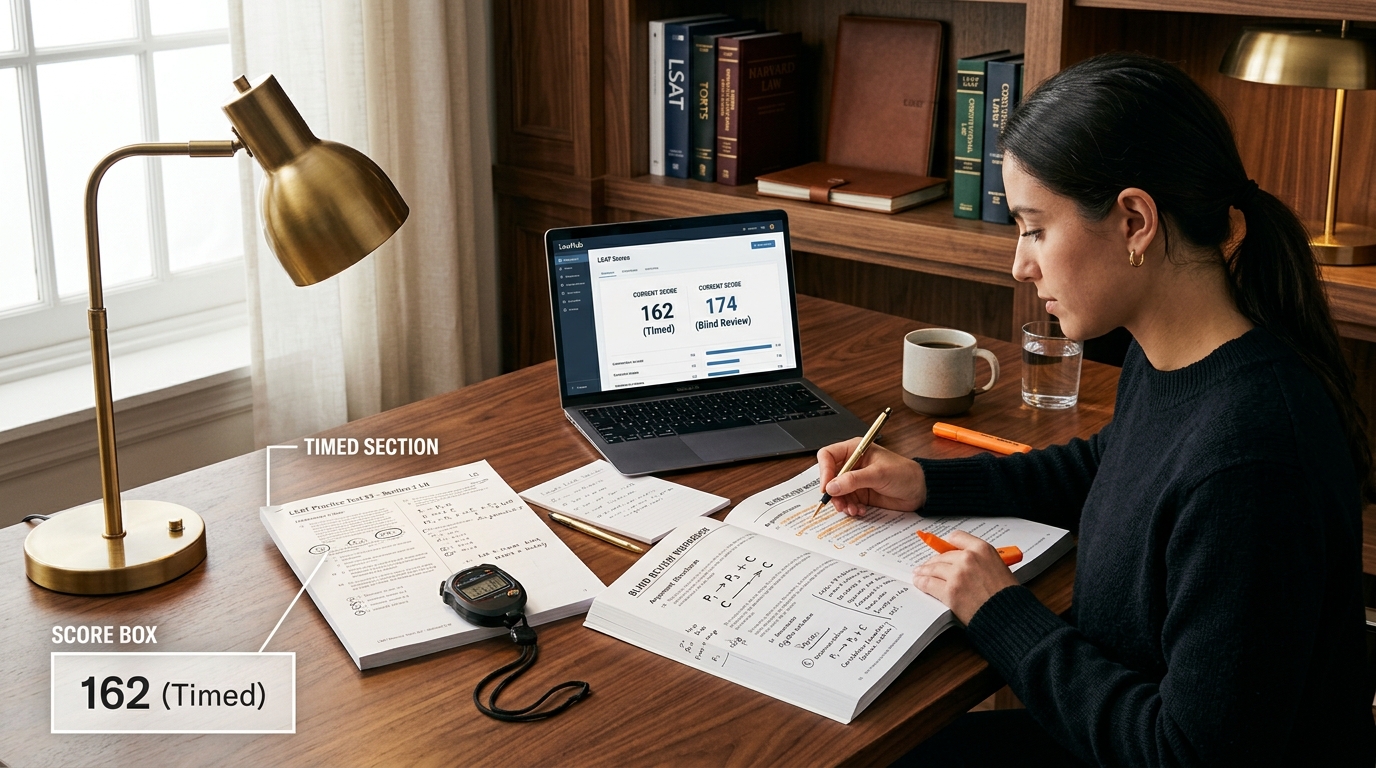


The LSAT exam (Law School Admission Test) is administered by the Law School Admission Council (LSAC) and serves as the benchmark entrance exam for Juris Doctor (JD) and Master of Laws programs globally. If you are preparing for the LSAT exam, this technical guide breaks down the post-2024 four-section architecture, the 120–180 scoring curve, the 50-minute Argumentative Writing task, and international testing protocols.
LSAT Exam Architecture: Sections, Questions & Timing Breakdown
The LSAT is a computer-based exam consisting of four 35-minute multiple-choice sections (three scored, one unscored experimental) with a 10-minute intermission between sections 2 and 3:
| Section Name | Question Count | Section Duration | Pacing per Question | Scoring Status |
|---|---|---|---|---|
| Logical Reasoning 1 | 24 – 26 Questions | 35 Minutes | ~82 Seconds / Question | Scored (approx. 33.3%) |
| Logical Reasoning 2 | 24 – 26 Questions | 35 Minutes | ~82 Seconds / Question | Scored (approx. 33.3%) |
| Reading Comprehension | 26 – 28 Questions (4 Passages) | 35 Minutes | ~78 Seconds (~8.5 min/passage) | Scored (approx. 33.3%) |
| Unscored Experimental Section | 24 – 28 Questions (LR or RC) | 35 Minutes | ~80 Seconds / Question | Unscored (Pre-testing) |
| Argumentative Writing | 1 Promoted Essay Prompt | 50 Minutes | Administered asynchronously | Unscored (Sent to law schools) |
| Total Multiple Choice Test | 75 – 78 Scored Questions | 2 Hours 30 Minutes | High Pacing Focus | 120–180 Scaled Score |
Detailed Syllabus: What the LSAT Actually Tests (and Doesn't Test)
Fast-Track Your College & Career Strategy
Get immediate, personalized AI insights tailored to your grade, strengths, and dream universities — 100% free with instant reports.
Know Your Personality Type for Free
Take our 18-question AI psychometric test to uncover your cognitive archetype, hidden learning superpowers, and ideal university courses.
Personalized Career & University EduPath
Build a step-by-step Grade 8–12 admissions blueprint with AI-matched target universities, exam schedules, and extracurricular profiles.
The LSAT requires zero background knowledge of the law. You do not need to know statutes, constitutional amendments, or legal precedents. Instead, it measures foundational cognitive reasoning across two domains:
Logical Reasoning Syllabus (LR)
Analyzes short arguments (50–100 words) across diverse topics. Question types include: Must Be True/Inference, Main Point, Necessary & Sufficient Assumptions, Strengthen/Weaken, Flaw in the Reasoning, Method of Reasoning, Parallel Reasoning, Point at Issue, and Principle Application.
Reading Comprehension Syllabus (RC)
Features dense academic prose (450–500 words) from 4 areas: Law & Legal Philosophy, Social Sciences & Economics, Humanities & Arts, and Natural Sciences. Evaluates Main Idea, Author Perspective, Specific Detail retrieval, Analogy, and Argumentative Structure.
Download The Complete LSAT Guide & Law Admissions Roadmap
Get our comprehensive 10-page guide covering the post-2024 format, 120–180 scoring percentiles, 4-month study plan, and T14 law school score benchmarks.
The 120–180 Scaled Scoring Curve: Converting Raw Points to Percentiles
Your raw score (total number of correctly answered questions out of roughly 75–78 scored items) is converted into a scaled score ranging from 120 to 180. Because the scoring is curved (equated across test forms), the difficulty remains identical across administrations:
| LSAT Scaled Score | Raw Misses Allowed (Approx.) | Percentile Rank | Law School Admissions Tier |
|---|---|---|---|
| 175 – 180 | -0 to -3 Misses | 99.5th – 99.9th Percentile | Top 3 US Law: Yale, Stanford, Harvard (Full-Ride Scholarship Range) |
| 170 – 174 | -4 to -8 Misses | 97th – 99th Percentile | T14 US Law: Columbia, Chicago, NYU, Penn, UVA, Berkeley, Michigan |
| 165 – 169 | -9 to -14 Misses | 89th – 96th Percentile | Top 20–35 US Law: UCLA, Georgetown, Texas, Vanderbilt, WashU |
| 160 – 164 | -15 to -20 Misses | 77th – 88th Percentile | Top 50 US Law: Boston University, Fordham, Emory, George Washington |
| 150 – 159 | -21 to -32 Misses | 40th – 75th Percentile | Regional Law Schools & Canadian JD Programs |
| Below 150 | -33+ Misses | Below 40th Percentile | Retake Strongly Recommended |
The 50-Minute Argumentative Writing Task: Structure and Rubrics
Administered separately from the multiple-choice test on your own computer via secure proctoring, the LSAT Argumentative Writing task gives candidates 50 minutes (15 minutes reading & planning + 35 minutes writing) to build a persuasive case on an issue of public policy, ethics, or institutional governance:
- No Single "Right" Answer: The prompt presents a dilemma with two viable options. You are evaluated on how convincingly you advocate for your chosen position.
- Addressing Counterarguments: Elite essays explicitly acknowledge opposing perspectives, explain their merits, and demonstrate why their chosen option remains superior.
- Admissions Importance: While unscored, admissions committees at top law schools read your writing sample to evaluate grammar, persuasive rhetoric, and unassisted writing ability.
Test-Day Pacing & Mental Endurance: Managing the 35-Minute Section Crunch
With only 35 minutes per section, test-takers have approximately 82 seconds per question on Logical Reasoning. Use this time-allocation strategy:
First 10 Questions Sprint (10 Minutes)
Questions 1 through 10 in an LR section are statistically the most straightforward. Bank time by solving them in under 60 seconds each with 100% accuracy.
Questions 11 to 20 Crucial Zone (15 Minutes)
This zone contains high-difficulty Flaw, Parallel Reasoning, and Assumption questions. Allocate 90 seconds per question here.
Questions 21 to 26 & Final Buffer (10 Minutes)
Tackle the final complex items and use your remaining 2-minute buffer to review flagged questions.
Frequently Asked Questions About the LSAT Exam
How is the LSAT exam administered?
The LSAT is administered in two formats: online remotely proctored on your personal computer, or in-person at authorized Prometric testing centers worldwide.
Is there a penalty for guessing on the LSAT exam?
No. There is no negative marking on the LSAT. An unanswered question and an incorrect question receive the exact same score. Always select an answer choice before time runs out.
How many times can I take the LSAT?
The LSAC limits candidates to taking the LSAT 3 times in a single testing year (June 1 to May 31), 5 times within a 5-year period, and a maximum of 7 times in a lifetime.
How long are LSAT scores valid?
Official LSAT scores are valid for 5 years following the testing cycle in which they were earned.
Ready to Crack the LSAT Exam on Your First Attempt?
Join EduQuest to access post-2024 PrepTest simulators, section-wise drills, and personalized coaching from 99th percentile law mentors.