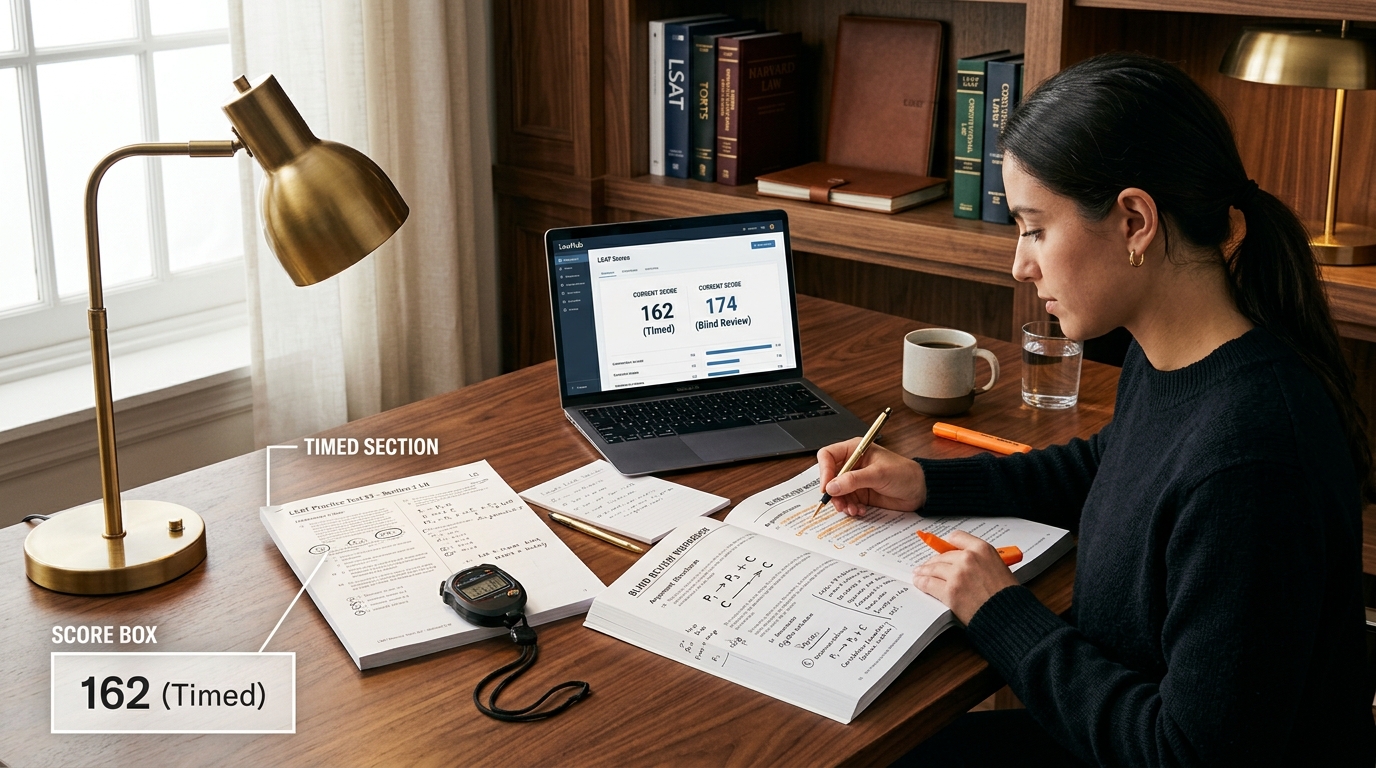


Why Taking More LSAT Mocks Isn't Enough
Every admissions cycle, thousands of ambitious law school applicants fall into the "Mock Hamster Wheel." They take 20, 30, or even 40 full-length practice tests on LawHub, grinding through hundreds of Logical Reasoning stimuli and Reading Comprehension passages. Yet, after months of grueling effort, their scores remain stubbornly cemented in the **152–159 band**.
Why does brute-force repetition fail so consistently on the LSAT? Because the LSAT is not an exam of memorized facts—it is a calibrated psychometric assessment of your thinking habits under intense cognitive strain. When you take a practice test and merely glance at your scaled score before rushing to the next mock, you do not fix flawed reasoning patterns. Instead, you **reinforce and automate your logical errors**.
- The Score-Validation Trap: Treating mock tests as an ego measurement rather than a diagnostic scalpel designed to expose microscopic reasoning blind spots.
- Burning Finite Official PrepTests: Wasting fresh, high-value LSAC official tests without fixing foundational logical flaws like conditional negation, scope mismatch, and causation traps.
- Ignoring Lucky Guesses (Phantom Accuracy): Celebrating correct answers where you guessed between two choices, allowing unstable intuition to masquerade as conceptual mastery.
- Passive Explanation Reading: Reading forum explanations and nodding along with "Oh, of course that makes sense," without actively generating the deduction from first principles yourself.
Top scorers who cross the 170+ threshold treat every mock test as a telemetry diagnostic flight. The actual test takes approximately 2 hours and 30 minutes, but their post-test analysis often takes **4 to 6 hours**. Powered by the EduQuest LSAT 180 Mock Portal and our LSAT 170+ Coaching Program, below is the exact, battle-tested framework engineered to turn raw practice tests into top-percentile law school admits.
Fast-Track Your College & Career Strategy
Get immediate, personalized AI insights tailored to your grade, strengths, and dream universities — 100% free with instant reports.
Know Your Personality Type for Free
Take our 18-question AI psychometric test to uncover your cognitive archetype, hidden learning superpowers, and ideal university courses.
Personalized Career & University EduPath
Build a step-by-step Grade 8–12 admissions blueprint with AI-matched target universities, exam schedules, and extracurricular profiles.
Accelerate Your LSAT Mastery with EduQuest Ecosystem
Official LawHub Interface Simulation
LSAT 180 Mock Portal
Experience real LawHub-calibrated full-length timed mocks, granular time telemetry, and instant 120–180 scaled score predictions.
Launch Free LSAT MockComprehensive Mentorship
EduQuest LSAT 170+ Coaching
1-on-1 tutoring, argument breakdown masterclasses, and tailored study plans for Harvard, Yale, Columbia & Oxbridge law schools.
Explore LSAT CoachingMulti-Exam Diagnostic Hub
EduQuest Mock Hub
Explore diagnostic testing suites for LSAT, UCAT, SAT, GMAT Focus, ESAT, and AP exams with unified psychometric analytics.
Explore Mock HubThe 5-Step LSAT Mock Review Framework
The **LSAT Mock Test Review Framework** is an iterative, forensic process designed to extract every drop of instructional value from your practice exams. Follow these five consecutive steps following every single mock test you take.
Step 1: Identify Every Incorrect Answer (The Blind Review Phase)
Before you look at the answer key or let software reveal which choices were right and wrong, conduct a **Blind Review (BR)** on every question you flagged or felt hesitant about during timed conditions. Sit down with the untimed section and solve those questions again with zero time constraints.
- Timed Score vs. Blind Review Score: Your timed score reflects your current test-taking efficiency under pressure. Your Blind Review score reflects your theoretical maximum conceptual ceiling.
- Diagnosing the Gap: If you miss a question under timed conditions but easily solve it during Blind Review, you have a speed/pacing problem. If you miss it in both timed and untimed conditions, you have a fundamental conceptual or logic reasoning flaw.
- Do Not Spoil the Answers: Reviewing the answer key prematurely robs your brain of the struggle required to form new synaptic connections in formal logic.
Step 2: Identify Why You Got It Wrong (Dissecting the Flaw)
When analyzing a missed question, you must articulate the error across four specific dimensions. Never settle for superficial explanations like "I misread." Pinpoint the exact cognitive failure:
Stimulus Misunderstanding
Did you fail to identify the core conclusion? Did you confuse a premise with background context? Did you overlook conditional indicator words like "only if", "unless", or "provided that"?
Question Stem Misinterpretation
Did you mistake a Necessary Assumption (something required) for a Sufficient Assumption (something that guarantees the conclusion)? Did you confuse a Weaken question with a Flaw question?
The Allure of the Wrong Answer (The Trap)
What specific feature made the wrong choice attractive? Was it a subtle scope shift, an overly extreme degree word ("never", "always"), or a reversal of necessary and sufficient conditions?
The Disguise of the Correct Answer
Why did you reject the credited response? Did the test writers disguise a crucial deduction using unfamiliar synonyms, passive voice, or counter-intuitive phrasing?
Step 3: Review Questions You Guessed Correctly
Correct guesses are the most dangerous questions on the LSAT because they create a false sense of security. If you narrowed a question down to (B) and (D), picked (B) on a hunch, and got it right, your score went up—but your underlying reasoning was only 50% sound.
During your mock analysis, treat every question you flagged as a potential error, regardless of whether you received a green checkmark. Force yourself to clearly articulate exactly why the remaining 4 choices are objectively 100% incorrect.
Step 4: Analyse Timing & Pacing Telemetry
Each section of the LSAT gives you 35 minutes to tackle 25–27 Logical Reasoning questions or 4 Reading Comprehension passages (approx. 27 questions). To break 170, timing cannot be an afterthought; it must be managed with algorithmic discipline.
| Question Band / Difficulty | Target Pace (Per Question) | Strategic Goal | Pacing Rule |
|---|---|---|---|
| Questions 1 – 10 (Easy) | 45 – 60 seconds | Build a 3–5 min time bank | Read stimulus once, spot deduction, move immediately |
| Questions 11 – 19 (Medium) | 1 min 15s – 1 min 30s | Maintain high accuracy | Watch for conditional traps & scope shifts |
| Questions 20 – 26 (Hardest) | 1 min 45s – 2 minutes | Dissect complex arguments | If stuck past 2 min, eliminate obvious wrong choices, flag & move |
| Reading Comp (Per Passage) | 8 min 15s – 8 min 45s | Complete all 4 passages | 2.5–3 min reading passage structure; 5.5 min on questions |
Step 5: Identify Recurring Patterns & Meta-Flaws
After reviewing individual questions, zoom out to examine macro trends across your last 3–5 tests. Ask yourself:
- Question Type Vulnerability: Are you consistently missing Parallel Flaw, Weaken-Except, or Rule Substitution questions?
- Reading Comprehension Subject Bias: Do your scores dip on Comparative Law or Dense Science passages compared to Humanities?
- Fatigue Falloff: Are errors disproportionately concentrated in the final 5 questions of Section 3 and Section 4?
- Trap Susceptibility: Do you repeatedly pick answers that sound morally true but are unsupported by the stimulus?
The LSAT Error Log
An **LSAT Error Log** is the centerpiece of every 170+ scorer's preparation. Without an error log, test reviews evaporate from memory within 48 hours. By recording every mistake in a structured matrix, you build a personalized study bible that exposes your exact psychological and logical tendencies.

Here is an authentic sample of how top scorers structure their LSAT Error Log table:
| Question | Error | Why? | Correct Approach | Action |
|---|---|---|---|---|
| PT 92, S2, Q17 (Flaw) | Chose (C) instead of (E) | Confused Correlation with Causation. I thought the author assumed cause, but the real flaw was a Part-to-Whole composition error. | Isolate the premise ("each team member is fast") and the conclusion ("the team is fast"). Recognize composition flaw immediately. | Drill 15 Part-to-Whole flaw questions. Write a 1-sentence summary of composition vs division errors in notebook. |
| PT 93, S1, Q21 (Necessary Assumption) | Chose (A) instead of (D) | Picked an overly strong sufficient assumption ("all regulations must fail") rather than the minimal necessary requirement. | Apply the Negation Technique. If negated, does the argument completely collapse? (D) destroyed the argument; (A) was overkill. | Review Negation Technique drills. Always eliminate extreme language in Necessary Assumption questions. |
| PT 94, S3, Q14 (Reading Comp - Main Point) | Chose (B) instead of (A) | Got trapped by a paragraph-level detail in Paragraph 3 and mistook it for the author's overall thesis. | Zoom out after reading. Identify the structural pivot in Paragraph 2 ("However, recent legal scholars contend..."). | Write a 5-word mental summary for every RC paragraph before looking at the question stem. |
| PT 91, S4, Q24 (Parallel Reasoning) | Guessed (B) due to time crunch (ran out of time) | Spent 2 minutes and 45 seconds on Q19 (a difficult resolve discrepancy question), starving Q24 of time. | Identify argument form symbolically: If A -> B, and Not B -> Not A. Match valid contrapositive structure quickly. | Set strict 2-minute hard stop timer. If a question is taking >120s, flag, guess, and protect remaining easy points. |
Don't Ignore Correct Answers You Guessed
This is the most critical educational distinction separating 160-level test takers from 175+ masters. When students self-evaluate, they intuitively focus only on red marks (incorrect questions). However, **phantom accuracy** is the single greatest cause of score stagnation on the LSAT.
If you get a question right for the wrong reason, or because you got lucky between two remaining answer choices, you have not mastered the question—you have merely delayed an inevitable point drop on test day.
— EduQuest LSAT Faculty
To systematically neutralize lucky guesses, integrate these three habits into your post-mock review:
Confidence Flagging During the Test
While taking the timed mock, place a flag or write down the question number for any question where your confidence is below 90%. Even if you get it right, that question automatically goes into your in-depth review queue.
The 4-Way Elimination Rule
For every flagged correct answer, write down why the other four choices are objectively flawed. Can you identify the exact word that makes Option C incorrect? If you cannot explain why the runner-up choice is wrong, you did not fully solve the problem.
Heuristic Reconstruction
Identify what instinct led you to guess correctly. Was it an intuitive recognition of scope, or genuine logical deduction? Convert that subconscious intuition into a conscious, repeatable rule.
When Should You Take Your Next LSAT Mock?
One of the most frequent questions students ask is: "How often should I take an LSAT mock test?" The answer depends entirely on where you are in your preparation timeline and whether you have completed the forensic review of your previous exam.
Foundation & Concept Mastery (Months 1 – 2)
1 Mock Every 2 to 3 Weeks
- Focus on untimed section mastery and understanding conditional logic, quantifiers, and argument structure.
- Taking full mocks too early burns official PrepTests before you have the tools to solve them.
- Use mocks purely as periodic benchmarks to test endurance and interface familiarity.
Section Pacing & Targeted Remediation (Months 3 – 4)
1 Full Mock Every 7 to 10 Days
- Take one full 4-section mock every weekend under strict test-day conditions (start at 9:00 AM, exact breaks).
- Spend Monday and Tuesday conducting the 5-Step Forensic Review.
- Spend Wednesday through Friday drilling 30–50 questions focused specifically on the errors identified in your log.
Peak Testing & Tapering (Final 30 Days)
1 to 2 Mocks Per Week Max
- Take maximum 2 mocks per week to build stamina without causing mental burnout.
- In the final 7 days before the exam, take zero full mocks—only light review of your Error Log and high-confidence drills.
- Peak cognitive performance requires well-rested neural pathways.
How EduQuest LSAT Mocks Help You Analyse Performance
Reviewing a practice test manually with a spreadsheet is valuable, but EduQuest's proprietary **LSAT Diagnostic Testing Platform** automates the entire telemetry process, giving you the analytical depth of an admissions psychometrician.

Granular Question-by-Question Telemetry
Track exact seconds spent on each stimulus, identify which question stems triggered decision paralysis, and see where you changed answers from right to wrong.
Automated Error Categorization
Our AI categorizes every missed question across 18 distinct Logical Reasoning subtypes (Flaw, Strengthen, Weaken, Sufficient Assumption, Paradox, Parallel, etc.) and 4 Reading Comp genres.
Instant 120–180 Scaled Score & T14 Law Probability
Get an accurate scaled score based on calibrated LSAC curves, combined with real-time admissions probability projections for top law schools (Harvard, Yale, Stanford, Columbia, NYU, Chicago, Penn).
Dynamic Remediation Queues
Based on your mock performance, the platform automatically populates a personalized practice queue of similar high-difficulty questions to drill immediately.
Download The Complete LSAT Guide & Law Admissions Roadmap
Get our comprehensive 10-page guide covering the post-2024 format, 120–180 scoring percentiles, 4-month study plan, and T14 law school score benchmarks.
Frequently Asked Questions About LSAT Mock Review
How long should I spend reviewing a single LSAT mock test?
A comprehensive review should take between 1.5x to 2x the time it took to write the test. For a 2.5-hour 4-section LSAT mock, expect to invest 3.5 to 5 hours conducting Blind Review, logging missed and flagged questions, and analyzing pacing telemetry.
What is Blind Review (BR) on the LSAT and how does it work?
Blind Review is a method where you retake every flagged or uncertain question from a mock test under untimed conditions before looking at the answer key. If you get it right untimed, it is a pacing issue; if you miss it untimed, it is a conceptual/reasoning gap.
Should I review the unscored experimental section in my mock?
Yes, absolutely. Even though experimental sections do not count toward your scaled score on the real LSAT, the questions represent official LSAC reasoning. Reviewing them builds stamina and exposes additional logical patterns.
How many total LSAT practice tests should I take before test day?
Most students who achieve 170+ complete between 20 to 35 full-length mocks over a 4 to 6 month period. Taking more than 40 often leads to diminishing returns and mental burnout. Quality of review always beats quantity of tests.
How can EduQuest help me improve my LSAT score to 170+?
EduQuest provides full LawHub-calibrated mock exams, 1-on-1 personalized tutoring with 99th percentile instructors, argument structure masterclasses, and tailored study schedules for admission to top US, UK, and Canadian law schools.
Ready to Crack 170+ on the LSAT? Start with an Official Diagnostic Mock
Join hundreds of EduQuest students accepted into top global law schools. Take a calibrated full-length mock or connect with our senior LSAT strategists today.