

What Is Blind Review?
Simply put, **Blind Review (BR)** is a two-stage test review method where you retake every flagged or uncertain question from a practice exam under untimed conditions before looking at the answer key or seeing your raw score.
In standard test prep, a student finishes a 35-minute section, hits submit, checks which questions have red X's, reads a brief forum explanation, and thinks, "Oh, I get it now." In reality, they have learned nothing. Their brain only recognized an explanation after the fact—they did not build the cognitive muscle to generate the correct deduction independently.
With **Blind Review**, you separate the two distinct variables tested on the LSAT:
- Variable 1: Logical Competence (Can you solve it?): Tested under infinite time during Blind Review.
- Variable 2: Processing Efficiency (Can you solve it in 80 seconds?): Tested under strict 35-minute timed conditions.
Fast-Track Your College & Career Strategy
Get immediate, personalized AI insights tailored to your grade, strengths, and dream universities — 100% free with instant reports.
Know Your Personality Type for Free
Take our 18-question AI psychometric test to uncover your cognitive archetype, hidden learning superpowers, and ideal university courses.
Personalized Career & University EduPath
Build a step-by-step Grade 8–12 admissions blueprint with AI-matched target universities, exam schedules, and extracurricular profiles.
Power Your LSAT Practice with EduQuest Official Platforms
Calibrated LawHub Simulation
LSAT 180 Mock Portal
Take full-length timed exams with built-in Blind Review flagging, question timers, and 120–180 score scaling.
Launch Free LSAT MockElite 1-on-1 Mentorship
EduQuest LSAT 170+ Coaching
Personalized tutoring from 99th percentile instructors to master formal logic, argument mapping, and T14 law school admissions.
Explore LSAT CoachingUnified Testing Hub
EduQuest Mock Hub
Access psychometric diagnostic testing suites for LSAT, UCAT, SAT, GMAT Focus, ESAT, and AP exams.
Explore Mock HubWhy Taking More Mocks Doesn't Fix the Problem
When students plateau at a 155 or 162, their default instinct is to schedule more mock tests. They burn through PrepTest after PrepTest, taking three or four 4-section mocks every week. Yet their score oscillates within a narrow 2-point margin.
- Speed Pressure Camouflages Logic Gaps: When you are rushing against a ticking 35-minute clock, you rely on fuzzy heuristics and gut feelings rather than rigorous conditional diagrams and premise-conclusion breakdowns.
- The Illusion of Hindsight: Looking at the correct answer key tricks your brain into believing you understood the reasoning, creating false confidence.
- Exhaustion of Finite Official Material: LSAC has released approximately 90+ official PrepTests. Burning through them without extracting maximum pedagogical value permanently destroys pristine diagnostic data.
- Reinforcing Bad Reading Habits: Taking tests under unmanaged panic reinforces rushed skimming, overlooking qualifying words like "some", "most", "unless", and "all".
You do not get faster on the LSAT by rushing. You get faster on the LSAT by understanding the logic so deeply that the correct answer becomes glaringly obvious.
— EduQuest LSAT Master Instructor
Blind Review vs Normal Review
To understand why top scorers (170+) consistently outperform average test takers, compare how each group approaches post-test analysis:
| Dimension | Normal (Traditional) Review | LSAT Blind Review Method |
|---|---|---|
| Trigger Point | Checks only questions marked wrong by software | Reconsiders all incorrect AND flagged/uncertain questions |
| Primary Focus | Obsesses over the final 3-digit scaled score | Focuses purely on deep argument structure and reasoning |
| Cognitive Depth | Finds surface mistakes ("I misread line 3") | Uncovers underlying thinking patterns and cognitive traps |
| Answer Key Usage | Looks at the answer key immediately after finishing | Never looks at the answer key until untimed re-solve is complete |
| Treatment of Lucky Guesses | Ignores correct guesses (Phantom Accuracy) | Unmasks 50/50 guesses and forces 4-way elimination proof |
| Explanation Source | Passively reads online forums or answer keys | Actively generates the proof from first principles |
| Outcome | Score plateau; high testing anxiety | Consistent breakthrough toward 170+ 99th percentile |
How to Perform Blind Review After an LSAT Mock
Here is the step-by-step protocol used by EduQuest students to execute a flawless Blind Review session:
Flag Uncertain Questions During the Timed Exam
While taking your timed 35-minute section on LawHub or the EduQuest portal, flag any question where you are not 100% certain of your answer. If you narrowed it down to two choices and made an educated guess, flag it.
Stop! Do NOT Grade or Look at the Answer Key
When the timer expires, do not submit for instant automated scoring. Walk away, grab a glass of water, and return to the test with an untimed mindset.
Retake Every Flagged Question with Infinite Time
Open the test again without a timer. Go straight to every question you flagged. Take 5, 10, or even 15 minutes per question if necessary. Diagram conditional statements, isolate premises, find the conclusion, and articulate the flaw.
Execute the 4-Way Elimination Rule
You cannot move past a question during Blind Review until you can prove beyond a shadow of a doubt why the credited choice is 100% airtight and why the other four choices are objectively flawed.
Score Both Versions (Timed Score vs. Blind Review Score)
Now reveal the answer key. Calculate two separate scores: (1) Your Timed Score (your original timed answers) and (2) Your Blind Review Score (your untimed answers).
Log All Insights into Your Permanent LSAT Error Log
Enter every question where you missed the answer in Timed or BR mode into your structured Error Log, classifying the error by subtype and cognitive trap.
What Your Blind Review Results Tell You: Timed Score vs. Blind-Review Score
The relationship between your **Timed Score** and your **Blind Review Score** is the single most valuable diagnostic metric in LSAT preparation. It creates an undeniable diagnostic mirror of your strengths and weaknesses.
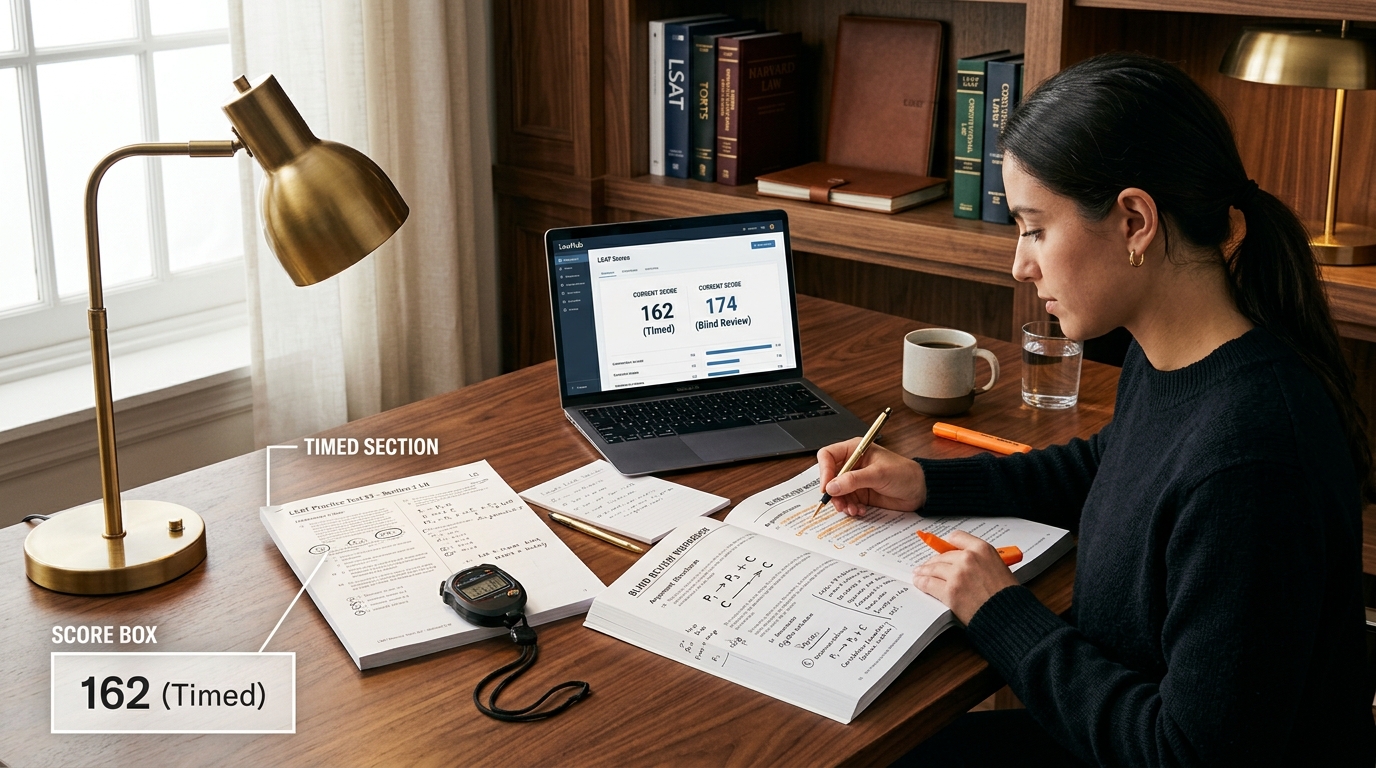
Here is how to interpret your dual-score data and formulate an immediate action plan:
High Blind Review (172+) vs. Low Timed (156–162)
Diagnosis: The Pacing & Decision-Paralysis Trap
- What it means: Your brain understands formal logic, argument structure, and trap answers perfectly when unhurried. Your only barrier is speed and decision velocity.
- Action Plan: Do not spend hours studying theory. Instead, focus on section pacing drills, eliminating early question hesitations (Q1–10 in under 10 minutes), and setting strict 2-minute hard stops on complex stimuli.
Low Blind Review (154–160) vs. Low Timed (150–156)
Diagnosis: Foundational Logic & Conceptual Deficit
- What it means: Even with infinite time and zero pressure, you are still falling for LSAC distractor answers. Taking more timed mocks will only cause frustration.
- Action Plan: Halt full timed mocks immediately. Return to fundamental textbooks and 1-on-1 coaching to master conditional logic diagrams, quantifiers, causality, and assumption negation.
Answer Changed from RIGHT (Timed) to WRONG (Blind Review)
Diagnosis: Second-Guessing & Cognitive Over-Complication
- What it means: Your initial timed intuition was correct, but extended deliberation caused you to overthink and rationalize a trap answer.
- Action Plan: Analyze why the trap choice lured you away. Train yourself to look for objective textual support rather than inventing elaborate hypothetical narratives.
High Timed (168+) vs. High Blind Review (175+)
Diagnosis: Elite Mastery & Test-Day Calibration
- What it means: You have reached near-complete mastery of the exam format, logical reasoning, and reading comprehension.
- Action Plan: Maintain testing endurance, practice with strict 5-section fatigue simulations, and refine test-day mindset and anxiety control.
How EduQuest Can Track Your Mock Performance
Executing Blind Review manually on paper can be tedious. EduQuest has engineered a cutting-edge **LSAT Testing & Telemetry Ecosystem** that automates the entire Blind Review workflow for serious applicants.

Integrated Dual-Mode Test Engine
Our platform automatically allows you to take a full timed exam, flags your uncertain questions, and opens an instant untimed Blind Review interface with a single click.
Real-Time Timed vs. BR Gap Telemetry
View historical trendlines showing your Timed Score vs. Blind Review ceiling across all 4 sections, pinpointing whether your score is bottlenecked by speed or conceptual mastery.
18-Type Flaw Tagging & Time-Spent Tracking
Instantly identify which specific logical reasoning question types (e.g. Flaw in Reasoning, Necessary Assumption, Method of Argument) cost you the most time and accuracy.
1-on-1 T14 Faculty Case Reviews
Work directly with EduQuest master instructors who analyze your Blind Review logs to eradicate elusive cognitive blind spots before test day.
Download The Complete LSAT Guide & Law Admissions Roadmap
Get our comprehensive 10-page guide covering the post-2024 format, 120–180 scoring percentiles, 4-month study plan, and T14 law school score benchmarks.
Frequently Asked Questions About LSAT Blind Review
Should I Blind Review every single question or only flagged ones?
When starting out, it is highly recommended to Blind Review every question you flagged as well as any question where you spent over 1 minute and 45 seconds. Top scorers often review the entire section untimed to ensure that even fast, correct answers were solved with airtight logical rigor.
How long should a Blind Review session take?
A thorough Blind Review session for a 4-section LSAT mock typically takes between 3 to 5 hours. It is completely normal for the untimed review phase to take longer than the timed test itself.
What if my Blind Review score is the same as my Timed Score?
If your Timed and Blind Review scores are identical, you have a conceptual/foundational issue rather than a pacing issue. You must pause full-length practice tests and review core logic fundamentals (such as conditional logic and question-type strategies).
How many practice tests should I do per week with Blind Review?
Because Blind Review requires intensive cognitive effort (6–8 hours total per mock cycle), you should take at most 1 to 2 full mocks per week. Doing 1 mock with thorough Blind Review will boost your score far more than taking 4 mocks with shallow review.
Can I do Blind Review for Reading Comprehension as well?
Yes! Blind Review is exceptionally powerful for Reading Comprehension. Untimed, you can re-read passages carefully, map paragraph functions, track author perspective shifts, and prove why 4 out of 5 answer choices contain subtle scope or extreme language distortions.
Unlock Your 170+ LSAT Potential with EduQuest Diagnostic Mocks
Join high-scoring law applicants worldwide. Practice on our LawHub-calibrated simulator with built-in Blind Review telemetry and personalized faculty mentorship.