

Facing a Multiple Mini Interview (MMI) for medical school admissions is one of the most high-pressure milestones an aspiring doctor encounters. With over 85% of leading medical faculties across the United Kingdom, Australia, Canada, and the United States using MMIs, candidate preparation often makes the difference between an outright offer and a painful rejection. Yet, the single most common mistake candidates make is attempting to memorize robotic, pre-written answers to past MMI interview questions.
MMI evaluators are trained to see through scripted lines within seconds. Instead of testing whether you can regurgitate a rehearsed monologue, medical school interviewers assess *how you think under pressure*—your ethical problem-solving instincts, empathy in tense human interactions, active listening, and clinical safety awareness. Mastering MMI interview questions and answers requires structured frameworks (such as the 4 Pillars of Medical Ethics, the SPIKES protocol, and the STARR model) combined with authentic interpersonal communication. Powered by the EduQuest AI MMI Simulator and EduPath, this comprehensive guide provides high-yield questions, model responses, examiner commentary, and a proven preparation blueprint to ace every MMI station.

Practice Real MMI Questions with EduQuest AI
AI MMI Station Simulator
Interactive Question Bank
Simulate over 150+ real-world ethical dilemmas, actor role-plays, and calculation stations with instant clinical feedback.
Launch MMI SimulatorElite UCAT Coaching
Score 3000+ & Band 1 SJT
Master cognitive subtests and Situational Judgement with former top 1% scorers and medical school admissions readers.
Explore UCAT CoachingPersonalized Medical Roadmap
EduQuest EduPath Platform
Map your medical school timeline connecting GCSE/Class 10 subjects, clinical shadow hours, UCAT dates, and MMI circuits.
Launch EduPath Roadmap1. The 4 Core Frameworks for Answering Any MMI Question
Rather than memorizing thousands of individual questions, elite candidates rely on four universal frameworks that structure thoughts logically in seconds:
Fast-Track Your College & Career Strategy
Get immediate, personalized AI insights tailored to your grade, strengths, and dream universities — 100% free with instant reports.
Know Your Personality Type for Free
Take our 18-question AI psychometric test to uncover your cognitive archetype, hidden learning superpowers, and ideal university courses.
Personalized Career & University EduPath
Build a step-by-step Grade 8–12 admissions blueprint with AI-matched target universities, exam schedules, and extracurricular profiles.
The 4 Pillars of Medical Ethics (For Ethical Dilemmas)
Evaluate scenarios across Autonomy (patient self-determination), Beneficence (acting in the patient’s best interest), Non-Maleficence (doing no harm), and Justice (fair distribution of resources and legal compliance).
The SPIKES Protocol (For Breaking Difficult News & Role-Plays)
Follow Setting (create a private, calm environment) ➡️ Perception (ask what the patient understands) ➡️ Invitation (ask what detail they want) ➡️ Knowledge (deliver news clearly without jargon) ➡️ Empathy (validate feelings) ➡️ Strategy & Summary.
The CAMP Model (For Motivation & "Why Medicine" Questions)
Structure personal insight across Clinical (hands-on shadow experience), Academic (scientific curiosity and research), Management (leadership and teamwork), and Personal (stress resilience and durable hobbies).
The STARR Method (For Behavioral & Teamwork Scenarios)
Describe the Situation ➡️ Task ➡️ Action (what you specifically did) ➡️ Result ➡️ Reflection (what you learned and how it shapes your future clinical practice).
2. 6 High-Yield MMI Question Categories with Model Answers & Breakdowns
Here are six representative **MMI interview questions**, complete with model student responses and examiner evaluation criteria:

| Question Category | Sample MMI Scenario Prompt | Primary Objective Tested | Recommended Framework | Scoring Focus |
|---|---|---|---|---|
| 1. Ethical Dilemma | An adult Jehovah’s Witness refuses a life-saving blood transfusion following severe trauma. How do you respond? | Respect for patient autonomy vs duty of care | 4 Pillars of Ethics | Nuanced balance & legal capacity |
| 2. Actor Role-Play | You are a junior doctor. Speak with an angry daughter whose elderly mother’s discharge was delayed. | De-escalation, empathy, emotional validation | SPIKES + De-escalation | Active listening & composure |
| 3. Motivation / Insight | Why do you want to become a doctor rather than a clinical research scientist or nurse? | Authentic understanding of the doctor’s role | CAMP Framework | Self-awareness & humility |
| 4. Resource Allocation | You have one liver transplant available for a 22yo recovering alcoholic and a 60yo CEO. Who receives it? | Equitable triage & clinical utility | Justice + Clinical Need | Objective criteria & non-bias |
| 5. Teamwork / Failure | Tell me about a time a collaborative project failed and how you handled team conflict. | Humility, conflict resolution, reflection | STARR Reflection | Self-honesty & growth mindset |
| 6. Healthcare Policy | Should private healthcare companies be allowed to deliver NHS diagnostic services? | Understanding healthcare economics and equity | Health Equity Analysis | Balanced multi-perspective synthesis |
3. Deep-Dive Model Answer: Navigating an Ethical Dilemma
Let us examine how a top-scoring candidate answers a classic high-stakes MMI ethics question:
"A 16-year-old patient visits your clinic asking for confidential prescription medication without informing their parents. How would you handle this consultation?"
— Standard MMI Ethics Prompt (UK & Australia Medical Circuit)
- Step 1: Frame the Central Ethical Tension: "This scenario presents a delicate tension between the patient’s right to autonomy and medical confidentiality versus my duty of beneficence and non-maleficence in ensuring their safety and wellbeing."
- Step 2: Assess Gillick Competence & Fraser Guidelines: "First, I would assess whether the 16-year-old has sufficient maturity, intelligence, and understanding of the nature, consequences, and risks of the proposed treatment—evaluating their Gillick competence."
- Step 3: Explore Underlying Circumstances Empathetically: "I would gently explore why they do not wish to involve their parents. Is there fear of stigma, domestic conflict, or abuse? I would encourage them to discuss this with a trusted adult or family member."
- Step 4: Establish Safeguarding Boundaries: "I would explain that while confidentiality is fundamental, it is not absolute. If there is evidence of significant harm, exploitation, or safeguarding concerns, I have a professional duty to involve appropriate safeguarding teams."
- Step 5: Conclude with a Safe Clinical Action Plan: "If the patient is competent, understands the treatment, and refusing treatment would harm their health, I would provide the necessary care while arranging a follow-up consultation and offering continued counseling support."
4. The 30-Day Intensive MMI Question Preparation Blueprint
Structure your final month of interview preparation using this week-by-week high-yield blueprint:

Ethical Foundations & NHS Core Values
Master the 4 Pillars & GMC Good Medical Practice
- Deep-dive into the 4 Pillars of Medical Ethics, Fraser guidelines, and consent laws.
- Read the 6 NHS Constitutional Values: Working together, Respect, Compassion, Improving lives, Everyone counts, Commitment to quality.
Communication Frameworks & Role-Play Mastery
Practice De-escalation & Breaking Bad News
- Master the SPIKES protocol for delivering difficult information.
- Practice live role-plays with mentors to eradicate filler words and build active listening posture.
Timed AI Circuits & Rapid Structuring
Simulate Realistic 7-Minute Stations
- Complete 10+ full MMI circuits using the [EduQuest AI MMI Simulator](/mmi-interview).
- Train strictly with 1-minute reading times and 7-minute answer timers.
Mock Interview Panels & Mindset Polish
Final Calibration with Former Admissions Readers
- Participate in full 8-station mock panels with clinical doctors and NHS interviewers.
- Master the "clean slate" mentality: leaving each station behind as you move to the next.
5. 5 Golden Rules to Deliver High-Scoring MMI Answers
State the Core Dilemma in Sentence One
Immediately demonstrate that you understand what the station is really testing. Do not waste the first 90 seconds summarizing the prompt.
Explore the "Why" Behind Conflicting Perspectives
High-scoring medics explain the underlying fears, legal constraints, and emotional motivations of all parties involved in the scenario.
Validate Emotions Before Proposing Bureaucratic Steps
In role-plays, human empathy comes before hospital policy. Always acknowledge emotional distress ("I understand how frightening this must be") first.
Conclude with a Decisive, Patient-Centered Action Plan
Never end on a vague "It depends." Summarize your chosen clinical approach while stating how you would safeguard patient wellbeing.
Embrace the Power of a Structured Pause
If an examiner asks a challenging follow-up question, take a 3-second pause to collect your thoughts rather than blurting out rushed statements.

6. Common Pitfalls When Answering MMI Questions
- Scripting Word-for-Word Memorized Answers: Rote-memorized answers collapse when interviewers introduce unexpected twists or ask personalized follow-ups.
- Focusing on Scientific Facts Rather than Communication: MMIs evaluate emotional intelligence and ethics. Quoting biochemistry textbooks during an empathy station leads to low marks.
- Forgetting to Ask Clarifying Questions in Role-Plays: Assuming you know the whole story without asking the actor about their immediate concerns shows poor clinical listening.
- Becoming Defensive When Challenged by Examiners: Examiners often push back to test your emotional resilience. Accept their point thoughtfully rather than arguing aggressively.
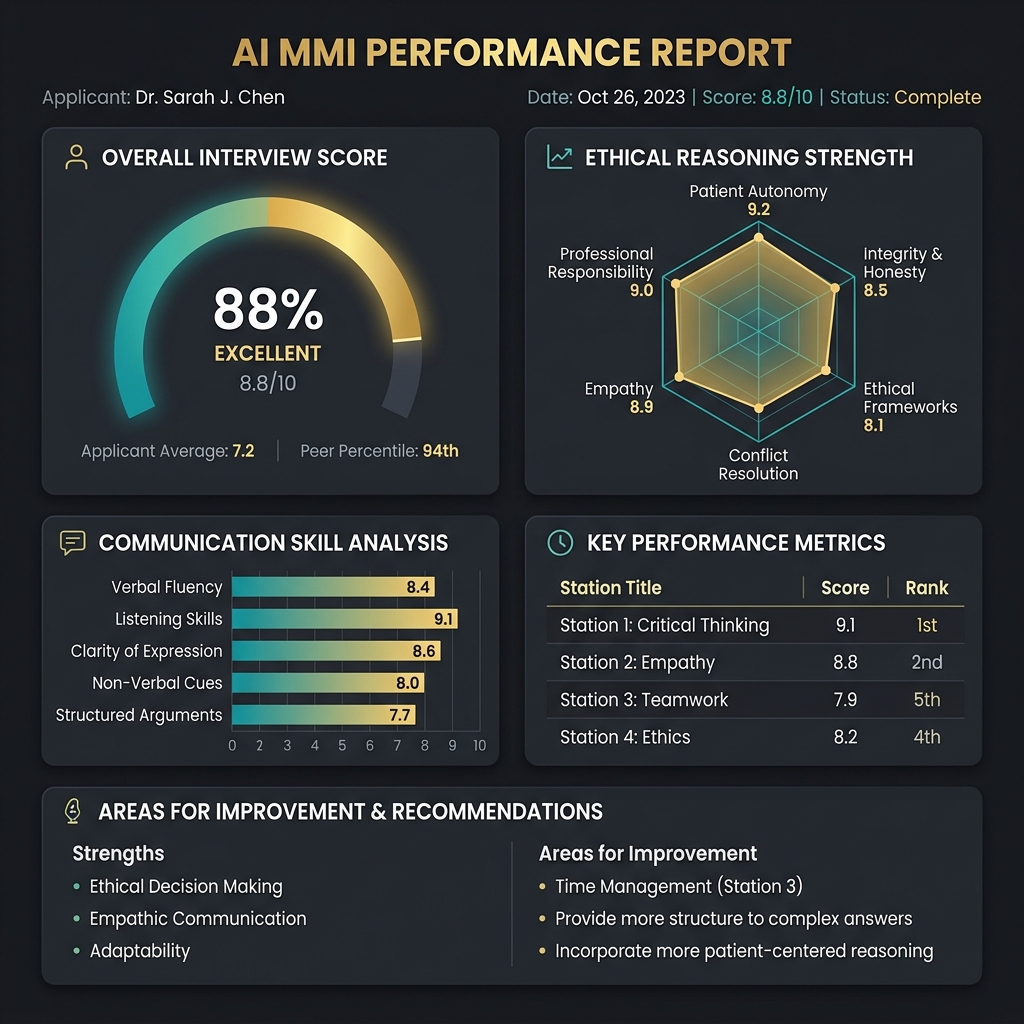
7. How EduQuest Empowers Your MMI Interview Preparation
At EduQuest, mastering **MMI interview questions and answers** is powered by our complete global medical admissions ecosystem:
- 1. 150+ Interactive AI MMI Stations: Practice realistic ethical scenarios, calculations, and actor role-plays with instant domain scoring.
- 2. 1-on-1 Mock Panels with NHS Doctors: Receive individualized feedback from former medical school interviewers and admissions readers.
- 3. End-to-End Medical Strategy: Integrated support covering UCAT Preparation, super-curricular research papers, and Global Study Abroad Placement.
8. Frequently Asked Questions (FAQ) About MMI Questions & Answers
How many questions are asked in a typical MMI interview station?
A standard MMI station presents 1 core prompt, followed by 2 to 4 follow-up probing questions from the examiner as you discuss your thought process over the 6–8 minute window.
What if I do not know the clinical or scientific facts in a prompt?
MMIs do not require advanced medical knowledge. Examiners evaluate your structured reasoning, ethical awareness, and communication. Acknowledge what you do know, state any assumptions, and apply ethical principles.
How should I answer "Why this medical school?" in an MMI?
Avoid generic compliments about rankings. Highlight specific aspects of the curriculum (e.g., integrated vs traditional, early clinical exposure), unique student societies, research facilities, and alignment with your career vision.
How can I practice role-play stations effectively?
Practice with a mentor or peer who plays the role of a distressed patient. Focus on active listening, validating feelings, maintaining open posture, and using structured frameworks like SPIKES.
Is the EduQuest MMI question bank free for medical applicants?
Yes! EduQuest offers free access to our AI MMI Simulator with high-yield ethical scenarios and interactive scoring.
Download the 2026 MMI Questions & Model Answers Master Guide
Get instant access to EduQuest’s 32-page whitepaper featuring 50 high-yield ethical scenarios, model role-play transcripts, SPIKES frameworks, and scoring rubrics.
Ace Your Medical School MMI Interview Today
Join hundreds of successful medical students who secured offers at Oxford, Cambridge, Imperial, Monash, and KCL with EduQuest AI. Book your mock circuit now.