
SAT Advanced Math Command Center (2026)
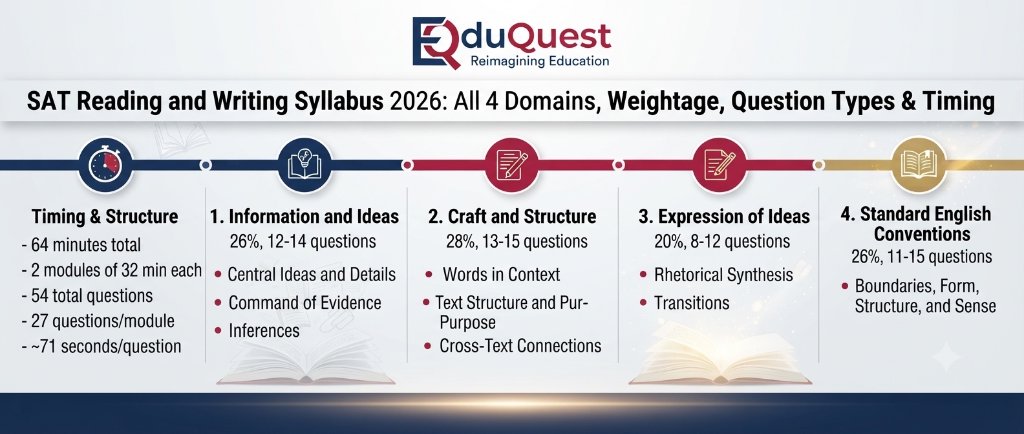
Domain Weightage
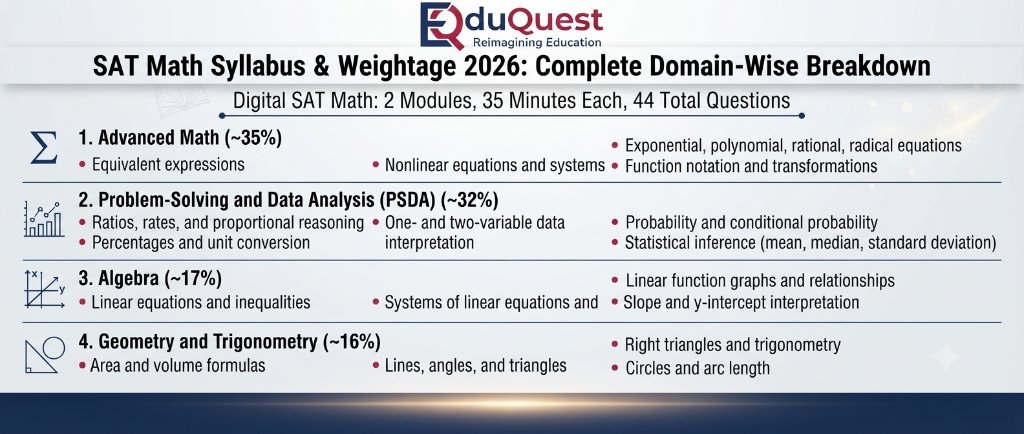
≈35% of Math
Roughly 13–15 questions across both modules. Focuses on quadratics, exponentials, polynomials & radicals.
Explore TopicsQuadratics Mastery
3 Forms & Discriminant
Convert between Standard, Factored, and Vertex forms. Use b² − 4ac to find number of real solutions instantly.
Quadratics GuideExtraneous Roots Trap
Always Check Solutions
Squaring both sides in radical and rational equations can produce fake roots. Always verify by substitution.
Check TrapsDownload The SAT Advanced Math Toolkit: 120 Smart Moves (PDF)
See the structure, skip the grind, and check with Desmos.
1. What Advanced Math Covers on the Digital SAT
If you are a Class 11 or 12 student in Delhi, Mumbai, Bengaluru or anywhere else, you have probably met most of these topics in school already: quadratics, polynomials, exponential functions, surds and modulus. The digital SAT asks about them in a particular style, usually through short word problems, graphs, and 'which expression is equivalent' questions.
| Testing point | What it looks like on the screen | Typical topics |
|---|---|---|
| Equivalent expressions | 'Which expression is equivalent to...?' | Expanding, factoring, exponent rules, combining rational expressions |
| Nonlinear equations in 1 variable & systems in 2 variables | 'What is the sum of the solutions?' or 'How many solutions?' | Quadratics, radicals, rational equations, absolute value, line plus parabola |
| Nonlinear functions | 'Which graph/table/function represents...?' | Parabolas, exponentials, transformations, rates of change, context models |
Fast-Track Your College & Career Strategy
Get immediate, personalized AI insights tailored to your grade, strengths, and dream universities — 100% free with instant reports.
Know Your Personality Type for Free
Take our 18-question AI psychometric test to uncover your cognitive archetype, hidden learning superpowers, and ideal university courses.
Personalized Career & University EduPath
Build a step-by-step Grade 8–12 admissions blueprint with AI-matched target universities, exam schedules, and extracurricular profiles.
2. Equivalent Expressions: Rewriting Without Changing the Value
Two expressions are equivalent when they give the same output for every allowed input. Key moves: distributing like terms, exponent rules (x^a · x^b = x^(a+b), (x^a)^b = x^(ab)), special products ((a+b)² = a² + 2ab + b², (a−b)(a+b) = a² − b²), and factoring out common factors.
3. Quadratics: Factoring, Vertex Form, Discriminant and Roots
| Quadratic Form | Equation | What It Shows Instantly |
|---|---|---|
| Standard form | y = ax² + bx + c | The y-intercept (c) and direction of opening (sign of a) |
| Factored form | y = a(x − r)(x − s) | The x-intercepts (zeros) r and s |
| Vertex form | y = a(x − h)² + k | The vertex (h, k) and the maximum or minimum value k |
Discriminant (b² − 4ac) Decision Matrix
| Value of Discriminant D | Number of real solutions | Graph on xy-plane |
|---|---|---|
| D > 0 | Two distinct real solutions | Parabola crosses x-axis twice |
| D = 0 | Exactly one real solution (repeated root) | Parabola touches x-axis at vertex (tangent) |
| D < 0 | No real solutions (0 solutions) | Parabola never touches or crosses x-axis |
4. Exponential Growth and Decay on the SAT
An exponential function has the form f(t) = a · b^t, where a is the initial value at t = 0 and b is the growth factor per unit of t. If b > 1, the quantity grows; if 0 < b < 1, it decays.
| Real-World Growth Statement | Mathematical Function Model | Key Property |
|---|---|---|
| Starts at 500, grows 4% per year | f(t) = 500(1.04)^t | Annual factor 1.04 |
| Starts at 2,400, halves every 5 years | V(t) = 2400(1/2)^(t/5) | Exponent t/5 counts number of 5-year periods |
| Starts at 800, grows 25% every 3 years | P(t) = 800(1.25)^(t/3) | Growth factor 1.25 per 3 years |
| Starts at 50, triples every 2 hours | N(t) = 50 · 3^(t/2) | Triples (b = 3) every 2 hours |
5. Polynomials: Operations, Factors and Remainders
Key theorems: Remainder Theorem states that when polynomial p(x) is divided by (x − c), the remainder is p(c). Factor Theorem states that (x − c) is a factor if and only if p(c) = 0.
6. Radical and Rational Equations (and Extraneous Solutions)
When you square both sides of an equation or multiply through by a variable denominator, you risk generating extraneous solutions: algebraic answers that produce false statements in the original equation.
7. Systems of Equations with a Nonlinear Equation
These questions combine a line and a parabola (or two curves) and ask about the intersection points. Set the two expressions for y equal to each other, then solve the resulting quadratic or evaluate its discriminant.
8. Desmos Strategy for Advanced Math
- Finding roots and vertices: Graph the quadratic and click the grey intercepts and vertex coordinates.
- Solving radical/rational equations: Graph y = left side and y = right side. Desmos only shows real intersections, automatically filtering out extraneous roots!
- Sliders: For tangent-line problems like y = 4x + k touching y = x² + 1, add a slider for k to inspect the single point of tangency.
Mini Practice Set with Answers and Explanations
Frequently Asked Questions (FAQ)
What percentage of the digital SAT Math section is Advanced Math?
According to College Board specifications, Advanced Math is approximately 35% of the Math section (roughly 13–15 questions).
What are extraneous solutions and why does the SAT test them?
Extraneous solutions are values that emerge algebraically after squaring or clearing denominators but fail when plugged back into the original expression.
How do I know when to use the quadratic formula versus factoring?
Try factoring first. If the numbers are not clean integers, use the quadratic formula or graph in Desmos to read the x-intercepts directly.
What is the discriminant used for on the SAT?
The discriminant (b² − 4ac) determines the number of real roots: D > 0 gives two roots, D = 0 gives exactly one root (tangent parabola), and D < 0 gives no real roots.
Ready to Master the Nonlinear 35% of SAT Math?
Quadratics, exponentials, and radicals are predictable and scoring once you learn their patterns. Take the free diagnostic test to evaluate your readiness.
How EduQuest Helps You in SAT Advanced Math Guide 2026 (35% of Math): Quadratics, Exponentials, Polynomials, Radicals & Nonlinear Functions at Our Gurugram Centre (F-45, South City II)
Mastering SAT and securing competitive global university admissions demands structured instruction, diagnostic error post-mortems, and proven testing frameworks. At EduQuest Gurugram, we deliver bespoke test preparation and holistic admissions consulting designed specifically for Indian and NRI high school students.
🏫 Offline Classroom Coaching
Study at our premier learning centre: F-45, First Floor, South City II, Sector 50, Gurugram, Haryana 122018. Small cohorts (8–10 students) ensure interactive whiteboard problem breakdowns, physical testing terminals, and immediate face-to-face mentor doubt resolution.
💻 Live Online Interactive Classes
Join high-definition two-way interactive classes via EduQuest LMS with live digital whiteboards, screen-shares, session video recordings for revision, and 1-on-1 virtual office hours for students across India, Dubai, Singapore, and the US.
🔄 Seamless Flexible Hybrid Mode
Transition effortlessly between classroom sessions at our Gurugram F-45 centre and live virtual classes whenever school exams, projects, or travel require flexibility, ensuring zero interruption to your preparation.
Batch timings are scheduled collaboratively around high school hours (CBSE, ICSE, IB, and Cambridge), featuring personalized 1-on-1 mentorship and small batches (8–10 students). A free diagnostic demo class is scheduled prior to enrollment. Weekday batches run in the afternoon and evening after school hours (Mon–Thu), alongside weekend intensive drill bootcamps (Sat–Sun). We invite parents and students for a complimentary 1-on-1 diagnostic evaluation before enrollment.
F-45, First Floor, South City II, Sector 50, Gurugram, Haryana 122018