

Digital SAT Math At A Glance (2026)
Test Timing & Questions
44 Qs · 70 Mins
Two 22-question modules, 35 minutes each. Roughly ~1 min 35 sec per question.
Pacing BudgetThe 70% Core
Algebra + Adv Math
Algebra (~35%) and Advanced Math (~35%) make up 70% of the entire Math section (26–30 questions).
Weightage TableDesmos Graphing
Built-In & Unlimited
Built-in Desmos graphing calculator is available throughout the entire Math section in Bluebook.
Desmos GuideDownload The SAT Math 2026 Domain Map & Topic Tracker (PDF)
Every testing point, every weightage, one planner: know exactly what to study and how long to study it.
1. How the SAT Math Section Is Built in 2026
If you are a Class 11 or Class 12 student in Delhi, Mumbai, Bengaluru or anywhere else in India, the first thing to understand about the SAT Math syllabus is that it is not a 'syllabus' in the conventional school-board sense. There is no textbook, no chapter list you must finish in order, and no surprise topics from far outside the published scope. The College Board publishes a fixed set of content domains and testing points, and every Math question on every test form maps back to one of them.
That is good news. It means you can study the exact list of skills, measure yourself against it, and spend your hours where they pay off most.
Fast-Track Your College & Career Strategy
Get immediate, personalized AI insights tailored to your grade, strengths, and dream universities — 100% free with instant reports.
Know Your Personality Type for Free
Take our 18-question AI psychometric test to uncover your cognitive archetype, hidden learning superpowers, and ideal university courses.
Personalized Career & University EduPath
Build a step-by-step Grade 8–12 admissions blueprint with AI-matched target universities, exam schedules, and extracurricular profiles.
The big picture: 44 questions, 70 minutes
The digital SAT is taken in College Board's Bluebook app. It has two sections, Reading and Writing first, then Math, with a 10-minute break in between. The Math section works like this:
- 44 questions in total: Two modules, each with 22 questions.
- Scored vs Pretest: Each module has 20 operational (scored) questions and 2 pretest (unscored) questions (40 scored + 4 unscored across the section).
- Timing: 35 minutes per module, so 70 minutes for the whole section (~1 minute 35 seconds per question).
- Score contribution: Math carries 50% of your total score (200 to 800 scale).
Multistage adaptive testing, explained simply
Each section is multistage adaptive. Your performance in Module 1 decides how difficult Module 2 will be. Do well in the first module and the second module leans harder; struggle and it leans easier. This is why you cannot treat Module 1 as a warm-up. Careless errors in the first 22 questions can cap your maximum potential score.
2. Table 1: SAT Math Domains, Testing Points and Weightage
This is the core reference for the entire SAT Math syllabus 2026, based on the official Digital SAT Specifications published by College Board:
| Domain | Description | Skill/Knowledge testing points | Distribution |
|---|---|---|---|
| Algebra | Interpret, create, use, represent, solve problems using linear representations; make connections between different representations of linear relationships | Linear equations in 1 variable; Linear equations in 2 variables; Linear functions; Systems of 2 linear equations in 2 variables; Linear inequalities in 1 or 2 variables | ≈35% (13–15 Qs) |
| Advanced Math | Interpret, rewrite, fluently solve, make strategic use of structure, create absolute value, quadratic, exponential, polynomial, rational, radical and other nonlinear equations; make connections between different representations of a nonlinear relationship between two variables | Equivalent expressions; Nonlinear equations in 1 variable and systems of equations in 2 variables; Nonlinear functions | ≈35% (13–15 Qs) |
| Problem-Solving and Data Analysis (PSDA) | Using quantitative reasoning, fluently solve problems using percentages, proportional relationships, ratios, rates, and units; analyze and interpret distributions of data; relative frequency, probabilities, and conditional probabilities; fit models to data and compare linear and exponential growth; mean, median, range, standard deviation; margin of error | Ratios, rates, proportional relationships, and units; Percentages; One-variable data: distributions, center and spread; Two-variable data: models and scatterplots; Probability and conditional probability; Inference from sample statistics and margin of error; Evaluating statistical claims | ≈15% (5–7 Qs) |
| Geometry and Trigonometry | Solve problems with length, area, volume, scale factors using geometric figures; vertical angles, triangles, and parallel lines cut by a transversal; Pythagorean theorem, right triangle and unit circle trigonometry, special right triangles; circle theorems | Area and volume; Lines, angles, and triangles; Right triangles and trigonometry; Circles (theorems and xy-plane equations) | ≈15% (5–7 Qs) |
| Domain | Approx. weightage | Approx. questions (whole test) | Strategic Share |
|---|---|---|---|
| Algebra | ≈35% | 13–15 questions | Largest, tied with Advanced Math |
| Advanced Math | ≈35% | 13–15 questions | Largest, tied with Algebra |
| Problem-Solving and Data Analysis | ≈15% | 5–7 questions | High scoring yield for careful reading |
| Geometry and Trigonometry | ≈15% | 5–7 questions | Formula-driven; requires circle & radian fluency |
3. Algebra (about 35%): Linear Everything
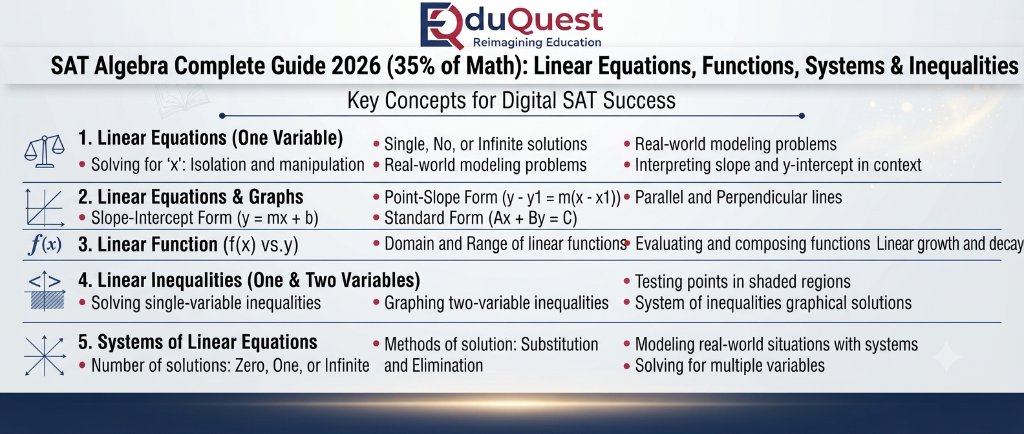
Weightage: ≈35%, roughly 13 to 15 questions. College Board describes this domain as interpreting, creating, using, representing and solving problems with linear representations. In plain English: straight lines, in every form they can appear (equations, tables, graphs, word problems).
- Linear equations in 1 variable: Solving for x, identifying no solution or infinitely many solutions, and solving with parameters.
- Linear equations in 2 variables: Writing and interpreting y = mx + b or Ax + By = C, where slope is rate and intercept is initial value.
- Linear functions: Function notation f(x), evaluating inputs/outputs, and interpreting models.
- Systems of 2 linear equations: Solving by substitution, elimination, or Desmos intersection; knowing the slope-intercept criteria for 0, 1, or infinite solutions.
- Linear inequalities: Solving, graphing shaded half-planes, and testing points.
4. Advanced Math (about 35%): Nonlinear Thinking
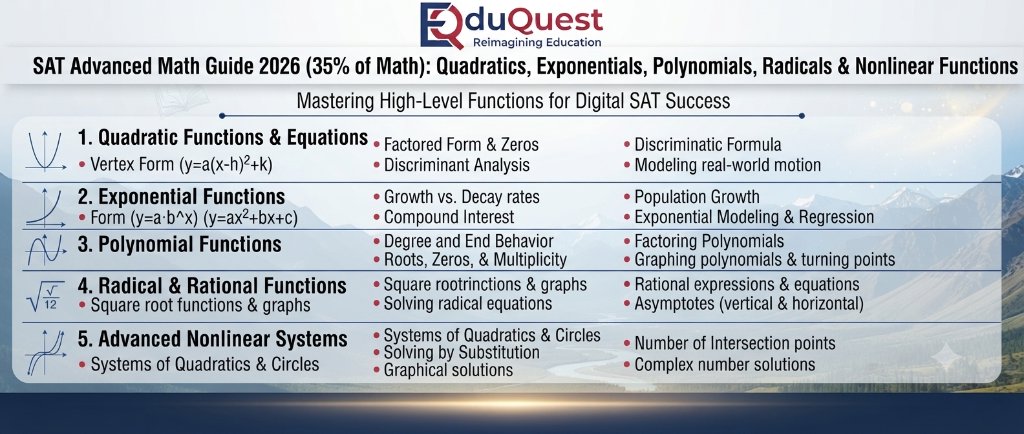
If Algebra is the world of straight lines, Advanced Math is everything that curves. The domain covers interpreting, rewriting, fluently solving and making strategic use of structure in absolute value, quadratic, exponential, polynomial, rational, radical and other nonlinear equations.
5. Problem-Solving and Data Analysis (about 15%)
PSDA represents roughly 5 to 7 questions. Although it is only ~15%, it is often the quickest source of marks. Many questions need no advanced algebra, just careful reading of tables, units, percentages, and statistical statements.
- Percentages: Percent change = (new − old) / old × 100. Successive percentage changes multiply; they do not add.
- Mean vs. Median: Outliers pull the mean, while the median remains resistant.
- Probability: Use two-way tables carefully; ensure the condition restricts the denominator to the relevant row/column.
6. Geometry and Trigonometry (about 15%)
Geometry and Trigonometry covers roughly 5 to 7 questions across area/volume, lines & angles, right triangles & trigonometry, and circles in the xy-plane.
Is trigonometry on the SAT? Yes. Right-triangle trigonometry (SOH CAH TOA), the complementary angle identity (sin A = cos(90° − A)), and circle radians (180° = π radians) are regularly tested.
7. Multiple Choice vs Student-Produced Response
| Feature | Multiple choice | Student-produced response (SPR / Grid-in) |
|---|---|---|
| Answer format | Choose one of four options | Type your own numerical answer (decimals or fractions) |
| Guessing | A blind guess has a 25% chance | Zero chance; must solve directly |
| Strategy tools | Back-solving, elimination, testing options | Solve directly, verify by substitution |
| Typical risk | Falling for a distractor option | Careless arithmetic or typing format slip |
| Appears in | All four domains | All four domains (~25% of questions) |
8. Desmos and Calculator Strategy
The Bluebook app includes the Desmos graphing calculator built in, and it is available for the entire Math section. You may also bring an approved handheld calculator, but Desmos is faster for almost every graphical task.
- Graphing intersections: Type two linear or nonlinear equations exactly as given and click the intersection point.
- Finding vertex and zeros: Type a quadratic like y = x² − 8x + 19 and click the grey minimum dot to see (4, 3).
- Sliders for parameters: Type y = 3x − k/2 and add slider for k to visualize parallel or coinciding lines.
- Sanity-checking: Don't rely on Desmos for reading word problems; set up the equation first.
9. Pacing: Time Per Question in Each Module
| Question tier | Typical share of module | Target time each | Total time budget |
|---|---|---|---|
| Quick, routine questions (first 8 Qs) | ~8 questions | 45–60 sec | 6–8 minutes |
| Medium questions (middle 8 Qs) | ~8 questions | 90 sec–2 min | 12–16 minutes |
| Harder questions (last 6 Qs) | ~6 questions | 2–3 min | 12–18 minutes |
10. Topic-by-Topic SAT Math Checklist
- Algebra: Linear equations in 1 & 2 variables, slope & intercepts, linear functions f(x), systems of linear equations, linear inequalities.
- Advanced Math: Quadratics (factoring, quadratic formula, vertex form, discriminant), exponentials (a·b^t), polynomials (factor/remainder theorem), radicals and rational equations.
- PSDA: Ratios & rates, percent change, mean/median/spread, scatterplots & line of best fit, conditional probability tables, margin of error.
- Geometry & Trig: Area & volume, vertical/parallel angles, Pythagorean theorem & special right triangles (30-60-90, 45-45-90), circle equations & arc length, radians.
11. How to Allocate Study Hours by Weightage
| Domain | Weightage | Baseline Hours (out of 100 hrs) | Recommended Split |
|---|---|---|---|
| Algebra | ≈35% | 35 hours | Focus on word-problem translation and systems shortcuts |
| Advanced Math | ≈35% | 35 hours | Master vertex form, discriminant, and extraneous root checks |
| Problem-Solving and Data Analysis | ≈15% | 15 hours | Drill two-way tables, percent change, and statistics vocabulary |
| Geometry and Trigonometry | ≈15% | 15 hours | Memorize circle equation, radian conversions, and right triangle ratios |
12. Common Mistakes Across All Four Domains
- Studying by chapter instead of by SAT testing point.
- Over-relying on Desmos for problems that need algebraic reasoning.
- Never practising student-produced response questions without options.
- Skipping the mistake log and repeating identical arithmetic slips.
- Treating Module 1 as a warm-up and making careless early errors.
13. How EduQuest Helps
EduQuest's SAT Math programme provides full diagnostic benchmarking, domain-by-domain hours allocation, Bluebook-style module practice, Desmos masterclasses, and error pattern coaching. Try our EduQuest Free SAT Diagnostic Test or explore the EduQuest SAT Coaching Program.
Frequently Asked Questions (FAQ)
How many questions are on the digital SAT Math section?
There are 44 questions, split across two modules of 22 questions each (20 scored + 2 unscored per module). Total time is 70 minutes (35 minutes per module).
How much time do I get for each SAT Math question?
On average, about 1 minute 35 seconds per question (~95 seconds). Easy questions take 45–60 seconds, leaving 2–3 minutes for tougher Module 2 items.
What are the four domains in SAT Math 2026?
Algebra (about 35%), Advanced Math (about 35%), Problem-Solving and Data Analysis (about 15%), and Geometry and Trigonometry (about 15%).
Is trigonometry tested on the digital SAT?
Yes. Geometry and Trigonometry includes right-triangle trigonometry (sine, cosine, tangent), complementary angle relations, and unit-circle radians.
Can I use a calculator on the whole SAT Math section?
Yes. The built-in Desmos graphing calculator is available for all 44 questions in Bluebook, and approved handheld calculators are also allowed.
What is a student-produced response question?
It is a question where you type your own numerical answer instead of picking from multiple-choice options. There is no penalty for wrong answers.
Ready to Turn the Syllabus into an 800 Math Plan?
Knowing the weightage is step one; building a plan around it is step two. Take the free diagnostic test to evaluate your accuracy in Algebra, Advanced Math, PSDA and Geometry.
How EduQuest Helps You in SAT Math Syllabus & Weightage 2026: Complete Domain-Wise Breakdown (Algebra, Advanced Math, PSDA, Geometry & Trig) at Our Gurugram Centre (F-45, South City II)
Mastering SAT and securing competitive global university admissions demands structured instruction, diagnostic error post-mortems, and proven testing frameworks. At EduQuest Gurugram, we deliver bespoke test preparation and holistic admissions consulting designed specifically for Indian and NRI high school students.
🏫 Offline Classroom Coaching
Study at our premier learning centre: F-45, First Floor, South City II, Sector 50, Gurugram, Haryana 122018. Small cohorts (8–10 students) ensure interactive whiteboard problem breakdowns, physical testing terminals, and immediate face-to-face mentor doubt resolution.
💻 Live Online Interactive Classes
Join high-definition two-way interactive classes via EduQuest LMS with live digital whiteboards, screen-shares, session video recordings for revision, and 1-on-1 virtual office hours for students across India, Dubai, Singapore, and the US.
🔄 Seamless Flexible Hybrid Mode
Transition effortlessly between classroom sessions at our Gurugram F-45 centre and live virtual classes whenever school exams, projects, or travel require flexibility, ensuring zero interruption to your preparation.
Batch timings are scheduled collaboratively around high school hours (CBSE, ICSE, IB, and Cambridge), featuring personalized 1-on-1 mentorship and small batches (8–10 students). A free diagnostic demo class is scheduled prior to enrollment. Weekday batches run in the afternoon and evening after school hours (Mon–Thu), alongside weekend intensive drill bootcamps (Sat–Sun). We invite parents and students for a complimentary 1-on-1 diagnostic evaluation before enrollment.
F-45, First Floor, South City II, Sector 50, Gurugram, Haryana 122018