1. What Assessors Notice Before You Open Your Mouth
Most candidates walk into an MMI station focused entirely on what words they are going to say. But experienced medical school interviewers spend equal time observing the silent signals: your eye contact, posture, active listening pauses, non-defensive posture under questioning, and emotional self-regulation.
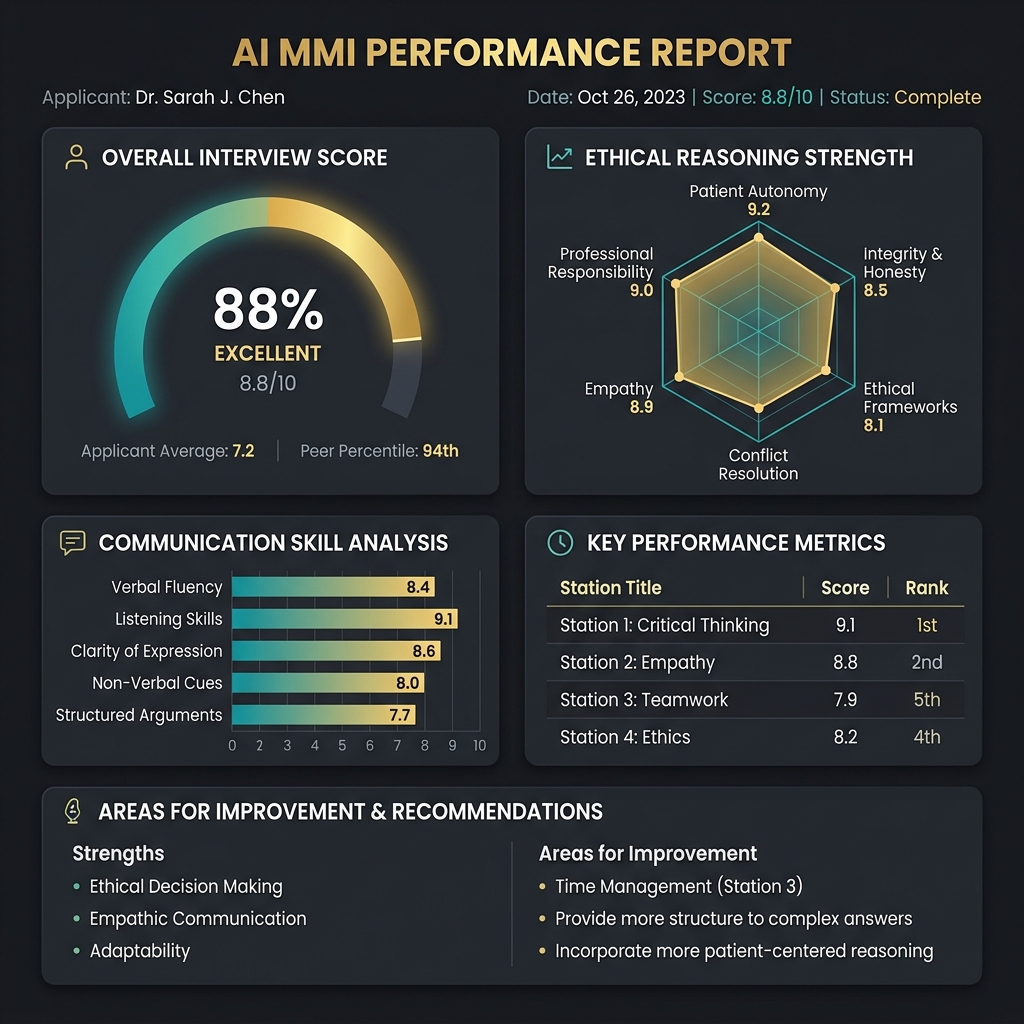
In clinical practice, a doctor who talks over patients or becomes defensive when challenged is dangerous. MMI assessors use specific probing questions to intentionally test your emotional regulation. EduQuest’s AI MMI Simulator evaluates these subtle communication markers.
Master Silent Communication Skills
AI Tone & Pace Scan
MMI Practice AI
Evaluate your active listening pauses, speech speed, and non-defensive phrasing during AI MMI mocks.
Practice MMI Interview NowLive Panel Review
EduQuest Medical Mentors
Get video feedback on body language, posture, and facial expressions from live doctors.
Explore MMI Platform2. The 3 Pillars of the "Silent Skill"
Active Listening & Pause Control
Taking 3-5 seconds of reflective pause after an interviewer asks a question demonstrates thoughtfulness rather than impulse.
Non-Defensive Receptivity to Pushback
When an assessor challenges your point of view, responding with "That is a valid perspective to consider..." instead of becoming defensive.
Micro-Expression & Tone Self-Regulation
Maintaining a warm, calm, reassuring vocal tone even when handling difficult role-play confrontations.
Fast-Track Your College & Career Strategy
Get immediate, personalized AI insights tailored to your grade, strengths, and dream universities — 100% free with instant reports.
Know Your Personality Type for Free
Take our 18-question AI psychometric test to uncover your cognitive archetype, hidden learning superpowers, and ideal university courses.
Personalized Career & University EduPath
Build a step-by-step Grade 8–12 admissions blueprint with AI-matched target universities, exam schedules, and extracurricular profiles.
| Probing Assessor Challenge | Defensive Low-Score Response | Winning High-Score Response |
|---|---|---|
| "Isn’t your solution completely unrealistic in a busy NHS hospital?" | "No, it is realistic if doctors just follow the rules." | "You make a very fair point about hospital workload constraints. Let me refine my approach to fit acute resource limits." |
| "Why didn’t you consider the patient’s financial situation?" | "Because the prompt didn’t mention money." | "That is a crucial oversight on my part. Patient socio-economic context is vital, and I should have factored that into my plan." |
| "Are you sure that is ethical?" | "Yes, I read it in an ethics book." | "I appreciate you highlighting that tension. Re-evaluating autonomy versus non-maleficence here, I see why caution is needed." |
Top MMI candidates don’t fight the interviewer; they collaborate with the interviewer to explore the problem together.
— EduQuest Senior Medical Panelist
Master the 5-Second Reflective Pause
Control Impulse Speeches
- Practice taking a deliberate 5-second breath before answering.
- Nod and maintain calm eye contact.
Validate Assessor Pushback
Use Receptive Phrasing
- Begin follow-up answers by validating the interviewer’s nuance.
- Show willingness to adapt your reasoning.
Simulate High-Pressure Stations
AI & Live Doctor Mocks
- Run high-pressure role-play stations with EduQuest AI.
- Achieve top scores on communication rubrics.
Download the MMI Silent Skills & Rubric Guide
Learn how MMI examiners score non-verbal communication, tone, active listening, and receptivity.
Does body language matter during online zoom MMI interviews?
Yes! Camera eye contact, upright posture, and pleasant vocal modulation are just as critical in online MMIs as in-person.
How do I avoid sounding defensive when an assessor corrects me?
Acknowledge their point immediately: "Thank you for pointing that out. Looking at it from that perspective..."
Master the Secret Skill of MMI Interviews
Transform your communication style with EduQuest AI MMI Simulator today.
Access EduQuest MMI Platform
AI Simulator
MMI Practice AI
Simulate high-pressure MMI stations and refine your communication.
Go to MMI Interview PageLive Panel
EduQuest Assessors
Book live video mock sessions with medical school interviewers.
Access Platform