1. The Rehearsed Answer Trap in Medical School Interviews
Many Indian medical school applicants prepare for MMI interviews by purchasing sample answer booklets and attempting to memorize speeches for common questions like "Why Medicine?", "Tell me about a time you failed," or "Is euthanasia ethical?".
When these candidates step into an MMI station, MMI assessors spot rehearsed answers within 20 seconds. Rehearsed answers sound robotic, lack genuine empathy, and fall apart immediately when an assessor asks an unexpected follow-up question. EduQuest’s AI MMI Simulator trains you to think dynamically on your feet rather than recite scripts.
Practice Dynamic Ethical Reasoning with AI
AI Scenario Generator
MMI Practice AI
Face randomized, non-repeating MMI prompts that test your real-time critical thinking.
Practice MMI Interview NowFeedback Engine
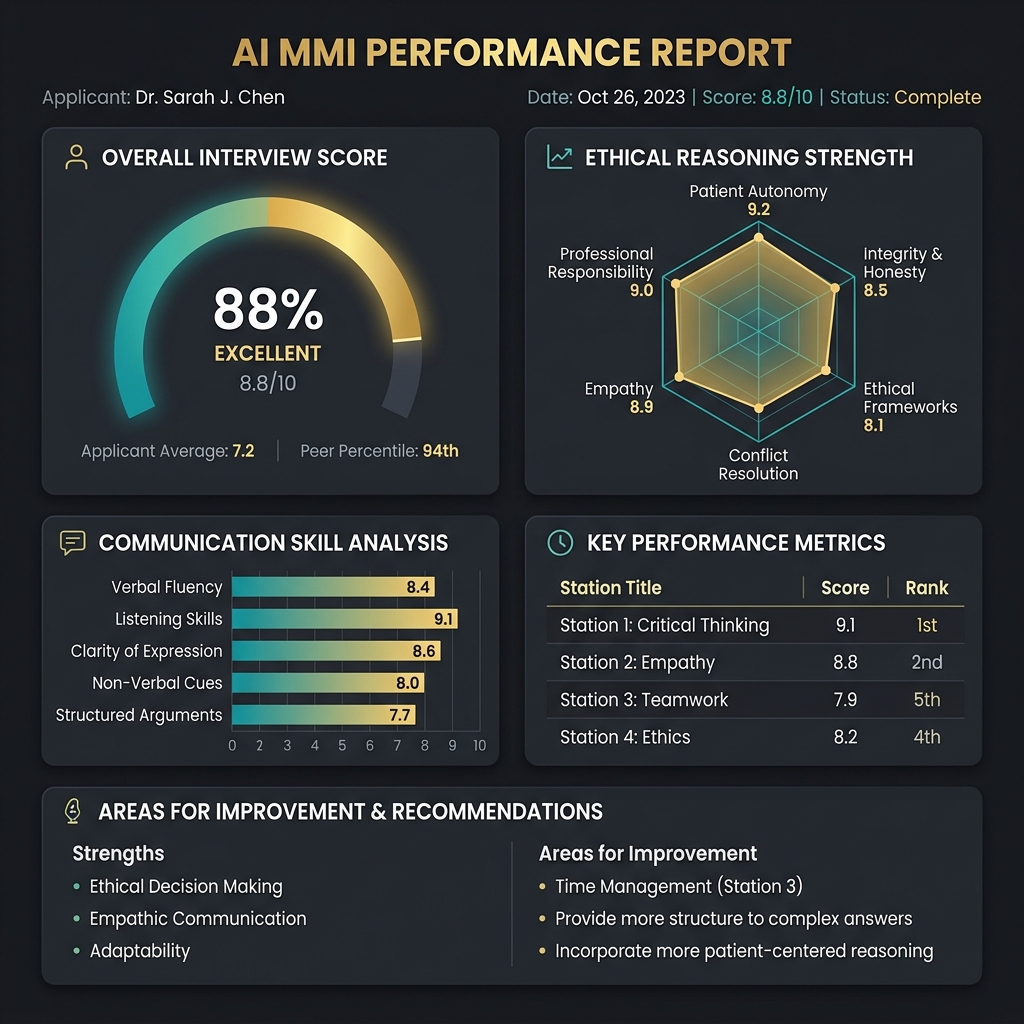
EduQuest MMI Analysis
Get instant evaluation on whether your answer sounds authentic or overly rehearsed.
Explore MMI Platform2. Why Assessors Reject Memorized Scripts
Lack of Active Listening during Follow-ups
Candidates who memorize a fixed script fail to adapt when an interviewer modifies the scenario parameters mid-station.
Absence of Authentic Emotional Empathy
In role-play stations (e.g., breaking bad news), memorized lines sound cold and robotic to simulated patients and assessors.
Failure to Demonstrate Real-Time Problem Solving
MMI stations test HOW you think through an ethical conflict, not whether you have memorized medical school policy manuals.
Fast-Track Your College & Career Strategy
Get immediate, personalized AI insights tailored to your grade, strengths, and dream universities — 100% free with instant reports.
Know Your Personality Type for Free
Take our 18-question AI psychometric test to uncover your cognitive archetype, hidden learning superpowers, and ideal university courses.
Personalized Career & University EduPath
Build a step-by-step Grade 8–12 admissions blueprint with AI-matched target universities, exam schedules, and extracurricular profiles.
| Interview Behavior | Memorized Script Candidate | EduQuest-Trained Dynamic Candidate |
|---|---|---|
| Response Delivery | Fast, monotone recitation without eye contact or pauses | Structured, thoughtful delivery with natural pacing |
| Handling Probing Questions | Panic or repeating the same memorized lines | Adapting framework to address the new prompt nuance |
| Role-Play Performance | Reciting sympathy phrases ("I am sorry to hear that") | Demonstrating active listening and non-verbal empathy |
| Scoring Rubric Outcome | Low marks for communication & adaptability | Top marks for reasoning, empathy, and integrity |
We don’t want actor-students; we want future doctors who can listen, reflect, and make ethical choices under real clinical pressure.
— Former UK Medical School MMI Panelist & EduQuest Advisor
3. What to Practice Instead: The SPIKES & STARR Frameworks
Instead of memorizing static answers, master versatile communication frameworks that apply to any station prompt.
The 4-Pillar Ethical Decision Tree
Autonomy, Beneficence, Non-Maleficence, Justice
- Identify competing ethical principles in the scenario prompt.
- Evaluate short-term and long-term consequences for all stakeholders.
The SPIKES Protocol for Breaking News
Setting, Perception, Invitation, Knowledge, Empathy, Summary
- Establish quiet setting and check patient perception.
- Deliver information clearly and validate emotional responses.
The STARR Method for Behavioral Stations
Situation, Task, Action, Result, Reflection
- Summarize past experiences briefly (20% of time).
- Focus heavily on deep reflection and lessons learned (80% of time).
Download the MMI Communication Framework Manual
Learn how to apply SPIKES, STARR, and 4-Pillar Medical Ethics frameworks to any MMI station without memorizing answers.
Is it okay to pause before answering an MMI question?
Yes! Pausing for 5–10 seconds to collect your thoughts demonstrates maturity and structured thinking.
How does EduQuest AI help me avoid sounding memorized?
EduQuest AI evaluates your voice cadence, phrase repetition, and adaptability to randomized follow-up questions.
Master Authentic MMI Communication Today
Stop memorizing scripts. Build dynamic ethical reasoning with EduQuest AI MMI Simulator.
Access EduQuest MMI Practice Portal
Practice Tool
MMI AI Simulator
Train on randomized stations with real-time feedback on delivery.
Go to MMI Interview PageSchedule Coaching
EduQuest Doctors
Get live 1-on-1 mock interview feedback from medical school assessors.
Access Platform