The AP Physics C Mechanics exam format is highly compressed. You only get 45 minutes for 35 Multiple-Choice Questions, and 45 minutes for 3 Free Response Questions (FRQs). That means you have exactly 15 minutes per FRQ. Speed and precision are paramount.
The Three Types of FRQs
While the College Board can throw anything at you, the 3 FRQs generally follow a predictable pattern. Knowing what to expect allows you to allocate your 15 minutes effectively.
The Experimental Question
Data and Graphing
- You will be given raw data to plot.
- You must 'linearize' the graph (e.g., plot T² vs L).
- Calculate the slope to find an experimental constant (like g).
The Differential Equation
Calculus Heavy Derivation
- Usually involves a force that depends on velocity (drag).
- Set up ΣF = ma = m(dv/dt).
- Separate variables and integrate to find v(t).
The Rotation Monster
Everything Everywhere All at Once
- A complex object rolling, falling, or swinging.
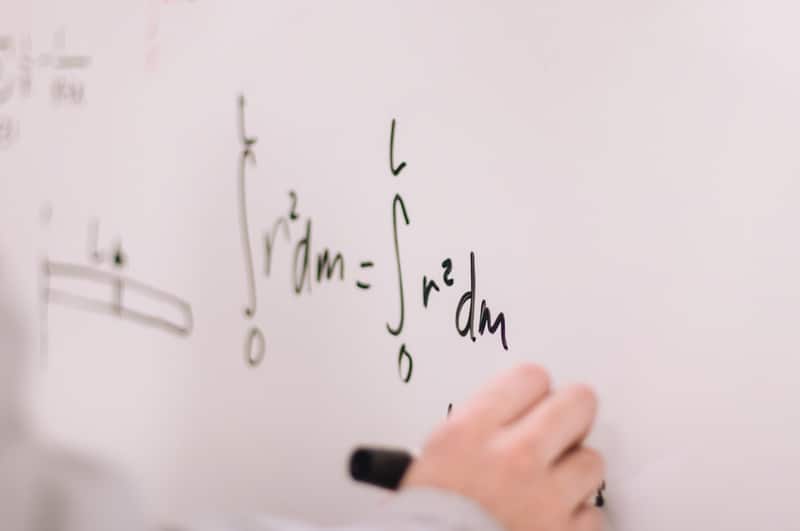
- Derive the moment of inertia using ∫r²dm.
- Apply conservation of mechanical energy.
The Art of the Derivation
Never Skip Steps
A derivation must start with a fundamental equation from the formula sheet. You cannot start halfway through the math.
Use Given Variables
If the question asks for an answer in terms of M, R, and fundamental constants, do not leave an 'm' or 'r' in your final answer.
Box Your Final Answer
Graders have hundreds of papers to read. Make it easy for them to find your final, simplified expression.
Fast-Track Your College & Career Strategy
Get immediate, personalized AI insights tailored to your grade, strengths, and dream universities — 100% free with instant reports.
Know Your Personality Type for Free
Take our 18-question AI psychometric test to uncover your cognitive archetype, hidden learning superpowers, and ideal university courses.
Personalized Career & University EduPath
Build a step-by-step Grade 8–12 admissions blueprint with AI-matched target universities, exam schedules, and extracurricular profiles.

Linearization is a guaranteed topic. You must know how to look at an equation like y = ax² and realize that graphing y on the vertical axis and x² on the horizontal axis will produce a straight line with a slope of 'a'.
Maximizing Partial Credit
- Erasing Work: Never erase anything unless you have time to rewrite it. A crossed-out correct equation earns zero points. A messy correct equation earns a point.
- Giving Up Early: Part (d) of a question might not depend on Part (c). If you get stuck on a tough integral, skip to the next part.
- Number Crunching Too Early: Do all the algebra using variables first. Only plug in numbers at the very last step. This prevents rounding errors.
If you are asked to 'determine' or 'calculate', you must show your work. A correct answer with no supporting work will not receive full credit.
In AP Physics C, 50% on the FRQ is often enough to secure a 4, and 65% is usually a 5. Fight for every single point; you don't need perfection.
— AP Exam Scorer
The Differential Equation Checklist
| Step | Action | Why it matters |
|---|---|---|
| 1 | Start with ΣF = ma | The fundamental starting point. |
| 2 | Substitute a = dv/dt | Introduces the calculus variable. |
| 3 | Substitute forces (e.g., -kv) | Puts the equation in terms of v. |
| 4 | Separate Variables | Get 'v' on one side and 't' on the other. |
| 5 | Integrate with Limits | Integrate from 0 to t, and v₀ to v. |
| 6 | Solve for v(t) | Use exponentiation to clear natural logs. |
The sequence above is worth 4 to 5 points on a 15-point FRQ. Even if you mess up the integration in step 5, doing steps 1-4 perfectly guarantees you more than half credit.
Need FRQ Practice?
Our AP Physics C intensive grading service evaluates your derivations line-by-line, just like a real AP reader.
Time Management Strategy
With only 15 minutes per question, you must read the entire FRQ booklet in the first 2 minutes. Decide which of the 3 questions is your strongest, and do that one first. Secure the easiest 15 points immediately.
- 0-2 Mins: Read all three prompts.
- 2-16 Mins: Solve your strongest FRQ.
- 16-30 Mins: Solve the second easiest FRQ.
- 30-45 Mins: Battle the hardest FRQ (usually Rotation) for partial credit.
The Power of Limits
Often, the final part of a derivation will ask, 'Does this answer make physical sense?' You can test your equation by taking limits. If you derived an equation for velocity with air drag, what happens as time (t) goes to infinity? It should equal terminal velocity. If it doesn't, your derivation is wrong.
Final Thoughts
Write clearly, explain your assumptions, and always let the fundamental laws of physics guide your algebra.
FAQs: FRQ Strategy
Can I use a pen?
You are allowed to, but you should absolutely use a pencil. Physics derivations require erasing mistakes.
What if my graph is messy?
You will lose the point for the line of best fit. Bring a straight edge or ruler.
Do I lose points for spelling?
No, as long as the grader can understand what physics concept you are communicating.
Dominate Exam Day
Join EduQuest's elite AP Physics C prep program to master the most challenging derivations and secure a 5.
Accelerate Your College Prep
Evaluate Your Profile
AI Profile Evaluator
Submit your academic scores, AP results, and extracurriculars to get instant feedback on your chances for top universities.
Evaluate ProfileDiscover Your True Potential
Narrative Intelligence Scan
Personality Tester
Uncover your hidden strengths and cognitive profile with our scientifically backed assessment.
Take the TestFind Your Path
Career Cluster AI
Explore the best career pathways perfectly aligned with your unique personality and goals.
Check ProfileTake an AP Mock Test
Download the Official AP Exam Mastery & 5-Score Strategy Blueprint
Get immediate access to EduQuest’s 8-page comprehensive candidate toolkit with diagnostic benchmarks, step-by-step frameworks, error telemetry logs, and structured preparation timelines.