

Scoring in the top 1% (1500–1600) on the Digital SAT is no longer a game of memorizing flashcards or solving hundreds of unorganized practice questions. With College Board’s transition to a multi-stage adaptive testing model (MST), test success requires a rigorous, data-driven methodology. Whether you are beginning your preparation at 1100 or trying to break a stubborn 1380 plateau to reach a 1550+, your study plan must integrate psychometric diagnostics, calibrated mock simulations, and real-time error telemetry.
To provide students and parents with a single, comprehensive roadmap, the EduQuest Standardized Testing Faculty has unified the 7 Core Pillars of Digital SAT Preparation into this definitive master guide. Powered by the EduQuest SAT Prep Suite and EduPath, this blueprint walks you through adaptive mechanics, test volume calibration, topic drills, forensic error logging, predictive formulas, Bluebook reality checks, and global percentile ranking dashboards.
Launch Your 1550+ SAT Preparation with EduQuest AI
Free Adaptive SAT Mock
Digital SAT Simulation
Simulate the exact Bluebook format with multi-stage adaptive routing, Desmos integration, and predictive scoring.
Launch Free SAT MockFree Mock Test Hub
Adaptive Question Bank
Isolate and drill your weakest sub-topics with thousands of calibrated questions and video explanations.
Explore Mock HubPersonalized SAT Roadmap
EduQuest EduPath Platform
Build an 8-week breakthrough plan balancing topic remediation drills with full-length milestone mocks.
Launch EduPath RoadmapPillar 1: Adaptive SAT Mock Test vs Official Bluebook Test
The Digital SAT is a **Multi-Stage Adaptive Test (MST)**. Your performance in Module 1 dictates whether you unlock the high-scoring Hard Module 2 (score ceiling: 800 per section) or get routed to the Easy Module 2 (score ceiling: capped at 590–620). While College Board’s Bluebook app provides an authentic UI, early Bluebook practice tests (Tests 1–3) have noticeably easier question curves than recent official administrations.
Fast-Track Your College & Career Strategy
Get immediate, personalized AI insights tailored to your grade, strengths, and dream universities — 100% free with instant reports.
Know Your Personality Type for Free
Take our 18-question AI psychometric test to uncover your cognitive archetype, hidden learning superpowers, and ideal university courses.
Personalized Career & University EduPath
Build a step-by-step Grade 8–12 admissions blueprint with AI-matched target universities, exam schedules, and extracurricular profiles.
What Makes the SAT Adaptive?
Module 1 contains a balanced mix of difficulties. Answering ~65–70%+ correctly routes you to the Hard Module 2, which is required to achieve any score above 1350.
Limitations of Official Bluebook Tests
Only 6 tests are available, questions are widely spoiled online, and the app provides no granular per-question time telemetry or mistake classification.
The Hybrid Testing Solution
Use Bluebook Test 1 as an early diagnostic, use EduQuest Adaptive Mocks for weekly stress-testing during weeks 2–6, and finish with Bluebook Tests 4–6 in the final 2 weeks.
📖 Read the full deep-dive: Adaptive SAT Mock Test vs Official Bluebook Test: Which Predicts Your Real SAT Score Better?
Pillar 2: How Many SAT Mock Tests Should You Take?
Taking too few mocks leaves you vulnerable to cognitive stamina collapse during Math Module 2, while taking too many causes burnout. The optimal mock count depends on your target score tier:
| Target Score Tier | Recommended Mocks | Study Focus & Distribution | Target Universities |
|---|---|---|---|
| 1200+ Score | 4–6 Full Mocks | 70% Grammar/Algebra Theory + 30% Full Mocks | State flagship universities, regional colleges |
| 1400+ Score | 8–10 Full Mocks | 50% Topic Drills + 50% Full-Length Mocks | Top 50 US universities (NYU, UIUC, Purdue, UW) |
| 1500+ Score | 12–14 Full Mocks | 35% Advanced Desmos/Craft + 65% Timed Mocks | Top 25 US universities (Cornell, Berkeley, Duke, UCLA) |
| 1550+ Score (Top 1%) | 15+ Full Mocks | 20% Edge-Case Drills + 80% Full Proctored Simulations | Ivy League, MIT, Stanford, Oxford, Cambridge |
📖 Read the full deep-dive: How Many SAT Mock Tests Should You Take for a 1400+, 1500+, or 1550+ Score?
Pillar 3: SAT Topic Tests vs Full-Length Mock Tests
Topic tests build concept mastery, while full-length mocks condition timing and cognitive endurance. Attempting full mocks before mastering individual sub-topics leads to repeated score plateaus. Top scorers use a 3-stage study funnel:
Isolated Topic Tests (25-Minute Drills)
Drill 15–20 questions focused on a single sub-domain (e.g., Circle Geometry, Transitions, Quadratic Systems) until reaching 90%+ accuracy.
Mixed Sectional Practice (35-Minute Sets)
Combine 4–5 related domains under timed conditions to practice switching cognitive modes without losing momentum.
Full-Length Adaptive Mock (2h 14m Exam)
Execute a complete 4-module simulation under strict test-center conditions on Saturday mornings to calibrate composite pacing.
📖 Read the full deep-dive: SAT Topic Tests vs Full-Length Mock Tests: What Improves Scores Faster?
Pillar 4: Why Your SAT Score Is Stuck: 4-Tier Error Logging
When scores stall between 1300 and 1400, solving more questions blindly does not work. You must adopt the **4-Tier Forensic Error Logging Protocol**:
Knowledge/Concept Gap
Did not know the underlying mathematical rule or grammatical principle. Fix: Study theory and complete 5 targeted drills.
Timing/Pacing Rush
Ran out of time and guessed blindly. Fix: Apply Two-Pass pacing to flag difficult questions in <20 seconds.
Question Stem Misinterpretation
Misread qualifiers like "which is NOT true" or solved for x instead of 2x + 1. Fix: Underline target variables on scratchpad.
Careless Execution Slip
Simple arithmetic calculation error or sign flip (+/-). Fix: Double-check calculations with Desmos.
📖 Read the full deep-dive: Why Your SAT Score Is Stuck: Use Mock Test Analytics to Break Through
Pillar 5: Can SAT Mock Tests Predict Your Real Score?
Statistical analysis of over 5,000 students reveals that high-fidelity adaptive mocks achieve a correlation coefficient of **r = 0.91** with official results. To calculate your predicted test-day score with 95% confidence, use EduQuest’s **Weighted 3-Mock Formula**:
Example: If your last three mock scores are 1440, 1480, and 1520 (most recent), your weighted projection is: (1520 × 0.5) + (1480 × 0.3) + (1440 × 0.2) = **1492 (Projected Range: 1470–1520)**.
📖 Read the full deep-dive: Can SAT Mock Tests Predict Your Real SAT Score? Top Scorer Data & Forecasting Formula
Pillar 6: Bluebook Practice Test vs Real SAT: 7 Core Differences
While Bluebook and the real SAT share the identical software interface and Desmos calculator, students must prepare for 7 critical test-day differences:
| Difference Dimension | Bluebook Practice Tests | Real Exam Day Reality | Preparation Remedy |
|---|---|---|---|
| 1. Question Novelty | Questions are widely discussed online | 100% unseen questions | Drill third-party adaptive banks to build first-sight synthesis |
| 2. Hard Module 2 Curve | Easier in Tests 1–3; realistic in Tests 4–6 | Brutal multi-step algebra & geometry | Take updated 2026 calibrated adaptive mocks |
| 3. Experimental Items | 2 simpler pretest items per module | High-difficulty pretest items drain energy | Do not panic if 1–2 questions look unusually obscure |
| 4. Environment Pressure | Comfortable home environment | Strict proctors, room noise, anxiety | Simulate exam conditions with proctored Saturday morning sessions |
| 5. Pacing Clock | Temptation to pause or stretch | Strict non-negotiable countdown | Practice hiding the clock and doing Two-Pass sprints |
| 6. Diagnostic Depth | Basic score without time tracking | Broad percentile score report | Use AI dashboards with millisecond chronometer telemetry |
| 7. Available Tests | Only 6 official tests | Endless global test administrations | Combine Bluebook with EduQuest adaptive mock suites |
📖 Read the full deep-dive: Bluebook Practice Test vs Real SAT: 7 Differences Students Must Know
Pillar 7: SAT Ranking Dashboard Explained: Percentile Telemetry
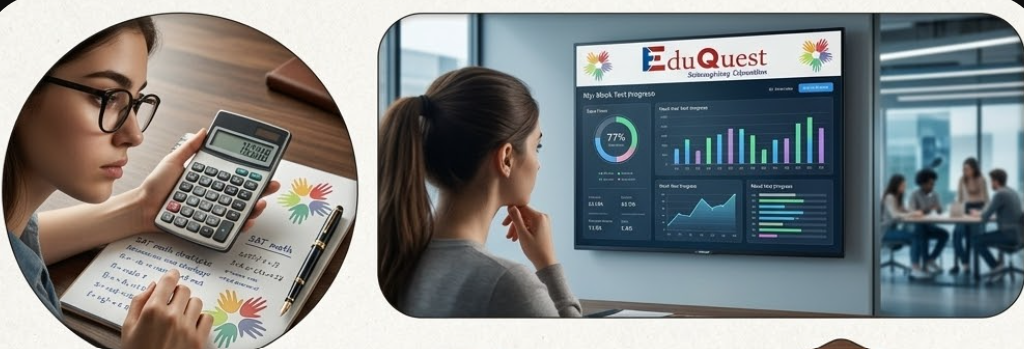
Top students do not rely on intuition—they use an **SAT ranking dashboard** to audit their performance across 4 essential analytical panels:
Panel 1: Global Cohort Percentiles
Displays scaled scores and compares them against 10,000+ test-takers targeting Ivy League and Top 20 universities.
Panel 2: 8-Domain Performance Heat Map
Color-coded mastery levels across Algebra, Advanced Math, Geometry, Craft & Structure, and Standard English.
Panel 3: Millisecond Chronometer Timeline
Identifies pacing leaks where students spent >90 seconds on early questions, starving time for Module 2.
Panel 4: Dynamic Mistake Log Queue
Provides 1-click retests of all previously missed questions to ensure 100% concept resolution before test day.
📖 Read the full deep-dive: SAT Ranking Dashboard Explained: How Top Students Use Analytics
How EduQuest Powers Your Complete 1550+ SAT Journey
At EduQuest, our standardized testing ecosystem delivers full-scale simulation tools and personalized mentorship:
- 1. 15+ Adaptive Full-Length Digital SAT Mocks: Pixel-perfect replica of the official Bluebook testing engine with calibrated Module 2 curves.
- 2. Instant AI Heat-Map Diagnostics & Ranking: Granular sub-topic performance reports, cohort rankings, and millisecond time-tracking.
- 3. 1-on-1 Mentorship with 1550+ Top Scorers: Expert coaches who analyze your ranking dashboard and assign targeted drills between mocks.
Frequently Asked Questions (FAQ)
What is the fastest way to improve my SAT score by 150 points?
The fastest method is to combine 1 weekly adaptive mock test with 4 hours of forensic 4-tier error logging, followed by 25-minute topic drills on your 3 weakest sub-domains.
Should I use official Bluebook tests or third-party adaptive mocks?
You should use both! Use Bluebook Test 1 as an initial diagnostic, take 6–10 EduQuest adaptive mocks for weekly practice, and finish with Bluebook Tests 4–6 right before exam day.
Is a 1500 score required for Ivy League admissions?
A 1500+ places you in the 98th–99th percentile, which is the competitive middle-50% range for Ivy League and elite institutions.
Are EduQuest SAT mock tests and analytics free?
Yes! EduQuest offers free full-length adaptive Digital SAT mock exams with instant AI diagnostic heat maps and score projections.
Download the Complete SAT 7-in-1 Master Prep Toolkit & Spreadsheet Matrix
Get instant access to EduQuest’s complete suite of Excel & Google Sheets prep tools: SAT Mock Score Tracker, 8-Week Calendar, Study Planner, 4-Tier Error Log, Score Prediction Calculator, Bluebook Review Checklist, and Progress Ranking Sheet.
Launch Your 1550+ Digital SAT Preparation on EduQuest AI Today
Join thousands of ambitious students worldwide who mastered the Digital SAT with EduQuest AI. Take your free adaptive mock exam now.