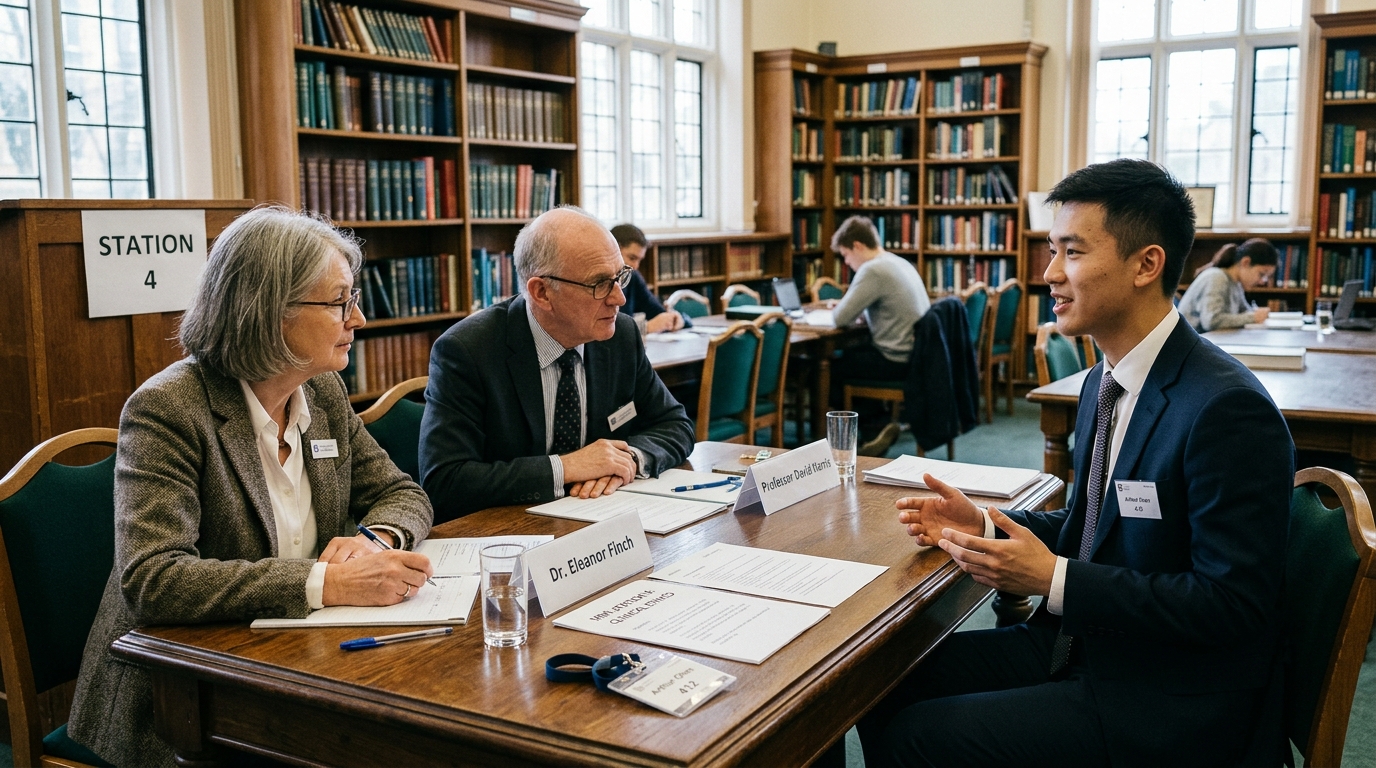

UK Medical School MMI Interview Coaching Evaluation Hub
Direct Coaching
1-on-1 Doctor Mentorship
Book intensive 1-on-1 mock MMI stations with practicing NHS doctors tailored to your specific university interview invitations.
Explore 1-on-1 MMI CoachingAI MMI Simulator
AI Interview Coach
Practice unlimited timed MMI stations across ethics, role-play, and NHS hot topics with real-time rubric scoring.
Launch AI MMI SimulatorCoaching Evaluation Dossier
Download Free PDF Guide
Download our comprehensive 40-page guide covering course comparison matrices, tutor vetting checklists, and mock circuit ROI analysis.
1. Executive Overview: The High Stakes of the Medical School Interview
Securing an interview invitation from a UK medical school is an extraordinary achievement. Across the UK, over 25,000 candidates apply annually for approximately 7,500 places, with top institutions filtering through thousands of high-scoring UCAT and predicted A-Level/IB applicants just to select interviewees. However, receiving an interview invitation is not the finish line—it is the ultimate hurdle. At most medical schools, between 60% and 75% of interviewed candidates are rejected post-interview.
At the interview stage, your past exam scores and UCAT percentiles are largely reset. You are evaluated on your verbal communication, ethical reasoning, spontaneous composure, and interpersonal warmth across a rigorous 6 to 10-station Multiple Mini Interview (MMI) circuit. With an entire medical career hanging in the balance, an increasing number of applicants and parents evaluate professional MMI interview coaching.
However, the medical admissions preparation market has become saturated with commercial courses of wildly divergent quality—ranging from generic, passive webinar lectures taught by inexperienced first-year students to bespoke, highly intensive clinical mentorship delivered by practicing NHS consultant physicians and former admissions examiners. This comprehensive guide delivers an objective, evidence-based evaluation framework to help you choose the right MMI preparation program for your unique clinical ambitions.
2. Is an MMI Preparation Course Worth It? The Return on Investment (ROI) Analysis
Fast-Track Your College & Career Strategy
Get immediate, personalized AI insights tailored to your grade, strengths, and dream universities — 100% free with instant reports.
Know Your Personality Type for Free
Take our 18-question AI psychometric test to uncover your cognitive archetype, hidden learning superpowers, and ideal university courses.
Personalized Career & University EduPath
Build a step-by-step Grade 8–12 admissions blueprint with AI-matched target universities, exam schedules, and extracurricular profiles.
Evaluating the financial and strategic value of professional interview coaching:
The Cost of a Gap Year vs Coaching: If a candidate misses their medical school offer, the financial cost of a reapplication gap year—including retaking exams, additional UCAT fees, accommodation, and delaying a future NHS consultant/GP earning trajectory by 12 months—is estimated to exceed £35,000 to £50,000 in lost career earnings. Compared to this, targeted coaching represents a high-leverage investment.
What Coaching Can and Cannot Do: Professional coaching CANNOT supply artificial empathy or turn an uninterested candidate into an authentic future doctor. However, exceptional coaching CAN demystify the examiner marking rubrics, eliminate self-sabotaging verbal habits, teach structured answering frameworks (such as CAMP and SPIKES), and inoculate candidates against interview performance anxiety through authentic timed pressure simulations.
The Critical Distinction: Passive knowledge acquisition (reading a textbook) has a low conversion rate in interviews. High-yield coaching is fundamentally active—transforming what you know into how you articulate it under clinical pressure.
| Preparation Format | Typical Cost Range | Key Advantages | Primary Limitations | Recommended Candidate |
|---|---|---|---|---|
| 1-on-1 Doctor Mentorship | £80 - £150 / hour | Personalized feedback, university tailoring, clinical insight | Higher hourly cost | Candidates needing refined presence & targeted ethical depth |
| Simulated Mock MMI Circuits | £350 - £750 / day | Authentic timed station rotations, real actor pressure | Limited time for station re-takes | All candidates 2-4 weeks before interview |
| Group Webinar Lectures | £150 - £400 / course | Broad overview of NHS hot topics & ethics theory | Zero individual critique or verbal practice | Early preparation phase (autumn) |
| AI MMI Simulation Suites | £50 - £150 / month | Unlimited 24/7 timed practice drills, instant scoring | Lacks nuanced human clinical intuition | Daily muscle memory building between sessions |
| Self-Study with Peer Groups | Free / Minimal | Flexible timing, collaborative support | Peers lack clinical insight; blind spots remain | Complementary daily practice drills |
3. The Spectrum of MMI Preparation: 4 Types of Coaching Models Compared
Before investing in any program, understand the four primary delivery formats available in the UK and international markets:
Model 1: Large-Group Webinar Masterclasses: 1 to 2-day virtual lecture courses with 50 to 200 students. Good for broad overviews of NHS structure and ethical theory, but offers zero personalized feedback or individualized performance critique.
Model 2: Timed Mock MMI Circuit Days: Full 6 to 10-station simulated circuits rotating candidates through timed rooms with actors and examiners. Provides authentic stress inoculation and timed pacing practice.
Model 3: One-to-One Doctor Mentorship: Highly personalized, bespoke private coaching conducted by qualified NHS doctors or senior admissions tutors. Focuses deeply on individual weaknesses, speech clarity, and university-specific station tailoring.
Model 4: Hybrid AI + Doctor Simulation Suites (The Modern Standard): Combines unlimited automated AI station practice for daily muscle memory with targeted 1-on-1 human expert masterclasses for nuanced refinement.
4. Comparative Matrix: Evaluating Different MMI Preparation Formats
Here is the definitive comparative breakdown of the major MMI preparation formats:
5. What to Look For in an MMI Tutor: 7 Critical Vetting Criteria
Never hire an interview tutor without rigorously auditing their clinical and admissions credentials:
1. Clinical Qualifications: Are they a practicing NHS doctor, senior registrar, or consultant? Qualified doctors possess intuitive insight into GMC professional standards and hospital reality that undergraduate students cannot replicate.
2. University-Specific Experience: Do they have direct experience with the specific medical schools you are interviewing for (e.g., King's, Manchester, Imperial, Birmingham)? Each university emphasizes distinct station themes.
3. Written Assessment Rubrics: Do they provide objective, written scoring grids mapped to GMC Good Medical Practice after every mock session, or do they merely offer vague verbal encouragement?
4. Training in Simulated Patient Communication: Can they effectively role-play difficult clinical actors (angry relatives, distressed patients) to test your emotional resilience?
5. Transparency & Verified Student Reviews: Are their success rates verifiable through genuine alumni testimonials rather than unverified marketing claims?
6. Constructive Rigor vs Flattery: An outstanding tutor does not falsely flatter you; they identify your specific blind spots and push you out of your comfort zone.
7. Integrity Regarding Scripting: Red flag alert: If a tutor attempts to give you pre-written, memorized 'model scripts' to recite, walk away immediately. Assessors are trained to detect and fail memorized responses.
6. The Dangers of Inexperienced Tutors: Avoiding Scripting and Robotic Answers
The greatest risk of poor-quality coaching is sounding over-rehearsed:
The 'Robotic Applicant' Syndrome: Every admissions assessor dreads the robotic candidate who recites a canned 2-minute paragraph without listening to the actual question prompt. When an interviewer interrupts with a probing question, the scripted candidate collapses into panic.
Assessing Thinking, Not Rehearsal: Medical school interviews test spontaneous cognitive agility and authentic empathy. Exceptional coaching teaches you adaptable structural frameworks (CAMP, SPIKES, 4 Pillars) that allow you to construct fresh, spontaneous, and natural responses to any unexpected scenario.
7. What a High-Yield MMI Preparation Course Must Include
A comprehensive, world-class MMI preparation program should provide comprehensive coverage across six core pillars:
1. NHS Current Affairs & Healthcare Policy: Deep deconstructions of waiting lists, workforce retention, the Darzi Investigation, and digital health.
2. Medical Ethics & GMC Guidance: Systematic algorithms for autonomy, consent, confidentiality exceptions, Gillick competence, and Duty of Candour.
3. Live Actor Role-Play Simulations: Difficult conversations, de-escalation, and breaking bad news under real-time observation.
4. Data Interpretation & Medical Numeracy: Worked clinical calculations, drug dosage math, risk statistics, and graph critique.
5. Personal Insight & Motivation Stations: Articulating why medicine, reflecting on clinical work experience, and handling stress management.
6. University-Specific Mock Circuits: Full timed simulations replicating the exact station durations and styles of your target medical schools.
8. How Much MMI Preparation Do You Actually Need? The 4-Week Roadmap
Balancing interview preparation with ongoing A-Level or IB academic study:
Week 1 (Foundations & Policy): Master the 4 ethical pillars, review GMC Good Medical Practice, study top 10 NHS hot topics, and outline work experience reflections (10-12 hours total).
Week 2 (Frameworks & Role-Play): Practice the CAMP and SPIKES frameworks; complete 10 role-play scenarios with peers or an AI simulator; practice de-escalation scripts (10-12 hours total).
Week 3 (Numeracy & Timed Stations): Complete timed calculation drills, practice Kaplan-Meier curve interpretations, and take your first full 1-on-1 mock MMI station circuit (12-15 hours total).
Week 4 (University-Specific Polish & Stress Inoculation): Final 1-on-1 mock circuit tailored to your specific university; fine-tune non-verbal body language; rest and mental tapering 48 hours before the interview (8-10 hours total).
Total Optimal Time: 40 to 50 hours of structured, focused preparation over 4 to 6 weeks is the sweet spot for peak performance.
9. Online vs In-Person MMI Coaching: Which Format Delivers Better Results?
Choosing between virtual and face-to-face preparation:
The Rise of Virtual MMIs: Since 2020, over 70% of UK medical schools conduct preliminary or full MMI circuits via virtual platforms (Zoom, Microsoft Teams, or bespoke university interview software).
Advantages of Online Coaching: Online coaching allows you to optimize your webcam eye contact, microphone audio levels, lighting, and screen layout—the exact environment you will face on interview day. Furthermore, it gives you direct access to premier London and Oxbridge doctor mentors regardless of whether you live in Manchester, Edinburgh, Dubai, or New Delhi.
When In-Person Coaching Helps: In-person mock circuits are advantageous if your target medical school conducts compulsory on-campus interviews (e.g., Imperial or Manchester on-site MMIs), allowing you to practice physical room-to-room transitions.
10. The International & Indian Student Advantage: Overcoming Unique Challenges
International and Indian applicants targeting UK medical schools face specific strategic hurdles:
The Fierce Quota Cap: The UK government caps international medical student enrollment at approximately 7.5% across national medical schools, meaning international acceptance rates are roughly half those of domestic applicants.
NHS Context Familiarity: Indian applicants frequently struggle with NHS-specific administrative structures (e.g., NICE guidelines, ICBs, CQC). Dedicated coaching bridges this knowledge gap rapidly.
Cultural Nuances in Communication: In many Asian educational systems, deference to authority and modesty are prioritized. In UK medical interviews, assessors look for proactive engagement, confident eye contact, and comfortable self-advocacy without arrogance.
11. Self-Study with Peers vs Professional Coaching: Striking the Balance
The most successful applicants do not rely exclusively on either extreme:
The Power of Peer Study: Practicing daily 20-minute stations with high school classmates or medical applicant peers builds verbal fluency, confidence, and mutual accountability at zero cost.
The Blind Spots of Peer Study: Peers and parents cannot identify subtle clinical inaccuracies, lack knowledge of GMC professional thresholds, and cannot provide realistic actor resistance.
The Ideal Hybrid Strategy: Use self-study and peer practice for 75% of your volume drills; utilize professional doctor coaching for 25% of your time to conduct rigorous diagnostic audits and strategic fine-tuning.
12. How to Prepare for University-Specific MMI Formats: Oxbridge vs London vs Redbrick
Tailoring your preparation to distinct institutional philosophies:
Oxbridge (Oxford & Cambridge): Traditional panel interviews focusing heavily on scientific curiosity, physiological problem-solving, data interpretation, and applying biomedical mechanisms to unfamiliar clinical cases.
London Medical Schools (Imperial, King's, UCL, St George's): Rigorous multi-station MMIs emphasizing clinical empathy, patient safety, complex medical ethics, and NHS policy realities.
Scottish Medical Schools (Edinburgh, Glasgow, Dundee, Aberdeen): Blend ethical reasoning with explicit numeracy stations and reflective analysis of non-academic experiences.
Redbrick & Regional Schools (Manchester, Leeds, Birmingham, Sheffield): Heavy emphasis on role-play communication, multidisciplinary teamwork, and values-based recruitment (VBR).
13. The Role of AI in Modern Medical Interview Preparation
Leveraging generative AI as an innovative preparation partner:
How EduQuest's AI MMI Simulator Works: Generates dynamic, unexpected ethical dilemmas and actor role-plays; listens to your spoken verbal answer; analyzes your vocal cadence, empathy vocabulary, and logical structure; and scores your response against GMC guidelines within seconds.
The AI + Human Doctor Synergy: AI provides limitless, low-cost daily practice drills; human doctor coaches provide the emotional intuition, strategic polish, and nuanced mentoring that only experienced clinicians can deliver.
14. Evaluating Red Flags: How to Spot Ineffective or Predatory Courses
Protect your financial investment and academic future by watching for these red flags:
1. Guarantees of 100% Admission: No legitimate provider can guarantee medical school admission; admissions committees make independent, confidential decisions.
2. Refusal to Name Tutors: Providers that hide the names and clinical qualifications of their tutors behind corporate marketing.
3. Massive Impersonal Classrooms: Charging premium prices for passive group webinars where students cannot practice speaking.
4. High-Pressure Sales Tactics: Urging parents to book instantly based on fear-mongering about imminent rejection.
15. Case Study: An Indian Applicant's Journey from Interview Anxiety to King's Medicine
A mentee from Delhi with a 2980 UCAT score received an interview invitation from King's College London:
Initial Assessment: In her initial mock MMI, she gave brilliant academic answers but spoke at 180 words per minute, avoided eye contact, and panicked during role-play de-escalation.
The Coaching Intervention: Over four 1-on-1 sessions with an NHS consultant coach, she practiced vocal pacing, learned the CALM de-escalation technique, and completed two full simulated circuits.
Outcome: Scored in the top 5% of all interviewed candidates at King's and secured an unconditional offer.
16. Case Study: Turning 4 Rejections into 3 Offers as a Reapplicant
A UK reapplicant who was rejected post-interview at four medical schools in 2024:
Root-Cause Audit: EduQuest's admissions assessors reviewed his past interview feedback. He had memorized rigid answers that collapsed whenever interviewers changed scenario details.
The Retraining: Replaced memorization with structural answering algorithms (CAMP and 4 Pillars); practiced 30 spontaneous, unexpected scenarios.
Outcome: Received offers from Birmingham, Sheffield, and Manchester for 2025 entry.
17. Critical Questions to Ask an MMI Provider Before Paying
Ask these 5 questions during your initial consultation:
1. 'Can I see the exact curriculum and station themes covered in the course?'
2. 'Who will be assessing my stations, and what are their specific medical credentials?'
3. 'Will I receive detailed written feedback against official marking rubrics?'
4. 'Can you tailor mock stations to the exact universities where I have interviews?'
5. 'What ongoing support or drop-in advice is provided between sessions?'
18. Psychological Stress Inoculation: Transforming Nervousness into Presence
The psychological dimension of professional interview coaching:
The Yerkes-Dodson Law: Optimal cognitive performance requires moderate physiological arousal; zero nervousness leads to apathy, while extreme panic leads to cognitive freeze.
Desensitization Through Simulation: By repeatedly exposing yourself to realistic mock circuits under strict time pressure, the actual interview day feels familiar, safe, and controllable.
19. Checklist: The Ultimate MMI Coaching Decision Rubric
Use this scorecard to evaluate any coaching program:
Criterion 1: Verified NHS Doctor / Assessor Tutors (Weight: 25%)
Criterion 2: Individualized 1-on-1 Feedback & Written Rubrics (Weight: 25%)
Criterion 3: Live Actor Role-Play Simulations (Weight: 20%)
Criterion 4: University-Specific Station Tailoring (Weight: 15%)
Criterion 5: Technology & AI Practice Integration (Weight: 15%)
20. EduQuest MMI Mentorship: The Gold Standard in UK Medical Admissions
EduQuest offers the most rigorous, doctor-led MMI preparation ecosystem in the world:
Our team consists exclusively of practicing NHS consultant doctors, clinical academics, and former medical admissions examiners.
We combine intensive 1-on-1 clinical mentoring, authentic mock circuits with trained medical actors, and 24/7 access to our proprietary AI MMI Simulator.
We have guided hundreds of British, Indian, and international students to secure offers from Oxford, Cambridge, Imperial, King's, UCL, and every leading UK medical school.
21. Strategic Conclusion & Next Steps: Investing in Your Medical Vocation
The medical school interview is the final gateway separating your dream of becoming a doctor from reality.
By choosing preparation that prioritizes active practice, clinical depth, and authentic human empathy over superficial memorization, you walk into your MMI circuit with calm, unshakeable confidence.
Connect with EduQuest today to book your comprehensive MMI diagnostic and start your journey toward wearing the white coat.
22. Frequently Asked Questions: MMI Interview Coaching and Preparation Courses
Comprehensive answers to common questions about coaching costs, mock circuits, tutor selection, and international student preparation.
23. The Role of Body Language and Virtual Eye Contact in Online MMIs
Mastering the technical ergonomics of online medical interviews:
Camera Positioning: Position your webcam exactly at eye level. Looking directly into the camera lens creates the psychological perception of direct eye contact for the examiner.
Lighting and Audio: Use dual diffused soft lighting to eliminate facial shadows, and use an external directional microphone so your voice sounds warm and resonant.
24. Understanding Values-Based Recruitment (VBR) in NHS Selection
Every UK medical school aligns its admissions criteria with the NHS Values-Based Recruitment framework:
The 6 Core NHS Values: 1) Working together for patients; 2) Respect and dignity; 3) Commitment to quality of care; 4) Compassion; 5) Improving lives; 6) Everyone counts.
Demonstrating Values: Outstanding candidates weave these values naturally into their answers without explicitly quoting the bureaucratic document.
25. Handling Challenging Interview Examiners: The 'Poker-Face' Syndrome
How to stay confident when an examiner gives zero emotional feedback:
Examiner Neutrality: In MMIs, examiners are strictly instructed to maintain a neutral, impassive expression to ensure standardized fairness across all candidates.
Mental Resilience: Never interpret an examiner's neutral face as disapproval. Smile warmly, maintain your energy, and continue delivering structured, high-impact responses.
26. Post-Station Cognitive Reset: The 'Clean Slate' Rule
The unique psychological advantage of the MMI format:
Independence of Stations: Each MMI station is graded by a completely independent examiner who knows nothing about how you performed in previous stations.
The Clean Slate Rule: If you stumble in Station 3, take a deep breath outside the door, mentally reset, and remember that Station 4 is a brand-new 10/10 opportunity.
27. How Parents Can Support Medical Applicants During Interview Season
Guidance for supportive parents:
Provide Quiet Practice Spaces: Ensure a distraction-free home environment for virtual mock sessions.
Encourage Rest and Nutrition: Interview burnout is real; ensure candidates maintain balanced sleep and healthy nutrition rather than cramming late into the night.
Avoid Placing Undue Pressure: Reinforce that getting an interview is already an extraordinary achievement, and focus on supporting their calm self-belief.
28. Cost Comparison: Private Tutoring vs Commercial Prep Companies
A transparent financial breakdown of market rates:
Individual Freelance Tutors: Typically £40 to £80 per hour, but qualifications vary widely.
Commercial Group Companies: Typically £300 to £600 for a weekend webinar, offering low individual ROI.
Comprehensive Institutional Programs: Typically £600 to £1,500 for end-to-end doctor mentorship, live actor circuits, and AI simulation software.
29. Group Work and Teamwork MMI Stations: The Task Station Guide
Several medical schools feature collaborative group tasks:
What is Tested: Active listening, delegating tasks, resolving disagreements with respect, and including quiet team members.
The Golden Rule: Dominating the discussion or shouting over peers is an instant fail. Praise others' ideas and build consensus.
30. Prioritizing Tasks Under Pressure: The Clinical Prioritization Station
Navigating prioritization dilemmas (e.g., 'You have 5 urgent tasks and 15 minutes'):
Clinical Triage Framework: 1) Immediate life threats (Airway, Breathing, Circulation); 2) Acute clinical deterioration; 3) Administrative and discharge tasks.
Delegation: Always delegate non-clinical tasks to ward clerks, nursing staff, or colleagues.
31. The 24-Hour Countdown to Interview Day: Sleep, Tech Checks, and Mindset
What to do the day before your real MMI:
Do NOT do full mock circuits the day before; cognitive fatigue impairs verbal agility.
Test your laptop, camera, internet speed, and microphone.
Prepare smart, professional business attire.
Get a minimum of 8 hours of restful sleep.
32. Appendix: Directory of UK Medical School Interview Formats and Timelines
Comprehensive matrix of interview formats (MMI vs Panel vs Virtual) across all 42 UK medical schools for 2027 entry.
Accelerate Your Interview Readiness with EduQuest AI Intelligence Suite
Simulate realistic MMI stations, evaluate your personal statement, and test your interview performance against official GMC standards.
AI MMI & Interview Coach
Simulate live timed MMI stations across ethics, role-play, NHS hot topics, and numeracy with real-time rubric scoring.
- ✓ CAMP Framework Scoring
- ✓ GMC Professionalism Metrics
- ✓ Spontaneous Follow-Up Counter-Probes
Narrative Intelligence Engine
Scans your UCAS personal statement and medical reflective essays against successful UK medical school applications.
- ✓ Work Experience Reflection Check
- ✓ Scientific Rigor Scoring
- ✓ GMC Values Alignment
EduPath Admissions Profiler
Calculates your interview invitation probability across all 42 UK medical schools based on your UCAT and academic profile.
- ✓ UCAT Cutoff Prediction
- ✓ Strategic Medical School Shortlisting
- ✓ International Quota Modeling
Career Cluster Assessment
Aligns your clinical interests with medical and surgical specialties across the NHS and international healthcare markets.
- ✓ Clinical Specialty Diagnostic
- ✓ Surgical vs Medical Personality Mapping
- ✓ NHS Training Pathway Index
Is an MMI preparation course really necessary for medical school?
While not formally mandatory, over 60% of interviewed candidates are rejected post-interview. Quality preparation—whether through structured peer simulation or professional doctor coaching—ensures you understand examiner marking rubrics, avoid scripted answers, and manage timed station pressure effectively.
What should I look for in an MMI interview tutor?
Prioritize practicing NHS doctors or experienced medical admissions examiners rather than junior medical students. Ensure they provide detailed written feedback against GMC rubrics, offer university-specific mock stations, and teach adaptable reasoning frameworks rather than memorized scripts.
How much time should I spend preparing for my medical school MMI?
The optimal preparation window is approximately 40 to 50 hours over 4 to 6 weeks. This includes studying NHS hot topics, mastering ethical frameworks, practicing role-play scenarios, and completing 2 to 3 full simulated mock circuits.
Why are memorized answers dangerous in MMIs?
Medical admissions examiners are trained to identify and penalize scripted responses. When an interviewer interrupts a scripted candidate with a surprise follow-up probe, the candidate often panics. Assessors test genuine thinking, intellectual agility, and spontaneous empathy.
Can international and Indian applicants prepare for UK MMIs remotely?
Yes. Since most UK medical schools now conduct initial or full interviews online, virtual coaching via Zoom replicates the exact ergonomics, camera eye contact, and audio presence required on interview day.
Download the MMI Interview Coaching & Course Evaluation Guide (PDF)
Get our complete 40-page selector guide featuring course comparison matrices, tutor vetting rubrics, mock circuit ROI analysis, and self-study roadmaps.