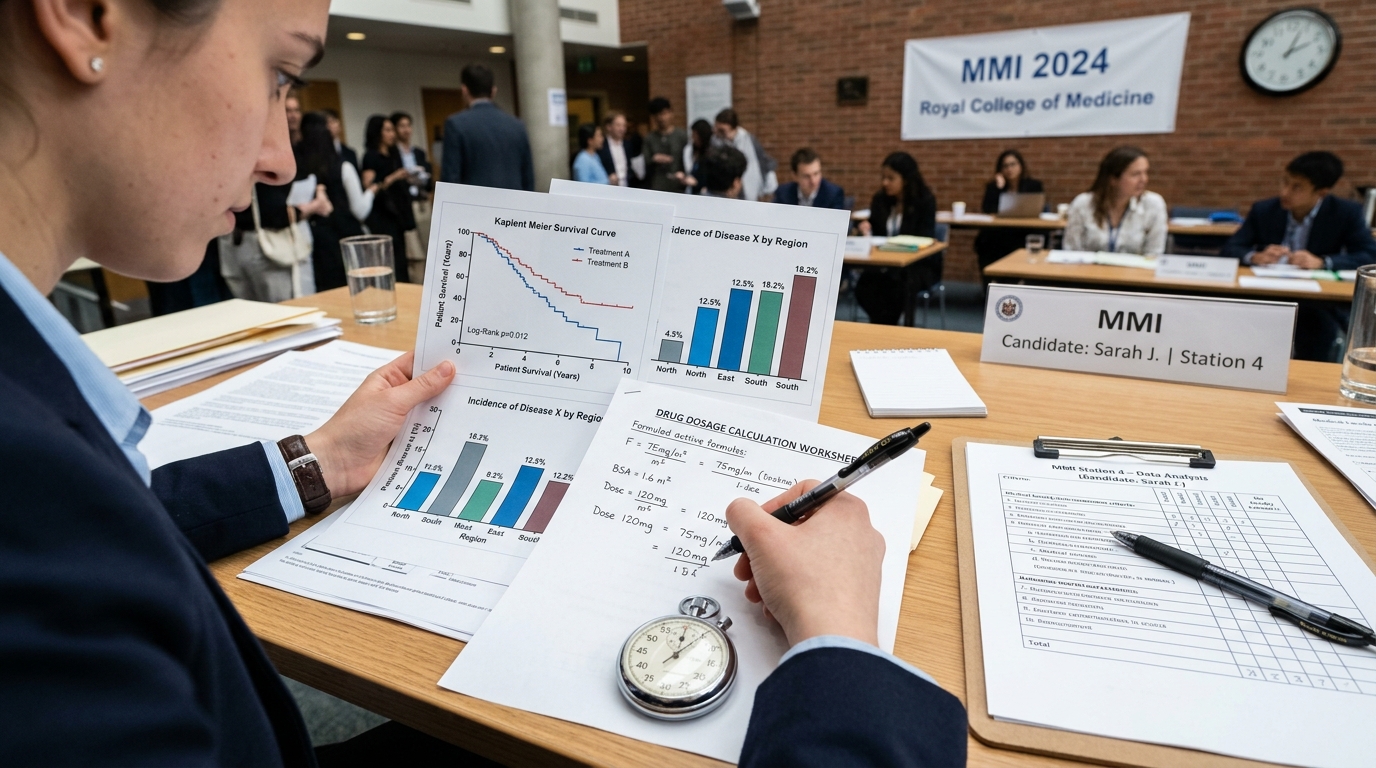

MMI Role-Play & Clinical Communication Station Command Center
Live Simulation
1-on-1 Actor Station Coaching
Practice real-time role-play simulations with experienced medical actors and receive immediate critique from NHS doctors.
Book Actor Role-Play SessionAI Communication Coach
AI Interview Coach
Simulate difficult patient conversations with real-time feedback on empathy tone, active listening, and de-escalation pacing.
Practice AI Role-Play StationMaster Role-Play Dossier
Download Free PDF Pack
Download the complete 40-page practice pack featuring 15 role-play scenarios, actor briefing prompts, and scoring rubrics.
1. Executive Overview: The Power and Purpose of MMI Role-Play Stations
Among all Multiple Mini Interview stations, role-play stations evoke the greatest anxiety among medical school applicants. Walking into a small room to interact with a trained simulated patient (or an actor portraying an anxious relative, an angry colleague, or a distressed child) tests qualities that cannot be memorized from textbooks: genuine emotional empathy, poise under acute interpersonal stress, spontaneous de-escalation, and active listening.
Medical schools such as King's College London, Manchester, Leeds, Sheffield, St George's, Queen's Belfast, and Warwick incorporate role-play stations because clinical medicine is fundamentally built on human communication. Studies show that over 80% of formal patient complaints in the NHS stem not from clinical incompetence, but from poor communication, perceived arrogance, or feeling unheard.
Crucially, assessors in role-play stations are NOT expecting you to give medical advice or diagnose illnesses—in fact, attempting to offer clinical diagnoses as an unqualified high school student is an automatic red flag. Assessors are evaluating your interpersonal warmth, non-verbal cues, and ability to handle difficult human emotions. This comprehensive guide outlines the master strategies, core communication protocols, and 15 realistic role-play scenarios with candidate instructions and model practice tips.
2. What Examiners Secretly Grade in Role-Play Stations: The 4-Pillar Scoring Rubric
Fast-Track Your College & Career Strategy
Get immediate, personalized AI insights tailored to your grade, strengths, and dream universities — 100% free with instant reports.
Know Your Personality Type for Free
Take our 18-question AI psychometric test to uncover your cognitive archetype, hidden learning superpowers, and ideal university courses.
Personalized Career & University EduPath
Build a step-by-step Grade 8–12 admissions blueprint with AI-matched target universities, exam schedules, and extracurricular profiles.
While you interact with the actor, an examiner sits quietly in the corner grading your performance against an objective marking grid:
Pillar 1: Active Listening & Verbal Validation: Do you allow the actor to speak without interruption? Do you reflect back their emotions using phrases like 'I hear how distressing this has been for you' rather than immediately rushing to solve the problem?
Pillar 2: Non-Verbal Communication & Body Language: Do you maintain open, non-defensive posture? Is your eye contact compassionate without staring? Do you nod attentively and modulate your vocal tone to match the gravity of the conversation?
Pillar 3: Empathy vs Sympathy: Sympathy is feeling sorry for someone ('That is terrible'); empathy is understanding and sharing their emotional reality ('I can see how overwhelming it feels to wait three hours when you are in pain'). Assessors look for deep, authentic empathy.
| Scenario Theme | Emotional Core | Common Candidate Pitfall | Winning Technique & Framework |
|---|---|---|---|
| Angry Patient (Long Wait) | Frustration & neglected pain | Making bureaucratic excuses | CALM method: validate pain, apologize, offer water & timeline |
| Friend with Suicidal Secret | Despair, fear & isolation | Promising absolute confidentiality | Refuse secrecy warmly; prioritize life; escort to crisis support |
| Elderly Patient Feeling Ignored | Dignity stripped by jargon | Speaking about them to family | Sit at eye level; hold hand; restore autonomy in care decisions |
| Colleague Drinking on Shift | Severe shame & stress | Ignoring it out of loyalty | Firmly stop clinical work; escort to occupational health support |
| Lost Borrowed Laptop | Guilt & devastating loss | Blaming library security / excuses | SPIKES protocol: full accountability, apology, IT & cloud search |
| Vaccine-Hesitant Parent | Protective maternal fear | Mocking or lecturing parent | Validate love for child; explore root fear; debunk Wakefield data |
| Non-Compliant Heart Patient | Medicine ruins quality of life | Scolding patient on compliance | Uncover hidden obstacle; adjust dosing schedule collaboratively |
| Grieving Sudden Death | Acute shock & numbness | Offering toxic positivity clichés | Embrace silence; sit quietly; offer tissues and contact family |
| Intimidating Consultant Error | Hierarchy fear vs safety | Staying silent out of intimidation | PACE technique: firm, respectful alert to penicillin allergy |
| Anxious Relative (Dementia) | Guilt & fear of neglect | Defending hospital staff loudly | Validate anger; inspect mother immediately; engage PALS team |
Pillar 4: Professional Boundaries & Practical Problem-Solving: Do you stay within your competence without making false promises? Do you collaborate with the actor to establish a concrete, step-by-step path forward?
3. The 3-Phase Structure of Every 7-Minute Role-Play Station
To manage your 7 minutes effectively, structure every role-play station into three distinct clinical phases:
Phase 1: Rapport Building & Information Gathering (Minutes 1 to 3): Introduce yourself warmly, clarify the other person's name, sit down comfortably, and use an open-ended invitation: 'I understand you wanted to speak with me today; could you tell me what has been happening?' Listen without interruption for at least 60 to 90 seconds.
Phase 2: Exploration & Emotional Validation (Minutes 3 to 5): Acknowledge their feelings directly. Explore the underlying causes: 'When you say you feel ignored, what specifically happened that made you feel that way?' Paraphrase their concerns to prove you have truly listened.
Phase 3: Collaborative Action Plan & Summary (Minutes 5 to 7): Never impose a top-down solution. Partner with them: 'Here is what we can do right now... How does that sound to you?' Summarize the agreed next steps and check their comfort level before the bell rings.
4. Breaking Bad News Protocol: Mastering the SPIKES Framework
When a scenario involves delivering upsetting news (e.g., admitting you broke a friend's heirloom, having to inform a patient an appointment is canceled), follow the internationally accredited SPIKES protocol:
S - Setting: Ensure privacy, minimize distractions, sit down at eye level, and ensure tissues are available.
P - Perception: Ask what the person already knows: 'Before we discuss this, how much do you understand about what happened?'
I - Invitation: Ask if they are ready to hear the information now or prefer someone to be with them.
K - Knowledge: Deliver a gentle 'warning shot' followed by clear, non-jargon truth: 'I am afraid I have some difficult news to share with you...'
E - Empathy: Pause immediately. Expect tears, shock, or anger. Acknowledge the emotion: 'I can see how much shock this is causing you; take all the time you need.'
S - Strategy & Summary: Formulate an actionable plan together and confirm support networks.
5. De-Escalating the Angry and Aggressive Person: The CALM Technique
Encountering an aggressive or shouting actor is one of the most common MMI stress tests. Use the CALM framework:
C - Stay Calm & Centered: Take a slow breath. Never match their raised volume or defensive tone. Speak in a quiet, steady, calm voice (which naturally forces the other person to lower their volume to hear you).
A - Acknowledge the Anger: Do not tell an angry person to 'calm down'—this universally makes people angrier. Say: 'I can see how furious you are about this delay, and I completely understand why you feel that way.'
L - Listen Actively: Let them vent their initial surge of anger without talking over them. Maintain relaxed, open body language with uncrossed arms.
M - Move to Solutions: Once their emotional peak subsides, transition into practical options: 'Now that I understand the full situation, let us look at what we can do right now to put this right.'
6. Scenario 1: The Frustrated Patient Waiting 4 Hours in the Waiting Room
Candidate Instructions: You are a volunteer at an NHS hospital outpatient clinic. John, a 52-year-old patient, approaches the reception desk visibly furious because his clinic appointment is running 4 hours late. He is shouting that the NHS is useless and demanding to see the consultant immediately.
Actor Brief: You have taken unpaid leave from work to attend this appointment. Your hip is in agony, and nobody has offered you an explanation or an apology. You feel completely disregarded.
Candidate Strategy & Practice Tips: 1) Step out from behind the desk to reduce physical hierarchy; 2) Do not make bureaucratic excuses ('We are short-staffed'); 3) Validate his pain and lost time: 'Mr. Davis, waiting four hours while in severe physical pain is completely unacceptable, and I sincerely apologize for the lack of communication'; 4) Offer practical comforts: a glass of water, checking where he is on the clinic list; 5) Explain honestly that an acute clinical emergency required the consultant's immediate attention, and give him an accurate realistic estimate of wait time.
7. Scenario 2: The Close Friend Asking You to Keep a Dangerous Secret
Candidate Instructions: You are meeting your close friend Mark in a university cafe. Mark confides in you that he has been feeling intensely suicidal and has bought a stockpiled supply of prescription painkillers. He begs you to promise on your friendship that you will never tell anyone.
Actor Brief: You are overwhelmed by academic failure and depression. You trust your friend, but you are terrified of being hospitalized or judged by your family. You demand an absolute promise of secrecy.
Candidate Strategy & Practice Tips: 1) NEVER promise unconditional confidentiality when someone's life is in imminent danger; 2) Respond with profound warmth: 'Mark, you are my close friend, and hearing you in this much pain breaks my heart. I promise I will stand by you through every step of this, but because I care about you staying alive, I cannot keep a secret that puts your life at risk'; 3) Validate his feelings of despair without judgment; 4) Support him to seek urgent help together: offering to walk with him right now to the university mental health crisis team, A&E, or calling 111/Samaritans together.
8. Scenario 3: The Elderly Patient Feeling Ignored by the Medical Team
Candidate Instructions: You are volunteering on a geriatric rehabilitation ward. Mrs. Higgins, an 81-year-old patient recovering from a stroke, is crying in her chair. She tells you that the doctors talk about her over the foot of her bed as if she were an object and that nobody explains what is happening.
Actor Brief: You were a headmistress for 35 years. You feel stripped of your dignity. The medical team uses medical jargon and speaks to your daughter rather than looking at you.
Candidate Strategy & Practice Tips: 1) Pull up a chair and sit directly at eye level with Mrs. Higgins, holding her hand if appropriate; 2) Validate her loss of autonomy: 'Mrs. Higgins, it must feel deeply distressing to feel like people are talking about you rather than with you, especially after such a distinguished career of leadership'; 3) Reassure her that she remains the central decision-maker in her care; 4) Ask for her permission to raise this with the ward sister or consultant so that future ward rounds address her directly.
9. Scenario 4: The Colleague Disclosing Chronic Alcohol Relapse
Candidate Instructions: You are in the staff room. Your close nursing colleague Sarah breaks down in tears and confides that she has relapsed into heavy alcohol consumption to cope with work stress, and she drank vodka this morning before coming to work.
Actor Brief: You are terrified of losing your nursing registration. You know you made a terrible mistake by drinking today, but you feel completely trapped by stress and shame.
Candidate Strategy & Practice Tips: 1) Express immediate compassionate concern for her personal health and well-being; 2) Firmly uphold patient safety: 'Sarah, I care about you deeply and want to help you recover, but you cannot be caring for patients today when your judgment is impaired'; 3) Offer to accompany her right now to speak with the nurse manager or occupational health; 4) Clarify that occupational health exists to support staff rehabilitation, not simply punish; 5) Ensure she does not return to the ward floor under any circumstances.
10. Scenario 5: Breaking Bad News: You Accidentally Lost a Borrowed Laptop
Candidate Instructions: You borrowed your flatmate David's high-end laptop to complete your university coursework. While studying in the library, you stepped away for 5 minutes, and the laptop—which contained David's unbacked-up master's dissertation—was stolen. You are now meeting David to tell him.
Actor Brief: You have spent 9 months researching this dissertation, due in 4 days. When told, you experience profound shock, then furious despair.
Candidate Strategy & Practice Tips: 1) Apply the SPIKES protocol; 2) Deliver the warning shot: 'David, I am so sorry, but I have some terrible news to tell you about your laptop'; 3) Take 100% full accountability—do NOT make excuses ('The library security was asleep'); 4) Allow him to express anger and shock without defending yourself; 5) Offer constructive remedies: immediately notifying library IT and security, checking if cloud autosave (OneDrive/Google Drive) preserved drafts, offering to purchase a replacement immediately, and helping him contact his university department for an emergency mitigating circumstances extension.
11. Scenario 6: The Vaccine-Hesitant Parent Refusing the MMR Vaccine
Candidate Instructions: You are a medical student shadowing a community pediatric clinic. A mother, Claire, refuses to allow her 13-month-old son to receive the MMR (Measles, Mumps, Rubella) vaccine, citing articles she read online about autism and toxic additives.
Actor Brief: You love your son and are genuinely terrified of doing something that might harm him. You expect the doctor to be condescending and dismissive of your concerns.
Candidate Strategy & Practice Tips: 1) NEVER ridicule or dismiss her concerns; 2) Validate her maternal protective instinct: 'Claire, I can see how deeply you love your son and that every question you are asking comes from wanting to keep him safe'; 3) Ask open-ended questions: 'Could you tell me more about what you read online and what worries you most?'; 4) Address the historical context: gently explain the fraudulent 1998 Wakefield paper that has been thoroughly retracted and debunked across millions of children globally; 5) Share the genuine, severe risks of measles (pneumonia, encephalitis); 6) Provide approved NHS informational leaflets and invite her back for a follow-up discussion without pressuring her.
12. Scenario 7: The Non-Compliant Patient with Chronic Heart Failure
Candidate Instructions: You are speaking with Mr. Davies, a 64-year-old heart failure patient who has been readmitted for the third time in two months with severe fluid retention. The medical notes show he repeatedly stops taking his furosemide diuretics and ignores fluid restrictions.
Actor Brief: You hate taking the water tablets because they make you need the toilet every 20 minutes, which means you cannot leave the house or visit your grandchildren. You feel like the medicine ruins your life.
Candidate Strategy & Practice Tips: 1) Avoid lecturing him about medication compliance; 2) Uncover the hidden barrier: 'Mr. Davies, taking medication every day is tough. What is the hardest part about taking these tablets for you?'; 3) When he reveals the urinary frequency barrier, show profound empathy: 'I completely understand why needing the bathroom constantly makes you feel isolated from your family'; 4) Propose collaborative medical solutions: consulting the cardiologist to adjust the dosage timing (e.g., taking tablets early in the morning so afternoons are free) to give him his life back while protecting his heart.
13. Scenario 8: Comforting a Grieving Relative After an Unexpected Cardiac Arrest
Candidate Instructions: You are in a hospital family quiet room. Mrs. Taylor has just been informed that her 48-year-old husband passed away suddenly from a massive myocardial infarction. She is sitting in complete silence, trembling in shock.
Actor Brief: Your husband was healthy this morning. You cannot process that he is gone. You transition between numbness, denial ('This cannot be real'), and tears.
Candidate Strategy & Practice Tips: 1) Sit quietly beside her without speaking immediately; silence is a profound communication tool in acute grief; 2) Offer a warm, gentle presence and a tissue or glass of water; 3) Acknowledge the sheer shock: 'Mrs. Taylor, there are no words to take away this unimaginable pain, but I am right here with you'; 4) Do NOT offer toxic positivity clichés ('He is in a better place' or 'Everything happens for a reason'); 5) Ask gently if there is family, a close friend, or a faith leader you can call to be with her right now.
14. Scenario 9: Mediating a Heated Dispute Between Two University Project Teammates
Candidate Instructions: You are the leader of a 4-person university group presentation worth 40% of your grade. Two members, Alex and Priya, are screaming at each other. Alex accuses Priya of doing zero work; Priya accuses Alex of being an aggressive control freak who deleted her slides.
Actor Brief: Both actors are defensive, stressed, and angry. Each demands that the candidate take their side and kick the other person off the team.
Candidate Strategy & Practice Tips: 1) De-escalate the room: 'Let us take a breath. We all care deeply about this presentation, and our goal is to deliver an outstanding project together'; 2) Separate the people from the problem; 3) Give each person 2 minutes of uninterrupted speaking time while the other listens; 4) Summarize the legitimate grievances of both sides; 5) Re-establish objective structure: create a clear, transparent shared document where responsibilities and deadlines are explicitly mapped out.
15. Scenario 10: Confronting a Superior About an Overlooked Medication Allergy
Candidate Instructions: You are a medical student on an acute medical ward. Your consultant physician, who is notoriously intimidating and busy, writes a prescription for penicillin for an unconscious patient. You notice on the patient's wristband that they have a severe, anaphylactic allergy to penicillin.
Actor Brief: You are a stressed, rushed consultant. When the student speaks, you snap: 'I have been a doctor for 25 years; do not interrupt me while I am reviewing charts.'
Candidate Strategy & Practice Tips: 1) Uphold the non-negotiable rule: Patient safety supersedes all medical hierarchy; 2) Use the graded assertiveness PACE technique (Probe, Alert, Challenge, Emergency); 3) Speak with calm, polite, but unwavering clarity: 'Dr. Smith, I understand you are under immense pressure, but I must stop you immediately: the red wristband indicates this patient has a documented anaphylactic allergy to penicillin'; 4) Stand your ground firmly until the prescription is rescinded and verified; 5) Never allow intimidation to silence a safety concern.
16. Scenario 11: The Secretive Teenager Suspected of an Eating Disorder
Candidate Instructions: You are talking to your 16-year-old sister's friend, Emma, who is staying at your house. You notice she has lost significant weight, wears baggy clothes, cuts her food into tiny pieces, and immediately runs to the bathroom after eating. She catches you watching her.
Actor Brief: You are deeply defensive, anxious, and ashamed. You snap: 'Why are you staring at me? I am completely fine, stop being creepy.'
Candidate Strategy & Practice Tips: 1) Defuse defensiveness immediately: apologize for making her feel uncomfortable; 2) Frame your inquiry around care, not physical appearance: avoid saying 'You look so skinny'; say: 'I noticed you seem really stressed and burdened lately, and I just wanted to make sure you are okay'; 3) Create a safe, pressure-free space for her to talk; 4) Normalize seeking help: mention BEAT (the UK eating disorder charity) and encourage her to confide in someone she trusts.
17. Scenario 12: An Anxious Relative Suspecting Hospital Neglect
Candidate Instructions: You are an NHS hospital volunteer. David approaches you demanding to see the chief executive. His 84-year-old mother with dementia was left in soiled bedsheets for an hour because nurses were managing a cardiac arrest in the next room. He accuses the ward of elder abuse.
Actor Brief: You feel intense guilt about putting your mother in hospital. Seeing her in soiled sheets makes you furious and heartbroken.
Candidate Strategy & Practice Tips: 1) Validate his distress completely: 'Seeing your mother in that state must have been agonizing for you, and I am so sorry that happened'; 2) Immediately take action: inform the nursing team to attend to his mother's comfort and hygiene right now; 3) Explain transparently that a critical medical emergency occurred, but acknowledge that communication should have been better; 4) Offer to connect him with the ward sister and the PALS (Patient Advice and Liaison Service) team.
18. Scenario 13: Exploring End-of-Life Wishes with a Terminally Ill Patient
Candidate Instructions: You are volunteering at a hospice. Arthur, an 80-year-old retired carpenter with terminal motor neurone disease, tells you quietly: 'I am so tired. I don't want any more machines or tubes. I just want to slip away peacefully in my own bed.'
Actor Brief: You are calm, reflective, and tired of struggling to breathe. You want someone to listen to your wishes without panicking or trying to give you false cheer.
Candidate Strategy & Practice Tips: 1) Match his calm, dignified tone; 2) Validate his autonomy and fatigue: 'Arthur, it takes immense courage to share that, and it is completely understandable that you want peace and dignity'; 3) Listen deeply to what matters to him in his remaining time; 4) Explain how palliative care teams support Advance Care Planning (ACP) and ReSPECT forms to ensure his wishes are legally documented and respected by all clinicians.
19. Scenario 14: The Demanding Patient Insisting on Inappropriate Antibiotics
Candidate Instructions: You are observing in a GP surgery. A 35-year-old corporate lawyer, Sarah, has a 2-day history of a common cold and viral sore throat. She demands a prescription for amoxicillin, stating: 'I have a major client presentation tomorrow and do not have time to be sick.'
Actor Brief: You are used to getting what you want through executive assertiveness. You view antibiotics as a fast-acting cure and view doctors who refuse them as unhelpful gatekeepers.
Candidate Strategy & Practice Tips: 1) Acknowledge the immense pressure of her presentation and career; 2) Explain the biology clearly without condescension: antibiotics only kill bacteria, not viruses like the common cold, so taking them will not cure her cold or speed up recovery; 3) Explain the genuine personal risks: side effects (diarrhea, allergic rash) and antimicrobial resistance; 4) Offer effective symptomatic relief: high-dose paracetamol, honey-lemon lozenges, and decongestant sprays; 5) Offer a delayed prescription or safety-netting advice if symptoms worsen after a week.
20. Scenario 15: The Distressed Coworker Struggling with Severe Imposter Syndrome
Candidate Instructions: You are a first-year medical student. Your peer Marcus is packing his locker during dissection lab, crying and whispering: 'I don't belong here. Everyone else is smarter, their parents are doctors, and I am going to fail out. I made a huge mistake coming to medical school.'
Actor Brief: You are from a working-class background and the first in your family to attend university. You failed your first anatomy quiz and feel totally out of place.
Candidate Strategy & Practice Tips: 1) Normalize imposter syndrome immediately: 'Marcus, almost every single person in our cohort feels like an imposter at times, including me'; 2) Validate his belonging: remind him that medical school admissions committees chose him out of thousands of applicants because of his proven brilliance and empathy; 3) Share practical study strategies: forming a peer dissection study group; 4) Encourage him to speak with his personal academic tutor for supportive study skills guidance.
21. Comparative Table: 15 MMI Role-Play Scenarios, Traps, and Key Techniques
The following master reference matrix outlines the 15 role-play scenarios, their primary communication traps, and the winning clinical technique:
22. Non-Verbal Communication Mastery: Micro-Expressions and Vocal Modulation
Over 70% of human communication is non-verbal, especially during emotionally charged interactions:
The 45-Degree Seating Angle: In role-play stations, avoid sitting directly face-to-face across a table like an interrogation. Position your chair at a slight 45-degree angle to create a collaborative, conversational atmosphere.
Vocal Modulation: Lower your pitch slightly and speak at an unhurried, steady pace. When the actor speaks about something painful, soften your tone.
The Power of the Thoughtful Nod: Practice the slow, empathetic head nod while listening to communicate that you are tracking their emotional reality.
23. Handling Role-Play Actors Who Refuse to Cooperate: The 'Stone-Wall' Test
In some MMI stations, actors are deliberately briefed to give one-word answers or cross their arms in hostile silence:
Why Medical Schools Do This: To see if you panic, start rambling, or become frustrated.
How to Break the Deadlock: 1) Acknowledge the silence gently: 'I can sense that you are feeling reluctant to talk right now, and that is completely okay'; 2) Remove pressure: 'We do not have to rush into anything. I am happy to just sit here with you until you feel ready'; 3) Use gentle, open curiosity: 'Is there anything I can do right now to make this space feel safer for you?'.
24. The Critical Difference Between Medical Advice and Interpersonal Empathy
The single most fatal mistake in MMI role-play stations is pretending to be a qualified doctor:
Do NOT Say: 'Take two paracetamol every four hours and we will order an MRI scan for your knee.'
DO Say: 'I can see how much pain your knee is causing you. While I am not a doctor and cannot give medical advice, I will make sure the medical team examines your knee as soon as possible.'
25. Emotional Regulation Under Pressure: Managing Your Own Nervousness
Role-play stations trigger physiological adrenaline spikes in candidates:
The Box Breathing Technique: Practice inhaling for 4 seconds, holding for 4 seconds, exhaling for 4 seconds, and holding for 4 seconds before entering the station.
Reframing Anxiety as Compassion: Instead of thinking 'I am being judged by an examiner,' tell yourself 'There is an actor in that room pretending to be in pain, and my job is to make them feel cared for and heard for 7 minutes.'
26. Feedback and Post-Station Self-Reflection: How to Answer Examiner Probes
At the end of some role-play stations, the examiner asks: 'How do you think that conversation went?'
The Balanced Reflection Formula: 1) Highlight what went well: 'I felt I established good initial rapport and validated her frustration effectively'; 2) Acknowledge areas for refinement: 'In retrospect, I could have explored her home support network earlier in the conversation'; 3) Demonstrates high emotional intelligence and capacity for reflective learning.
27. Practicing Role-Plays with Peers: The 3-Person Simulation Protocol
How to practice effectively at home with two friends or family members:
Role 1 (Candidate): Steps outside the room for 1 minute reading the candidate brief, then completes the 7-minute station.
Role 2 (Actor): Memorizes the actor brief and stays strictly in character, responding dynamically to the candidate's empathy.
Role 3 (Examiner): Sits quietly with a stopwatch and scoring rubric, taking notes on active listening, eye contact, and de-escalation.
Rotate roles after each scenario to gain deep empathy for both sides of the consultation desk.
28. Case Study: Queen's Belfast MMI Role-Play (Full Marks Breakdown)
A candidate at Queen's University Belfast was tested on breaking bad news about a lost library book containing irreplaceable handwritten family recipes:
Why the Candidate Scored Full Marks: The candidate did not make excuses; she leaned forward, apologized with heartfelt sincerity, helped the actor brainstorm whether relatives might have copies, and offered to pay for professional book restoration if found.
29. Case Study: Recovering from an Interpersonal Stumble at Leeds MMI
At Leeds School of Medicine, an applicant accidentally interrupted an angry actor:
The Masterful Recovery: The candidate immediately caught herself: 'I am so sorry for interrupting you, please continue; I want to hear everything you have to say.' This instant humility and self-awareness scored higher marks than if the stumble had never occurred.
30. Checklist: What to Remember When the Buzzer Sounds
1. Read the scenario prompt outside the door twice; identify who the person is and their emotional state.
2. Knock gently, enter with a warm smile, and introduce yourself by name.
3. Sit down at eye level; never stand over a seated actor.
4. Listen without speaking for the first 60 seconds.
5. Validate emotions before proposing solutions.
6. Never make false promises or give unqualified medical advice.
7. Keep an unhurried, calm, and soothing vocal tone.
8. Involve them in creating the action plan.
9. Summarize agreed next steps in the final 60 seconds.
10. Thank them sincerely as the buzzer rings.
31. EduQuest MMI Simulation Lab: Medical Actor Stations & Doctor Feedback
Mastering role-play requires practicing with realistic simulated patients who test your emotional limits:
EduQuest operates simulated MMI circuits featuring professional medical actors and NHS doctor examiners.
We simulate real-time de-escalation scenarios, record your stations for video micro-expression analysis, and provide personalized coaching to transform communication anxiety into effortless clinical empathy.
32. Strategic Conclusion & Next Steps: Communicating with the Heart of a Doctor
Role-play stations are your golden opportunity to show medical schools the compassionate, emotionally intelligent clinician you will become.
By focusing on authentic active listening, mastering the SPIKES protocol, and viewing every interaction as a partnership of care, you turn the role-play station into your highest-scoring MMI asset.
Connect with EduQuest today to practice live simulated MMI role-play stations and secure your medical school offer.
33. Frequently Asked Questions: MMI Role-Play Scenarios and Practice Tips
Detailed answers to common questions about actor stations, breaking bad news, and handling uncooperative simulated patients.
Hone Your Clinical Communication with EduQuest AI Intelligence Suite
Simulate live actor role-play stations, evaluate your empathetic language, and receive instant feedback on non-verbal pacing and de-escalation.
AI MMI & Interview Coach
Simulate challenging role-play stations with conversational AI actors portraying angry patients, grieving relatives, and anxious colleagues.
- ✓ Empathy Tone Analysis
- ✓ SPIKES Protocol Compliance
- ✓ De-escalation Pacing Metrics
Narrative Intelligence Engine
Scans your UCAS personal statement and medical reflective essays against successful UK medical school applications.
- ✓ Work Experience Reflection Check
- ✓ Scientific Rigor Scoring
- ✓ GMC Values Alignment
EduPath Admissions Profiler
Calculates your interview invitation probability across all 42 UK medical schools based on your UCAT and academic profile.
- ✓ UCAT Cutoff Prediction
- ✓ Strategic Medical School Shortlisting
- ✓ International Quota Modeling
Career Cluster Assessment
Aligns your clinical interests with medical and surgical specialties across the NHS and international healthcare markets.
- ✓ Clinical Specialty Diagnostic
- ✓ Surgical vs Medical Personality Mapping
- ✓ NHS Training Pathway Index
What is the primary objective of an MMI role-play station?
Role-play stations assess non-academic, interpersonal competencies: empathy, active listening, de-escalation, professional boundaries, and emotional resilience. Assessors evaluate how you communicate and make the other person feel, rather than your factual medical knowledge.
Should I give medical advice in an MMI role-play station?
No. Never give medical advice or diagnose conditions. As a medical school applicant, you are unqualified to prescribe or diagnose. Giving clinical advice is an immediate error. Focus on empathy, active listening, and directing the patient to appropriate medical professionals.
What should I do if an actor starts shouting or crying?
Stay calm, lower your vocal pitch, and maintain open body language. Do not tell an angry person to 'calm down.' Validate their emotions directly: 'I can see how furious/distressed you are, and I am right here with you.' Let them vent before transitioning to collaborative problem-solving.
What is the SPIKES protocol in medical interviews?
SPIKES is a 6-step clinical framework for breaking bad news: Setting (privacy), Perception (asking what they know), Invitation (checking readiness), Knowledge (giving a warning shot before the news), Empathy (acknowledging emotional reactions), and Strategy & Summary (planning next steps together).
How should I handle a friend asking me to keep a suicidal thought secret?
Never promise unconditional confidentiality when a life is in imminent danger. Reassure your friend of your deep care and loyalty, but explain with warmth that because you value their life, you cannot keep a secret that endangers them. Offer to accompany them immediately to crisis support.
Download the MMI Role-Play & Communication Mastery Pack (PDF)
Get our full 40-page practice workbook featuring 15 complete actor briefing scripts, candidate instructions, de-escalation frameworks, and examiner scoring rubrics.