
Indian students are used to eligibility rules that are strict and precise: minimum percentage cutoffs in Class 12, rigid stream criteria, strict age limits, and domicile restrictions. So when families begin planning for international admissions, one of the first questions is: "Am I even eligible to take the ACT?"
The answer is refreshingly open, but it comes with a crucial distinction that many families miss: there is a profound difference between being eligible to take the ACT exam and being eligible for admission to a university that accepts your ACT score. Mixing the two up causes real confusion and misdirected effort.
This guide clarifies both dimensions completely: official ACT exam eligibility, the ACT exam age limit, attempt restrictions, international candidate logistics for India, a class-by-class timeline, and specific expectations for institutions like MIT and the Ivy League.
Fast-Track Your College & Career Strategy
Get immediate, personalized AI insights tailored to your grade, strengths, and dream universities — 100% free with instant reports.
Know Your Personality Type for Free
Take our 18-question AI psychometric test to uncover your cognitive archetype, hidden learning superpowers, and ideal university courses.
Personalized Career & University EduPath
Build a step-by-step Grade 8–12 admissions blueprint with AI-matched target universities, exam schedules, and extracurricular profiles.
1. The Short Answer: Who Can Take the ACT?
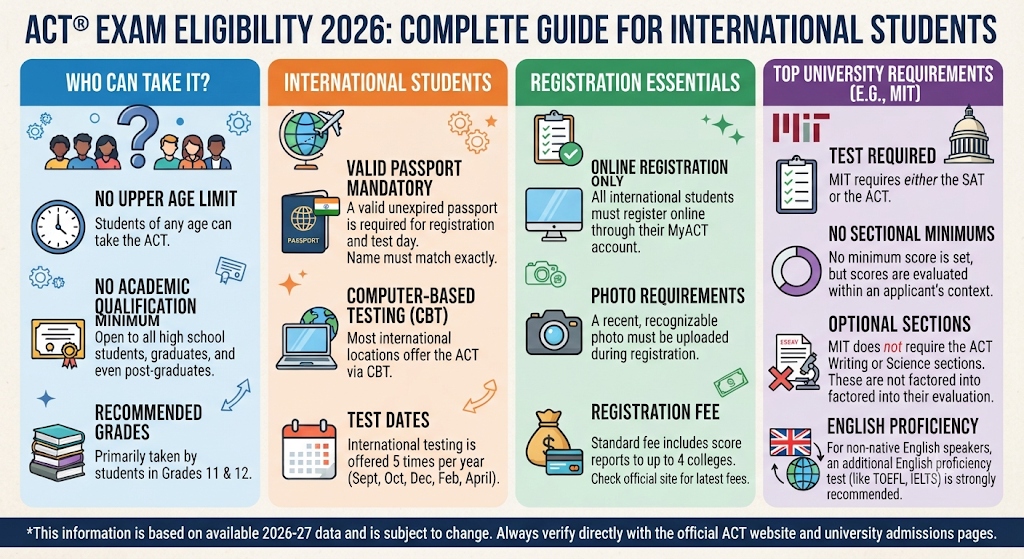
ACT sets no formal educational prerequisites. The examination is open to any individual worldwide who can create a MyACT account, pay the international fee, and present valid identification on test day:
| Eligibility Criterion | Official ACT Regulation | Practical Application for Indian Candidates |
|---|---|---|
| Minimum Academic Qualification | None prescribed by ACT | Students from CBSE, ICSE, IB, Cambridge, or State boards in Classes 10–12 can register. |
| Minimum High School Marks / GPA | None required to register | Zero minimum cutoffs. However, target universities evaluate GPA alongside ACT scores. |
| Age Limit (Upper & Lower) | No upper age limit | High schoolers, gap-year candidates, and adult learners can test. Students under 13 register with parental consent. |
| Nationality & Citizenship | Open to all nationalities | Indian citizens test on the International Test Schedule at Prometric CBT centers. |
| Total Permitted Attempts | Up to 12 lifetime attempts | Most students take the test 2 or 3 times; 12 is a maximum ceiling, not a target. |
| Identification Document | Unexpired government photo ID | A physical Indian Passport is mandatory for test center admission in India. |
| Curriculum Stream | Open to all streams | Science, Commerce, and Humanities students are equally eligible. |
2. ACT Exam Age Limit: What Is the Exact Policy?
ACT exam age limit is among the most frequently searched queries. Here is the definitive policy:
- No Upper Age Ceiling: Adults returning to complete an undergraduate degree, working professionals, and gap-year students can register without restriction.
- No Formal Grade Requirement: While designed primarily for students in Grades 11 and 12 (Classes 11 and 12 in India), younger students in Class 10 can take the test.
- Students Under 13: ACT complies with international digital privacy regulations (COPPA). Examinees under age 13 may require parent or guardian verification during the MyACT account creation process.
3. Academic Eligibility: Do You Need Minimum Marks?
No. ACT does not require a minimum percentage in Class 10 or Class 12 board examinations. A student with 60% in school exams is just as eligible to register as a student with 98%.
However, the exam assumes academic proficiency in core high school areas:
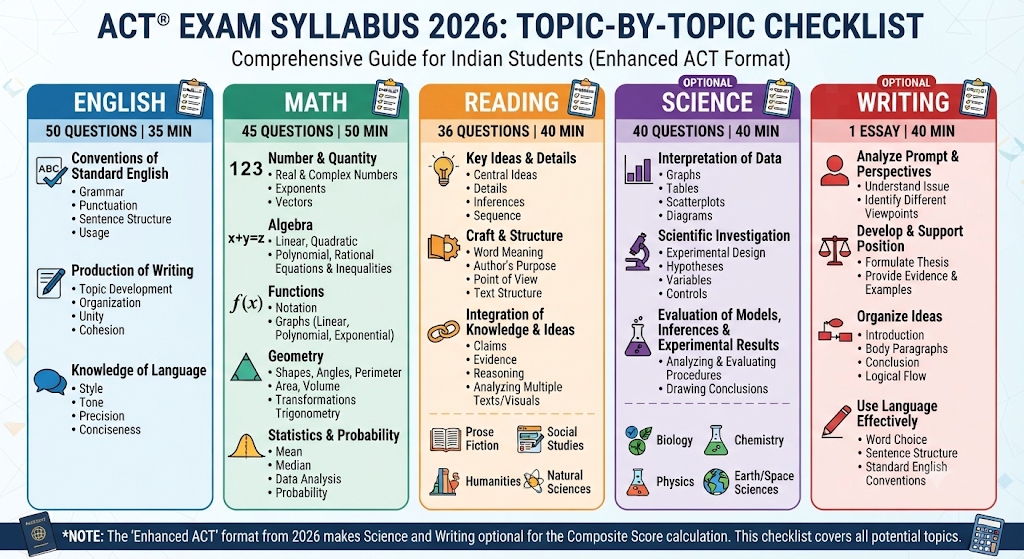
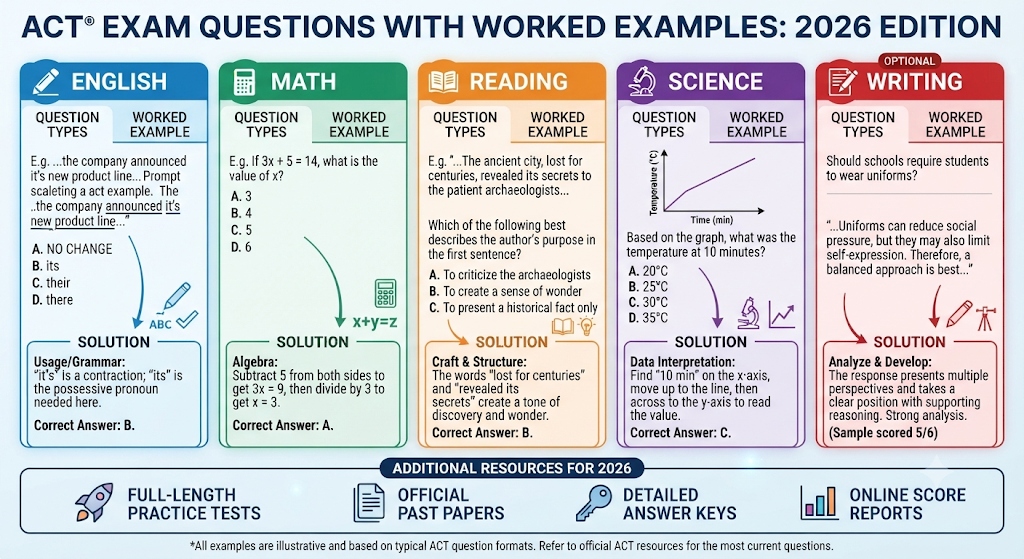
- English: Standard grammar conventions, sentence boundaries, and reading comprehension at a secondary school level.
- Mathematics: Foundational algebra, plane and coordinate geometry, right-triangle trigonometry, and statistics typically covered by the middle of Class 11.
- Science (Optional): The ability to read data graphs, tables, and experimental variables (covered in Class 9 and 10 science).
4. Attempt Limits: How Many Times Can I Take the ACT?
ACT's official examinee retest policy allows a candidate to take the ACT up to 12 times in total across their lifetime. Key retesting rules include:
- You may test only once during any specific testing weekend window.
- Any scores achieved beyond the 12-attempt limit are automatically canceled without refund.
- Strategic Reality: Taking the test 12 times is neither necessary nor advisable. University admissions deans recommend sitting for the ACT two or three times. Preparing thoroughly and utilizing ACT's official Superscore yields peak results without triggering application fatigue.
5. ACT Exam for International Students: The Indian Context
As an Indian candidate, you are classified as an international test-taker in ACT's portal. This brings specific operational realities:
- International Test Schedule: You test on ACT's international calendar (September, October, December, February, April, June, July) rather than US national dates.
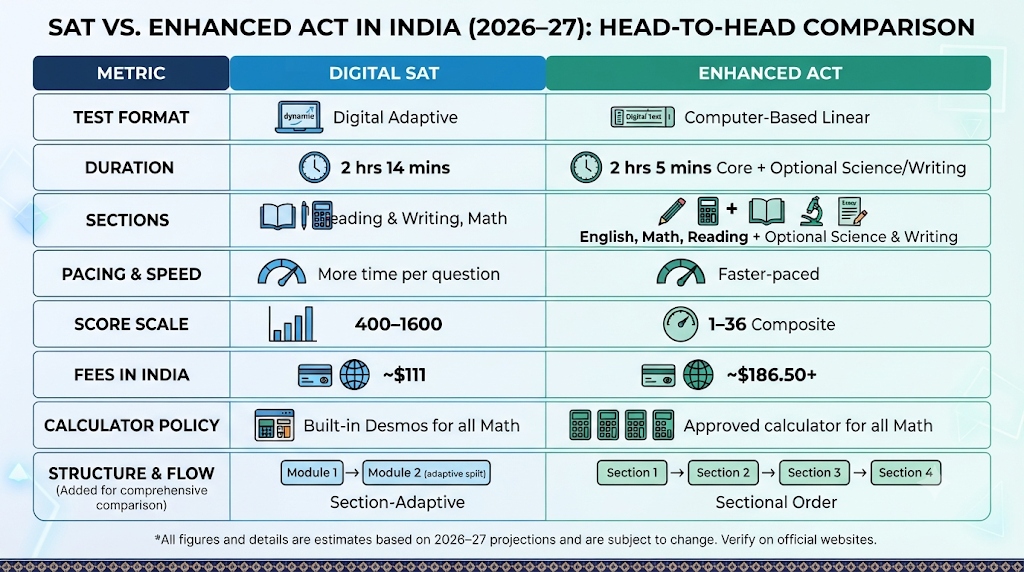
- International Pricing: Registration is billed in US dollars ($186.50 without Writing; $211.50 with Writing). Fee waivers provided by ACT are reserved for US domestic candidates and do not apply to international test-takers.
- Mandatory Passport ID: At Prometric testing centres across India (Delhi NCR, Mumbai, Bengaluru, Hyderabad, etc.), a valid, unexpired original passport is the sole acceptable photo identification.
- Computer-Based Testing (CBT): All international test centres administer the ACT on desktop computer terminals. Fast score turnaround means multiple-choice results are posted within 1 to 2 business weeks.
6. Test Eligibility vs University Eligibility: The Critical Filter
Understanding this distinction prevents wasted applications:
- Test Eligibility: Can I sit the ACT? Yes, absolutely anyone can.
- University Eligibility: Can I gain admission to my target university? That depends on holistic admissions criteria.
Top universities evaluate a composite of factors alongside your ACT score:
- High school academic transcript and board percentages (Classes 9, 10, 11, and 12 predicted).
- English language proficiency exams (TOEFL / IELTS / Duolingo) for students from non-English speaking schooling.
- Extracurricular leadership, olympiad achievements, published research, and community initiatives.
- Counselor and teacher letters of recommendation.
- Common App personal statement and university-specific supplemental essays.
7. ACT Exam for MIT and Elite US Universities
ACT exam for MIT is one of the most heavily searched queries by Indian STEM aspirants. Here are the precise expectations for MIT and peer institutions:
- Mandatory Testing: MIT strictly requires all undergraduate applicants to submit either official SAT or ACT scores. MIT does not permit test-optional applications.
- Zero Preference: MIT states clearly that it evaluates SAT and ACT scores interchangeably without preference.
- Score Expectations at MIT: For admitted MIT students, the middle 50% ACT Composite range is 34 to 36, with the Math sub-score typically sitting at 35 or 36. Quantitative mastery is non-negotiable for engineering and computer science.
- Science & Writing at MIT: On the Enhanced ACT, MIT does not require the optional Writing section or the optional Science section. However, ambitious STEM applicants frequently take Science to demonstrate research analysis through a standout STEM score.
- Superscoring Policy: MIT superscores both the SAT and ACT, combining your highest sub-scores across all test dates to evaluate your strongest composite.
Download the ACT Eligibility & Elite University Requirements Manual (PDF)
Get immediate access to the official ACT examinee eligibility checklist, 12-attempt management framework, passport verification guidelines, and MIT/Ivy League score benchmark tables.
8. Class-by-Class Testing Timeline for Indian Students
| Academic Year | Recommended Preparation & Testing Milestones |
|---|---|
| Class 9 | Focus on school academics. Read challenging fiction and scientific journals. Build foundational algebra and plane geometry. |
| Class 10 | Master CBSE/ICSE algebra, coordinate geometry, and grammar conventions. Take a baseline diagnostic mock in summer. |
| Class 11 (First Half) | Begin structured ACT preparation. Master pacing and timing. Target your first official attempt in December or February. |
| Class 11 (Second Half) | Review error logs from attempt 1. Sit for attempt 2 in April or June to secure your baseline composite before Class 12 pressure. |
| Class 12 (Autumn) | Take attempt 3 in September if targeting an increased Superscore before Early Action / Early Decision university deadlines in November. |
9. Pre-Registration Eligibility Checklist
- Valid, unexpired physical Indian Passport in hand.
- Exact name match between passport and MyACT account registration.
- Credit/debit card enabled for international US dollar online transactions.
- Digital passport-style headshot photo adhering to ACT specifications.
- Identified list of universities to confirm whether Science or Writing is required.
What is the ACT exam eligibility for Indian students?
Any student who can create a MyACT account, pay the exam fee, and present a valid passport at an authorized test center is eligible. There are no minimum academic percentages.
What is the ACT exam age limit?
There is no upper age limit. High school students, gap-year candidates, and adult learners can register.
How many times can I take the ACT?
ACT permits up to 12 lifetime attempts. Most students test 2 or 3 times to optimize their superscore.
Does MIT require the ACT in 2026?
Yes. MIT mandates standardized test scores, accepting either the SAT or ACT with zero preference.
Can I take the ACT after Class 12 during a gap year?
Yes. Gap-year candidates are fully eligible to sit the ACT on any international test date.
Is a passport mandatory for the ACT in India?
Yes. A valid unexpired passport is the sole authorized identification document for Indian test takers at Prometric centres.
11. Plan Your US Admissions Roadmap at EduQuest Gurgaon
Navigating standardized testing eligibility and elite US university applications requires comprehensive strategy. At EduQuest's learning center in Gurugram, our senior mentors design personalized testing timelines, evaluate diagnostic scores, and guide students toward admissions success at institutions like MIT, Stanford, and the Ivy League.
EduQuest Gurugram Admissions & ACT Mentorship Center
📍 Location
F-45 Baani Square, Sec 50
Unit F-45, Baani Square, Sector 50, Gurugram, Haryana 122018. Easily accessible from Golf Course Extension, Sohna Road, and Nirvana Country.
⏰ Batches
Comprehensive Cohorts
Weekday Batches (Mon–Thu 4:00 PM – 7:00 PM) and Weekend Intensive Batches (Sat–Sun 10:00 AM – 2:00 PM).
🧪 CBT Lab
Diagnostic & Profile Review
Take an authentic CBT mock test paired with a 1-on-1 Ivy League / MIT profile assessment with our senior admissions directors.
Build Your Pathway to MIT and Top US Universities
Join Gurgaon's premier ACT prep and admissions consultancy. Book a diagnostic mock test at Baani Square or schedule a 1-on-1 strategy consultation.