
Students preparing for Indian exams are used to a syllabus: a printed list of chapters, a weightage table and a clear boundary between "included" and "not included." The ACT does not publish that kind of document, and that is exactly why so many students feel lost when they search for the ACT exam syllabus.
If you want a quick ACT exam breakdown or a clear syllabus for ACT exam preparation, here is the truth in one line: the ACT is a skills test, not a chapter test. It does not ask you to memorise a textbook. It checks whether you can edit a paragraph, solve a problem using algebra or geometry, read a passage closely and interpret scientific data under time pressure. The "syllabus" is therefore a set of skills and content areas, not a list of chapters.
That does not mean it is vague. ACT publishes detailed content categories for each section, and once you translate them into topics, you get a practical checklist you can study from. This guide does that for the Enhanced ACT of 2026. It covers the ACT exam structure, the ACT exam sections and ACT exam subjects, then goes through each section topic by topic, includes a dedicated ACT exam math syllabus, maps everything to what Indian students learn in Classes 9 to 12, compares the SAT and ACT exam syllabus, and explains what to do about the "syllabus PDF" that every student keeps looking for.
Fast-Track Your College & Career Strategy
Get immediate, personalized AI insights tailored to your grade, strengths, and dream universities — 100% free with instant reports.
Know Your Personality Type for Free
Take our 18-question AI psychometric test to uncover your cognitive archetype, hidden learning superpowers, and ideal university courses.
Personalized Career & University EduPath
Build a step-by-step Grade 8–12 admissions blueprint with AI-matched target universities, exam schedules, and extracurricular profiles.
1. ACT Exam Structure and Format at a Glance
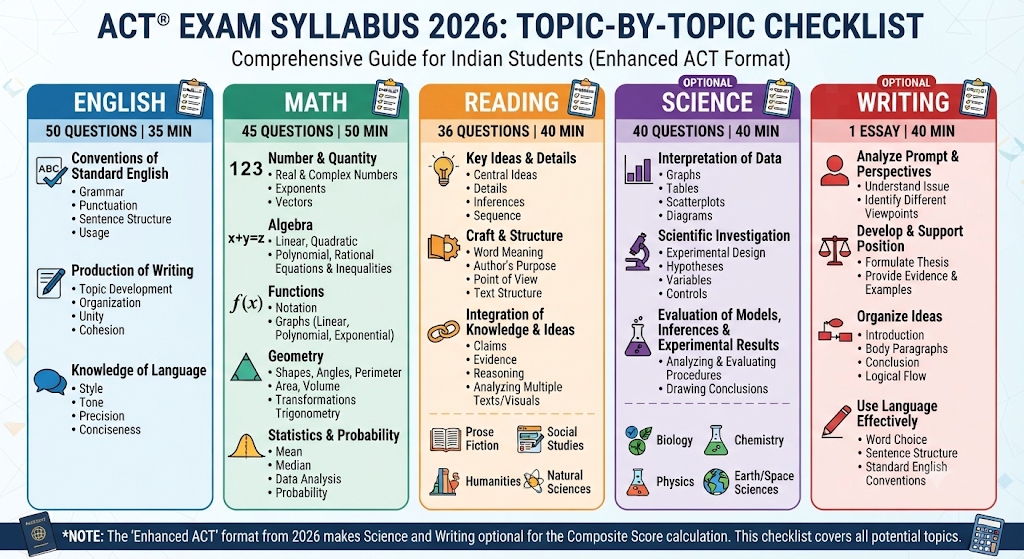
Before the topic list, you need the architectural framework. The ACT exam structure features three core mandatory sections and two optional sections:
| Section | Questions | Time Allocated | Requirement Status | Options / Choices |
|---|---|---|---|---|
| English | 50 questions | 35 minutes | Core (Mandatory) | 4 multiple-choice options (A, B, C, D) |
| Math | 45 questions | 50 minutes | Core (Mandatory) | 4 multiple-choice options (A, B, C, D) |
| Reading | 36 questions | 40 minutes | Core (Mandatory) | 4 multiple-choice options (A, B, C, D) |
| Science | 40 questions | 40 minutes | Optional Section | 4 multiple-choice options (A, B, C, D) |
| Writing | 1 essay prompt | 40 minutes | Optional Section | Open-ended typed argumentative essay |
Key Structural Features of the Enhanced ACT Format:
- Multiple choice throughout: All four main sections feature four answer choices. The Enhanced ACT eliminated the older 5-choice Math format, harmonizing all sections.
- Zero guessing penalty: There is no negative marking. Unanswered questions and incorrect guesses both receive zero points. Always bubble an answer for every item.
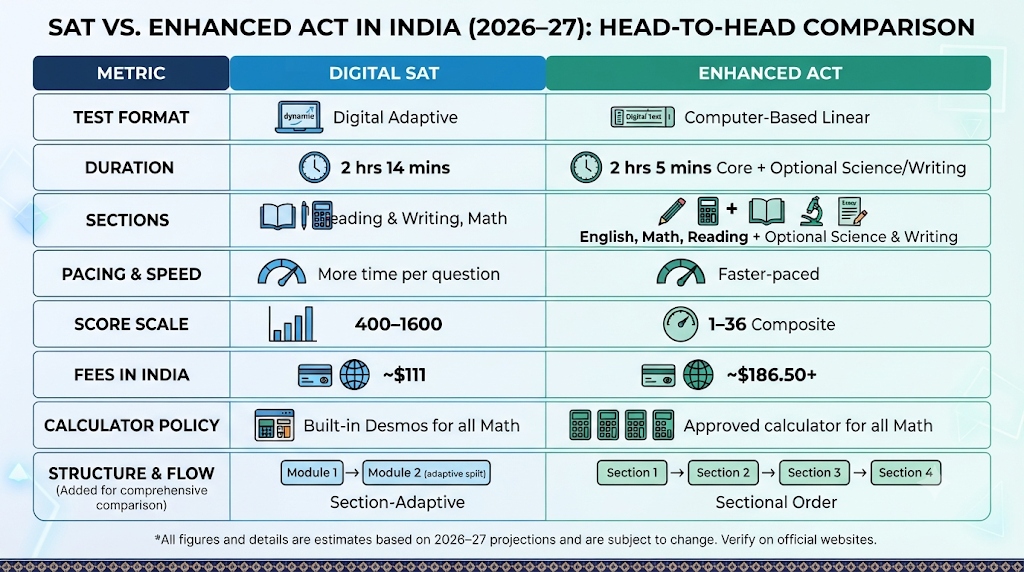
- Linear, non-adaptive administration: Unlike the Digital SAT's adaptive module routing, the ACT is linear. Every student receives a fixed test form with standard section difficulty from start to finish.
- Composite Score Composition: The official 1–36 Composite score is the rounded average of English, Math, and Reading only. Science yields a separate STEM score, and Writing yields an ELA score.
- Embedded Unscored Field-Test Items: Each section incorporates a small number of experimental items for psychometric calibration. Because they cannot be distinguished from scored items, treat every question with equal seriousness.
2. What Does "ACT Exam Syllabus" Really Mean?
The phrase syllabus of ACT exam is used loosely by students, so let us define it. ACT describes each section in terms of reporting categories. Every question on the test belongs to one of these categories. The categories describe the underlying competencies measured, and they are the closest thing to an official syllabus:
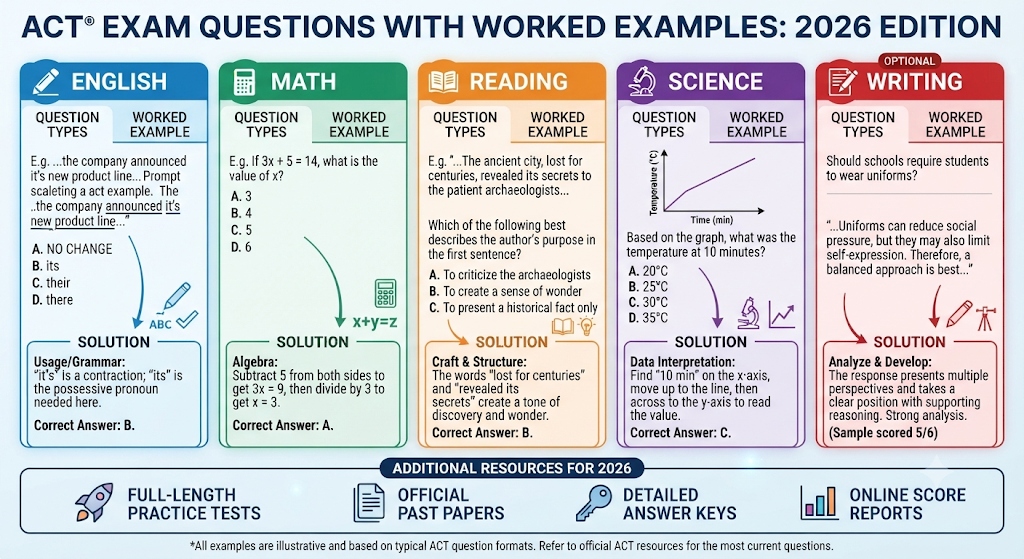
- English: Measures how well you can edit and improve written prose: structural organization, rhetorical effectiveness, stylistic clarity, and standard conventions of grammar and usage.
- Math: Measures your capacity to solve quantitative problems using mathematical reasoning taught up to the early part of Class 11.
- Reading: Measures your ability to comprehend central claims, synthesize paired passages, interpret vocabulary in context, and infer underlying perspectives.
- Science: Measures how well you interpret tables, scatter plots, experimental methodologies, and conflicting scientific models.
- Writing: Measures your ability to critique multiple perspectives and articulate a coherent, persuasive thesis supported by reasoned evidence.
Notice what is completely absent: no list of mandatory literary novels, no memorization of historical dates, and no complex physics constants to recall. That is why studying for the ACT is fundamentally about skills refinement and timed execution, not content memorization.
3. ACT Exam Subjects: The Five Components Explained
When candidates search for ACT exam subjects, they want to understand which disciplines are tested and whether they are compulsory:
- English (Compulsory): Focuses on grammar, punctuation, syntactic structure, concision, and rhetorical transition skills.
- Mathematics (Compulsory): Focuses on algebra, functions, coordinate and plane geometry, right-triangle trigonometry, and descriptive statistics.
- Reading (Compulsory): Four diverse passage genres: literary narrative (prose fiction), social sciences, humanities, and natural sciences.
- Science (Optional): Data representation, experimental analysis, and evaluation of competing hypotheses. Generates a distinct STEM score when paired with Math.
- Writing (Optional): A single argumentative essay responding to three contrasting perspectives on an issue of modern relevance.
4. ACT English: Topic-by-Topic Syllabus Checklist
English presents 50 questions across 35 minutes (~42 seconds per item). Questions accompany reading passages and fall into three primary reporting categories:
| Reporting Category | Approximate Section Weight | Core Competencies Assessed |
|---|---|---|
| Conventions of Standard English | 38% to 43% | Grammar, punctuation, usage, subject-verb agreement, sentence boundaries |
| Production of Writing | 38% to 43% | Topic development, paragraph organization, unity, thesis focus, logical transitions |
| Knowledge of Language | 18% to 23% | Precision, tone matching, concision, elimination of redundancy and wordiness |
Conventions of Standard English Checklist:
- Sentence Boundaries: Identifying fragments, run-ons, and comma splices. Correct use of semicolons, colons, and coordinate conjunctions (FANBOYS).
- Modifier Placement: Spotting misplaced and dangling modifiers. Ensuring modifying phrases clearly touch the noun they describe.
- Subject-Verb Agreement: Ignoring interrupting prepositional phrases (e.g. "The box of antique coins [is/are]"). Handling compound subjects and inverted sentences.
- Pronoun Usage: Pronoun-antecedent agreement, subject vs object case (who vs whom, I vs me), ambiguous reference, and possessives (its vs it's, their vs they're).
- Punctuation Mastery: Essential vs non-essential parenthetical clauses (dashes, commas, parentheses), apostrophes for possession vs contraction, and hyphens.
Production of Writing & Rhetorical Skills Checklist:
- Topic Development: Evaluating whether adding or deleting a sentence strengthens or distracts from the author's stated purpose.
- Transitions: Selecting the most accurate transitional adverb (contrast: however; cause/effect: therefore; addition: furthermore).
- Concision: Choosing the shortest grammatically sound answer choice that retains the exact intended meaning.
5. ACT Exam Math Syllabus: Topic-by-Topic Breakdown
Math is the most heavily scrutinized section for Indian candidates. The Enhanced ACT Math section contains 45 questions in 50 minutes (~67 seconds per question), each featuring 4 answer choices. A permitted calculator is authorized throughout.
ACT structures the content into three overarching domains:
- 1. Preparing for Higher Math (~75% of section): Divided across Number & Quantity, Algebra, Functions, Geometry, and Statistics/Probability.
- 2. Integrating Essential Skills (~25% of section): Multi-step synthesis involving middle-school foundations: proportions, percentages, unit rates, perimeter, and mean.
- 3. Modeling (Cross-cutting): Real-world scenario problems requiring mathematical equation formulation.
Complete ACT Math Topic Checklist:
| Math Domain | Key Specific Topics & Formulas Tested on the ACT |
|---|---|
| Number & Quantity | Real & complex numbers (operations with imaginary i), radical arithmetic, fractional exponents, scientific notation, absolute value, ratios, matrices (basic addition & scalar multiplication). |
| Algebra | Linear equations and inequalities, systems of two equations, quadratic factoring, completing the square, quadratic formula, polynomial division, rational expressions, setting up word equations. |
| Functions | Function notation f(x), composite functions f(g(x)), inverse functions, domain and range, linear/quadratic/exponential models, graph transformations f(x + c). |
| Geometry | Lines, angles, triangle congruence & similarity, Pythagorean theorem, special right triangles (30-60-90, 45-45-90), circle equations (x−h)²+(y−k)²=r², arcs and sectors, area, volume of prisms/cylinders, coordinate geometry (slope, midpoint, distance). |
| Trigonometry | Right-triangle ratios (SOH-CAH-TOA), radian-to-degree conversion, unit circle values, fundamental identity sin²θ + cos²θ = 1, graphs of sine and cosine. |
| Statistics & Probability | Mean, median, mode, weighted averages, range, standard deviation (conceptual interpretation), simple and compound probability, counting principles, permutations and combinations nCr/nPr. |
Where the ACT Math Syllabus Stops: The ACT does not test Calculus. There is zero differentiation, integration, limits, 3D vectors, or advanced linear algebra. Most problems test concepts covered in Indian schools by the middle of Class 11. The difficulty stems from speed, word problem translation, and algebraic endurance.
6. ACT Reading: Skills & Passage Genre Checklist
Reading contains 36 questions in 40 minutes (~67 seconds per question). Passages average 400 to 600 words across four established genres:
- Literary Narrative / Fiction: Excerpts from contemporary international novels or memoirs exploring character motivation, interpersonal relationships, and theme.
- Social Sciences: Anthropology, sociology, economics, history, or political science discussing empirical phenomena.
- Humanities: Art history, musicology, architecture, philosophy, or cultural essays.
- Natural Sciences: Biology, astrophysics, chemistry, ecology, or neuroscience describing experimental findings.
Reading Competencies Checklist:
- Locating stated factual claims and central arguments rapidly.
- Drawing supported inferences without making wild interpretive assumptions.
- Discerning the author's tone, stance, and underlying rhetorical purpose.
- Interpreting words in context based on nuance rather than dictionary definition.
- Synthesizing paired passages: identifying points of agreement, disagreement, or divergent evidentiary emphasis.
7. ACT Science (Optional): Skills & Reasoning Checklist
Science is a 40-question, 40-minute optional section. It is widely misunderstood as a test of memorized formulas. In reality, it is a test of scientific and graphical reasoning:
- Data Representation (~30–40%): Reading and interpreting line graphs, scatter plots, bar charts, and data tables. Locating trend directions (direct vs inverse proportionality) and interpolating data points.
- Research Summaries (~45–55%): Understanding the design of experiments. Identifying independent variables (what the scientist changes), dependent variables (what is measured), and control constants.
- Conflicting Viewpoints (~15–20%): Comparing two or three competing scientist hypotheses regarding an unexplained phenomenon. Evaluating which piece of new evidence would validate or invalidate a hypothesis.
- Outside Knowledge: Less than 5% of questions require basic scientific facts (e.g. photosynthesis consumes CO2 and produces glucose, freezing point of water is 0°C, like charges repel). A Class 10 science foundation is more than sufficient.
8. ACT Writing (Optional): What Is Assessed
The optional Writing test requires writing a persuasive essay in 40 minutes responding to a complex issue accompanied by three distinct perspectives. It is scored across four analytical domains (2 to 12 scale):
- 1. Ideas & Analysis: How effectively you dissect the issue and critique the three provided perspectives while establishing your own thesis.
- 2. Development & Support: The depth and relevance of your examples, evidence, and logical arguments.
- 3. Organization: Paragraph coherence, effective topic sentences, transitions, and introduction/conclusion impact.
- 4. Language Use: Sentence variety, precise academic vocabulary, and syntactic correctness.
9. Mapping the ACT Syllabus to Classes 9 to 12 in India
Here is how the ACT syllabus aligns with the curriculum taught in Indian CBSE, ICSE, and State Board schools:
| ACT Syllabus Area | Where Indian Students Learned It in School | What Indian Students Find Different on the ACT |
|---|---|---|
| English Grammar & Usage | Classes 8–10 English: Editing, omission, tenses, active/passive voice, direct/indirect speech. | ACT tests grammar in continuous long passages, emphasizing concision and punctuation rules (semicolons, dashes) rarely stressed in school boards. |
| Algebra & Polynomials | Classes 9–10 Algebra: Linear systems, quadratic equations, factorization. | ACT requires extreme rapid calculation and algebraic manipulation without step-marking. |
| Geometry & Mensuration | Classes 9–10: Circles, triangles, coordinate geometry, surface areas and volumes. | ACT incorporates circle equations and coordinate transformations in applied, visual formats. |
| Trigonometry & Functions | Class 10 Trigonometry ratios, extended into Class 11 Functions and Relations. | ACT tests right-triangle trig and basic radian identities without requiring Class 12 inverse trig or calculus. |
| Science Data Reasoning | Class 9–10 Science lab practicals. | Indian exams reward memorizing definitions and formulas; ACT tests pure graphical literacy and experimental control variables under tight time limits. |
10. SAT and ACT Exam Syllabus: Side-by-Side Comparison
Both exams test high-school college readiness, but they package and weight concepts differently:
| Syllabus Dimension | Digital SAT (College Board) | Enhanced ACT (2026) |
|---|---|---|
| English & Language | Merged into "Reading & Writing" section with short snippets. | Dedicated 50-question standalone English section with full passages. |
| Reading Passages | Short passages (25–150 words) with 1 question per passage. | Four full passages (400–600 words) with 9 questions each. |
| Math Scope | Heavy focus on Algebra, Advanced Math, and Data Analysis. | Balanced distribution across Algebra, Geometry, Trigonometry, and Modeling. |
| Science Component | No dedicated science section; science passages appear in RW. | Dedicated 40-question Science reasoning section (Optional; yields STEM score). |
| Calculator Access | Integrated Desmos graphing calculator on all 44 Math questions. | Permitted handheld calculator allowed on all 45 Math questions. |
| Format Algorithm | Computer-adaptive (Module 2 adapts to Module 1 performance). | Linear / fixed-form (Uniform difficulty for all examinees). |
Download the Complete ACT 2026 Topic-by-Topic Syllabus Checklist (PDF)
Get instant access to the official Enhanced ACT syllabus breakdown, CBSE/ICSE curriculum concordance, High-Frequency Math formula sheet, and 12-week study schedule.
11. The "Syllabus PDF": What Exists and How to Build a Dynamic Tracker
Students constantly search for an ACT exam syllabus PDF expecting a single 50-page document like a CBSE curriculum manual. ACT does not publish a single syllabus PDF. Instead, official content descriptions are distributed across:
- The ACT Technical Brief & Content Specifications: Outlines reporting categories and cognitive domain weightings.
- The ACT User Handbook: Explains testing standards and score concordance frameworks.
- Official Preparing for the ACT Guides: Show real operational questions matching current test specifications.
Rather than hunting for static PDFs on unofficial blogs, turn this article into your dynamic personal study tracker: copy the topic checklists into a Google Sheet, rate your proficiency from 1 to 5 after every mock test, and prioritize your study hours around your lowest-rated topics.
12. Sample 12-Week Study Plan Built on the Syllabus
- Weeks 1–2 (Diagnostic & Foundations): Take a timed CBT baseline mock. Review fundamental English conventions (comma rules, subject-verb agreement) and Class 9–10 algebra.
- Weeks 3–5 (Core Topic Drills): Master rhetorical English skills. Work through ACT Math coordinate geometry and functions. Practice active skimming on one Reading passage daily.
- Weeks 6–8 (Advanced Math & Science Logic): Drill right-triangle trigonometry and probability. If taking Science, practice experimental design questions and graph reading.
- Weeks 9–10 (Full-Length Testing): Complete one full-length timed CBT practice test every weekend. Maintain an error log classifying mistakes by topic.
- Weeks 11–12 (Pacing Refinement & Rest): Revisit low-scoring topics. Simulate test-day morning conditions. Rest your mind 48 hours prior to test day.
What is the ACT exam syllabus?
The ACT does not have a chapter-wise syllabus. It tests standardized college-readiness skills across English, Math, Reading, and optionally Science and Writing.
Does the ACT Math section have Calculus?
No. The ACT does not test Calculus. It covers arithmetic, algebra, coordinate/plane geometry, functions, trigonometry, and statistics up to early Class 11.
What are the main topics in ACT English?
Conventions of Standard English (punctuation, grammar, agreement, sentence fragments) and Rhetorical Skills (organization, topic focus, transitions, concision).
Is the ACT syllabus different for Indian students?
No. The ACT exam is identical worldwide. Indian students simply map the topics to their CBSE, ICSE, or IB curricula.
Do I need advanced science knowledge for ACT Science?
No. ACT Science evaluates graphical data interpretation and experimental methodology. A Class 9–10 general science foundation is sufficient.
How is the ACT syllabus different from the SAT?
The ACT includes a dedicated English section, longer reading passages, broader math coverage (more geometry/trigonometry), and an optional Science section, delivered in a linear format.
Can I download an official ACT syllabus PDF?
There is no single official syllabus PDF like an Indian board syllabus. Official content descriptions and practice guides can be downloaded free from act.org or via EduQuest's curated syllabus checklist.
How many questions are on the Enhanced ACT core syllabus?
The core test has 131 questions: 50 English, 45 Math, and 36 Reading, completed in 2 hours and 5 minutes.
14. Master the ACT Syllabus at EduQuest Gurgaon
Covering the ACT syllabus requires structured guidance from faculty who understand both the Indian school curriculum and international test psychometrics. At EduQuest's Baani Square center in Gurugram, students master every topic through topic-wise drills, full CBT simulations, and personalized score roadmaps.
EduQuest Gurugram ACT Coaching Hub & Batch Details
📍 Location
F-45 Baani Square, Sec 50
Unit F-45, Baani Square, Sector 50, Gurugram, Haryana 122018. Conveniently located near South City II, Nirvana Country, and Golf Course Extension.
⏰ Batches
Weekday & Weekend Cohorts
Weekday Batches (Mon–Thu 4:00 PM – 7:00 PM) and Weekend Intensive Batches (Sat–Sun 10:00 AM – 2:00 PM).
🧪 Diagnostic CBT
Topic-Level Analytics
Take an authentic computer diagnostic test to map your topic strengths and receive a custom 12-week study plan.
Master Every Topic on the ACT Syllabus with EduQuest
Join Gurgaon's premier ACT prep academy. Book a proctored diagnostic test at Baani Square or speak with our senior academic mentors.