
Most students begin their ACT preparation the same way: they search for ACT exam questions, download the first random ACT exam pdf they find and start solving blindly. A few weeks later, they are frustrated and surprised that their practice scores have not moved.
The problem is rarely effort. It is that practice without understanding the recurring archetypes of questions the ACT asks is just blind repetition. The ACT is built from a small number of recurring question types, each with its own trick, its own psychological trap, and its own optimal solution path. Once you learn to recognize the archetype within five seconds, you stop reading every question as if it were brand new.
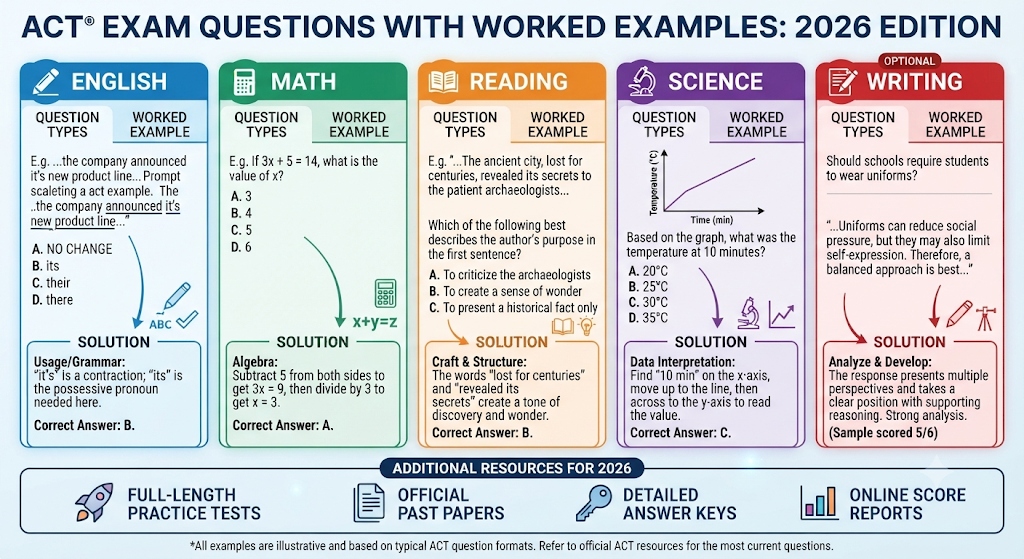
This guide does two jobs. First, it walks through the real question types in every section, each with an original worked example written by EduQuest master faculty. Second, it explains where to find official practice material: the ACT exam practice test, ACT exam sample paper, ACT exam past papers and ACT exam answers, and how to structure your review so every practice hour translates into composite points.
Fast-Track Your College & Career Strategy
Get immediate, personalized AI insights tailored to your grade, strengths, and dream universities — 100% free with instant reports.
Know Your Personality Type for Free
Take our 18-question AI psychometric test to uncover your cognitive archetype, hidden learning superpowers, and ideal university courses.
Personalized Career & University EduPath
Build a step-by-step Grade 8–12 admissions blueprint with AI-matched target universities, exam schedules, and extracurricular profiles.
1. Where to Find Real ACT Practice Material (Start Here)
Before solving examples, let us answer the search behind most students' queries: where is the authentic official material?
- Free Full-Length ACT Practice Tests: Available on act.org in both digital interactive format (simulating the Prometric testing interface) and downloadable PDF format.
- The "Preparing for the ACT" Guide: ACT's official free publication containing a full-length practice test with answer keys and scoring conversion tables. The 2025–2026 edition reflects the Enhanced ACT format.
- Official ACT Prep Guide (The "Red Book"): ACT's published textbook containing retired operational tests updated for the Enhanced ACT.
- What About "Past Papers" and "PYQ"? Unlike Indian CBSE or JEE exams where full past papers from every month are published, ACT does not release every administered test form. Instead, official practice tests are constructed from retired real test questions from earlier international and national test dates. These retired tests are the true gold standard.
Warning against fake "leaked papers": Websites or social media accounts claiming to sell "real leaked ACT papers" are running fraudulent operations. Using illicit materials violates test security agreements, resulting in score cancellation and reporting to universities.
2. The Anatomy of an ACT Question and Distractor Traps
Every multiple-choice item on the ACT comprises three distinct elements:
- 1. The Stem: The direct question or incomplete statement to be resolved.
- 2. The Stimulus: The reading passage, data table, graph, or algebraic equation.
- 3. Four Answer Choices (A, B, C, D): Exactly one mathematically or grammatically correct key, and three deliberately engineered distractors.
The distractors are not chosen randomly. They are designed by psychometricians to mirror predictable cognitive errors: forgetting to distribute a negative sign, matching a verb to the nearest plural noun in a prepositional phrase, or selecting an extreme answer choice not supported by the passage.
3. ACT English Question Types with Worked Examples
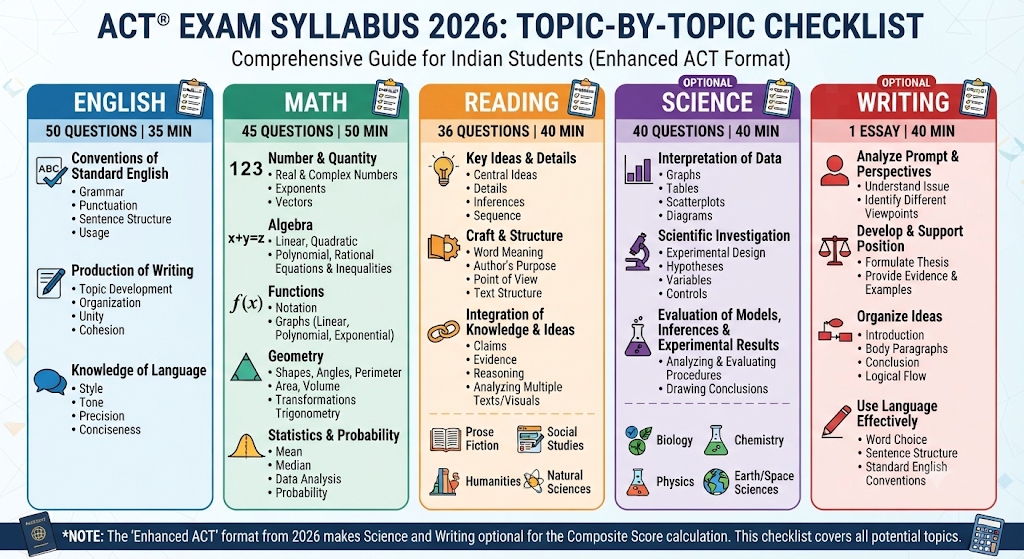
English presents 50 questions across 35 minutes. Here are four high-frequency question types:
4. ACT Math Question Types with 9 Original Worked Examples
The Enhanced ACT Math section contains 45 questions in 50 minutes. Here are nine representative worked examples covering essential syllabus categories:
Example 1: Linear Equation with Distribution
If 5(x − 2) = 3x + 8, what is the value of x?
A. 1 B. 4 C. 9 D. 18
Solution: Expand the left side: 5x − 10 = 3x + 8. Subtract 3x: 2x − 10 = 8. Add 10: 2x = 18. Divide by 2: x = 9. Correct Answer: C. Trap: Forgetting to distribute 5 to −2 leads to 5x − 2 = 3x + 8 → 2x = 10 → x = 5.
Example 2: Quadratic Factoring & Sign Reversal
What are all the solutions of x² − 5x − 14 = 0?
A. −7 and 2 B. −2 and 7 C. 2 and 7 D. −2 and −7
Solution: Find two numbers whose product is −14 and sum is −5. The pair is 2 and −7. Factor: (x + 2)(x − 7) = 0. Solving each factor yields x = −2 and x = 7. Correct Answer: B. Trap: Picking −7 and 2 directly from the factors without inverting signs.
Example 3: Multi-Step Percentage Change
A jacket originally priced at $80 is discounted by 25%. A 10% sales tax is then applied to the sale price. What is the final price?
A. $64 B. $66 C. $68 D. $72
Solution: Discounted sale price = 80 × (1 − 0.25) = $60. Adding 10% tax = 60 × 1.10 = $66. Correct Answer: B. Trap: Subtracting 10% from 25% to claim a net 15% discount (80 × 0.85 = $68).
Example 4: Pythagorean Theorem & Right Triangles
A 13-foot ladder leans against a vertical wall. The base of the ladder is 5 feet from the wall. How high up the wall does the ladder reach?
A. 8 feet B. 10 feet C. 12 feet D. 18 feet
Solution: The ladder forms a right triangle: 5² + h² = 13² → 25 + h² = 169 → h² = 144 → h = 12. Correct Answer: C. (Standard 5-12-13 Pythagorean triple).
Example 5: Function Evaluation with Negative Inputs
If f(x) = 2x² − 3x + 1, what is the value of f(−2)?
A. −13 B. 3 C. 9 D. 15
Solution: Substitute x = −2: f(−2) = 2(−2)² − 3(−2) + 1 = 2(4) + 6 + 1 = 8 + 6 + 1 = 15. Correct Answer: D. Trap: Sign error treating −3(−2) as −6 gives 8 − 6 + 1 = 3.
Example 6: Probability of the Complement Event
A bag contains 4 red, 6 blue, and 5 green marbles. One marble is drawn at random. What is the probability that it is NOT blue?
A. 2/5 B. 3/5 C. 2/3 D. 4/15
Solution: Total marbles = 4 + 6 + 5 = 15. Marbles that are NOT blue = 4 red + 5 green = 9. Probability = 9/15 = 3/5. Correct Answer: B. Trap: Choice A (6/15 = 2/5) calculates the probability that the marble IS blue.
Example 7: Right-Triangle Trigonometry (SOH-CAH-TOA)
In a right triangle, angle θ has an opposite side of length 8 and a hypotenuse of length 17. What is cos θ?
A. 8/17 B. 8/15 C. 15/17 D. 17/15
Solution: Find adjacent side via Pythagoras: adjacent² = 17² − 8² = 289 − 64 = 225 → adjacent = 15. Cosine = adjacent / hypotenuse = 15/17. Correct Answer: C. Trap: Choice A is sin θ.
Example 8: Systems of Linear Equations
If x + y = 10 and x − y = 4, what is the value of xy?
A. 12 B. 21 C. 24 D. 40
Solution: Add the equations: 2x = 14 → x = 7. Substitute x = 7: 7 + y = 10 → y = 3. Product xy = 7 × 3 = 21. Correct Answer: B. Trap: Answering x or y alone.
Example 9: Averages and Missing Term
The average of five numbers is 13. Four of the numbers are 8, 10, 14, and 16. What is the fifth number?
A. 13 B. 15 C. 17 D. 19
Solution: Total sum = 5 × 13 = 65. Sum of known four numbers = 8 + 10 + 14 + 16 = 48. Fifth number = 65 − 48 = 17. Correct Answer: C.
5. ACT Reading Question Types with a Worked Example
Reading contains 36 questions across 40 minutes. Consider this original passage excerpt and three common question types:
Every morning before the market opened, Meera swept the pavement in front of her father's spice stall, though no one had asked her to. The sweeping was not about the dust. It was a way of claiming the place, of telling the street that she belonged here as surely as the brass scales and the sacks of cumin. When her father finally noticed, he said nothing, only moved his stool a little to the left so the broom could pass. Meera understood that this small adjustment was his answer, and she swept all the more carefully that day.
— EduQuest ACT Reading Passage Excerpt
- Question 1 (Main Idea): Which statement best summarizes the passage?
A. Meera resents her father for ignoring her chores.
B. Meera quietly asserts her presence at the stall, and her father silently acknowledges it.
C. Meera aspires to abandon the family business to seek employment elsewhere.
D. Meera's father disapproves of her domestic effort and attempts to hinder her.
Solution: The text portrays sweeping as "claiming the place" and the stool movement as an unspoken "answer". Correct Answer: B. - Question 2 (Inference): The father's action of shifting his stool most strongly suggests that he:
A. is irritated by the physical disturbance.
B. welcomes Meera's presence and effort without verbalizing it.
C. intends to force Meera to cease cleaning.
D. has failed to register Meera's actions altogether.
Solution: Moving the stool "so the broom could pass" provides physical accommodation for her task. Correct Answer: B. - Question 3 (Vocabulary in Context): As used in the passage, the phrase "claiming the place" most nearly means:
A. demanding financial compensation for the shop.
B. establishing an authentic sense of belonging.
C. locating an unexplored physical territory.
D. thoroughly sanitizing a soiled surface.
Solution: The subsequent clause clarifies that she was "telling the street that she belonged here". Correct Answer: B.
6. ACT Science Question Types with a Worked Example
Science is an optional 40-question section focusing on data reasoning. Consider this experimental stimulus:
Experiment: Students cultivated identical bean specimens for 14 days under differing daily photoperiods (hours of light). Moisture, soil nitrogen, and ambient temperature were kept uniform. Average final plant heights were recorded:
| Daily Light Exposure (Hours) | Average Plant Height (cm) |
|---|---|
| 4 hours | 6 cm |
| 8 hours | 11 cm |
| 12 hours | 15 cm |
| 16 hours | 16 cm |
- Question 1 (Data Interpolation): Based on the data, the average height of specimens receiving 10 hours of light per day would most likely be closest to:
A. 9 cm B. 11 cm C. 13 cm D. 17 cm
Solution: 10 hours is midway between 8 hours (11 cm) and 12 hours (15 cm). Interpolating: (11 + 15) ÷ 2 = 13 cm. Correct Answer: C. - Question 2 (Trend Analysis): Which conclusion is directly supported by the findings?
A. Increasing illumination from 4 to 8 hours produced greater height gains than increasing from 12 to 16 hours.
B. Bean specimens maximize elongation under less than 4 hours of photoperiod.
C. Photoperiod has no measurable correlation with botanical growth.
D. Plants subjected to 16 hours grew exactly double the height of those receiving 8 hours.
Solution: Height increased by 5 cm (6 to 11 cm) between 4–8 hours, but only by 1 cm (15 to 16 cm) between 12–16 hours. Correct Answer: A. - Question 3 (Experimental Design & Controls): To maintain a controlled experimental test, which factor was deliberately kept constant for all specimens?
A. The daily duration of light exposure.
B. The volume of water administered.
C. The resulting final vertical height.
D. Both the light duration and vertical height.
Solution: Light duration was the independent variable (deliberately changed). Height was the dependent variable (measured outcome). Water volume was a control constant. Correct Answer: B.
7. ACT Writing Prompt and 40-Minute Strategy
The optional Writing prompt presents an issue with three diverse perspectives. Execute this structured 40-minute blueprint:
- Minutes 0–5 (Deconstruct & Thesis): Underline key claims in all three perspectives. Establish your overarching stance.
- Minutes 5–8 (Outline Structure): Plan introduction with clear thesis, Body 1 (analyze Perspective 1), Body 2 (analyze Perspective 2), Body 3 (defend your own position with evidence), and Conclusion.
- Minutes 8–35 (Drafting): Write with academic voice, clear transitional topic sentences, and varied clause structure.
- Minutes 35–40 (Proofreading): Check for pronoun clarity, comma splices, and spelling.
Download ACT Exam Questions with Worked Examples & Practice Kit (PDF)
Get instant access to EduQuest's curated 50-question diagnostic sample set with complete step-by-step solutions, distractor trap analysis, and official past paper links.
8. How to Use Official Practice Tests, Papers, and PDFs Effectively
Downloading practice PDFs is easy. Transforming them into score increases requires adhering to this six-step testing protocol:
- 1. Strict Exam Simulation: Test on Saturday morning at 08:30 AM. Timers on. Approved calculator only. No mobile phones.
- 2. Uncompromising Scoring: Convert raw scores using the form's official equating table. Never estimate.
- 3. The 4-Column Error Log: Log every mistake: (1) Question Number, (2) Subject & Concept Type, (3) Why I Missed It, (4) Specific Future Fix.
- 4. Analyze Guessing Wins: Review questions you answered correctly by lucky guessing; an unexamined guess is a hidden future penalty.
- 5. Drill Weakness Clusters: Spend 3–4 days drilling 20 targeted questions of the specific type you missed before attempting another full test.
- 6. Spaced Repetition: Space full-length diagnostic exams 7 to 14 days apart. Taking exams daily without remediation burns tests and demoralizes students.
Where can I find free official ACT practice tests?
ACT provides free official digital interactive and downloadable PDF practice tests directly on act.org, including the full Preparing for the ACT guide.
Are there official ACT past papers available for download?
ACT does not release every administered test form. However, official practice tests published by ACT are compiled from retired operational questions from real test dates.
What is ACT exam PYQ?
In the Indian exam context, PYQ refers to previous year questions. On the ACT, the equivalent is official retired question collections and official practice test forms.
How many practice tests should an Indian student take?
Most successful candidates take 4 to 8 full-length simulated CBT mocks over a 10 to 14 week preparation cycle. Thorough error analysis matters far more than test volume.
Can I use a calculator on all ACT math practice questions?
Yes, on the Math section only. Ensure you practice with the exact model you intend to use on test day (e.g. TI-84 Plus or Casio fx-991EX).
Are the questions in this guide actual ACT questions?
No. The questions are original sample problems written by EduQuest faculty matching current Enhanced ACT difficulty, format, and psychometric standards.
10. Master ACT Question Mechanics at EduQuest Gurgaon
Achieving a 34+ composite requires learning to dismantle ACT question traps with speed and precision. At EduQuest's dedicated Gurgaon learning center, students train in an authentic Prometric-style computer laboratory under the personal guidance of 99th-percentile faculty mentors.
EduQuest Gurugram ACT Question Mastery Academy
📍 Location
F-45 Baani Square, Sec 50
Unit F-45, Baani Square, Sector 50, Gurugram, Haryana 122018. Easily accessible from Golf Course Extension, Sohna Road, and South City II.
⏰ Batches
Weekday & Weekend
Weekday Batches (Mon–Thu 4:00 PM – 7:00 PM) and Weekend Intensive Batches (Sat–Sun 10:00 AM – 2:00 PM).
🧪 CBT Lab
Timed Question Telemetry
Take timed CBT diagnostics with question-by-question timing logs, trap analysis, and personalized error log review.
Turn ACT Practice Questions into a 34+ Composite Score
Join Gurgaon's premier test prep mentorship program. Book a diagnostic mock test at Baani Square or schedule a consultation with our senior faculty.