
Every year, thousands of Indian high school students applying to US, Canadian, and global universities face the exact same early dilemma: Should I take the SAT, the ACT, or both? Some search for the SAT and ACT exam combination, others type ACT vs SAT exam or difference between SAT and ACT exam into a search bar, and the underlying anxiety is always identical. Parents debate it, school counselors offer conflicting advice, and student WhatsApp groups are flooded with rumors:
"The ACT is easier because Math has less algebra." "The SAT is more popular in India, so colleges expect it." "The ACT has Science, so it is harder." "The SAT is adaptive, so one wrong question destroys your score."
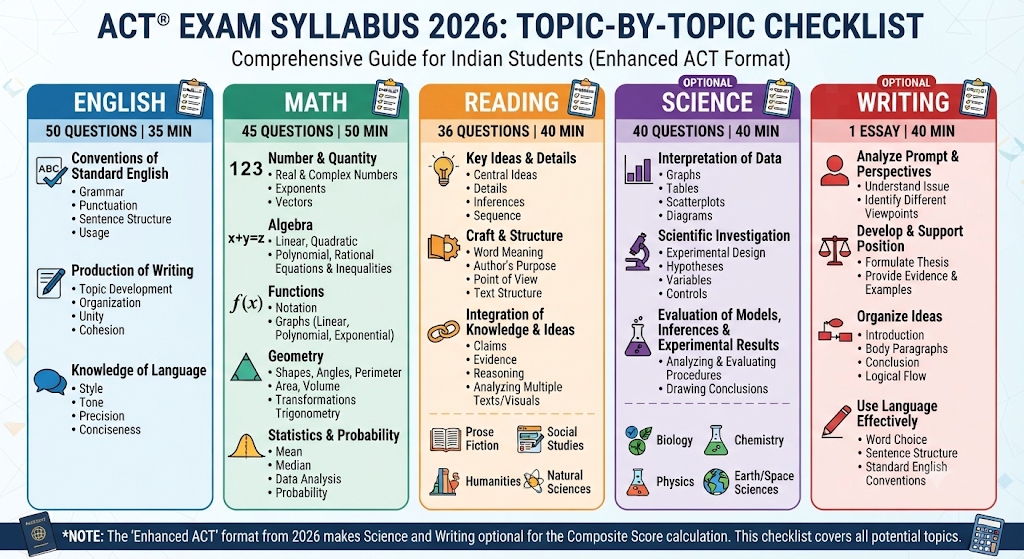
Almost all of those statements are outdated. Both standardized testing giants underwent radical architectural transformations over the past two years. The SAT transitioned to a fully digital, section-adaptive examination on the Bluebook app. Meanwhile, the ACT introduced its Enhanced ACT format, reducing core testing time to 2 hours 5 minutes, cutting 44 questions, and making Science completely optional. Any comparison written before 2025 no longer accurately reflects either test.
This guide moves beyond generic bullet points to provide an actionable, evidence-based decision framework tailored specifically for Indian CBSE, ICSE, IB, and Cambridge students.
Fast-Track Your College & Career Strategy
Get immediate, personalized AI insights tailored to your grade, strengths, and dream universities — 100% free with instant reports.
Know Your Personality Type for Free
Take our 18-question AI psychometric test to uncover your cognitive archetype, hidden learning superpowers, and ideal university courses.
Personalized Career & University EduPath
Build a step-by-step Grade 8–12 admissions blueprint with AI-matched target universities, exam schedules, and extracurricular profiles.
1. The Short Answer: SAT or ACT Exam?
For the vast majority of applicants, either exam will work perfectly. American college admissions committees do not harbor even an implicit bias toward either test. A 1500 on the SAT and a 34 on the ACT are viewed with equal admiration.
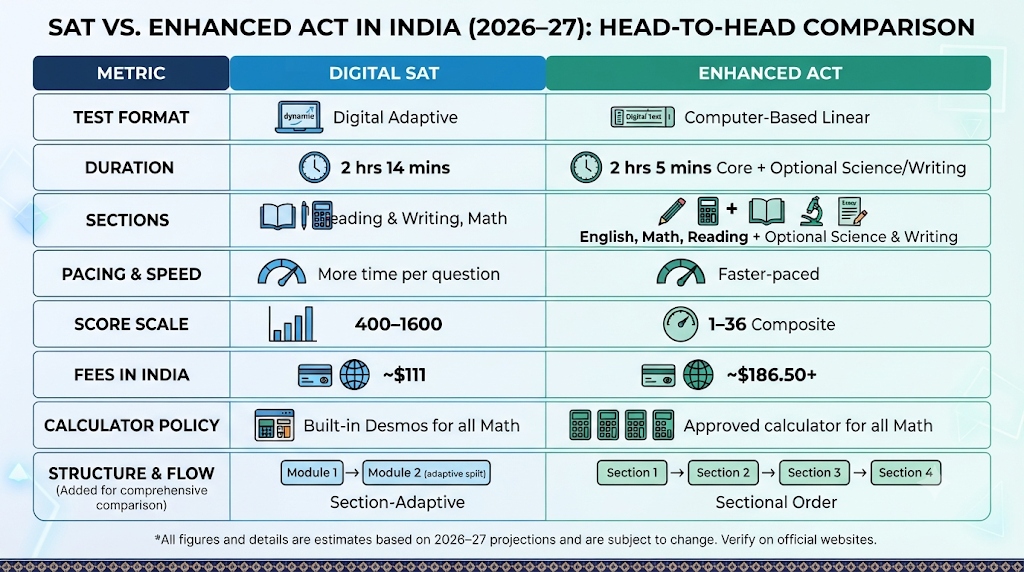
What differs fundamentally is cognitive fit. The Digital SAT features fewer questions and provides more generous time per item (~82 seconds on average), but it employs adaptive routing where your Module 1 accuracy dictates the difficulty of Module 2. The Enhanced ACT is a faster-paced test (~57 seconds per item), but it is linear, predictable, and allows examinees to freely navigate back and forth across each section. The goal is to identify which test matches your cognitive processing rhythm.
2. What Are the SAT and ACT Exams?
Both exams are standardized aptitude and achievement evaluations designed to assess college academic readiness. They provide admissions deans with an objective common denominator to compare students across wildly disparate grading standards — from rigorous CBSE/ICSE board percentages to IB predicted grades and American GPAs.
- The SAT: Administered by the College Board. Scored on a 400 to 1600 scale (Reading & Writing 200–800 + Math 200–800).
- The ACT: Administered by ACT, Inc. Scored on a 1 to 36 Composite scale (average of English, Math, and Reading).
3. The Difference Between SAT and ACT Exam: 2026–27 Head-to-Head Comparison
Here is the definitive comparative breakdown for students testing in the 2026–27 international cycle:
| Comparative Dimension | Digital SAT (College Board) | Enhanced ACT (2026) |
|---|---|---|
| Test Sections | Reading & Writing (2 Modules), Math (2 Modules) | English, Math, Reading + Optional Science & Writing |
| Total Question Count | 98 Questions | 131 Questions (Core) | 171 Questions (with Science) |
| Total Testing Duration | 2 Hours 14 Minutes (134 min) | 2 Hours 05 Minutes (Core) | 2h 45m (with Science) |
| Average Time per Question | ~82 Seconds / Question (RW: 71s, Math: 95s) | ~57 Seconds / Question (English: 42s, Math: 67s, Reading: 67s) |
| Scoring Continuum | 400 to 1600 Total Scale | 1 to 36 Composite Scale (E + M + R rounded average) |
| Testing Algorithm | Computer-Adaptive (Module 2 difficulty changes) | Linear / Fixed-Form (Uniform difficulty for all examinees) |
| Calculator Policy | Built-in Desmos graphing calculator on ALL Math | Permitted handheld calculator allowed on ALL Math |
| Reading Passage Style | Bite-sized short passages (25–150 words) with 1 question each | Longer passages (400–600 words) with 9 questions each |
| Science Section | No separate section; science passages in Reading | Dedicated 40-question section (Optional; yields STEM score) |
| Testing Fee in India | ~$111 USD (~INR 9,300) | ~$186.50 USD (~INR 15,600 without Writing) |
| Annual Testing Windows | 7 International Windows (Mar, May, Jun, Aug, Oct, Nov, Dec) | 7 International Windows (Feb, Apr, Jun, Jul, Sep, Oct, Dec) |
4. Do Colleges Prefer the SAT or the ACT in 2026–27?
Every college admissions officer will confirm: there is zero institutional preference. Universities convert scores using the official Concordance Table. However, the admissions landscape regarding testing requirements has evolved dramatically:
- The Ivy League & Elite Return to Testing: Six of the eight Ivy League universities (Harvard, Yale, Dartmouth, Brown, Cornell, Penn) along with MIT, Stanford, Caltech, Georgetown, Purdue, and UT Austin mandate test scores for the 2026–27 admissions cycle.
- Why Testing Matters for Indian Applicants: For Indian students, international high school marks from CBSE/ISC boards are notoriously difficult for US admissions committees to normalize. A strong SAT (1500+) or ACT (34+) provides unambiguous confirmation of academic excellence and unlocks substantial merit scholarships.
5. Which Test Suits You? Eight Distinct Student Profiles
Review these eight candidate cognitive profiles to see which exam aligns naturally with your strengths:
- Profile 1: The Rapid Reader & Skimmer → FAVORS ACT: You finish CBSE/ICSE reading comprehensions early and absorb long narrative passages without losing focus. The ACT's longer passages and brisk pacing reward your natural speed.
- Profile 2: The Deliberative Thinker → FAVORS SAT: You are intellectually meticulous, require time to process nuances, and hate feeling rushed. The Digital SAT's ~82 seconds per question allows breathing room.
- Profile 3: The Desmos Graphing Wizard → FAVORS SAT: You excel at leveraging digital graphing tools, solving quadratic systems, and finding coordinate intercepts using Desmos shortcuts. The SAT permits Desmos on every single math question.
- Profile 4: The Geometry & Trigonometry Specialist → FAVORS ACT: You have strong foundations in Class 9–10 Euclidean geometry, circle theorems, and right-triangle trigonometry. The ACT includes significantly more geometry items than the algebra-heavy SAT.
- Profile 5: The STEM / Pre-Med Applicant → FAVORS ACT: You are targeting engineering at Purdue, UIUC, or CMU, or pre-med tracks. The optional ACT Science section allows you to submit a standout 34+ STEM score that proves experimental data analysis prowess.
- Profile 6: The Grammar & Punctuation Master → FAVORS ACT: You have mastered punctuation rules (semicolons, dashes, apostrophes, commas). The ACT's standalone 50-question English section offers an easy path to a scaled 35 or 36.
- Profile 7: The Candidate Prone to Adaptive Anxiety → FAVORS ACT: The psychological dread of knowing that Module 2 difficulty hinges on Module 1 performance stresses you out. The ACT's predictable linear form provides peace of mind.
- Profile 8: The Fast Context-Switcher → FAVORS SAT: You prefer reading a 50-word snippet, answering one question, and resetting your brain rather than holding a 600-word passage in your head across 9 questions.
6. The 3-Step Empirical Method to Choose Your Exam
Never make your decision based on advice from friends. Follow this rigorous 3-step empirical test:
- Step 1: Take 1 Official Mock of Each: Download the College Board Bluebook app and take official Practice Test 1. Then download the official Enhanced ACT Practice Test from act.org. Complete both under strict timing with zero prior coaching.
- Step 2: Translate via Official Concordance: Convert your raw scores to scaled scores, and map them using the official ACT-SAT Concordance Table (e.g. 1500 SAT ≈ 34 ACT; 1420 SAT ≈ 32 ACT; 1360 SAT ≈ 30 ACT).
- Step 3: Evaluate Pacing and Emotional Stress: If your scores are within 1 ACT point (or ~40 SAT points), choose whichever test felt more comfortable under time pressure.
Download the Official SAT vs ACT Decision Matrix & Concordance Guide (PDF)
Get immediate access to the official College Board & ACT 1600-to-36 Concordance Table, the 8-Profile Decision Scorecard, and test date calendars for Indian Prometric & Bluebook centres.
7. Logistics in India: Calendars, Fees, and Test Centres
Key operational considerations for Indian high school test takers:
- Test Delivery Mode: Both exams are delivered via computer terminals in India (Digital SAT on your own laptop via Bluebook; Enhanced ACT on Prometric desktop computers).
- Board Exam Avoidance: Indian Class 12 board practicals and theory exams dominate February and March. Plan your primary sittings in August/September/October (Class 12) or April/June (Class 11).
- Fee Differential: The Digital SAT costs ~$111 USD (~INR 9,300), while the ACT costs ~$186.50 USD (~INR 15,600). Budget accordingly if you plan two testing attempts.
Do US universities prefer the SAT or ACT in 2026?
Neither. Every university in the United States, including Harvard, MIT, Stanford, and Yale, accepts both tests equally without prejudice.
Is the ACT easier than the Digital SAT?
No. The ACT is faster-paced with 131 core questions in 2 hours 5 minutes, while the SAT has 98 questions in 2 hours 14 minutes. Which test feels easier depends on your personal processing speed and comfort with adaptive testing.
Should an Indian student prepare for both tests?
No. Preparing for both simultaneously dilutes your study hours. Take a diagnostic of each, pick the test where you score higher, and dedicate 100% of your effort to that exam.
Can I take the ACT in India?
Yes. The ACT is offered seven times per academic year as a Computer-Based Test at authorized Prometric centers across Delhi NCR, Mumbai, Bengaluru, Hyderabad, Chennai, and other major cities.
How do I compare an SAT score with an ACT score?
Use the official College Board and ACT Concordance Table. For example, a 34 ACT composite corresponds to an SAT score of 1500.
9. Take a Dual Diagnostic Assessment at EduQuest Gurgaon
Still uncertain which testing pathway maximizes your Ivy League or Top 30 US admission odds? At EduQuest's dedicated learning center in Gurugram, students take full-length proctored SAT and ACT diagnostics under authentic computer lab conditions, receiving a scientific concordance evaluation and bespoke preparation roadmap.
EduQuest Gurugram SAT & ACT Dual Advisory Center
📍 Location
F-45 Baani Square, Sec 50
Unit F-45, Baani Square, Sector 50, Gurugram, Haryana 122018. Convenient to Golf Course Extension, Sohna Road, and Nirvana Country.
⏰ Batches
Dual SAT & ACT Cohorts
Weekday Batches (Mon–Thu 4:00 PM – 7:00 PM) and Weekend Intensive Batches (Sat–Sun 10:00 AM – 2:00 PM).
🧪 CBT Lab
Concordance Diagnostic
Sit both exams in our computer lab to identify your highest-yielding testing format before investing months in prep.
Make the Data-Driven Choice Between SAT and ACT
Schedule an official dual diagnostic assessment at Baani Square or book a 1-on-1 strategy session with our senior test prep directors.